


.png)



The consumer search journey for residential real estate is entirely visual. Home buyers expect immediate, fluid access to immersive property walkthroughs before they ever commit to an in-person viewing. For real estate teams and brokerage firms, meeting this demand requires producing an enormous volume of high-tier media assets for every active listing in their inventory.
However, delivering these consumer experiences introduces severe back-office complexity. The primary challenge is not capturing the footage; it is maintaining perfect adherence to Multiple Listing Service (MLS) media distribution rules. Real estate professionals constantly balance the need for branded promotional content on public channels against the strict, unbranded requirements of cooperative listing exchanges.
Failing to manage this balance stalls sales velocity. An accidental brand leak within an MLS video link results in swift compliance fines, automated link suppression, and delayed portal updates. To eliminate these errors while scaling your media output, your operational workflow must change. Implementing an MLS-friendly video software for Realtors removes manual rendering overhead, providing automated compliance verification and rapid unbranded asset provisioning.
The multiple listing system is constructed around the principle of a neutral data index. To preserve an objective search environment where property characteristics—rather than brokerage size—determine buyer engagement, the National Association of Realtors (NAR) maintains definitive guidelines outlined in the NAR Multiple Listing Policy. Local real estate boards interpret these foundational guidelines into localized rules that carry immediate, material penalties for non-compliance.
The target of the strictest enforcement mechanisms is rich media fields. Because video files carry significant marketing weight, regional automated scanning scripts and manual data audits evaluate every uploaded asset link.
These compliance systems look for any element that could identify the listing agent or brokerage entity. The core data rules explicitly prohibit:
When an asset violates these rules, the regional data engine responds instantly. The pipeline disruption moves through automated enforcement levels:
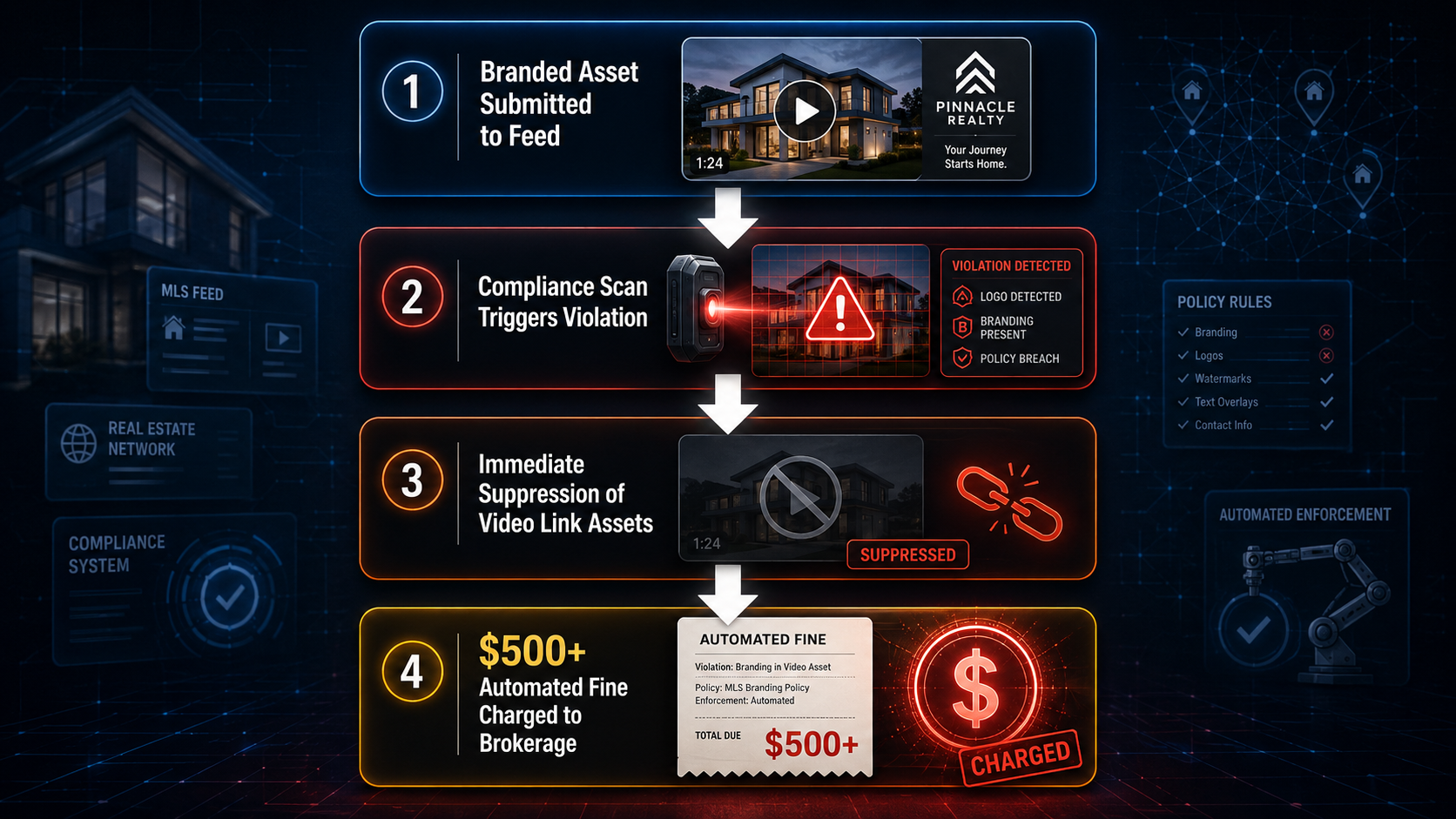
This sequence breaks the crucial momentum required during the initial 48 hours of a property launch. While administrative staff manually pull files, remove text layers, and re-submit unverified assets, the property remains invisible on third-party channels via Zillow Feed Syndication Networks and Redfin search feeds, lowering early market engagement.
For high-volume real estate teams, tracking two distinct versions of every property video is an expensive, slow process. Traditional marketing pipelines rely heavily on manual editing tasks.
Once raw listing footage is captured, an internal marketing team or freelance video editor must spend hours building separate project folders. They render a branded version for YouTube or Instagram, then manually hide graphic layers, swap audio tracks, and re-render a separate, unbranded file for the MLS. This manual process takes significant time, slows down property launches, and increases the risk of human error.
To understand how this approach compares to automation, examine this structural comparison of media asset processing:
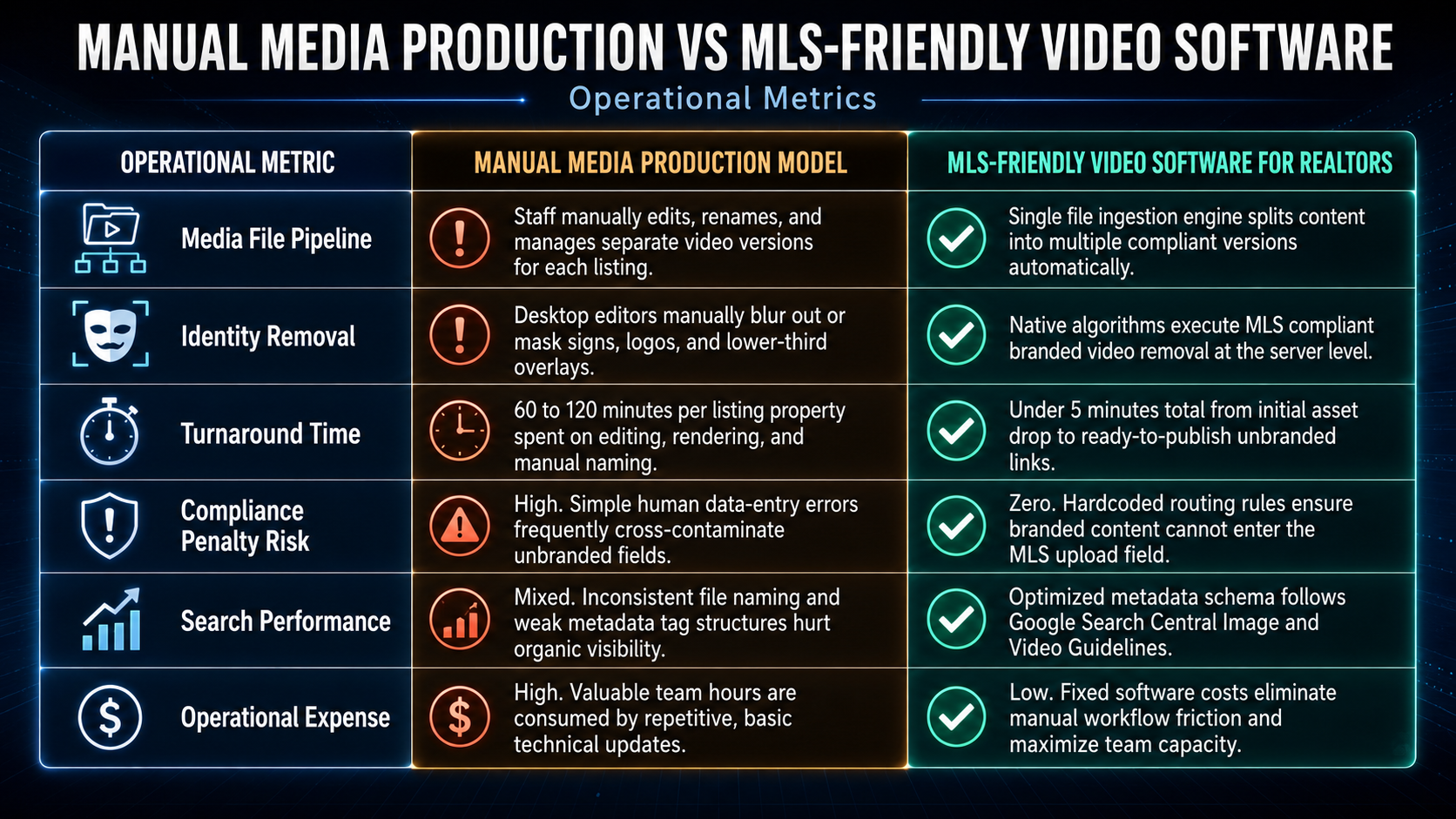
The data shows that traditional manual editing acts as a persistent speed bump for expanding real estate organizations. Scaling asset portfolios requires a systematic framework that ensures compliance from the initial step.
Automated media platforms solve the compliance bottleneck by separating raw property assets from personal marketing content. Instead of locking logos and text directly into the video file, an unbranded real estate video software framework treats every piece of property media as an adjustable data layout.
The core architecture separates visual information into two independent data tracks. The primary baseline layer contains only pure property data—stabilized room walkthroughs, structural dimensions, and drone footage showing real-world boundaries.
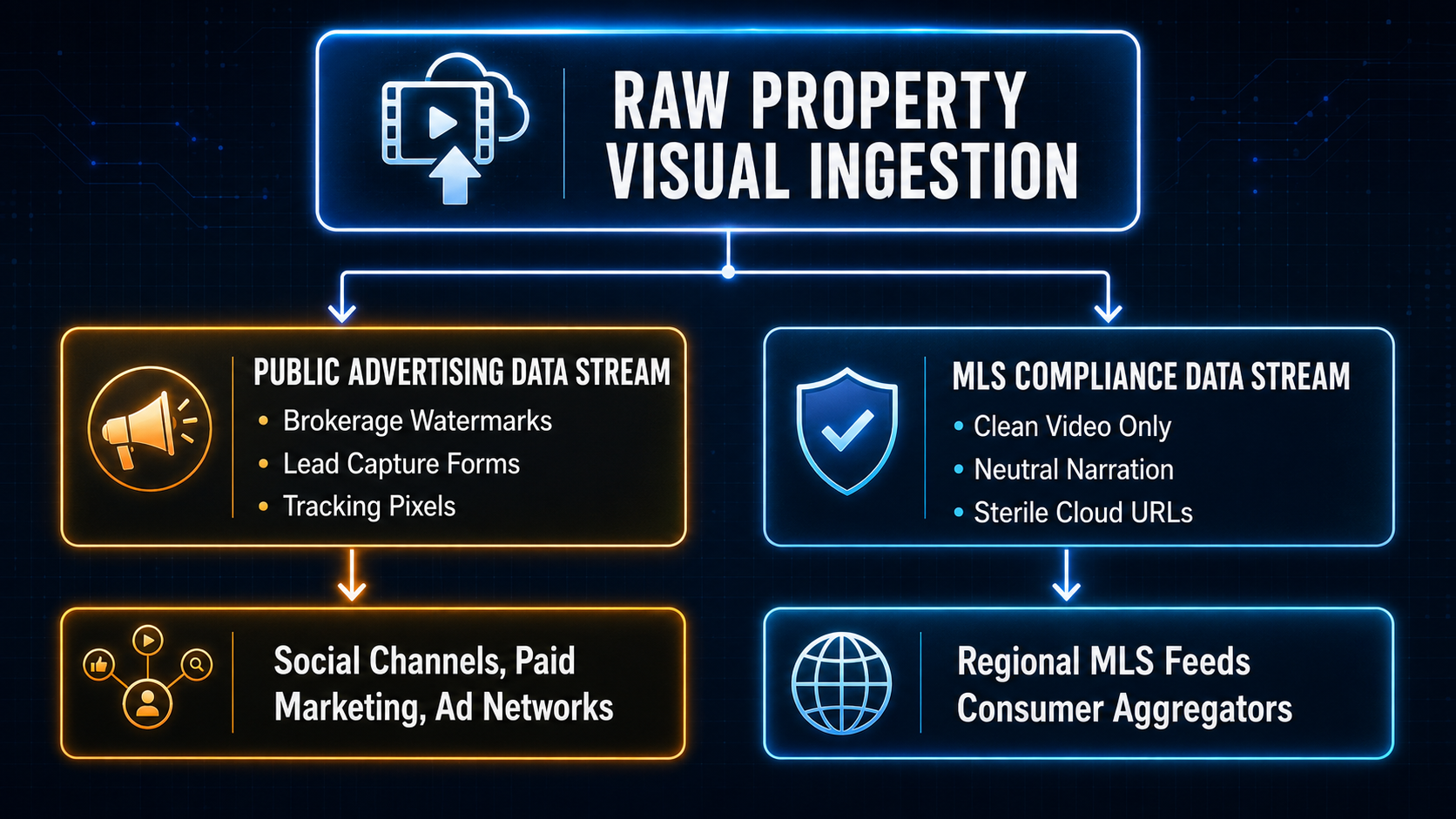
When you import raw property media into a modern MLS compliant real estate video generator, the platform processes the incoming file through an automated data pipeline:
This automated separation gives your operations team total security. You can deploy creative, branded campaigns to your public marketing networks while delivering clean, compliant unbranded assets directly to the listing service.
Transforming your business operations requires an organized, repeatable production schedule. The timeline below tracks a property listing asset from the initial upload through cloud processing to final live distribution.
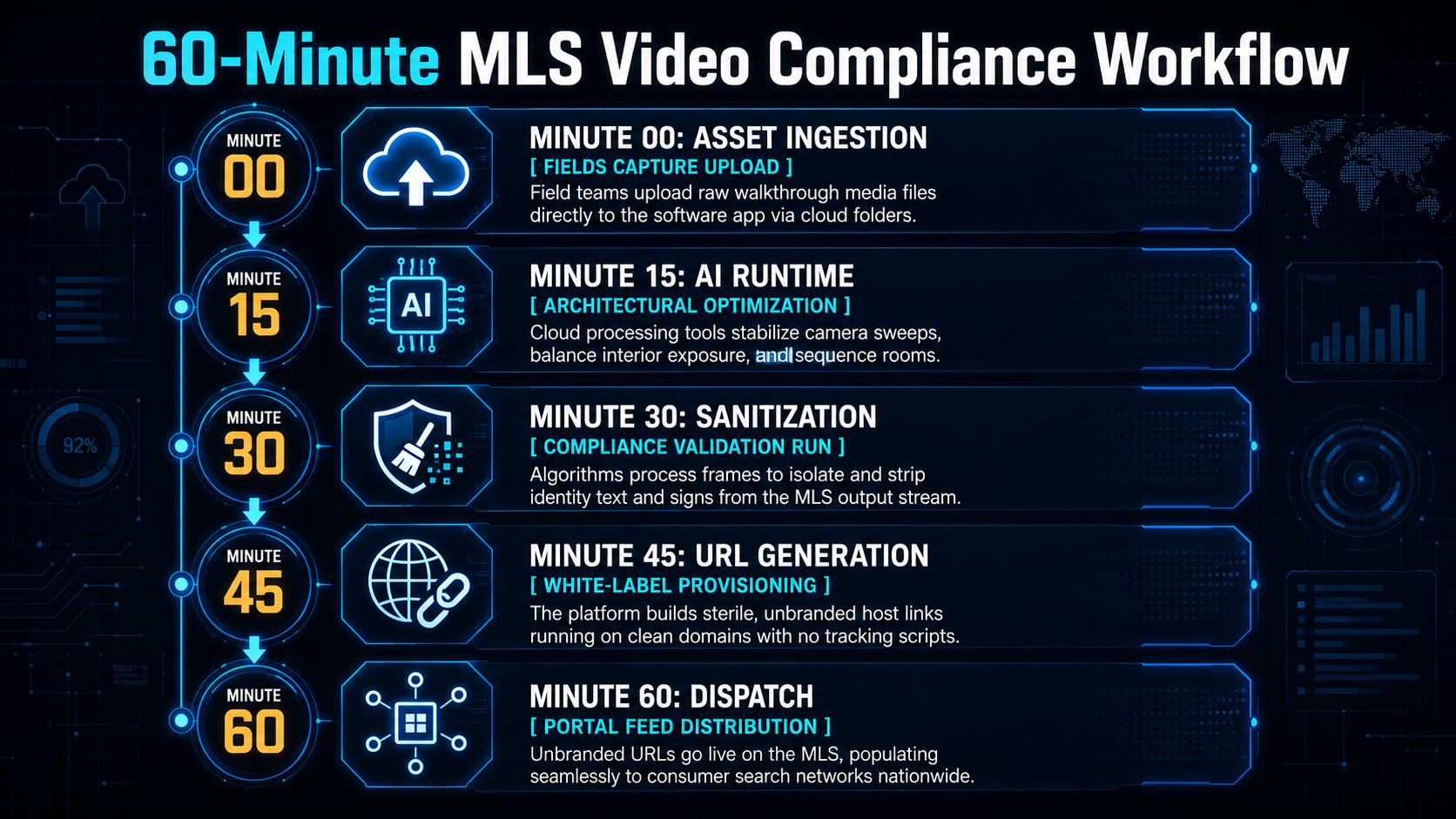
Your showing assistants or field team upload raw property footage and photos straight to the cloud platform right from the property, removing the need for local data storage or complicated management tools.
The platform's video processor balances uneven lighting, irons out camera shakes, and organizes the raw clips into an intuitive, room-by-room walkthrough sequence.
The software runs advanced frame-analysis tools to find and remove any identity elements, converting your primary video into a clean, unbranded property asset.
The system provides a clean, fast-loading URL that runs on a neutral domain, ensuring your media remains compliant with regional real estate board rules.
Your data manager copies the unbranded link directly into the virtual tour fields of your MLS platform. Within minutes, the video syndicates out across the global real estate ecosystem.
To maintain high output across twenty or fifty active listings, real estate operators must have real-time visibility. Managing files through disconnected messaging apps or basic cloud drives slows down operations and hurts accuracy.
Utilizing specialized MLS compliant listing media software centralizes this monitoring. It provides your administrative managers a single dashboard to track compliance status and asset delivery for your entire active inventory.
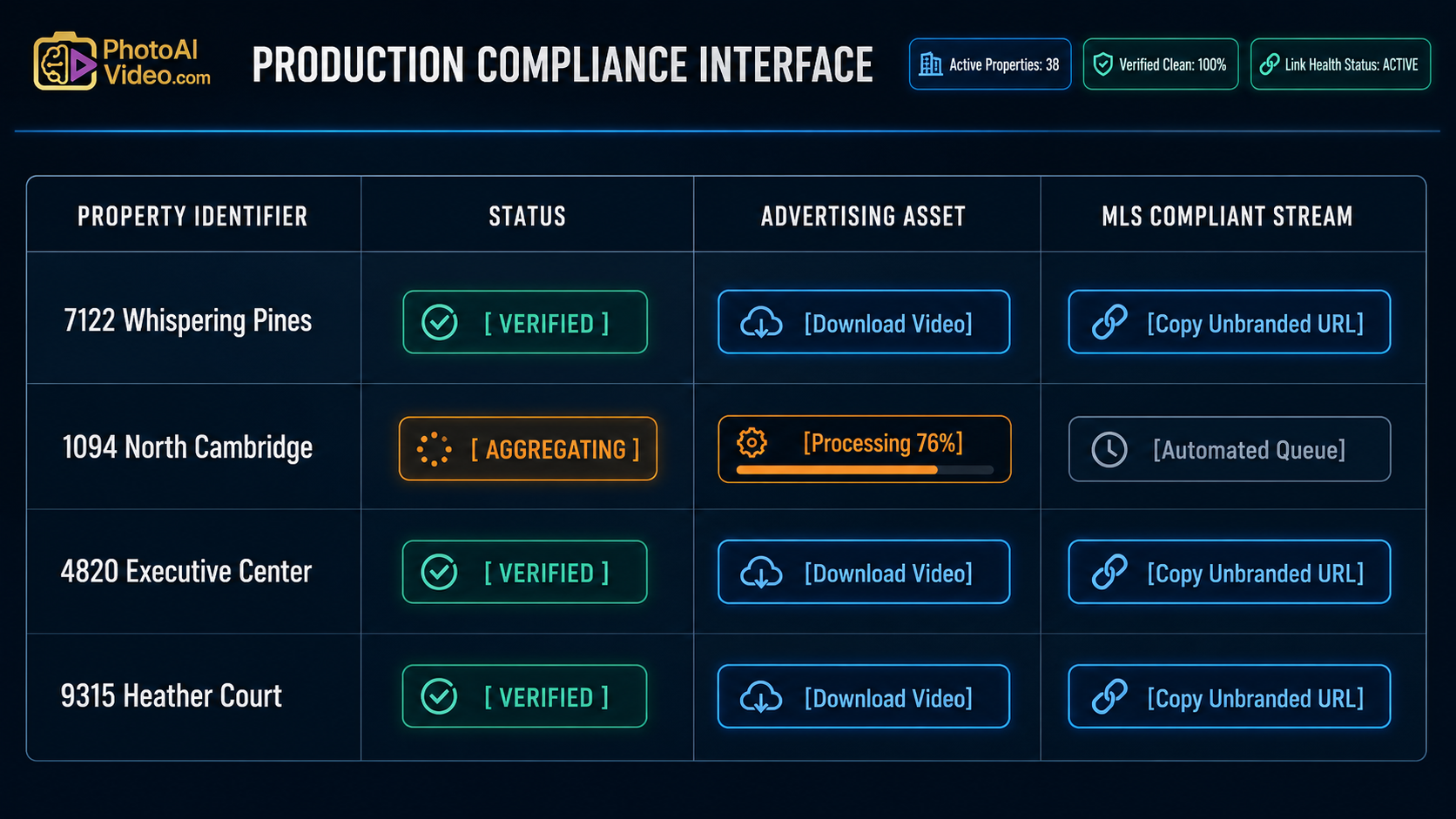
This structural setup gives your business a predictable path to growth. It keeps media staging organized, ensuring your staff can access and deploy compliant asset links instantly while protecting your team from manual distribution errors.
Deploying compliance automation isn't just a defensive move against fines—it directly enhances your market reach. Moving your property media through an automated MLS compliant video tours pipeline builds an efficient marketing funnel that maximizes your advertising dollar.

This strategic approach produces clear financial benefits across your entire real estate operation:
Even when using automated software tools, real estate professionals should watch for common operational missteps that can trigger unexpected data delays. Keep these issues in mind:
Growth in the modern real estate sector depends on your operational efficiency. Teams that spend their time manually editing media or chasing compliance flags will lose market share to modern brokerages that embrace automated workflows.
Using an automated, compliance-first video framework protects your inventory from data entry mistakes, keeps your listings active across consumer search sites, and scales your digital showings. Stop losing time to manual rendering bugs and compliance fines. Clean up your production pipeline, secure your portfolio, and expand your listing reach with modern automation systems.
Transform your listing media with PhotoAIVideo.com. Our powerful cloud platform converts raw property footage into professional marketing assets while instantly building clean, compliant, unbranded video streams for your local MLS.


Compact, ready to go anywhere
Interchangeable lens that’s upgradeable
Dual 1-inch sensors for improved clarity and low light performance
Dynamic range and 6K 360° capture
360° photo resolution at 21MP

8K 360° video recording for ultra-detailed visuals.
4K single-lens mode for traditional wide-angle shots.
Invisible selfie stick effect for drone-like perspectives.
2.5-inch touchscreen with Gorilla Glass protection.
Waterproof up to 33ft for underwater shooting.

360° photo resolution in 23MP
Slim design at 24 mm thick
Built-in image stabilization for smooth video capture.
Internal 19GB storage for photo and video storage.
Wireless connectivity for remote control and sharing.

60MP 360° still images for high-resolution photography.
5.7K 360° video recording at 30fps.
2.25-inch touchscreen for intuitive control.
USB Type-C port for fast charging and data transfer.
MicroSD card slot for expandable storage.
.png)

.png)

Try it free. No credit card required. Instant set-up.







.svg)


.svg)