CloudPano and Matterport: How They Fit Into MLS Workflows

Cloudpano
February 8, 2026
5 min read
Share this post

CloudPano and Matterport: How They Fit Into MLS Workflows 🏡🔗

Virtual tours have become a standard expectation in real estate listings. Sellers ask for them. Buyers rely on them. MLS systems support them—but only when they’re added correctly.

That’s why understanding CloudPano MLS workflow, Matterport MLS integration, and the broader real estate MLS virtual tour workflow is essential for agents, photographers, and brokerages who want reliable listing visibility.

This article breaks down how CloudPano and Matterport fit into MLS workflows, where problems usually occur, how to stay compliant long-term, and why recent industry disputes between CoStar, Matterport, and Zillow make workflow discipline more important than ever 🚨.

Why MLS Workflows Matter for Virtual Tours 📌

MLS systems are not just databases—they are distribution engines.

When a virtual tour is added correctly:

  • It appears in MLS public view
  • It syndicates to portals (when supported)
  • It increases engagement and time-on-listing
  • It supports seller marketing expectations

When it’s added incorrectly:

  • It may be hidden from public view
  • It may fail to syndicate
  • It may be removed after publication
  • It may trigger compliance warnings

That’s why the MLS listing virtual tour tools you use—and how you use them—matter just as much as the tour itself.

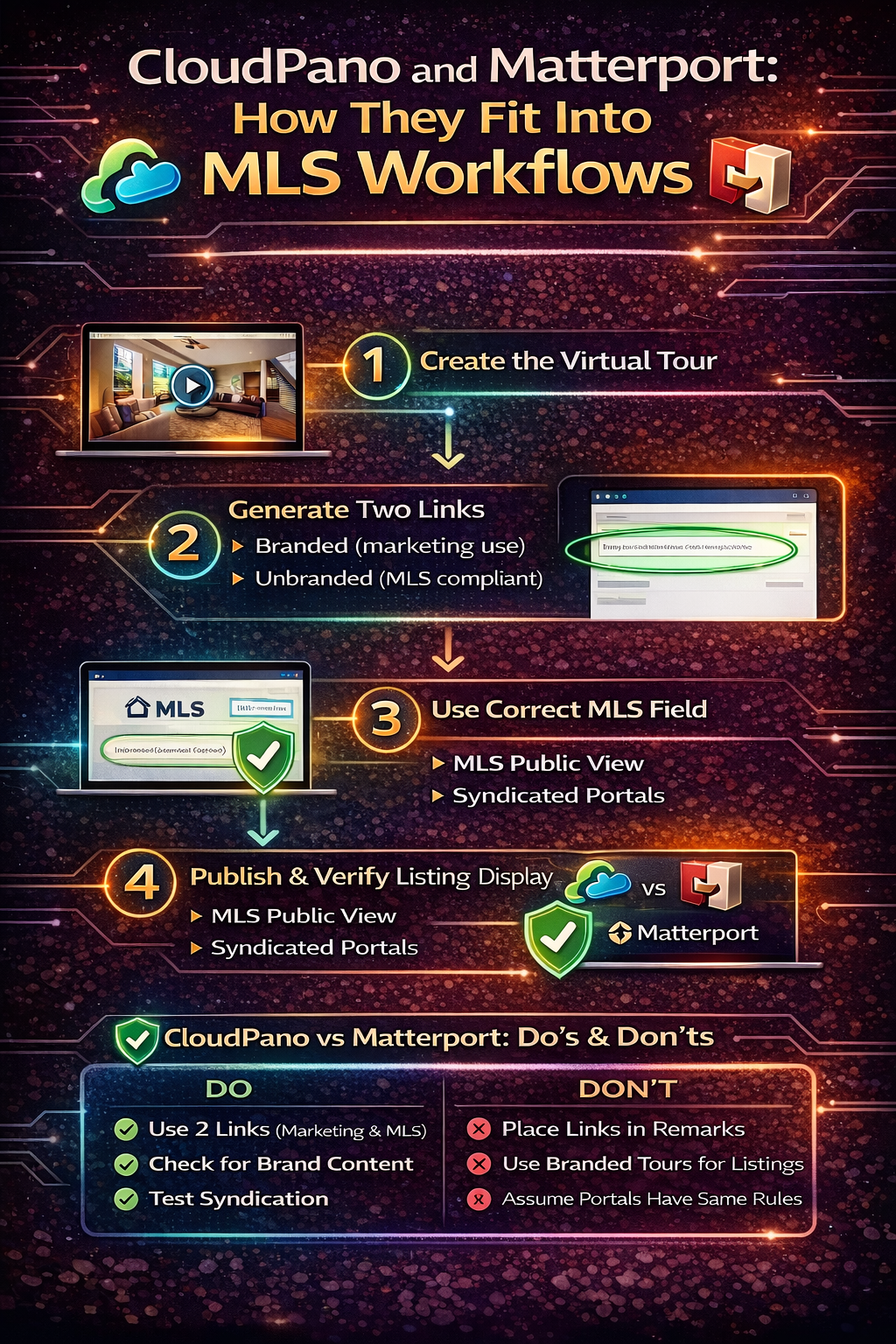
The Core Real Estate MLS Virtual Tour Workflow 🧩

Regardless of platform, most MLS workflows follow the same structure:

  1. Create the virtual tour
  2. Generate the correct link type
  3. Paste the link into the correct MLS field
  4. Publish the listing
  5. Verify public and syndicated display

Problems usually occur in steps 2 and 3—not in tour creation.
CloudPano MLS Workflow Explained 🔍

When people search CloudPano MLS workflow, they’re usually looking for one thing: a clean way to add tours to MLS without rejection.

A typical CloudPano workflow looks like this:

1. Create the tour

The tour is built using 360 images or media and finalized for the property.

2. Generate two versions of the link

Most agents and photographers maintain:

  • A branded tour for marketing (websites, email, social)
  • An unbranded / MLS-compliant tour for MLS submission

This separation is critical for CloudPano MLS compliance.

3. Select the MLS-ready link

The MLS version removes:

  • Agent or brokerage branding
  • Logos
  • Contact details
  • Lead capture elements

This aligns with MLS neutrality rules.

4. Add the link to the MLS virtual tour field

The link should go only into the field labeled:

  • “Virtual Tour URL”
  • “Unbranded Virtual Tour”
  • Or similar MLS-specific language

5. Verify after publishing

Always check:

  • MLS public view
  • Broker public listing page
  • Syndicated portals (if applicable)

CloudPano workflows are often praised because they make this branded/unbranded separation straightforward—reducing mistakes under deadline pressure ⏱️.

Matterport MLS Integration Explained 🧠

Matterport MLS integration follows the same principles but sometimes introduces confusion due to:

  • Multiple sharing options
  • Different embed formats
  • Account-level branding settings

A clean Matterport MLS workflow looks like this:

1. Create the 3D tour

The tour is captured and processed through Matterport’s system.

2. Identify the unbranded sharing option

MLS systems generally require:

  • No agent names
  • No logos
  • No contact information

The MLS-safe link should present only the property experience.

3. Use the correct MLS field

As with CloudPano, the link must be placed in the designated virtual tour field—not remarks or captions.

4. Confirm public display

Matterport tours may appear differently across MLS views and portals, so verification is essential.

When people run into trouble with Matterport, it’s usually because:

  • The wrong link was copied
  • Branding was left enabled
  • The link was placed in the wrong MLS field

These are workflow issues—not platform failures.

CloudPano vs Matterport MLS Process ⚖️

When comparing CloudPano vs Matterport MLS process, the biggest differences are not about quality—but about workflow simplicity.

Both platforms:

  • Can produce MLS-compliant virtual tours
  • Require unbranded links for MLS
  • Depend on correct field placement

The real difference comes down to:

  • How clearly unbranded links are labeled
  • How easy it is to manage branded vs MLS versions
  • How consistent your internal process is

Agents who struggle with MLS workflows usually don’t have a documented process—not a bad platform.

Where MLS Listing Virtual Tour Tools Fit In 🛠️

MLS listing systems (Matrix, Paragon, Flexmls, etc.) provide the final gatekeeper.

Important rules apply regardless of tour platform:

  • Only use the official virtual tour field
  • Avoid placing links in public remarks
  • Avoid photo captions for tour links
  • Follow MLS-specific branding policies

The MLS doesn’t care how the tour was made—it cares what the public sees.

The Most Common MLS Workflow Mistakes 🚫

Even experienced agents make these mistakes:

❌ Using a branded tour in an MLS field

This is the #1 cause of tour removal.

❌ Pasting links into remarks

Many MLS systems automatically strip or block links here.

❌ Not verifying after publish

A tour can appear in agent view but not public view.

❌ Assuming portals behave the same

Each portal applies its own display rules.

A disciplined workflow prevents all of these.

Why Syndication Depends on MLS-Friendly Workflows 🔁

MLS feeds power most listing portals. If the MLS doesn’t approve or pass the tour correctly, portals may never see it.

That’s why real estate MLS virtual tour workflow discipline is critical:

  • MLS first
  • Syndication second
  • Marketing third

If the foundation is broken, everything above it suffers.

The CoStar, Matterport, and Zillow Dispute: Why Workflow Matters More Now 📰

Recent industry conflict has reinforced the importance of MLS-first workflows.

What happened?

After CoStar acquired Matterport, Zillow removed Matterport 3D tours from its platforms, citing licensing and API issues. CoStar publicly disputed Zillow’s claims, stating that Matterport customers retained the right to share tours broadly.

Why this matters for MLS workflows

This dispute highlighted a key reality:

Portals can change policies overnight. MLS rules change far less frequently.

Agents who rely solely on portal behavior are exposed. Agents who build strong MLS workflows maintain stability—even when platforms disagree.

Best Practices for a Future-Proof MLS Workflow 🔒✨

To protect your listings long-term:

  • Always maintain two tour links (MLS + marketing)
  • Label links clearly in your files or CRM
  • Use MLS unbranded fields only
  • Verify public display after publishing
  • Treat portals as bonus exposure—not the foundation

This approach works regardless of platform changes.

Why MLS Workflow Discipline Builds Seller Trust 🤝

Sellers don’t care about:

  • Link types
  • Branding rules
  • MLS policies

They care that:

  • Their listing looks great
  • The tour shows everywhere it should
  • Nothing “disappears” unexpectedly

A strong CloudPano MLS workflow or Matterport MLS integration protects your credibility and reduces awkward conversations.

Final Thoughts: Workflow Beats Tools 🏁

CloudPano and Matterport are both powerful tools—but neither can fix a broken MLS process.

When you master:

  • CloudPano MLS workflow
  • Matterport MLS integration
  • MLS listing virtual tour tools
  • Real estate MLS virtual tour workflow

…you gain consistency, compliance, and confidence.

In a market where visibility equals opportunity, a clean MLS workflow isn’t a technical detail—it’s a competitive advantage 🚀.

🚀 Your All-In-One Virtual Experience Stack Starts Here

Share this post
Cloudpano

Choose The Right 360° Camera

Insta360 ONE RS 1-Inch 360 Edition

  • Compact, ready to go anywhere

  • Interchangeable lens that’s upgradeable

  • Dual 1-inch sensors for improved clarity and low light performance

  • Dynamic range and 6K 360° capture

  • 360° photo resolution at 21MP

Learn More

Insta360 X4

  • 8K 360° video recording for ultra-detailed visuals.

  • 4K single-lens mode for traditional wide-angle shots.

  • Invisible selfie stick effect for drone-like perspectives.

  • 2.5-inch touchscreen with Gorilla Glass protection.

  • Waterproof up to 33ft for underwater shooting.

Learn More

Ricoh Theta Z1

  • 360° photo resolution in 23MP

  • Slim design at 24 mm thick

  • Built-in image stabilization for smooth video capture.

  • Internal 19GB storage for photo and video storage.

  • Wireless connectivity for remote control and sharing.

Learn More

Ricoh Theta X

  • 60MP 360° still images for high-resolution photography.

  • 5.7K 360° video recording at 30fps.

  • 2.25-inch touchscreen for intuitive control.

  • USB Type-C port for fast charging and data transfer.

  • MicroSD card slot for expandable storage.

Learn More
Property Marketing
Allows potential buyers to explore properties in detail from anywhere, enhancing the real estate marketing process.
Automotive Spins
Create an interactive virtual showroom and engage affluent digital buyers with live 360º video calls, all through the CloudPano mobile app for a complete automotive sales solution.
Interactive Floor Plans
Create 2D and 3D floor plans with measurements in 4 minutes or less, all from your phone. Download the Floor Plan Scanner app and get your first scan free.

360 Virtual Tours With CloudPano.com. Get Started Today.

Try it free. No credit card required. Instant set-up.

Try it free
Latest posts

See our other posts

Interviews, tips, guides, industry best practices, and news.

Property Manager Video Hub: Scaling Rental Visibility with AI Photo-to-Video Workflows

This article explains how property managers can use PhotoAIVideo to build a property manager video hub: a repeatable system for turning rental photos, amenity images, floor plans, exterior shots, and neighborhood visuals into reusable rental marketing videos. The main idea is that property managers do not just need more listing exposure. They need clearer visual answers that help renters decide whether to schedule a tour. PhotoAIVideo is positioned as a practical tool for creating: Unit availability videos Amenity highlight videos Neighborhood videos Tour reminder clips Leasing follow-up videos Owner marketing proof videos Social media rental teasers Application or availability reminder videos Key takeaways: Property managers already have the media they need; the challenge is organizing it and turning it into reusable video assets. A video hub helps teams create consistent videos across units, floor plans, amenities, communities, and owner updates. Rental videos can reduce friction by answering renter questions about layout, condition, amenities, parking, pet features, and community feel. One rental photo set can become multiple video outputs for listings, social media, email, text follow-up, tour reminders, and owner reporting. Photographers can sell AI rental video packages to property managers as an upsell. Brokerages with property management divisions can use the same workflow to standardize leasing content. The article ends with a step-by-step process, video hub framework, mistakes to avoid, visual recommendations, FAQs, and a CTA encouraging readers to use PhotoAIVideo to turn rental photos into a scalable video system for rental visibility.
Read post

YouTube Shorts Listing Teasers: The 3-Scene Structure for Higher Property Clicks

This article explains how real estate agents, photographers, brokerages, and property managers can use YouTube Shorts listing teasers to drive more property clicks and showing requests. The main idea is that a YouTube Short should not try to show the entire house. Instead, it should use a simple 3-scene structure: Scene 1: Hook — stop the scroll with the strongest property feature. Scene 2: Proof — show the visuals that support the hook. Scene 3: Click Path — tell the viewer what to do next. The article positions PhotoAIVideo as a practical tool for turning listing photos into short vertical videos for YouTube Shorts, Reels, open house promotion, and listing campaigns. Key takeaways: YouTube Shorts should create curiosity, not replace the full listing video. The strongest property feature should appear first, not necessarily the front exterior. Agents should build each Short around one click reason, such as backyard, kitchen, layout, neighborhood, open house, or price point. One listing can become multiple Shorts instead of one generic video. Photographers can offer YouTube Shorts teaser packs as a video upsell. Brokerages can standardize the 3-scene structure across agents. Property managers can use the same structure to promote rentals and tours. The article ends with practical scripts, visual recommendations, FAQs, a visual placement guide, and a CTA encouraging readers to use PhotoAIVideo to create YouTube Shorts listing teasers from property photos.
Read post

Video Retargeting for Listings: Turning Photo-Based AI Videos into Appointment Follow-Up

This article explains how Realtors, photographers, brokerages, and property managers can use photo-based AI videos as follow-up assets after someone shows interest in a listing. The main idea is that most real estate marketing focuses on getting the first click, but many buyers and sellers need multiple touchpoints before booking a showing or appointment. Video retargeting helps agents re-engage people who already clicked a listing, watched a Reel, opened an email, attended an open house, asked about a property, or went quiet after showing interest. PhotoAIVideo is positioned as a practical tool for turning listing photos into short follow-up videos, including: Feature reminder videos Layout explainer videos Neighborhood fit videos Open house recap videos Price update videos Seller proof videos Showing request videos Rental tour recovery videos Key takeaways: A first-touch listing video introduces the property, while a retargeting video answers the next likely question. Follow-up videos should be short, usually 10–30 seconds, and focused on one action. Agents should send different videos based on behavior, such as email clicks, open house attendance, listing views, or showing interest. A good video follow-up feels helpful, not pushy. Photographers can package retargeting video clips as an upsell. Brokerages can standardize video retargeting workflows across agents. Property managers can use the same strategy to recover rental leads and book tours. The article ends with a simple retargeting sequence, visual recommendations, FAQs, and a CTA encouraging readers to use PhotoAIVideo to turn listing photos into appointment-driving follow-up videos.
Read post