


.png)


Property websites have changed dramatically over the last few years. What used to be a simple page with photos, a description, and a contact form has evolved into an interactive sales and qualification tool. Today, buyers, renters, investors, and tenants expect to explore a space digitally before they ever schedule a showing.
That expectation is exactly why property website 3D tours and real estate website tours are no longer optional. The question isn’t whether to use virtual tours—it’s how to embed virtual tours on a website in a flexible, future-proof way that supports SEO, conversions, and long-term ownership of your traffic.
This guide breaks down how to build modern property websites using flexible virtual tour integration, what to look for in a virtual tour website builder, and why controlling your own website experience matters more than ever—especially in light of the ongoing Zillow–Matterport–CoStar dispute.
Real estate is emotional and visual. People don’t just want specs—they want to feel the space.
Virtual tours help property websites:
From single-family homes to apartments, commercial spaces, and new developments, real estate website tours let visitors explore at their own pace—on their own device—without pressure.
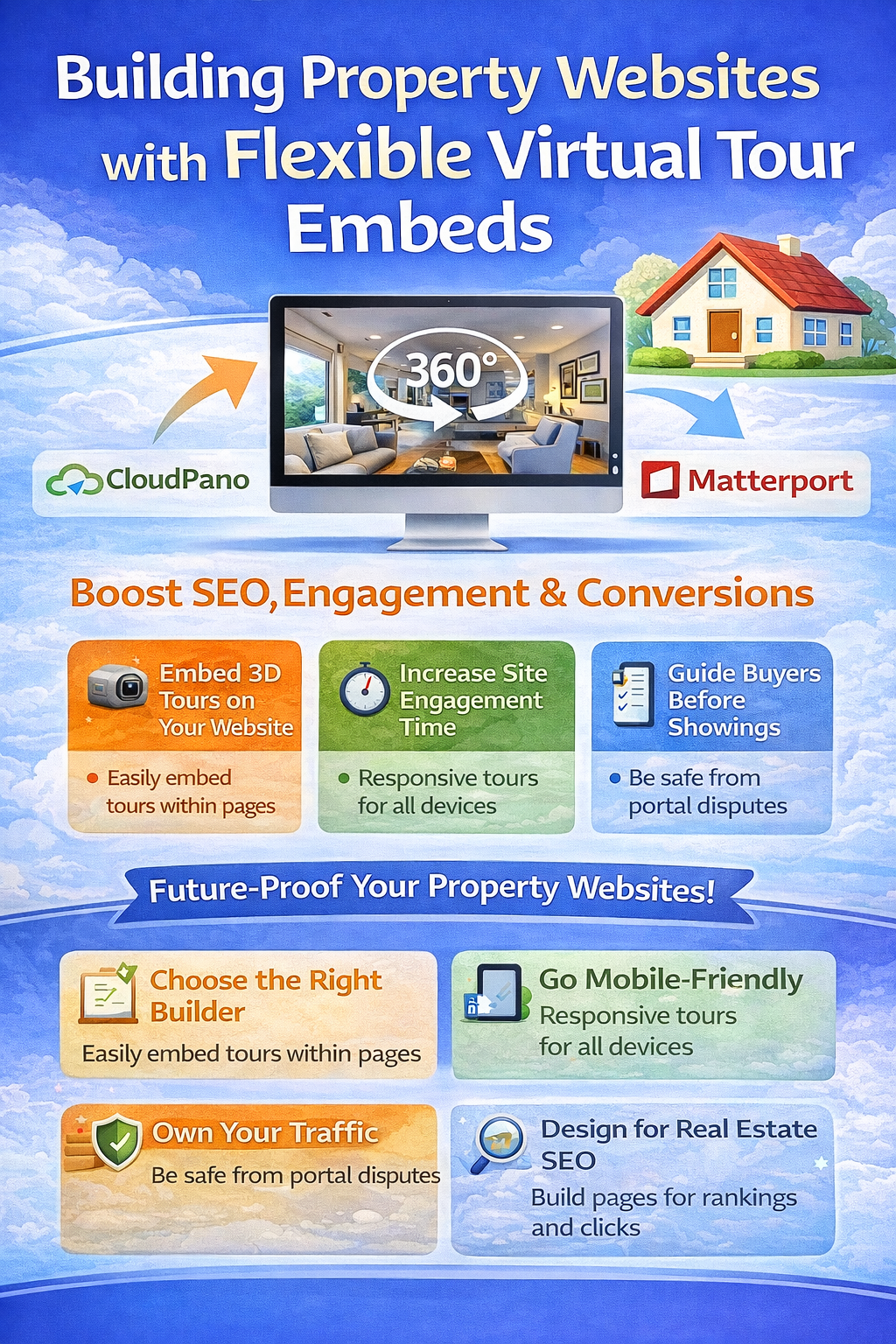
Flexibility is the difference between a website that works today and one that still works years from now.
Flexible virtual tour integration means your tours can be:
In short, the tour adapts to your website—not the other way around.
A good virtual tour website builder doesn’t just “support tours.” It makes them easy to deploy, manage, and scale.
When evaluating your setup, look for these essentials:
You should be able to embed virtual tours on a website using standard methods (such as iframe or supported embed blocks) that work across popular builders like WordPress, Webflow, Wix, and Squarespace.
Your tour embeds should resize naturally without custom CSS hacks.
The builder should allow:
Virtual tours are immersive, but the rest of the page must stay lightweight to avoid slow load times.
Embedding a tour is only part of the job. The page structure around it is what drives results.
A high-performing property page typically includes:
Describe the property or space clearly:
“Downtown Austin Loft with Interactive 3D Tour”
Explain what the visitor is about to explore and why it matters.
Placed near the top of the page so it’s immediately visible.
This layout works for buyers and search engines.
Virtual tours don’t replace SEO—they enhance it when used correctly.
Interactive content keeps users on the page longer, sending positive engagement signals.
Visitors are more likely to stay and explore instead of clicking back.
Tours paired with text, FAQs, and media create richer, more authoritative pages.
You can link:
This creates topical relevance and helps Google crawl your site more efficiently.
Flexible virtual tour integration shines when you apply it across multiple use cases:
One property, one tour, one focused CTA.
Showcase multiple tours from the same area to build local authority.
Highlight past listings, developments, or commercial projects.
Use tours alongside ads, email campaigns, and social traffic.
Because the same tour can be embedded in multiple places, you get more value from every capture.
Many real estate professionals rely heavily on third-party portals for exposure. While portals can drive traffic, they also come with risk.
That risk became very visible during the recent dispute involving Zillow, Matterport, and CoStar.
In late 2025, Zillow announced it would remove certain Matterport 3D tours from its platforms, citing issues related to API access and content agreements following Matterport’s acquisition by CoStar.
CoStar publicly disputed Zillow’s claims, stating that customers could still broadly share tours, while Zillow maintained that changes were necessary due to contractual and technical restrictions.
Regardless of where responsibility ultimately lies, one takeaway is undeniable:
👉 Distribution rules on major platforms can change without warning.
When tours live on your own website, your marketing isn’t at the mercy of third-party disputes.
If you want deeper context, these articles explain the situation clearly:
To build property websites that last, focus on ownership and flexibility:
Portals should support your strategy—not replace it.
One strong tour per page is usually better than cluttering multiple embeds.
Buyers, renters, and investors all look for different signals—tailor copy and CTAs accordingly.
Avoid locking yourself into a single distribution channel or platform dependency.
When you embed virtual tours on a website you control, you gain:
Instead of chasing traffic across platforms, you build a central hub where every tour strengthens your brand and your visibility.
The most successful property websites today aren’t just showing listings—they’re guiding decisions.
By using a solid virtual tour website builder and embracing flexible virtual tour integration, you create property websites that are immersive, SEO-friendly, and resilient against industry shifts.
Virtual tours are no longer just media assets. When embedded correctly, they become the centerpiece of a modern real estate website—working for you 24/7.


Compact, ready to go anywhere
Interchangeable lens that’s upgradeable
Dual 1-inch sensors for improved clarity and low light performance
Dynamic range and 6K 360° capture
360° photo resolution at 21MP

8K 360° video recording for ultra-detailed visuals.
4K single-lens mode for traditional wide-angle shots.
Invisible selfie stick effect for drone-like perspectives.
2.5-inch touchscreen with Gorilla Glass protection.
Waterproof up to 33ft for underwater shooting.

360° photo resolution in 23MP
Slim design at 24 mm thick
Built-in image stabilization for smooth video capture.
Internal 19GB storage for photo and video storage.
Wireless connectivity for remote control and sharing.

60MP 360° still images for high-resolution photography.
5.7K 360° video recording at 30fps.
2.25-inch touchscreen for intuitive control.
USB Type-C port for fast charging and data transfer.
MicroSD card slot for expandable storage.
.png)

.png)

Try it free. No credit card required. Instant set-up.







.svg)


.svg)