


.png)


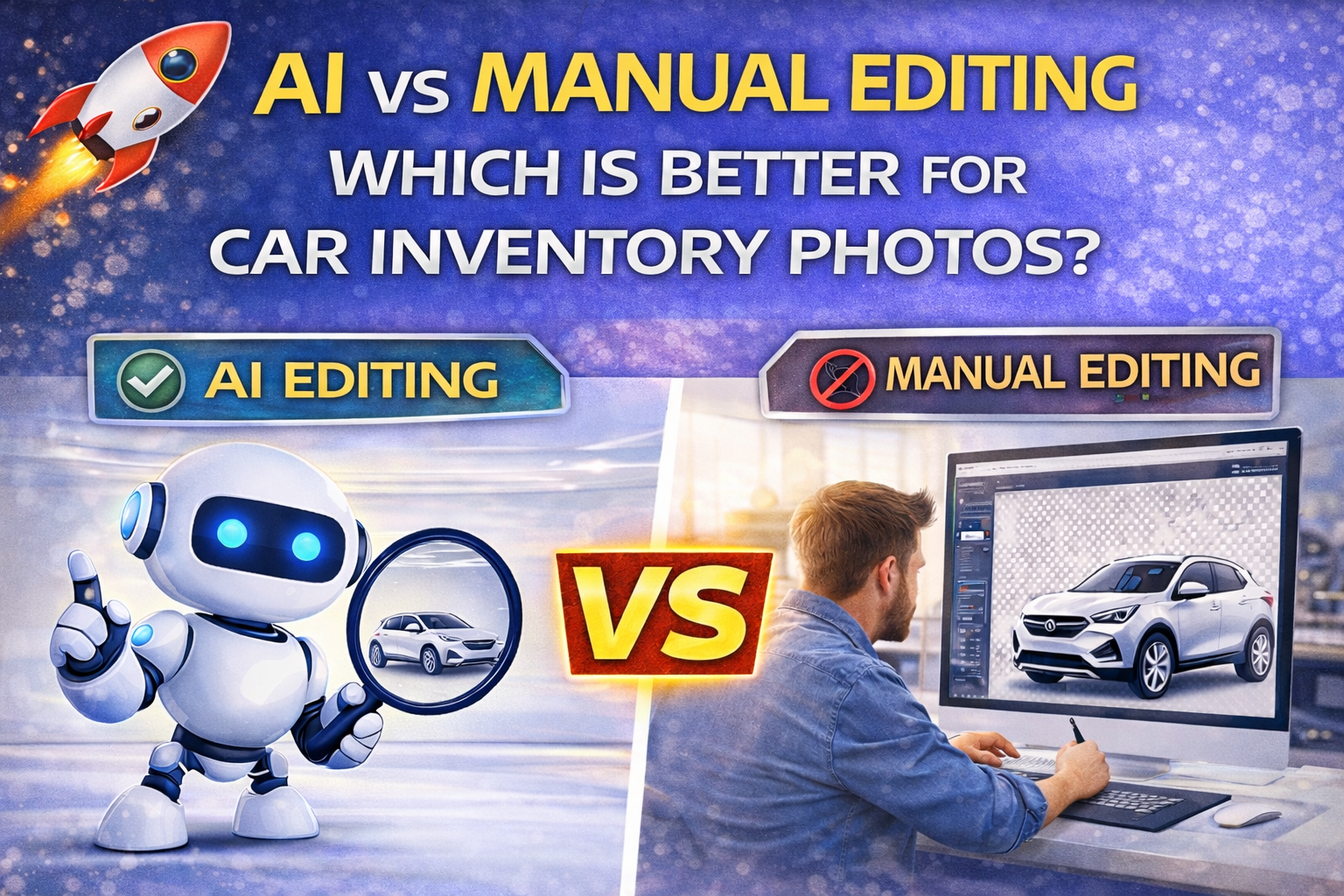
In today’s automotive market, your inventory photos are your first impression.
Before a customer walks onto your lot, they’ve already scrolled through dozens of listings online. They’ve compared lighting, backgrounds, image clarity, and overall presentation quality in seconds.
That’s why dealerships are increasingly asking:
AI vs manual car photo editing — which is better?
In this guide, we’ll break down the pros and cons of both approaches, explore how modern AI background removal works, and help you determine the most efficient and scalable solution for your dealership.
If you’d like to see AI in action, you can watch a full walkthrough here:
Let’s dive in. 🚀
Car buyers are visual shoppers.
When browsing inventory online, they evaluate:
If your inventory photos look inconsistent or cluttered, it reduces trust instantly.
Better presentation leads to:
That’s why the debate around ai vs manual car photo editing matters more than ever.
Manual car photo editing typically involves:
This process requires:
While manual editing can produce high-quality results, it comes with operational limitations.
Manual editing has been the industry standard for years, but it presents several challenges:
Each vehicle may require several minutes of editing. For dealerships processing 50+ vehicles weekly, that adds up quickly.
Different editors produce different results. Lighting, shadow placement, and background style may vary.
Manual editing requires trained staff or outsourced teams.
As inventory volume increases, editing capacity becomes a bottleneck.
These limitations are why more dealerships are exploring AI alternatives.

AI car photo editing uses machine learning and computer vision to automate background removal and image enhancement.
Instead of manually masking vehicles, AI:
This dramatically reduces editing time while maintaining professional presentation.
Understanding ai vs manual car photo editing starts with recognizing how automation changes the workflow.
Modern AI tools are trained on thousands of vehicle images.
When a photo is uploaded, the system:
1️⃣ Identifies the vehicle through object detection
2️⃣ Segments the car from the background
3️⃣ Removes distractions automatically
4️⃣ Generates a clean studio-style setting
5️⃣ Adjusts lighting and perspective
6️⃣ Creates proportional shadows
The result is a vehicle that looks like it was shot in a controlled studio — even if it was photographed on a busy lot.
No physical studio required. 🏢
One of the most powerful AI upgrades is saved background presets.
When you generate a studio background — for example:
“Clean white studio background with soft shadows”
It gets saved automatically.
Instead of recreating it every time, you can:
This ensures consistent dealership inventory photos across your entire catalog.
Manual editing rarely achieves this level of repeatable consistency without strict oversight.
In the comparison of ai vs manual car photo editing, bulk processing is a major differentiator.
AI platforms allow you to:
Every vehicle is placed into the same studio environment.
Manual editing simply cannot match this speed.
For dealerships processing 10, 20, or even 100+ cars per day, bulk automation is transformative.
Consistency builds trust.
When all inventory images:
Buyers perceive the dealership as more professional.
Manual editing often introduces subtle variations between images.
AI, on the other hand, locks in consistency.
And consistency equals brand polish. ✨
Manual editing costs include:
AI editing typically operates on:
When scaled across hundreds or thousands of vehicles per month, AI becomes significantly more cost-effective.
Plus, time savings translate directly into operational efficiency.
Modern AI systems now include:
This simplifies quality control for teams and resellers.
Manual editing requires file tracking and additional review processes.
AI centralizes it.
For dealership groups managing multiple rooftops, consistency becomes critical.
AI allows you to:
Manual editing struggles at this scale without increasing labor costs.
Manual editing may still rely on outdoor photography or physical studio setups.
AI eliminates that requirement entirely.
You can simply type a prompt like:
“Clean white infinity wall with soft shadows.”
The system generates a professional studio environment automatically.
That means:
Just automated studio-quality results.
Presentation impacts buyer behavior directly.
Professional, consistent inventory photos:
When comparing ai vs manual car photo editing, the method that delivers consistency and speed at scale will drive better overall results.
For high-volume dealerships, that’s AI.
Manual editing may still be useful for:
However, for daily inventory management, AI provides superior scalability and efficiency.
So which is better?
For low volume and specialized edits, manual editing can work.
For dealerships processing inventory daily and needing:
AI is the clear winner.
Modern AI automotive background removal platforms are built specifically for dealership workflows.
Upload a car.
Generate a studio.
Process in bulk.
Download.
Done. ✅
The automotive industry is evolving rapidly.
Dealerships that rely solely on manual editing will struggle to keep up with volume and consistency demands.
AI editing delivers:
When comparing ai vs manual car photo editing, the future clearly favors automation.
Your photos are your first salesperson.
Make sure they’re working at full capacity. 🚗✨


Compact, ready to go anywhere
Interchangeable lens that’s upgradeable
Dual 1-inch sensors for improved clarity and low light performance
Dynamic range and 6K 360° capture
360° photo resolution at 21MP

8K 360° video recording for ultra-detailed visuals.
4K single-lens mode for traditional wide-angle shots.
Invisible selfie stick effect for drone-like perspectives.
2.5-inch touchscreen with Gorilla Glass protection.
Waterproof up to 33ft for underwater shooting.

360° photo resolution in 23MP
Slim design at 24 mm thick
Built-in image stabilization for smooth video capture.
Internal 19GB storage for photo and video storage.
Wireless connectivity for remote control and sharing.

60MP 360° still images for high-resolution photography.
5.7K 360° video recording at 30fps.
2.25-inch touchscreen for intuitive control.
USB Type-C port for fast charging and data transfer.
MicroSD card slot for expandable storage.
.png)

.png)

Try it free. No credit card required. Instant set-up.






.svg)


.svg)