


.png)


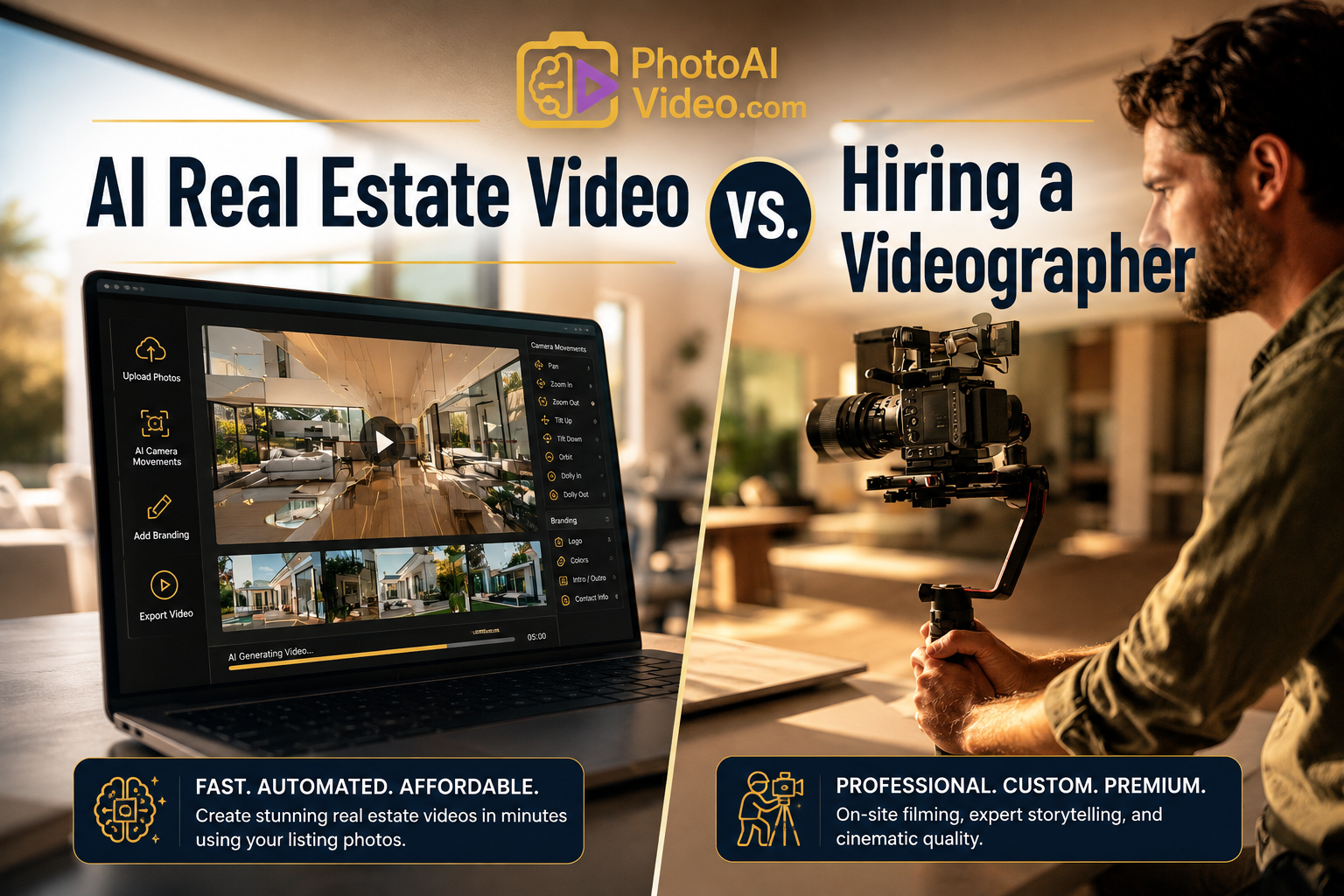
An AI real estate video is no longer just a novelty in listing marketing — it has become another option agents can consider alongside traditional videography when deciding how to market a property. The question isn't simply whether video belongs in real estate marketing; it's how to produce it consistently without stretching your marketing budget or adding unnecessary production time.
This article breaks down the practical tradeoffs between an AI real estate video workflow and hiring a professional videographer, so you can decide which approach makes the most sense for each listing.
An AI real estate video is generated from listing photos you already have — without requiring a separate camera crew or on-site video shoot. You upload your existing photos, and the system applies simulated camera movements such as pans, zooms, tilts, dolly-style movements, and orbits before combining everything into a polished property video.
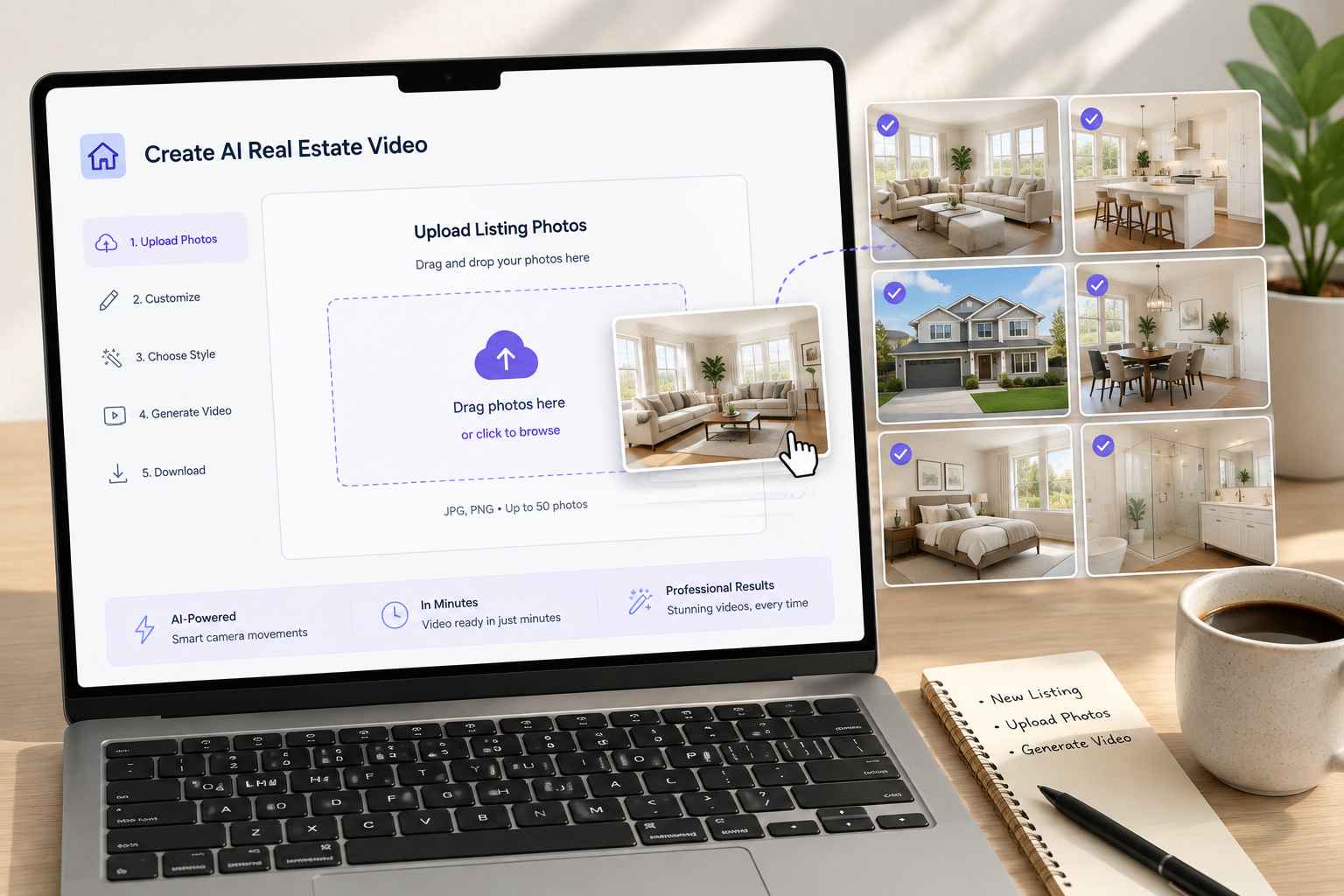
Platforms like PhotoAIVideo offer automated video creation along with branding options such as logos, colors, contact details, and intro and outro slides. Depending on the available features, users may also be able to add an AI voiceover or AI avatar.
The finished video can then be exported in formats suited to different platforms — such as widescreen 16:9 for websites and YouTube, vertical 9:16 for Reels, TikTok, and Stories, or square 1:1 for social media feeds — without requiring separate video shoots for each platform. PhotoAIVideo's current product pages confirm support for landscape and vertical outputs and multiple marketing formats.
Traditional videography, by contrast, typically means booking a videographer, coordinating a shoot around the property and seller's availability, capturing footage on-site, and then editing that footage into a finished video.
Both are legitimate ways to produce real estate marketing videos, but they solve different problems.
The most useful version of this comparison isn't "AI wins" or "videographers are obsolete."
It's about matching the production method to the property.
A starter home and a multimillion-dollar architectural showcase don't necessarily have the same marketing needs or budget. Treating them as though they do is where many AI-versus-human comparisons become misleading.
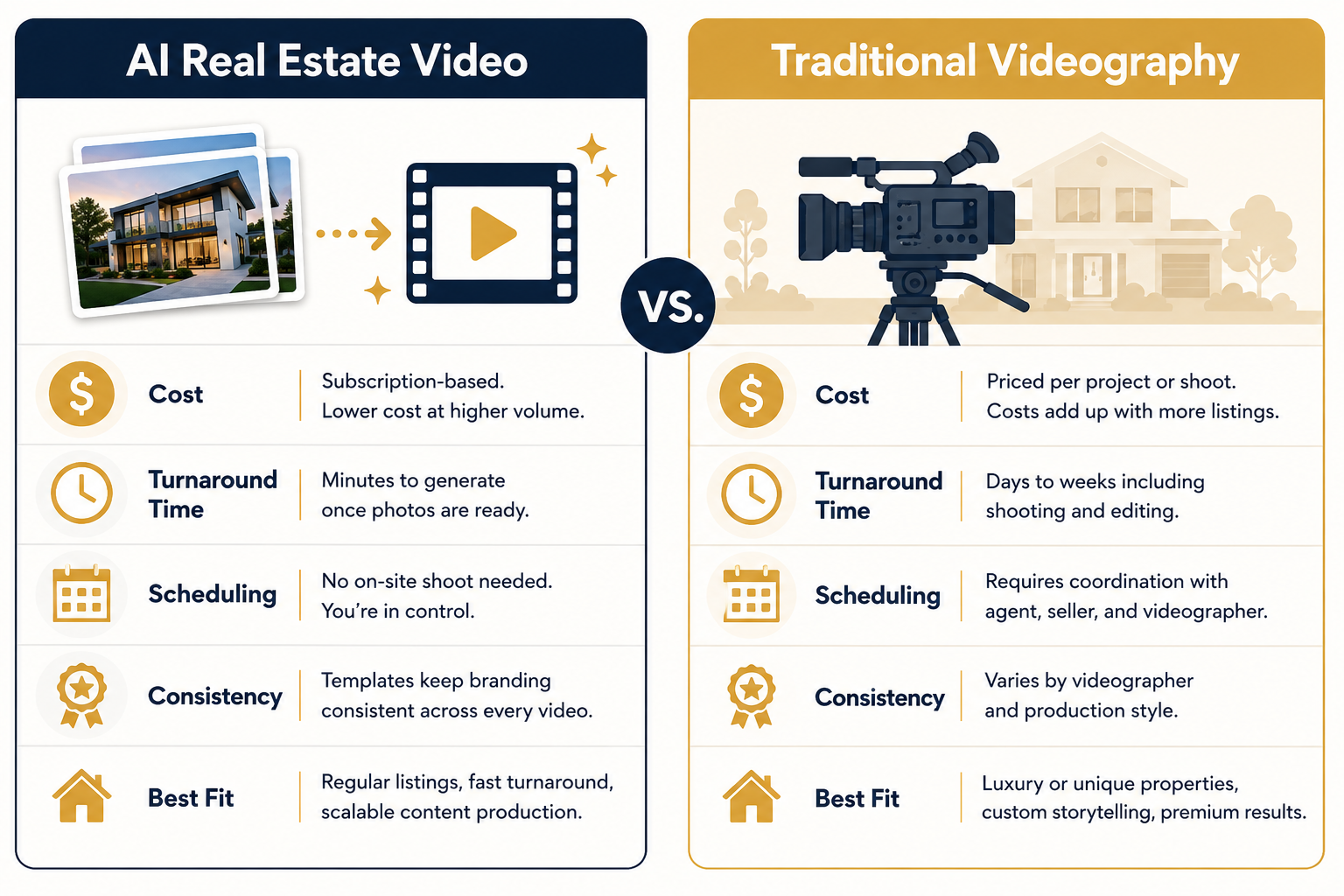
Traditional videographers typically charge per shoot, with pricing potentially influenced by factors such as property size, location, drone footage, video length, and editing complexity.
For a single listing, that expense may fit comfortably within the marketing budget. But for agents handling many listings throughout the year, paying a separate production fee for every property can add up quickly.
An AI real estate video platform may instead use a subscription-based pricing model.
PhotoAIVideo, for example, currently offers Free, Creator, Pro, and Enterprise options for users with different production needs. Agents producing videos regularly can compare these options with the cost of commissioning individual professional shoots.
The key cost consideration is volume. If you only need an occasional property video, paying per project may make sense. If you're producing videos regularly, a subscription-based workflow can potentially reduce the average production cost per listing.
This is one of the clearest differences between the two approaches.
Traditional videography requires scheduling the shoot, capturing footage at the property, transferring and organizing that footage, and completing post-production.
Depending on the videographer's availability and workflow, the entire process may take several days or longer.
An AI real estate video can eliminate much of that production schedule because it works directly from existing listing photos. There's no additional video shoot to arrange, so the video can potentially be created shortly after the listing photography is ready.
PhotoAIVideo describes its workflow as transforming listing photos into video within minutes, rather than requiring a separate property shoot.
For agents trying to publish marketing materials at roughly the same time a listing goes live, that faster workflow can be particularly useful.
Beyond production time itself, traditional videography involves coordination.
The agent, seller, and videographer all need to be available at an appropriate time, and exterior footage may also depend on weather and lighting conditions.
Photo-based AI video removes much of that coordination because its primary input is an existing set of listing photos.
That doesn't necessarily make one approach better than the other, but it does make AI video considerably easier to fit into a repeatable, high-volume listing workflow.
This is where professional videography has a genuine advantage.
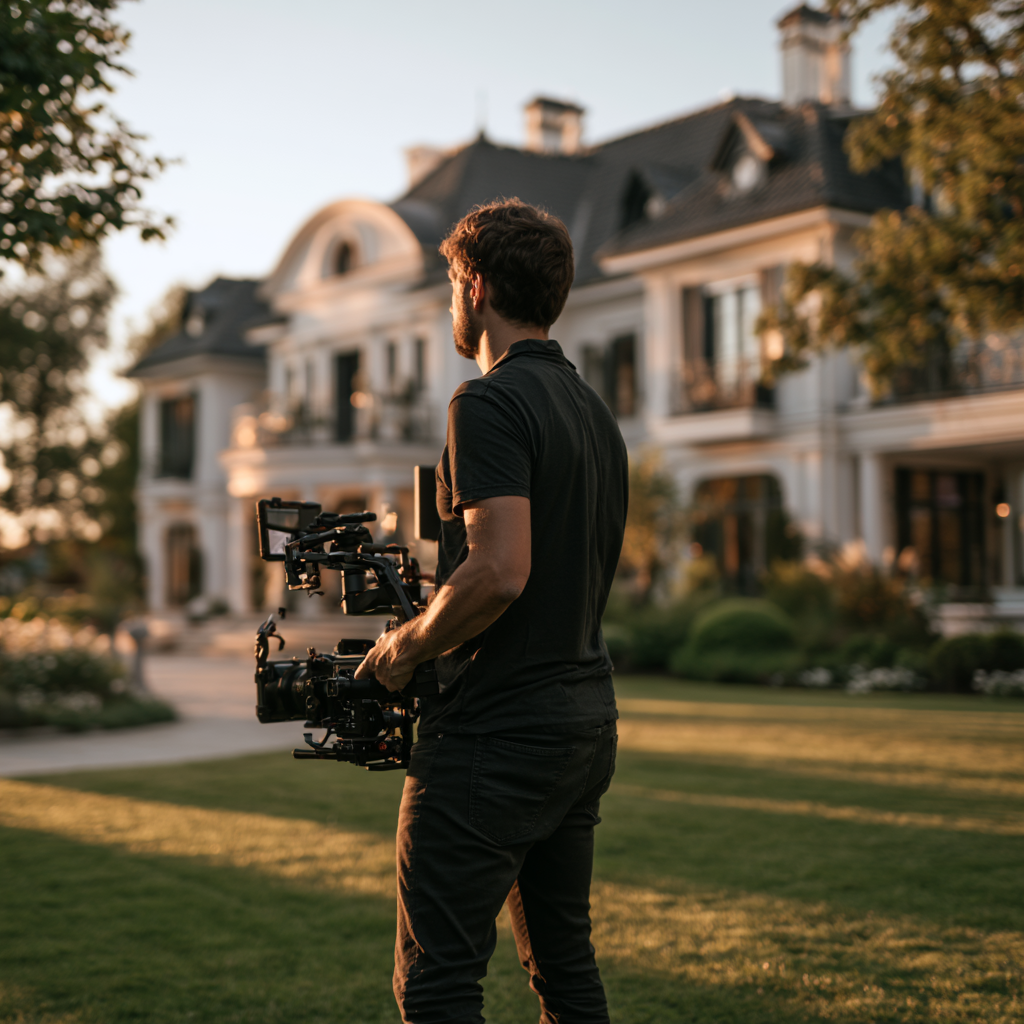
A skilled videographer can capture perspectives, lighting conditions, movement, and moments that simply don't exist in a set of still photos — a golden-hour drone flyover, natural movement through a space, sweeping footage of acreage, or a carefully composed reveal of an architectural feature.
If a property has a genuinely distinctive feature or view that needs to be experienced in motion, live footage can accomplish things that a photo-to-video workflow cannot.
An AI real estate video works with the visual information contained in the photos you provide.
That's an advantage for speed and scalability, but it's also a limitation: the quality of the finished video depends heavily on the quality, variety, and coverage of the original photography.
Strong, professionally composed listing photos provide better source material. Poorly lit or incomplete photography cannot be completely corrected simply by adding simulated camera movement.
Where AI video can be particularly useful is in repeatable branding. Logos, brand colors, contact information, and intro and outro sequences can be incorporated into a standardized workflow so videos maintain a consistent visual identity across multiple listings.
Consistency becomes increasingly important as an agent, team, or brokerage produces more content.
Traditional video projects may vary in editing style, pacing, color grading, music, and branding depending on the videographer or editor involved.
An AI real estate video workflow can make standardization easier by applying the same branding template — including your logo, colors, contact information, and intro or outro — across multiple videos.
For agents and brokerages building a recognizable brand across many listings, that consistency can be valuable.
It also reduces the need to communicate the same branding requirements to an editor for every new project.
For broader industry research and housing-market trends, agents can also explore the National Association of REALTORS® Research & Statistics resources. NAR publishes research covering home buyers and sellers, housing-market data, technology, and other topics relevant to real estate professionals.
The fairest way to compare AI video and traditional videography is by looking at the circumstances in which each approach is strongest.
A traditional videographer may make more sense when:
An AI real estate video may make more sense when:
These approaches also don't have to be mutually exclusive.
An agent or brokerage could use AI-generated video for routine listing marketing while reserving professional videography for showcase properties where custom cinematography provides additional value.
If you're evaluating whether an AI real estate video fits your listing workflow, one of the best ways to judge the technology is to look at actual output rather than relying solely on marketing descriptions.
PhotoAIVideo provides examples showing how listing photos can be transformed using simulated camera movement, branding, and pacing.
There's also a walkthrough of the upload-to-export process, which can help agents understand what's involved before incorporating the tool into their regular listing workflow.
See the PhotoAIVideo Walkthrough
The platform also supports different ways of working. Agents who want direct control can use a self-service workflow, while those who prefer to hand off more of the production process can explore available Done-For-You services. PhotoAIVideo currently lists several Done-For-You packages with video creation, branding, voiceover, and other options.
PhotoAIVideo for Real Estate Agents
For agents who want additional context on current housing-market activity, the Redfin Data Center provides regularly updated U.S. housing-market datasets covering areas such as market activity, price changes, luxury and starter homes, affordability, and buyer/seller conditions.
Ultimately, the goal isn't necessarily to replace one production method with another. It's to have more options for matching the right level of video production to each property's marketing needs.
Is an AI real estate video as good as one produced by a professional videographer?
It depends on what you need from the video. AI-generated video created from strong listing photography can produce a polished marketing asset for many standard listings. However, professional videography has a clear advantage when genuine camera movement, drone footage, customized cinematography, or unique architectural and landscape features are important to the story.
Can I use AI real estate video for every listing, or only some?
You can potentially use it across many types of listings, but that doesn't mean it will always be the best production method. Standard listings that already have strong professional photography may be well suited to an AI workflow, while flagship or highly distinctive properties may benefit from dedicated professional videography.
Do I need special equipment or photography skills to make an AI real estate video?
You don't need additional video equipment for a photo-based AI workflow. The video is generated from existing listing photos. However, the quality of those photos still matters, so professional-quality source photography will generally provide better material for the finished video.
How long does it take to produce an AI real estate video?
Generation times vary by platform and project, but AI-based workflows can be significantly faster than traditional video production because they don't require an additional property shoot or conventional editing workflow.


Compact, ready to go anywhere
Interchangeable lens that’s upgradeable
Dual 1-inch sensors for improved clarity and low light performance
Dynamic range and 6K 360° capture
360° photo resolution at 21MP

8K 360° video recording for ultra-detailed visuals.
4K single-lens mode for traditional wide-angle shots.
Invisible selfie stick effect for drone-like perspectives.
2.5-inch touchscreen with Gorilla Glass protection.
Waterproof up to 33ft for underwater shooting.

360° photo resolution in 23MP
Slim design at 24 mm thick
Built-in image stabilization for smooth video capture.
Internal 19GB storage for photo and video storage.
Wireless connectivity for remote control and sharing.

60MP 360° still images for high-resolution photography.
5.7K 360° video recording at 30fps.
2.25-inch touchscreen for intuitive control.
USB Type-C port for fast charging and data transfer.
MicroSD card slot for expandable storage.
.png)

.png)

Try it free. No credit card required. Instant set-up.







.svg)


.svg)