


.png)



For years, the standard real estate listing followed the same formula: a collection of professionally shot photos, a property description, and perhaps a virtual tour as an additional feature. That formula is evolving. Buyers increasingly browse listings in the same digital environments where they consume other content — environments built around motion, pacing, and visual storytelling. This is the backdrop against which AI real estate video has moved from a novelty to a practical marketing tool for agents looking to make their listings more engaging.
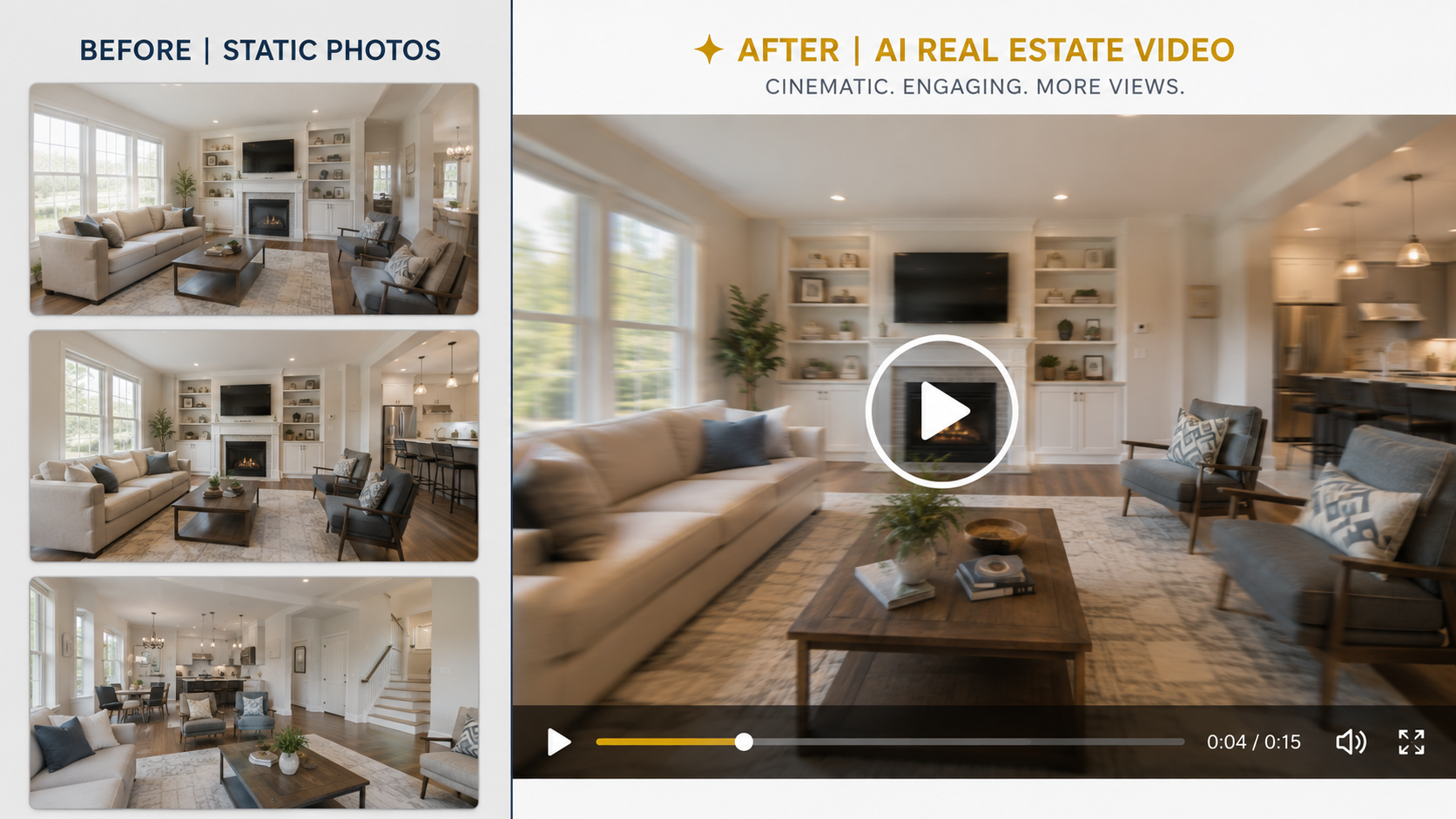
The shift isn't just aesthetic. It also reflects how people search for homes. Buyers increasingly begin their searches online and often browse properties from their phones. An agent relying exclusively on a static photo gallery may therefore have fewer ways to capture attention across video-first marketing channels. A well-paced property video, by contrast, can provide another way for buyers to experience a home's spaces, features, and overall presentation.
Housing data and research from sources such as Zillow Research and the Redfin Data Center offer insight into how buyer behavior and the digital home-search experience continue to evolve. As more real estate discovery happens online and across mobile-friendly platforms, video gives agents another format for presenting listings where potential buyers are already spending their time.
None of this is entirely new advice. Agents have heard "add video to your listings" for years. The challenge is that traditional video production isn't always practical for every agent or every property.
Hiring a videographer, coordinating an on-site shoot, editing the footage, and waiting for final delivery can make sense for a luxury property or a listing with a substantial marketing budget. For everyday listings that need to reach the market quickly, however, that additional production process may not always be practical.
This is precisely the gap that AI real estate video is designed to address.
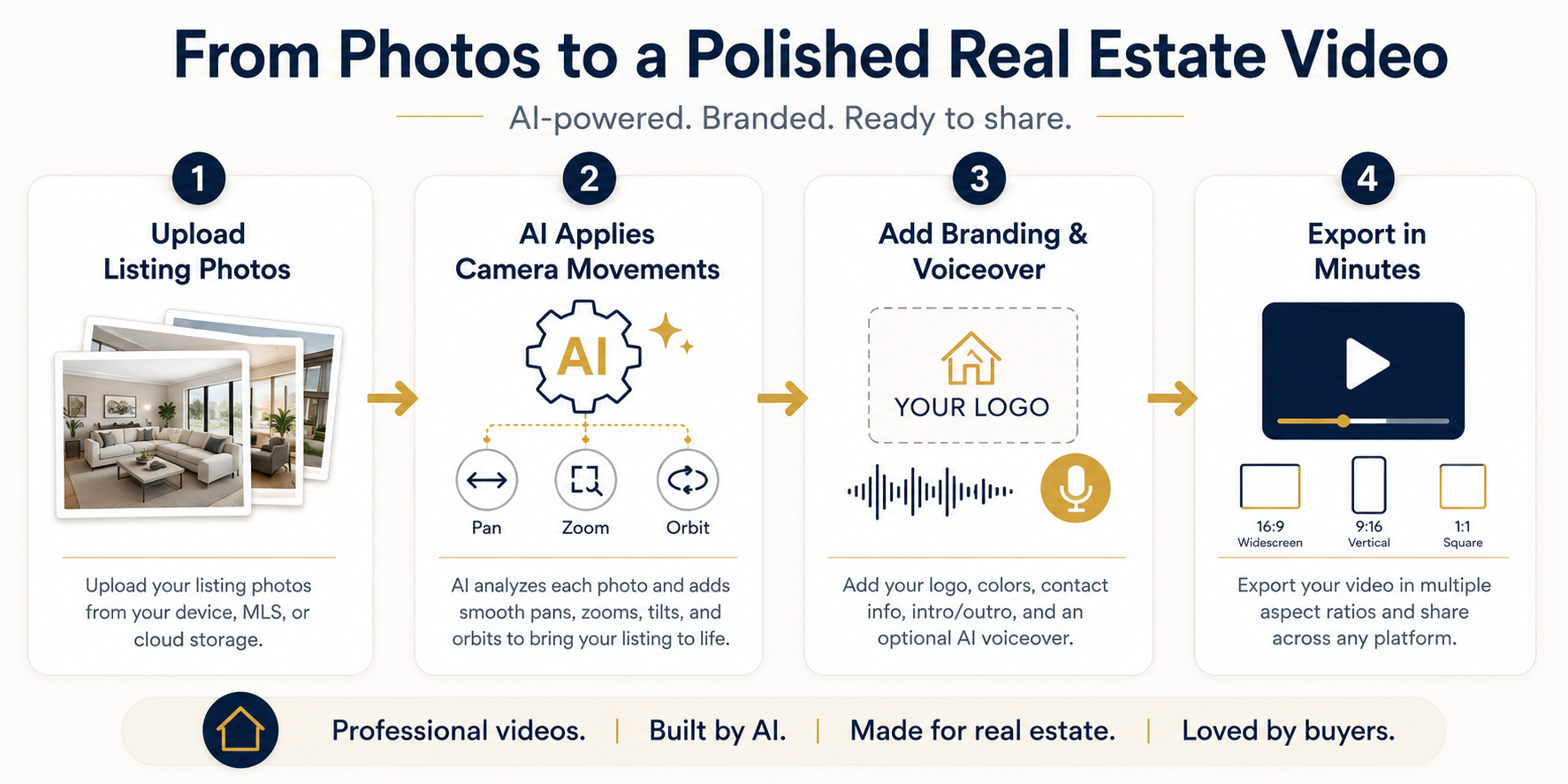
Instead of requiring a separate camera crew and video shoot, an AI-powered platform like PhotoAIVideo works from listing photos an agent already has. There's no additional site visit or video-production schedule to coordinate. The photos are uploaded to the platform and transformed into a polished property video using automated camera effects and other video-production features.
PhotoAIVideo offers more than 12 camera movement styles, including pans, zooms, tilts, dolly-style effects, and orbits, which can be applied to still photos to create a more dynamic presentation.
That combination of speed and accessibility can change how agents approach video. Instead of reserving video exclusively for flagship properties, agents can potentially incorporate it into a much larger portion of their listing workflow.
When production becomes faster and easier to manage, video becomes less of a special marketing project and more of a repeatable content format.
This may be one of the most significant changes AI real estate video introduces.
Historically, professionally produced listing videos have often been associated with properties where the marketing budget justified a dedicated video shoot. Everyday listings haven't always received the same level of video production.
AI-driven tools can lower that barrier.
Because the input consists of photos already captured for the listing, a modest single-family home or starter condo can also be turned into a property video without requiring a separate video shoot.
For individual agents, that makes it easier to create videos for more of their active listings rather than reserving them for occasional standout properties. For teams and brokerages, it creates an opportunity to maintain more consistent video marketing across a larger portfolio without necessarily scaling a traditional production team at the same rate.
Real estate photographers can also participate in this workflow by adding video output — including white-label options where available — to the photography packages they already provide to agents.
Buyer expectations evolve alongside the digital experiences available to them. As video becomes more common across online platforms, buyers may increasingly expect richer visual presentations when researching products, services, and properties.
That makes video particularly relevant to real estate marketing.
Broader guidance on video marketing from Think with Google highlights the role video can play in communicating information and engaging audiences. Real estate is naturally suited to visual storytelling because a home is inherently spatial.
While AI-generated video created from still photography cannot reproduce a true continuous walkthrough of a property, it can create a more dynamic presentation of individual rooms and features than static images alone.
There's also a practical dimension for buyers researching properties remotely.
Buyers relocating from another city, unable to attend every open house, or simply narrowing down a long list of potential properties can use listing videos as another screening tool before deciding which homes deserve closer attention.
Because AI real estate video tools can generate content in multiple aspect ratios — widescreen 16:9 for websites and YouTube, vertical 9:16 for Instagram Reels, TikTok, and Stories, and square 1:1 for social feeds — the same listing assets can also be adapted for several marketing channels without requiring an entirely separate production process for each one.
As video becomes easier to produce, the practical question for agents becomes how to incorporate AI real estate video into a repeatable listing workflow rather than treating it solely as a one-off tactic for special properties.
One straightforward approach is procedural: add video generation to the standard new-listing checklist alongside scheduling photography, preparing property details, and writing the listing description.
Because an AI-powered tool can work from the same listing photos an agent already has, this doesn't necessarily require changing the existing photo shoot or scheduling another visit to the property.
Instead, video becomes an additional marketing asset created from work that's already being done.
Agents can see examples of this process through PhotoAIVideo's before-and-after video examples, which demonstrate how static listing photos can be transformed into moving video presentations.
Movement alone creates a property video. Branding can turn that video into an agent marketing asset as well.
Custom elements such as a logo, brand colors, contact information, and consistent intros and outros can help ensure that videos produced across different listings maintain a recognizable identity.
Some agents may extend this further with optional AI voiceovers to narrate listing highlights or AI avatar features that provide presenter-style elements without requiring the agent to record a new introduction for every property.
Not every agent wants to manage another self-service tool between showings — and not every agent needs to.
A self-service app may suit agents who want direct control and fast turnaround on their own schedule, while a Done-For-You service may be more appropriate for agents and teams that prefer to submit listing photos and receive a finished video without managing the production process themselves.
Reviewing PhotoAIVideo's walkthrough can help agents understand how the process works from beginning to end. Its pricing can also help agents and teams compare available options based on their expected listing volume and workflow requirements.
Perhaps the biggest shift is treating AI real estate video as part of the regular listing workflow rather than as a campaign tactic reserved for major properties.
When video generation becomes fast and affordable enough to use repeatedly, the decision changes from "Which listings justify a video?" to "Which listings would benefit from one?"
That distinction matters because it makes video a repeatable marketing asset rather than an occasional production project.
Is AI real estate video only useful for high-end or luxury listings?
No. One of the main advantages of photo-based AI video is that it reduces some of the production and scheduling requirements associated with traditional videography. Because it works from existing listing photos rather than requiring a separate on-site video shoot, it can be practical across a wide range of property types and price points.
Do agents need video editing experience to create these videos?
Not necessarily. Platforms such as PhotoAIVideo automate camera movements, transitions, and other parts of the production process. Depending on the service, agents may be able to use a self-service application or choose a Done-For-You option instead.
What video formats do agents typically need for listing marketing?
Common formats include widescreen 16:9 for websites and YouTube, vertical 9:16 for Instagram Reels, TikTok, and Stories, and square 1:1 for social media feeds. Supporting multiple formats makes it easier to adapt the same listing content for different marketing channels.
How does AI real estate video fit alongside professional listing photography?
It complements professional photography rather than replacing it. Photo-based AI video uses listing images as its source material, so high-quality photography remains an important part of the finished result. This also creates an opportunity for real estate photographers to offer video as an additional service alongside their existing photo packages.


Compact, ready to go anywhere
Interchangeable lens that’s upgradeable
Dual 1-inch sensors for improved clarity and low light performance
Dynamic range and 6K 360° capture
360° photo resolution at 21MP

8K 360° video recording for ultra-detailed visuals.
4K single-lens mode for traditional wide-angle shots.
Invisible selfie stick effect for drone-like perspectives.
2.5-inch touchscreen with Gorilla Glass protection.
Waterproof up to 33ft for underwater shooting.

360° photo resolution in 23MP
Slim design at 24 mm thick
Built-in image stabilization for smooth video capture.
Internal 19GB storage for photo and video storage.
Wireless connectivity for remote control and sharing.

60MP 360° still images for high-resolution photography.
5.7K 360° video recording at 30fps.
2.25-inch touchscreen for intuitive control.
USB Type-C port for fast charging and data transfer.
MicroSD card slot for expandable storage.
.png)

.png)

Try it free. No credit card required. Instant set-up.







.svg)


.svg)