AI Dataset Licensing and Copyright: What Training Data Teams Need to Know

Cloudpano
August 1, 2026
5 min read
Share this post

AI Dataset Licensing and Copyright: What Training Data Teams Need to Know

Publicly accessible and properly licensed for AI training are two different things, and the gap between them is where AI dataset licensing questions actually live. A piece of content being visible on the open internet doesn't establish that using it to train a model is legally permitted — that's a separate, specific legal question copyright law addresses.

Copyright Compliance Training Data work is also, right now, an area with genuinely unsettled legal questions. Whether and how certain uses of copyrighted material for AI training qualify as fair use is the subject of active litigation, which means teams need real diligence here rather than an assumption that established norms already exist.

This article provides general informational context, not legal advice. Copyright questions specific to AI training are the subject of ongoing litigation and evolving legal interpretation — consult qualified legal counsel for decisions specific to your data sources and use case.

Why It Matters

A copyright gap in training data creates a different kind of risk than most other data quality issues, since it can surface as a legal dispute long after a model has been built and deployed, potentially implicating the model itself, not just the dataset. Google Research's "Data Cascades" study documented how unaddressed issues introduced early in a data pipeline compound into larger, harder-to-resolve problems later, a dynamic that applies directly to licensing questions left unaddressed at the data sourcing stage (Sambasivan et al., Google Research).

NIST's AI Risk Management Framework treats data provenance — including the legal basis under which data was obtained — as foundational to trustworthy AI, directly relevant to Fair Use AI Training questions that determine whether a specific use of copyrighted content is actually permitted (NIST AI RMF).

The stakes have risen visibly as AI training practices have drawn public and legal scrutiny. Stanford HAI's AI Index has tracked growing attention to data provenance and copyright questions specifically in the context of large-scale AI training (Stanford HAI, AI Index Report), and this is an area where legal outcomes are actively being shaped by ongoing cases rather than settled precedent.

How It Works

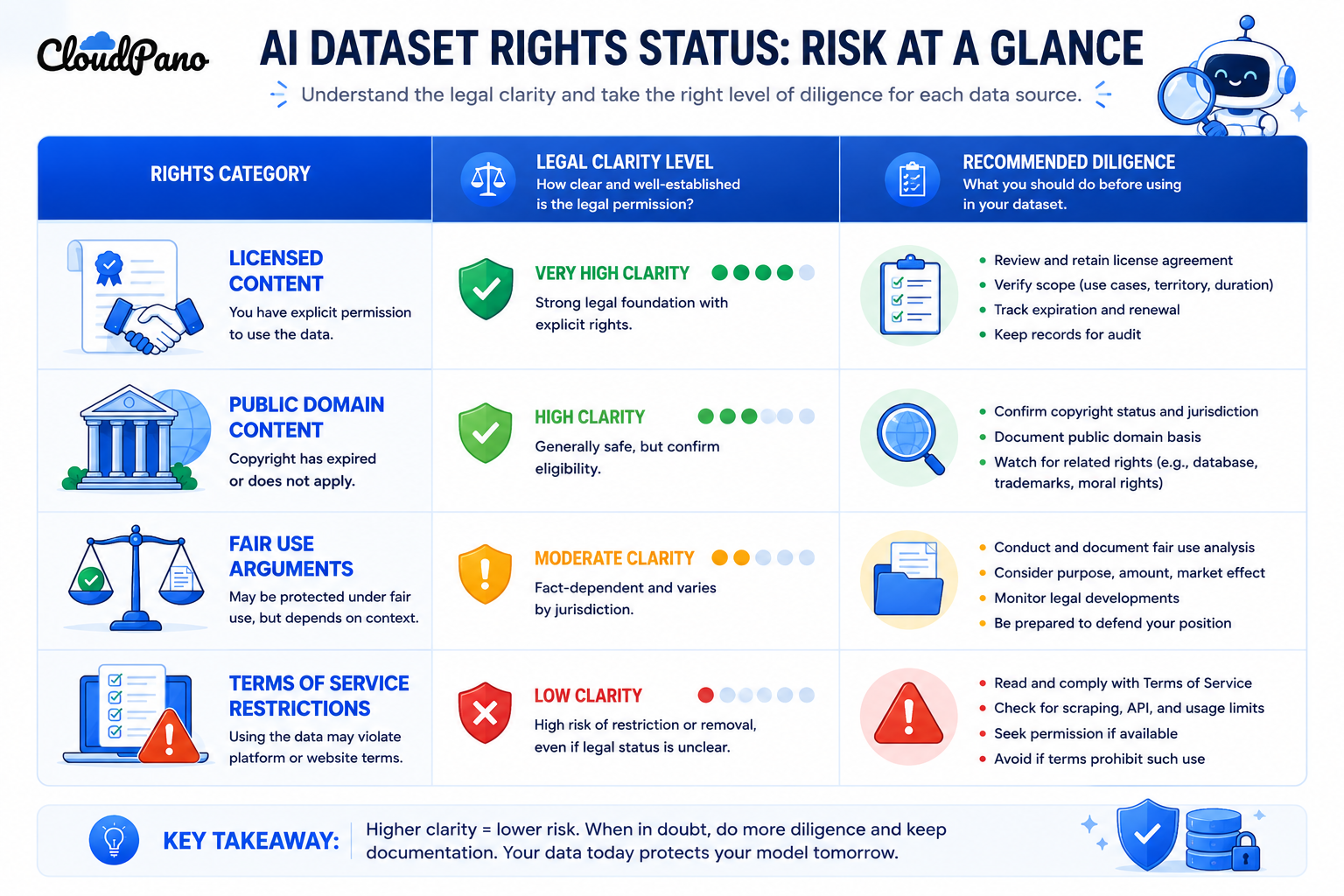
AI dataset licensing questions generally break down into a few specific categories.
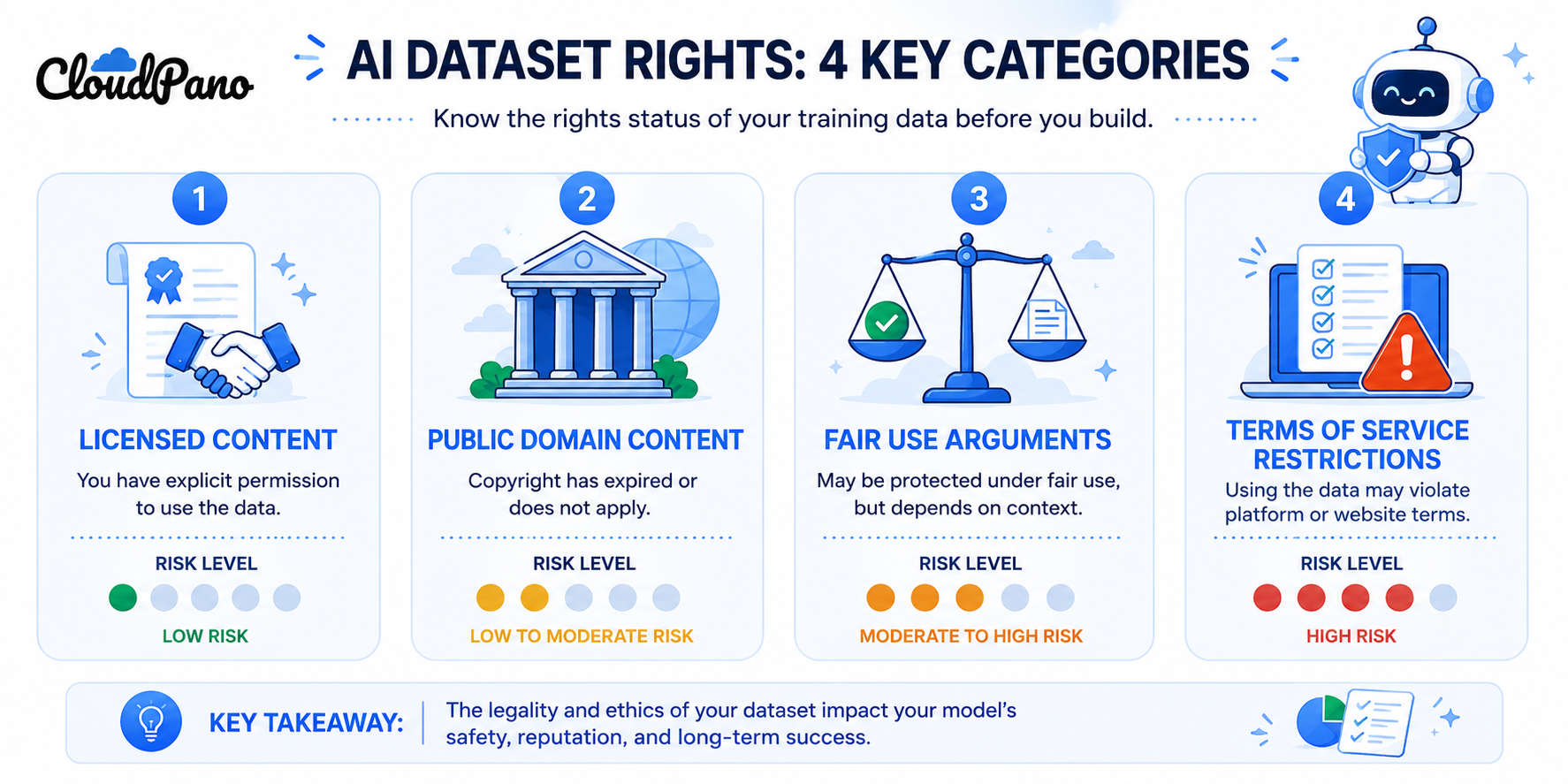
Infographic of four categories of AI dataset rights status for training data

Licensed content. Data explicitly licensed for AI training use, either through a direct agreement with a rights holder or a dataset provider whose terms clearly permit training use — the clearest path to confirmed rights.

Public domain content. Material no longer under copyright protection, which can generally be used for training without the same licensing concerns, though confirming public domain status accurately matters.

Fair use arguments. Some uses of copyrighted material may be argued to fall under fair use or similar exceptions, but this is precisely the area under active legal dispute, and outcomes vary by jurisdiction and specific use case.

Terms of service and platform restrictions. Even where copyright law might permit a use, a platform's own terms of service may separately restrict scraping or bulk collection, creating a distinct contractual issue apart from copyright itself.

Understanding how these workflows operate as genuinely distinct legal categories — not a single "is it copyrighted or not" question — is what allows a team to actually assess risk accurately rather than relying on a general sense that training data practices are broadly accepted.
Step-by-Step Workflow

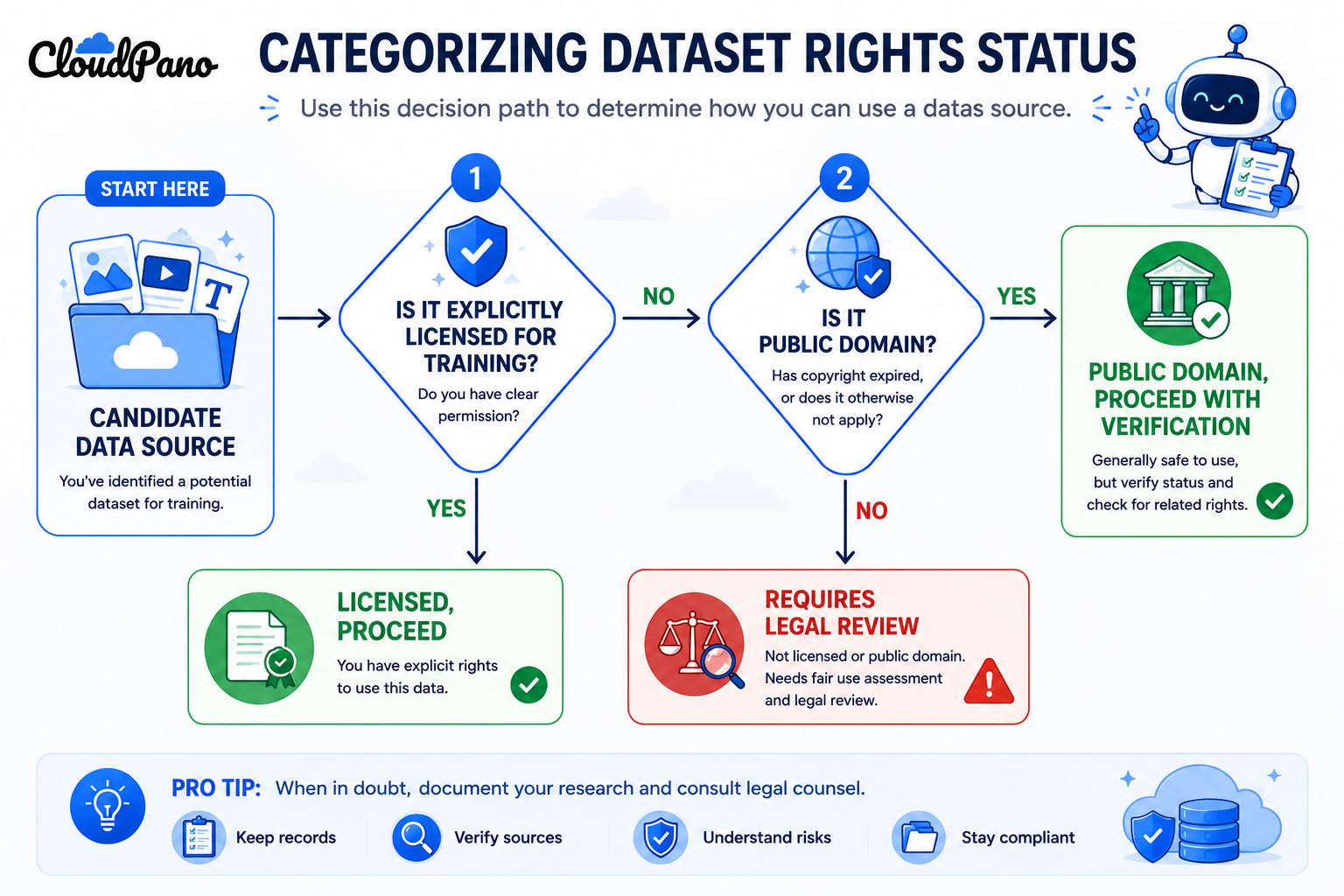
  • Categorize each data source by its rights status. Identify whether content is explicitly licensed, public domain, or relies on an unsettled fair use argument.
Flowchart for categorizing the rights status of an AI training data source
  • Prioritize licensed and public domain sources where feasible. These carry clearer legal footing than sources depending on contested fair use arguments.
  • Review platform terms of service separately from copyright status. Confirm that collection methods don't violate contractual restrictions even where copyright law might otherwise permit the use.
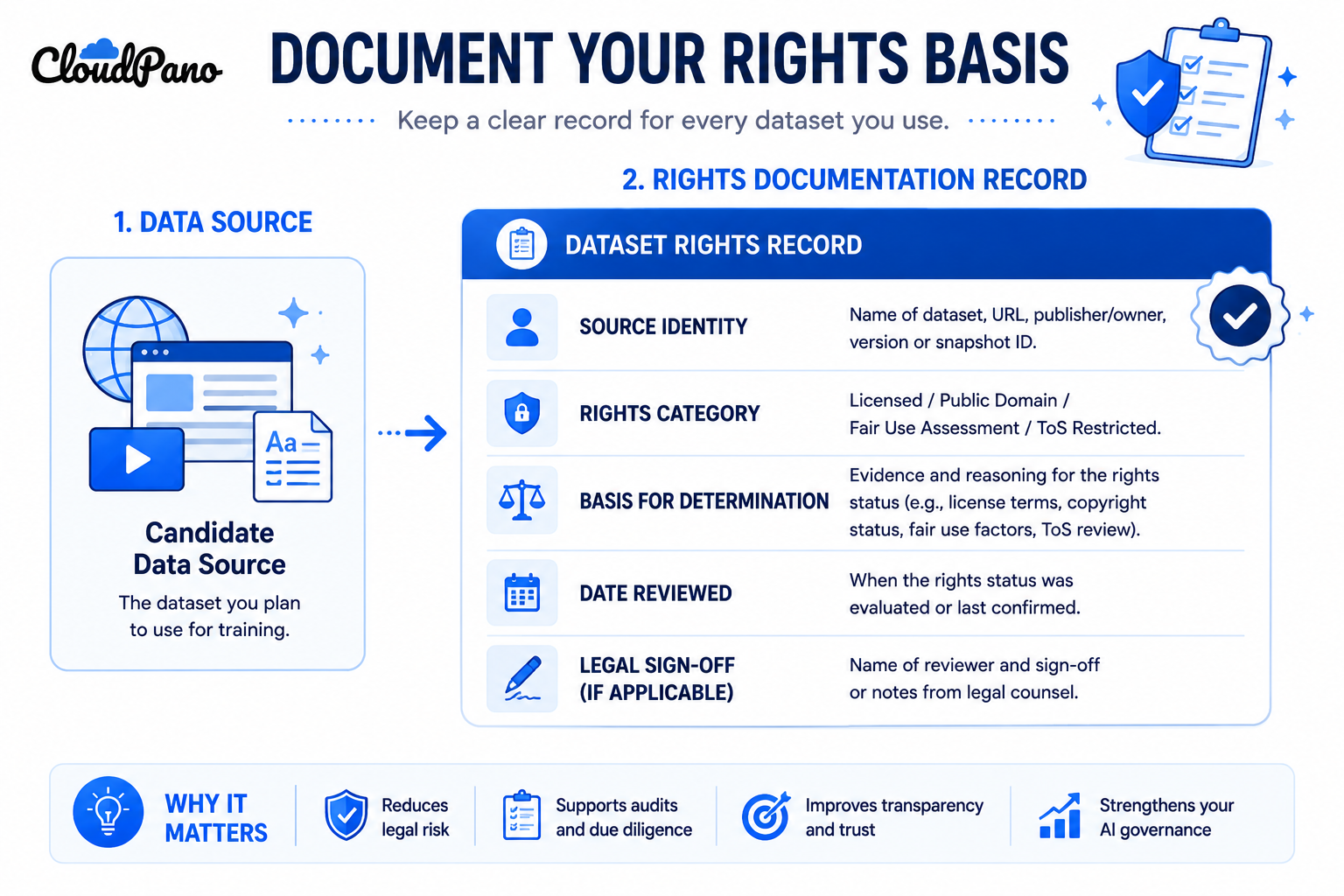
  • Document the rights basis for every data source used. Maintain records showing why each source was considered appropriately licensed or otherwise permitted.
Diagram of the documentation trail needed for AI training data rights status
  • Involve legal counsel for sources relying on fair use arguments. Don't make this determination purely as an engineering or product decision given the unsettled legal landscape.
  • Monitor ongoing litigation and regulatory developments in this area. Legal interpretation of AI training data rights is actively evolving, and practices may need to adjust.
  • Reassess data sourcing practices as legal clarity develops. Be prepared to revise sourcing strategy if court decisions or new regulations meaningfully change the legal landscape.

Industry Use Cases

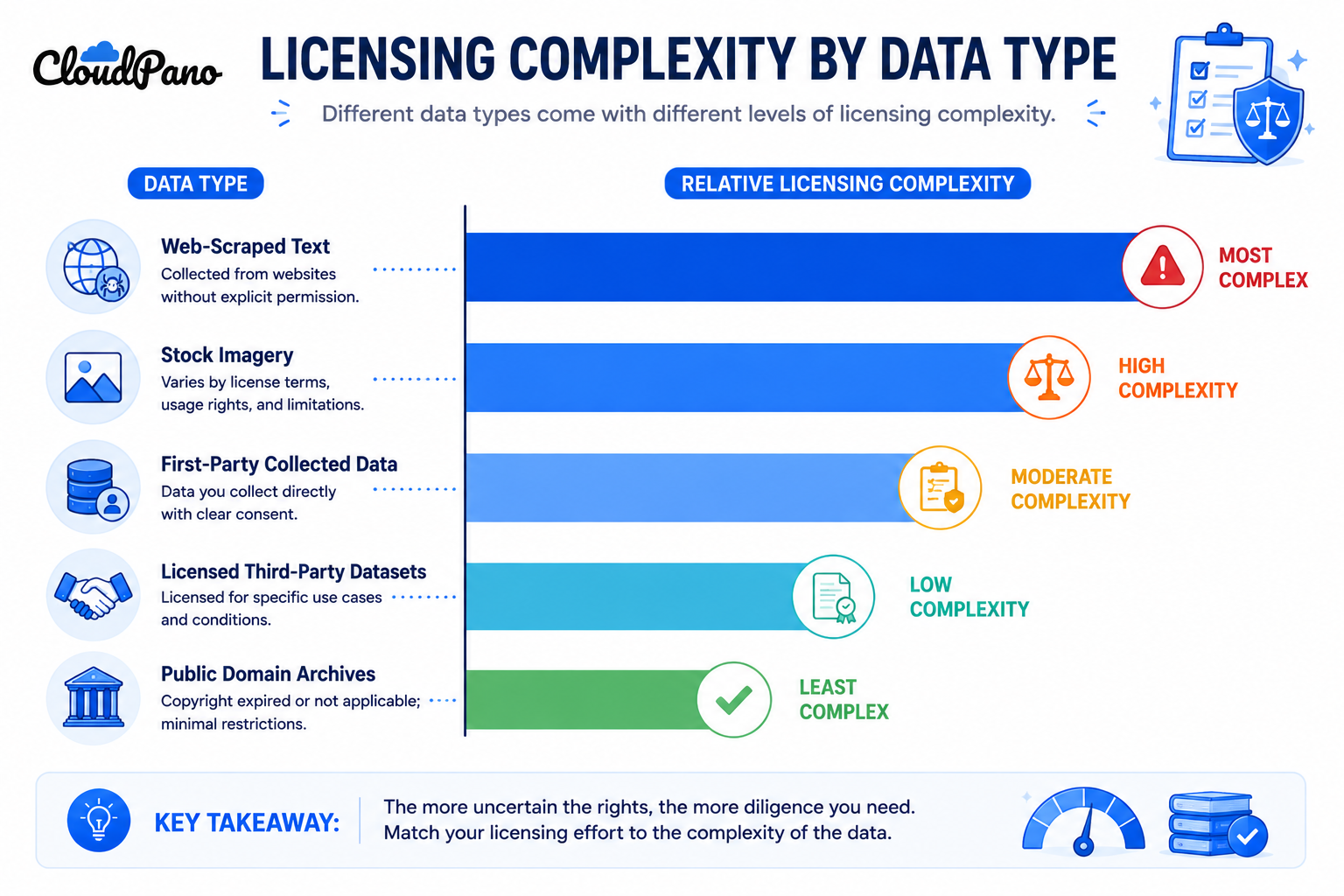
Bar chart showing AI dataset licensing complexity by data type
  • LLM developers: Text corpora sourced from the web face the most direct and actively litigated copyright questions, given the scale of content typically involved.
  • Computer vision / robotics: Image datasets sourced from the web or stock photo services raise similar licensing and fair use considerations specific to visual content.
  • Retail AI: Product imagery and descriptions used for training often involve licensed or first-party data, generally carrying clearer rights status than broad web scraping.
  • Healthcare AI: Medical literature and imaging datasets typically require specific licensing agreements given both copyright and separate privacy considerations.
  • Government & defense: Data sourcing in this sector often involves distinct rules around government works and classified content, separate from standard commercial copyright considerations.
  • Autonomous vehicles: Sensor and imagery data collected directly by a company's own vehicles generally carries clearer first-party rights status than externally sourced content.

Benefits

  • Reduced legal exposure. Clear licensing documentation and rights-status categorization reduce the risk of disputes over how training data was obtained and used.
  • More defensible model development. A documented rights basis for training data supports accountability if a model's training data composition is ever legally questioned.
  • Better-informed sourcing decisions. Understanding the distinct categories of licensed, public domain, and contested-fair-use content allows more deliberate risk management in data sourcing strategy.
  • Preparedness for evolving legal standards. Ongoing monitoring of this area positions a team to adapt sourcing practices as legal clarity develops, rather than being caught unprepared.
  • Stronger vendor and partnership relationships. Clear internal understanding of licensing categories supports better negotiation and due diligence when working with data providers or licensors.

Common Mistakes

  • Assuming public accessibility equals training rights. Treating content available on the open web as automatically usable for AI training without confirming its actual licensing status.
  • Treating all copyrighted content the same way. Missing the meaningful distinction between clearly licensed content, public domain material, and contested fair use arguments.
  • Ignoring platform terms of service separately from copyright law. Assuming that if copyright law permits a use, a platform's own contractual restrictions don't matter.
  • Making fair use determinations without legal counsel. Treating an unsettled legal question as a straightforward engineering decision rather than involving qualified legal review.
  • Not documenting the rights basis for data sources. Losing track of why a given source was considered appropriately licensed, making later legal review far more difficult.
  • Assuming current legal interpretation will remain static. Not monitoring ongoing litigation and regulatory developments that could meaningfully change what's considered permissible.

Best Practices

  • Categorize every data source by its specific rights status — licensed, public domain, or contested fair use — rather than treating copyright as a single binary question.
  • Prioritize licensed and public domain sources where feasible, reserving fair use arguments for situations genuinely requiring them.
  • Review platform terms of service as a distinct consideration from copyright law itself.
  • Document the rights basis for every data source, maintaining records that support later legal review.
  • Involve qualified legal counsel specifically for sources relying on fair use or other contested legal arguments.
  • Monitor ongoing litigation and regulatory developments in this area, since legal interpretation is actively evolving.

FAQ

Does content being publicly accessible mean it's usable for AI training?

No. Public accessibility doesn't establish training rights, which is a separate legal question determined by the content's actual licensing status, copyright protection, and applicable legal exceptions.

What is fair use in the context of AI training data?

An argument that certain uses of copyrighted material may be legally permitted without a license, though its application to AI training specifically remains the subject of active litigation and unsettled legal interpretation.

How is copyright different from privacy compliance for training data?

Copyright concerns the legal rights to use specific content itself, while privacy compliance concerns the handling of personal information about individuals; a data source can raise one, both, or neither consideration depending on its content.

Are dataset provider terms of service the same as copyright permission?

Not necessarily. Even where copyright law might permit a specific use, a platform's own terms of service may separately restrict scraping or bulk collection, creating a distinct contractual issue.

Should engineering teams make fair use determinations independently?

No. Given the unsettled legal landscape around AI training and fair use, these determinations should involve qualified legal counsel rather than being treated as a purely technical or product decision.

How often does the legal landscape around AI dataset licensing change?

This is an actively evolving area, with ongoing litigation and regulatory developments that can meaningfully shift what's considered legally permissible, requiring regular monitoring rather than a one-time assessment.

What documentation should be kept for AI training data licensing decisions?

Records showing the specific rights basis for each data source — licensing agreement, public domain status, or fair use rationale — supporting later legal review if the training data composition is questioned.

Conclusion

AI dataset licensing and copyright considerations require treating training data sourcing as a genuine legal question, not an assumption based on public accessibility. Licensed content, public domain material, and contested fair use arguments each carry meaningfully different risk profiles, and this remains an actively litigated area of law. Documenting rights status, involving legal counsel where genuine uncertainty exists, and monitoring how the legal landscape develops is what makes dataset licensing a managed risk rather than an unaddressed one.

🚀 Your All‑In‑One Virtual Experience Stack
🎬
PhotoAIVideo
Turn photos into scroll‑stopping AI videos.
Get Started →
🏡
Pictastic
Instantly stage listings with AI.
Try Staging →
🌀
CloudPano
Create stunning 360° tours in minutes.
Launch Tour →
💰
VirtualTourProfit
Build a profitable virtual tour business.
Learn More →
🤝
CloudPano Reseller
Resell AI visual software without building it.
Become a Reseller →
🚗
Auto CloudPano
Sell more vehicles with 360° experiences.
Explore Auto →
🏗️
AI Floor Plan Builder
Generate detailed floor plans with AI.
Build Now →
📐
3D Measure
Capture accurate floor plans & 3D measurements.
Measure Now →
🧠
AI Training Data
Custom AI training data services.
Learn More →
Share this post
Cloudpano

Choose The Right 360° Camera

Insta360 ONE RS 1-Inch 360 Edition

  • Compact, ready to go anywhere

  • Interchangeable lens that’s upgradeable

  • Dual 1-inch sensors for improved clarity and low light performance

  • Dynamic range and 6K 360° capture

  • 360° photo resolution at 21MP

Learn More

Insta360 X4

  • 8K 360° video recording for ultra-detailed visuals.

  • 4K single-lens mode for traditional wide-angle shots.

  • Invisible selfie stick effect for drone-like perspectives.

  • 2.5-inch touchscreen with Gorilla Glass protection.

  • Waterproof up to 33ft for underwater shooting.

Learn More

Ricoh Theta Z1

  • 360° photo resolution in 23MP

  • Slim design at 24 mm thick

  • Built-in image stabilization for smooth video capture.

  • Internal 19GB storage for photo and video storage.

  • Wireless connectivity for remote control and sharing.

Learn More

Ricoh Theta X

  • 60MP 360° still images for high-resolution photography.

  • 5.7K 360° video recording at 30fps.

  • 2.25-inch touchscreen for intuitive control.

  • USB Type-C port for fast charging and data transfer.

  • MicroSD card slot for expandable storage.

Learn More
Property Marketing
Allows potential buyers to explore properties in detail from anywhere, enhancing the real estate marketing process.
Automotive Spins
Create an interactive virtual showroom and engage affluent digital buyers with live 360º video calls, all through the CloudPano mobile app for a complete automotive sales solution.
Interactive Floor Plans
Create 2D and 3D floor plans with measurements in 4 minutes or less, all from your phone. Download the Floor Plan Scanner app and get your first scan free.

360 Virtual Tours With CloudPano.com. Get Started Today.

Try it free. No credit card required. Instant set-up.

Try it free
Latest posts

See our other posts

Interviews, tips, guides, industry best practices, and news.

Annotating First-Person and Human Activity Video Datasets

First-person video annotation addresses challenges third-person video doesn't — constant camera motion from the wearer's own movement, frequent close-range hand-object interaction, and a viewpoint that shifts unpredictably rather than staying fixed. These conditions require annotation guidelines and quality checks distinct from standard, fixed-camera video labeling approaches.
Read post

AI Dataset Licensing and Copyright: What Training Data Teams Need to Know

AI dataset licensing requires confirming that content used for training is either properly licensed, in the public domain, or covered by an applicable legal exception, since public accessibility alone doesn't establish training rights. Copyright questions specific to AI training remain actively contested in ongoing litigation, making this an area requiring real legal diligence.
Read post

Video Annotation Services: Tracking, Temporal Events, and Frame Sampling

Video annotation services apply labels across sequences of frames, not just individual images — tracking a consistent object identity over time, marking temporal event boundaries, and recognizing actions across a sequence. This requires different tooling and quality assurance than static image annotation, since consistency across frames is the core added challenge.
Read post