


.png)



Let’s be honest about the math behind local real estate marketing. When you score a listing, your top priority is to find high-intent buyers as fast as possible without burning through your entire commission check before you even reach the closing table. Most modern marketing advice tells you to double down on social video.
That sounds great on paper, but the actual reality of production is a massive headache.
Traditional video capture is slow, technically exhausting, and incredibly expensive. If you call an elite local videographer to film a walk-through tour for every standard single-family home or townhome on your desk, your budget will vanish. You have to handle coordinate schedules, prep the property, wait days for a draft file from a complex editing agency, and hope the market hasn't shifted by the time you can finally hit upload.
The alternative is leaving your property trapped in a flat format. However, relying purely on standard, unmoving MLS snapshots is a recipe for digital invisibility. Major social platforms have reworked their delivery architectures over the last few years. According to consumer interface studies published by the Nielsen Norman Group, web users bypass predictable static grids almost instantaneously.
When your ad content doesn't move, platform delivery mechanics drop your relevance scores and inflate your target auction pricing. Your static listing card gets shoved underneath a mountain of dynamic media. You are trapped in a corner: you can't afford to shoot cinematic custom video clips for every asset, but you can’t afford to remain static either.
The answer isn't to buy a heavy camera or pay a premium editing company to piece together generic slideshows. The answer lies in changing how you use the premium assets you have already paid for. Every time you onboard a listing, you commission sharp, high-resolution interior and exterior architectural photography for the MLS portal. Leaving those files flat on a drive means ignoring a goldmine of raw ad creative.
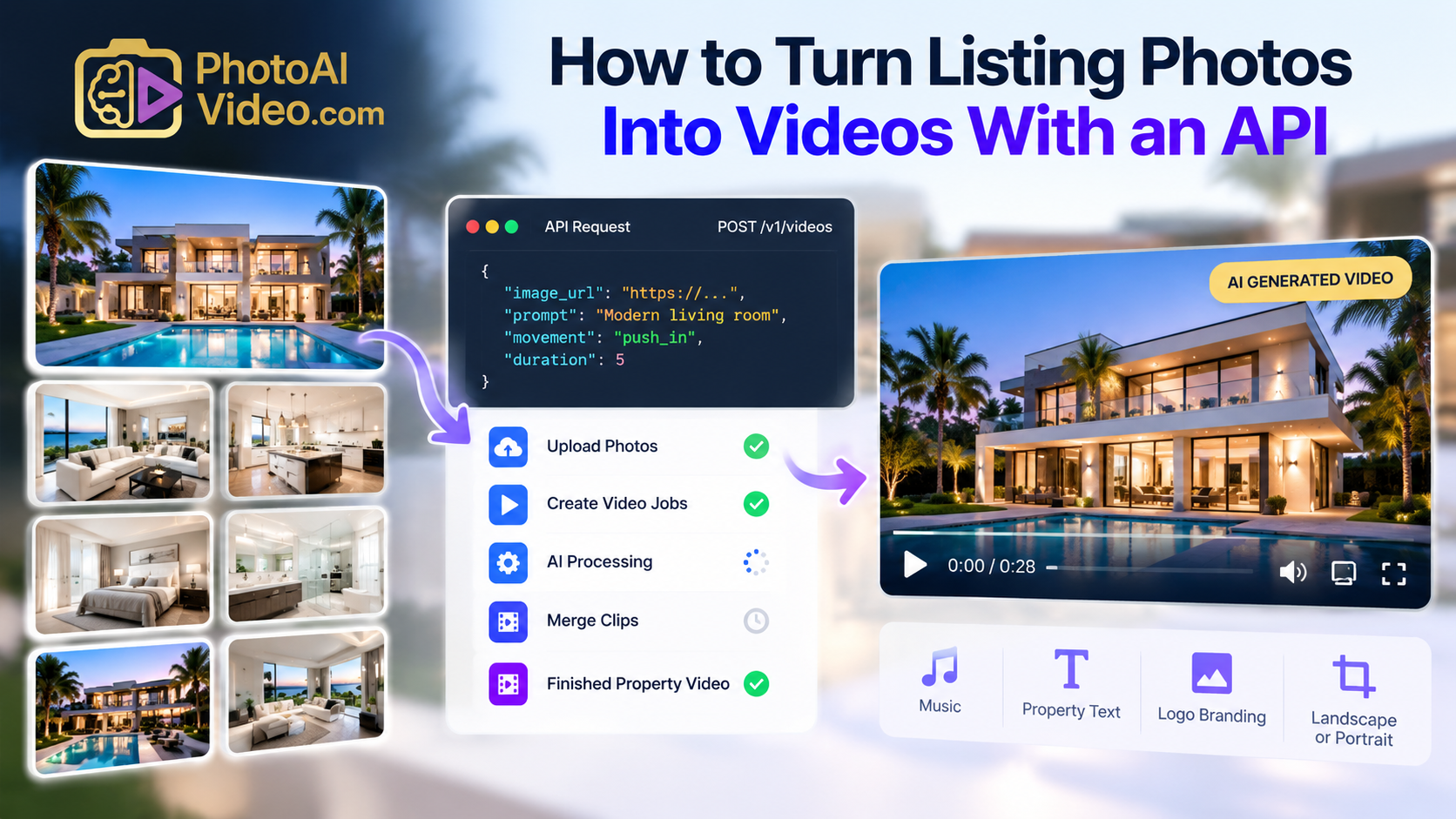
This is exactly where PhotoAIVideo.com modifies your weekly marketing pipeline. The application acts as an accessible, fast-moving web tool that completely bypasses standard production steps. It works as an automated real estate video ad maker AI, giving you the ability to transform static images into full-screen, vertical 9:16 video outputs designed for paid social media networks.
You do not need an expensive production computer, and you don’t need to fiddle with keyframes inside heavy editing applications. You drop your existing home photos into the cloud interface, and the system delivers polished cinematic motion in seconds. This allows you to build out hyper-targeted, high-converting video campaigns across your entire local market on a shoestring budget.
Static MLS Photo: Flat, unmoving 2D frame. Rapidly skipped by social algorithms and scrolling buyers.
3D Parallax Video: Immersive depth mapping creates a sweeping cinematic camera movement instantly.
You don’t need an engineering degree to implement this technology, but understanding how the system builds depth from an image will help you select the best photos from your folders.
When you upload an image, the system runs a depth estimation routine over the pixel structure. The engine maps out the spatial layout of the room, identifying what objects reside in the immediate foreground—like a modern stone kitchen counter or clean furniture placements—and isolates them from background fields, such as outdoor balconies or far-off wall trims.
Once the system completes this layer calculation, it establishes parallax motion. By shifting the foreground planes along a slightly faster track than the background, it creates an accurate illusion of physical perspective.
The file transitions from a standard crop into an asset built by short-form real estate video AI parameters. It mimics a physical fluid-head camera sliding past an architectural element. Because room dimensions and layouts remain completely true, home shoppers receive a genuine feeling of environmental scale, which immediately establishes trust before they even fill out a lead form.
Speed and consistency are what make digital marketing funnels work. Operating with an efficient short-form real estate video AI template lets you take flat, underused photography and scale it into active social ad formats before you can finish your morning coffee:
Paid traffic is an unyielding race against consumer momentum. Platform trends highlighted by Meta for Business show that modern consumer bases navigate digital feeds using fast patterns, scrolling through dozens of pieces of media before selecting anything to read. If you want your ad accounts to work efficiently, you have precisely three seconds to command attention and freeze a user's thumb.
If your ad campaign begins with a static picture, an extensive list of text specs, or a slow branding splash screen, you lose the opportunity. The data engines running paid auctions track early exits. If prospective buyers consistently swipe away inside the initial two seconds, the system labels your asset quality score as poor, driving up your cost-per-click numbers.
Utilizing clean, AI Facebook video ads for real estate deployments handles this retention challenge natively. Because the 3D parallax layers slide and move from the very first millisecond, you instantly capture human visual reflexes.
Users slow down because their spatial perception needs a moment to track the dimensional shift. This holds them on your frame long enough to digest your listing copy, driving up your click-through rates and lowering your target acquisition metrics.
The true benefit of updating your visual asset systems comes down to basic testing capabilities. If your business relies entirely on manual video production, you can’t iterate. You are locked into running a single creative asset over a large market slice, leading to rapid audience saturation and decaying lead counts.
By deploying an automated AI property reels software engine, your growth team can create 10 completely unique creative variants from a single listing folder in a fraction of an afternoon. You can test different interior angles, shuffle transitions, and analyze what message hits hardest with your local market demographic.
This creative flexibility fuels a self-sustaining marketing funnel engineered for high return-on-investment thresholds:
While utilizing automated content speeds can help you scale up your ad account metrics, you still have to follow basic presentation rules to protect your market positioning:
The real estate production teams securing the highest concentration of local inbound inquiries aren't necessarily spending the most money. They win because they operate with high content velocity—the internal capability to turn raw MLS images into polished, moving video ads before competitor systems can book a calendar slot with an outside videographer.
Instead of burning valuable capital on heavy agency margins or manual software tutorials, shift your design tasks straight to automated cloud rendering tools. Introduce true dimensional scale to your listings, capture high-retention consumer blocks, and expand your business by injecting cinematic 3D motion into your standard property folders.


Compact, ready to go anywhere
Interchangeable lens that’s upgradeable
Dual 1-inch sensors for improved clarity and low light performance
Dynamic range and 6K 360° capture
360° photo resolution at 21MP

8K 360° video recording for ultra-detailed visuals.
4K single-lens mode for traditional wide-angle shots.
Invisible selfie stick effect for drone-like perspectives.
2.5-inch touchscreen with Gorilla Glass protection.
Waterproof up to 33ft for underwater shooting.

360° photo resolution in 23MP
Slim design at 24 mm thick
Built-in image stabilization for smooth video capture.
Internal 19GB storage for photo and video storage.
Wireless connectivity for remote control and sharing.

60MP 360° still images for high-resolution photography.
5.7K 360° video recording at 30fps.
2.25-inch touchscreen for intuitive control.
USB Type-C port for fast charging and data transfer.
MicroSD card slot for expandable storage.
.png)

.png)

Try it free. No credit card required. Instant set-up.






.svg)


.svg)