To create and sell white-label virtual tours, choose a virtual tour platform that supports custom branding, configure your branded domain, capture 360-degree photographs, build interactive walkthroughs, and customize the experience with logos, colors, and contact information. You can sell these tours through one-time project fees, recurring hosting subscriptions, maintenance packages, and agency partnerships without developing your own software.
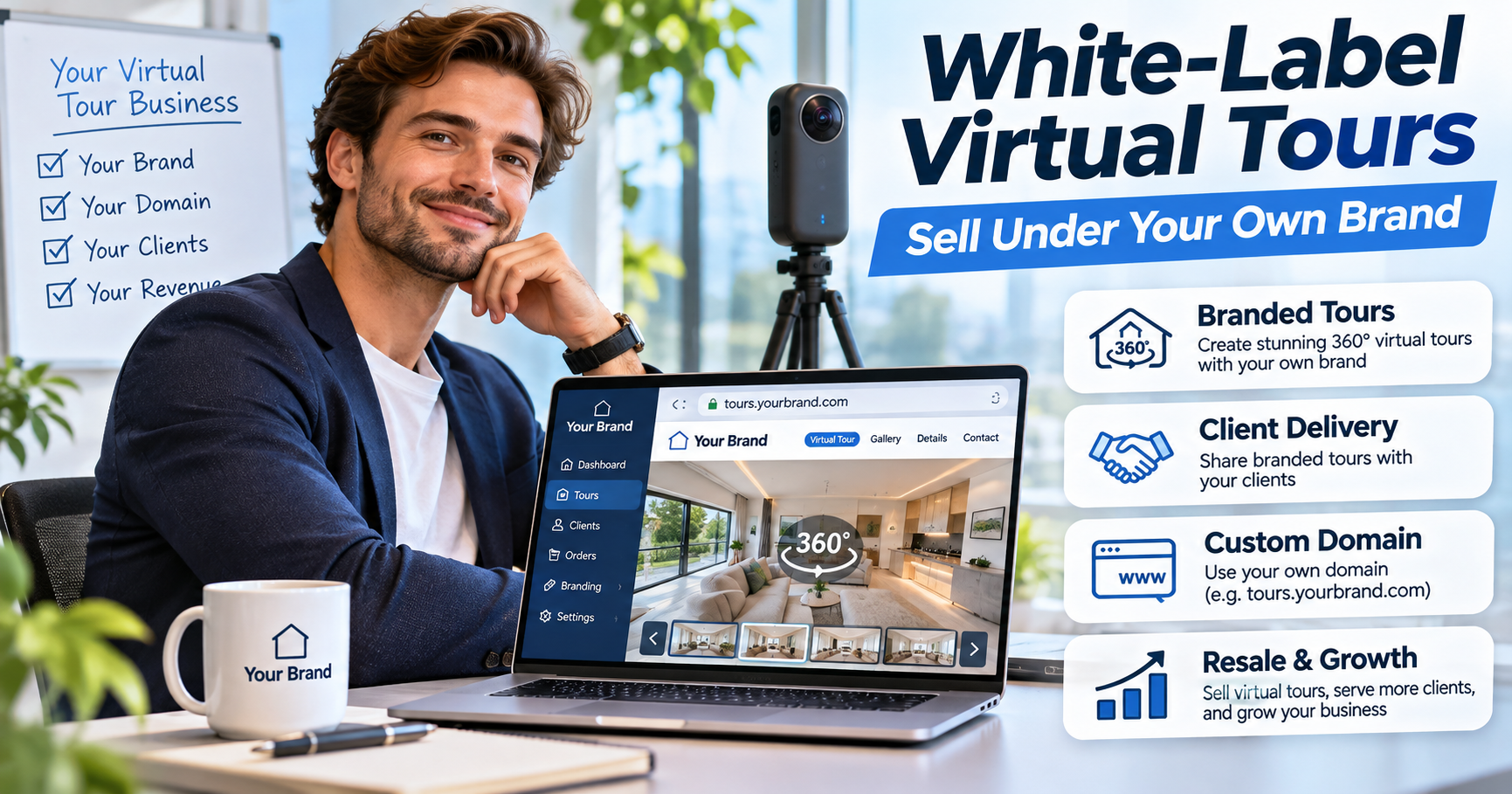
Imagine sending a virtual tour to a client and having them see your company's logo, your website domain, and your contact information instead of the name of the software you used to create it.
It immediately feels more professional. Your client sees your business as the service provider, and every virtual tour you deliver becomes another opportunity to strengthen your brand.
That's the appeal of white-label virtual tours.
You don't need to hire software developers, build a virtual tour platform from scratch, or invest thousands of dollars in proprietary technology. With the right white-label virtual tour software, you can create immersive experiences, customize their appearance, and sell them as part of your own branded services.
Whether you're a photographer looking to expand your offerings, an entrepreneur starting a virtual tour business, or a marketing agency exploring new revenue streams, white labeling can help you build a recognizable and scalable business.
White-label virtual tours are interactive digital walkthroughs created using a third-party platform that allows businesses to customize the finished experience with their own branding.
Instead of prominently displaying the software provider's identity, the virtual tour can feature the service provider's or client's branding, depending on the platform's capabilities.
A white-label virtual tour may include:
For example, imagine that you operate a photography business called Horizon Visual Media. Rather than sending clients a tour hosted under an unfamiliar software company's domain, you could deliver an experience through a branded address such as tours.horizonvisualmedia.com.
Your clients associate the experience with your business while the underlying software handles the technical infrastructure.
When clients hire you, they aren't necessarily interested in which software you use. They want a professional solution that helps them market their properties, attract customers, or communicate their services.
White labeling allows you to concentrate on delivering that solution while maintaining a consistent brand identity.
Every virtual tour you publish can become an extension of your company's marketing.
When potential customers encounter your tours on websites, property listings, or social media, they may also discover your business. Over time, this can help establish your reputation as a professional virtual tour provider.
A branded virtual tour makes the transition from your website to the finished product feel more consistent.
Clients receive an experience that reflects the identity of the business they hired rather than being redirected to an unrelated platform.
Building a virtual tour platform requires development expertise, hosting infrastructure, security maintenance, and ongoing technical support.
White-label software allows entrepreneurs to access existing technology without assuming the full cost and responsibility of developing it themselves.
Virtual tours can create income beyond the initial photography appointment. Depending on your service model, clients may pay for ongoing hosting, content updates, maintenance, and additional features.
This can help create a more predictable business model compared with relying exclusively on one-time projects.
Creating professional branded virtual tours is easier when you establish a repeatable process. Here's how to get started.
Before creating tours, decide how you want customers to recognize your business.
You don't need an elaborate branding strategy at the beginning. However, having a consistent visual identity makes it easier to establish credibility.
Start by preparing:
You should also identify your target customers. Are you planning to serve real estate agents, apartment communities, hotels, local businesses, or several industries?
The U.S. Small Business Administration's business planning guide provides useful guidance for defining your services, target market, and sales strategy.
Understanding your audience early will help you develop branding and service packages that appeal to the right customers.
Your virtual tour platform is the foundation of your business. It determines what you can offer customers, how efficiently you can complete projects, and how much control you have over the finished experience.
Look for software that supports:
Don't assume that every virtual tour subscription includes white-label functionality. Some providers reserve custom domains, branding removal, and commercial features for specific subscription tiers.
Review the platform's licensing conditions and pricing before committing.
If you're looking for a solution designed to support independent virtual tour businesses, explore CloudPano's virtual tour software for entrepreneurs.
The right platform should support your current needs while giving you room to expand as your client base grows.
A custom domain is one of the most recognizable elements of a white-label virtual tour.
Many businesses use a dedicated subdomain for their virtual tour portfolio and client projects.
Examples include:
Using a branded subdomain allows you to keep virtual tours connected to your main business identity.
Setting up a custom domain generally involves accessing your domain provider's DNS settings, adding the records required by your virtual tour platform, and completing domain verification.
You should also ensure that HTTPS encryption is active before distributing tour links to customers.
Follow your software provider's specific instructions, as DNS configuration and certificate activation procedures vary between platforms.
Even the most attractive branding cannot compensate for poor-quality photography.
Your virtual tour should accurately represent the property or business while providing a smooth and enjoyable viewing experience.
Essential equipment typically includes a 360-degree camera, a stable tripod or monopod, spare batteries, memory cards, and a computer for editing and publishing.
During each photography session, pay attention to lighting, camera placement, reflections, clutter, and the consistency of your images.
Capture enough viewpoints to allow visitors to move naturally through the space without feeling disoriented.
If you plan to offer Google Maps publishing as an additional service, Google's guide to creating and publishing Photo Spheres explains relevant capture and publishing options.
Google Maps imagery is a separate distribution channel and may not support the same white-label customization as tours hosted on your own domain.
Once your panoramic photographs are ready, upload them to your virtual tour platform.
Arrange the scenes in a logical order, connect rooms using navigation hotspots, and choose an appropriate starting viewpoint.
Next, customize the experience with the agreed branding.
You may want to add your logo, the client's logo, custom navigation labels, informational hotspots, property descriptions, booking links, or contact forms.
Remember that branding should enhance the experience rather than distract from it. Oversized logos, excessive buttons, and unnecessary animations can make tours difficult to navigate.
Accessibility also deserves attention. The W3C Web Accessibility Initiative's accessibility principles explain the importance of making digital content usable by people with different abilities.
Where possible, provide descriptive labels, accessible navigation, and alternative information for visitors who cannot fully interact with panoramic imagery.
Before delivering a tour, experience it from a customer's perspective.
Open it on different devices and check that every navigation element works correctly.
Your quality assurance checklist should include:
Also confirm that unwanted platform branding is absent wherever your subscription allows its removal.
Once the project passes your quality checks, publish it and provide the client with the tour URL, website embed code, and any agreed supporting materials.
Once you have a consistent production workflow, turn your capabilities into clearly defined service packages.
Clients generally find it easier to purchase a complete solution than to select individual technical features.
For example, you could offer a basic package for small properties, a professional package for businesses that need enhanced marketing features, and an enterprise package for larger organizations.
Your packages should clearly communicate what customers receive, the expected delivery timeframe, and whether ongoing hosting is included.
Your pricing should reflect the size of the property, production time, travel expenses, customization requirements, and ongoing hosting costs.
The following table provides illustrative pricing for an independent virtual tour business.
These figures are example pricing models, not guaranteed market rates. Adjust them according to your location, competition, operating costs, and customer requirements.
Avoid competing exclusively on price. A reliable delivery process, professional branding, responsive support, and consistent image quality can help justify premium pricing.
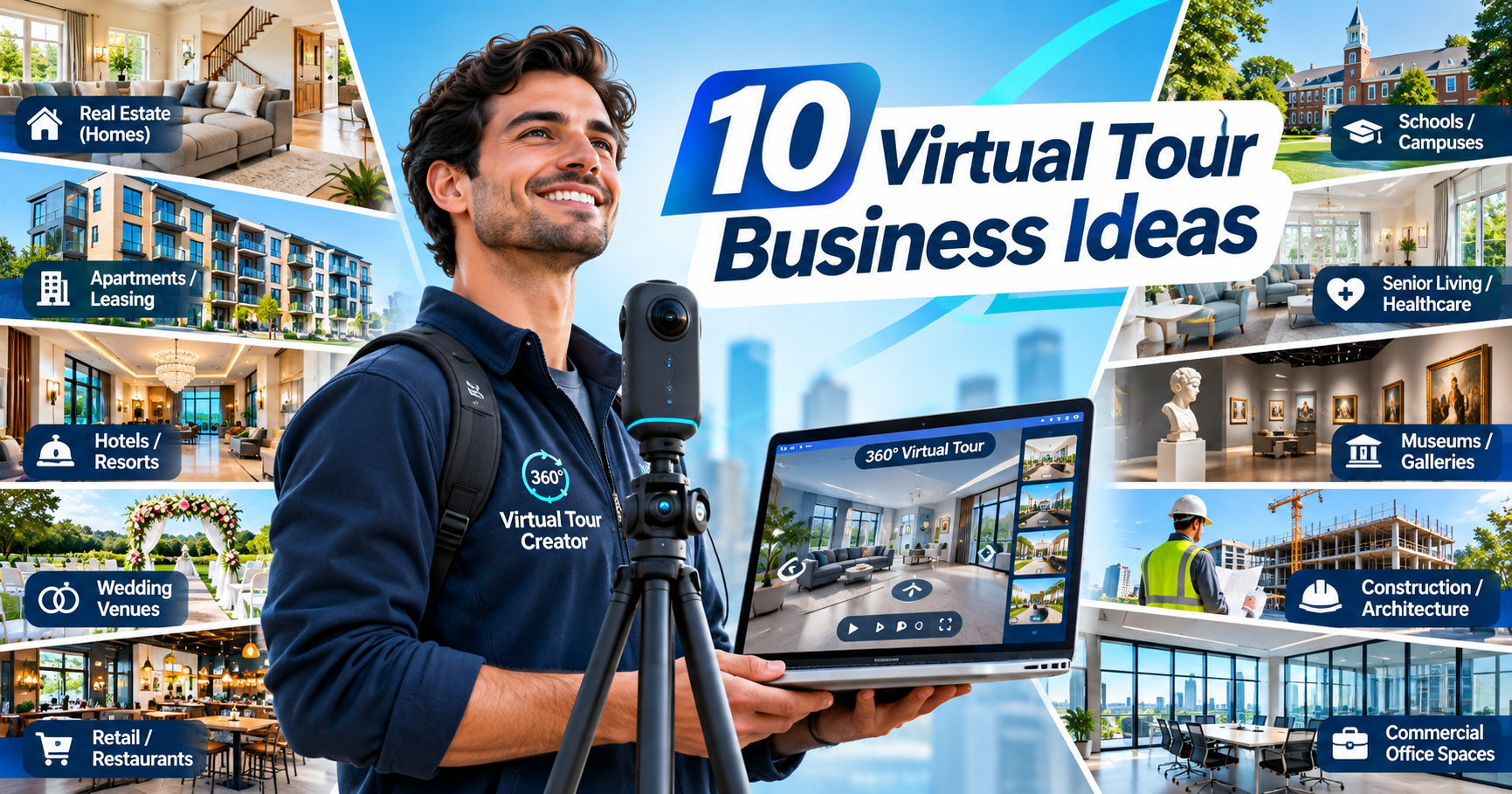
One advantage of white-label virtual tour services is that they can be adapted to numerous industries.
Real estate agents can use them to showcase listings. Apartment communities can promote available floor plans and amenities. Hotels can help guests explore accommodations before booking.
Other potential customers include:
Marketing agencies are particularly interesting potential partners. An agency may want to offer virtual tours to its customers without hiring photographers or establishing an internal production team.
You can operate as its behind-the-scenes virtual tour provider while delivering projects under the agency's branding.
Having excellent technology is only part of building a successful business. You also need to demonstrate why customers should pay for your services.
Start by creating a portfolio containing several high-quality demonstration tours. Tailor each example to the type of customer you want to attract.
When approaching a business, explain how an immersive experience could support its existing marketing efforts rather than simply describing camera specifications.
For example, a hotel owner may care about helping guests understand room layouts. A property manager may want to help prospective residents explore available apartments remotely.
Keep your sales claims realistic. The Federal Trade Commission's advertising and marketing guidance emphasizes truthful, evidence-supported advertising.
Avoid promising guaranteed sales, bookings, or conversion improvements unless you have reliable evidence to support those claims.
Focus on demonstrating value through real examples, professional presentations, and transparent pricing.
A virtual tour business becomes more sustainable when you don't have to find an entirely new customer for every payment.
Consider offering annual hosting agreements, monthly maintenance plans, scheduled photography updates, and multi-location contracts.
For example, if you have 20 customers paying $30 per month for virtual tour hosting, you could generate $600 in monthly recurring revenue before expenses.
Additional income could come from new tours, photography services, virtual staging, and customized marketing features.
Be transparent about hosting renewals, cancellation conditions, and what happens to a client's virtual tours when an agreement ends.
Clear expectations help protect both your business and your customer relationships.
Many new entrepreneurs focus heavily on branding while overlooking the practical details of delivering a reliable service.
Common mistakes include choosing software without reviewing resale permissions, underestimating hosting expenses, offering unlimited revisions, neglecting mobile compatibility, and failing to clarify ownership rights.
Another mistake is assuming that white labeling means you own the underlying software.
White labeling allows you to market an approved service under your brand, but the platform provider generally retains ownership of its technology. Your client agreements should accurately reflect what you provide, including any limitations involving hosting, licensing, or platform dependency.
Addressing these details early can prevent misunderstandings as your business grows.
White-label virtual tours give entrepreneurs an opportunity to build a professional brand without developing their own virtual tour technology.
By combining reliable software, professional 360-degree photography, customized branding, and thoughtful service packages, you can create experiences that help businesses showcase their spaces and connect with potential customers.
Start with a manageable number of services, build a portfolio you are proud to share, and focus on delivering consistent quality.
As your reputation grows, you can expand into new industries, establish agency partnerships, and introduce recurring revenue opportunities.
Ultimately, your clients are paying for more than a virtual walkthrough. They are paying for your expertise, creativity, reliability, and ability to deliver a professional experience under a brand they trust.
A white-label virtual tour is an interactive digital walkthrough created using third-party software that allows businesses to customize the finished product with their own logo, domain, colors, and other branding elements.
Yes. White-label virtual tour software allows entrepreneurs, photographers, and agencies to sell customized virtual tours under their own business identity, provided the software's licensing agreement permits commercial use and resale.
No. Many modern virtual tour platforms provide visual editors that allow users to upload panoramic images, connect scenes, customize branding, and publish interactive tours without programming experience.
Standard virtual tours may display the software provider's branding and domain. White-label virtual tours allow businesses to replace or remove certain provider branding elements and customize the experience to reflect their own identity.
The cost depends on equipment, software subscriptions, hosting, photography, and customization requirements. Entrepreneurs can reduce startup expenses by using an existing white-label platform instead of developing proprietary software.


Compact, ready to go anywhere
Interchangeable lens that’s upgradeable
Dual 1-inch sensors for improved clarity and low light performance
Dynamic range and 6K 360° capture
360° photo resolution at 21MP

8K 360° video recording for ultra-detailed visuals.
4K single-lens mode for traditional wide-angle shots.
Invisible selfie stick effect for drone-like perspectives.
2.5-inch touchscreen with Gorilla Glass protection.
Waterproof up to 33ft for underwater shooting.

360° photo resolution in 23MP
Slim design at 24 mm thick
Built-in image stabilization for smooth video capture.
Internal 19GB storage for photo and video storage.
Wireless connectivity for remote control and sharing.

60MP 360° still images for high-resolution photography.
5.7K 360° video recording at 30fps.
2.25-inch touchscreen for intuitive control.
USB Type-C port for fast charging and data transfer.
MicroSD card slot for expandable storage.


Try it free. No credit card required. Instant set-up.