


.png)


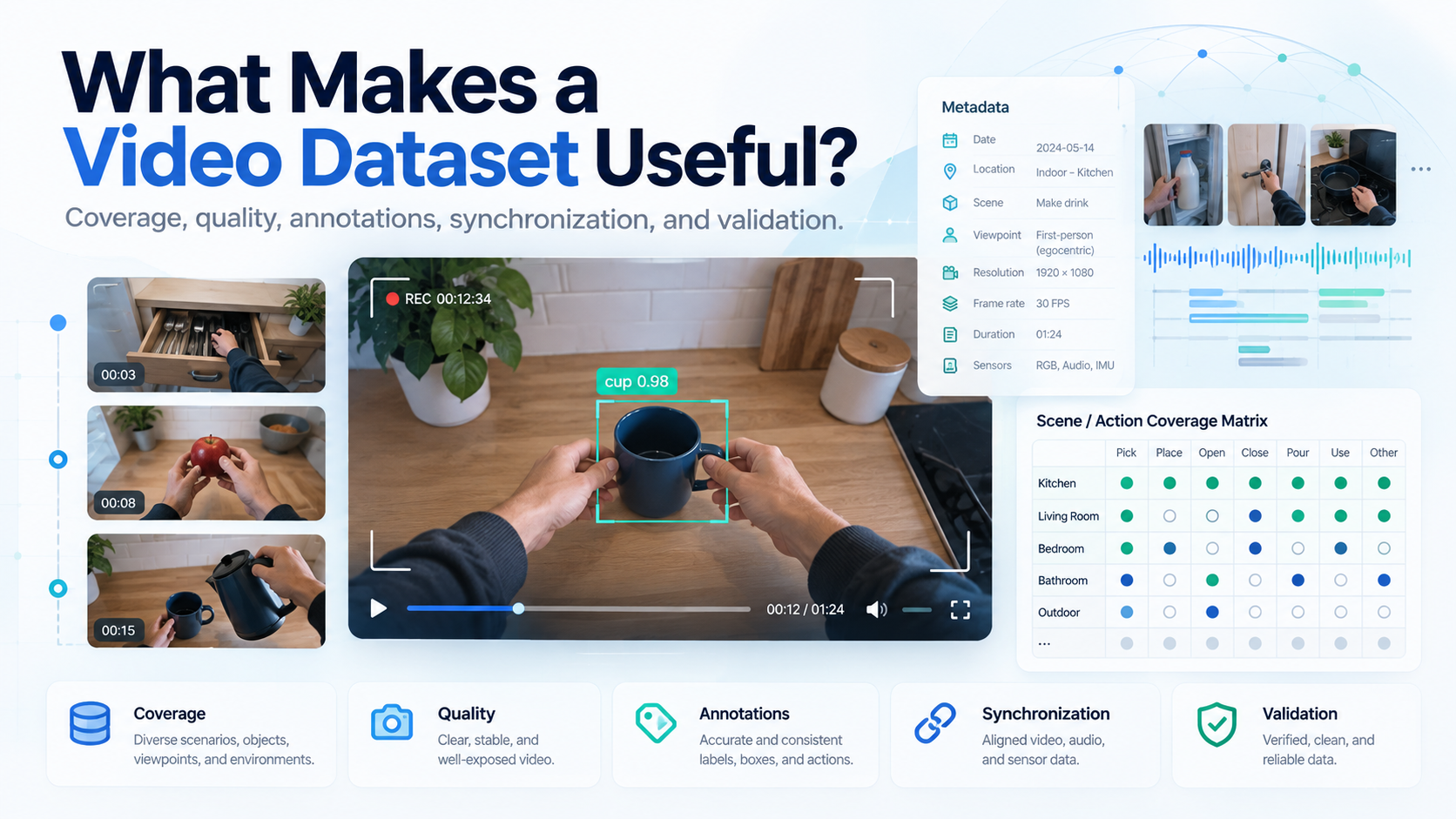
A useful video dataset contains the right examples for the task an AI model needs to learn. It should provide relevant coverage, realistic variation, consistent capture, usable annotations and metadata, and reliable validation. For embodied AI and robotics, viewpoint, temporal continuity, synchronization, and commercial usage rights can also affect whether the data is useful.
A video dataset is useful when its contents match what the model needs to learn and the environment in which that model will eventually operate. The number of recordings matters, but volume alone cannot tell you whether a dataset contains useful training information.
This is the first distinction teams should make when evaluating video data.
A dataset might contain thousands of hours of footage but repeatedly show the same activity, environment, camera angle, and object types. Another dataset might be smaller but deliberately cover different environments, participants, objects, viewpoints, task variations, and failure cases.
For many applications, the second dataset may provide more meaningful coverage.
A useful video dataset should therefore be evaluated against the intended model task.
Before collection begins, teams should be able to answer questions such as:
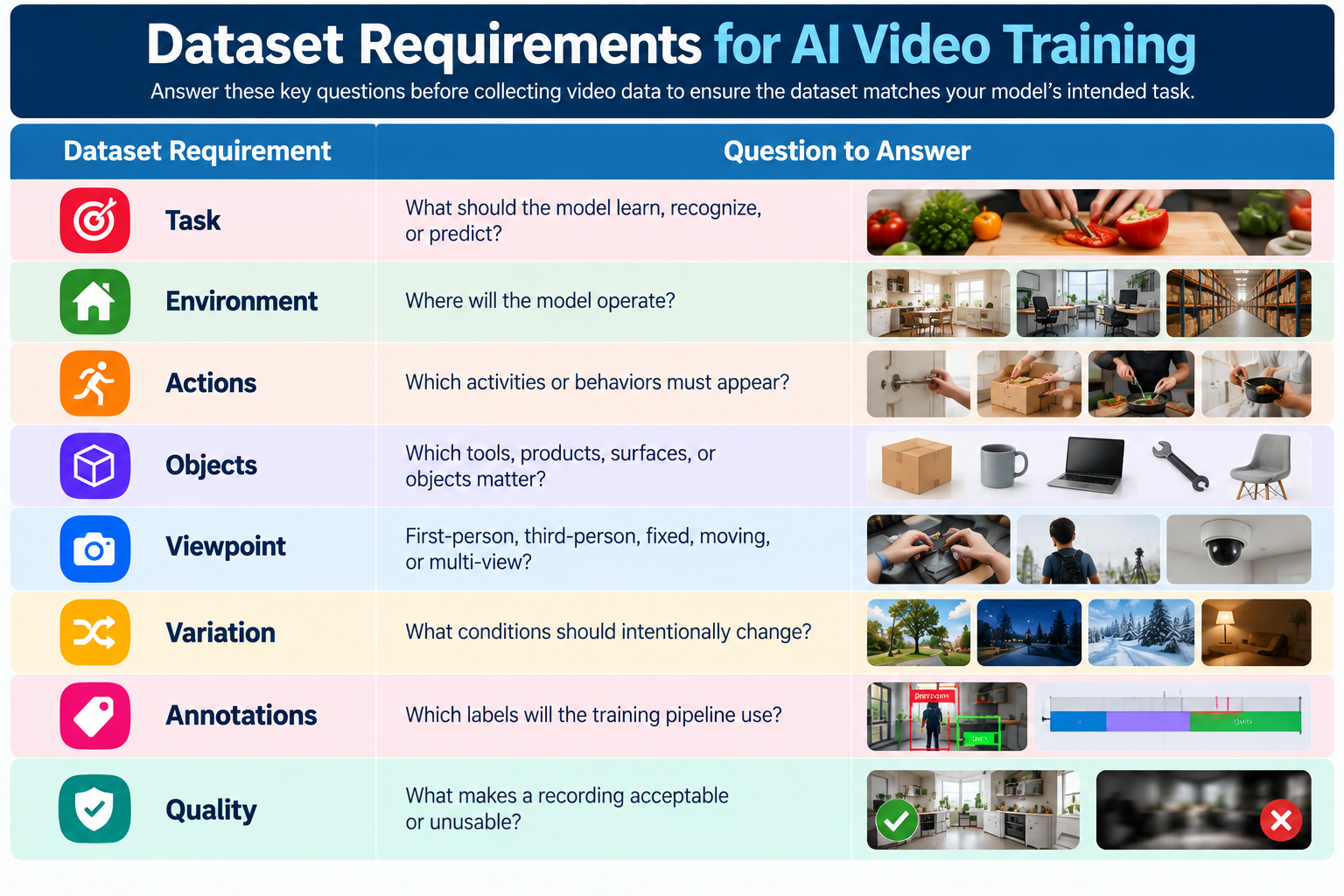
The important idea is simple: start with the learning requirement, then design the dataset backward from it.
That is also the principle behind Firsthand's approach to real-world video data collection. Rather than treating hours as the entire specification, Firsthand organizes collection around defined tasks, environments, viewpoints, conditions, and coverage requirements.
Dataset quality and coverage should be established before optimizing for raw volume. More video becomes useful when those additional recordings add relevant examples, meaningful variation, or repetition the training objective actually needs.
This is why “high-quality video” means something different in machine learning than it does in filmmaking.
A sharp, professionally framed recording can still be poor training data if the required action takes place outside the frame.
Likewise, a visually ordinary clip may be highly useful if it accurately captures the desired behavior under a realistic condition.
Useful dataset quality can involve several factors:
Large research datasets demonstrate why composition needs to be considered alongside hours.
EPIC-KITCHENS-100 contains 100 hours of unscripted first-person footage recorded in 45 kitchens, with approximately 90,000 action segments. Those details tell researchers much more than “100 hours” alone because they describe the environments and annotation coverage inside the dataset.
The better question is therefore not:
How many hours do we have?
It is:
What do those hours cover?
Video dataset coverage should be measured against the meaningful dimensions the target model is expected to encounter. Hours and clip counts are useful scale metrics, but they do not show whether important tasks, environments, or conditions are missing.
A coverage matrix can make those gaps visible.
For example:
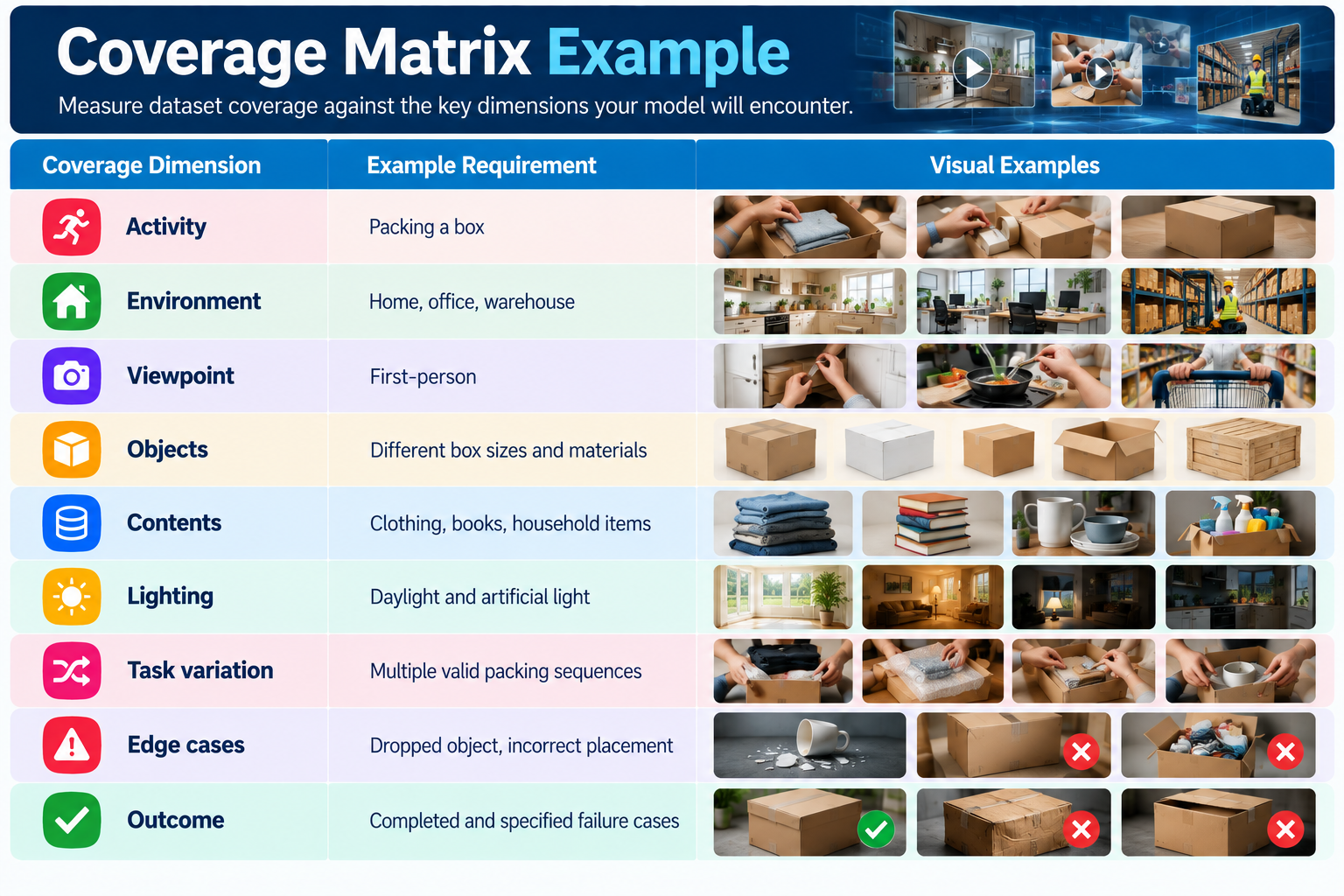
This is more useful than simply asking contributors to provide “diverse videos.”
Diversity should be measurable.
Firsthand describes its own dataset catalog in terms of environment and condition coverage rather than treating aggregate hours as the only indicator of dataset depth. Its published catalog also distinguishes areas with strong coverage from areas where data remains thin.
That type of transparency is useful because buyers can see both what a dataset contains and where additional collection may be necessary.
Real-world variation helps a dataset represent the conditions a model may encounter outside the collection environment. Relevant variation may include different locations, objects, participants, backgrounds, lighting conditions, viewpoints, or legitimate ways of completing the same task.
The word relevant matters.
Random variation does not automatically improve a dataset.
If a model will operate only in a fixed industrial environment, footage from unrelated household settings may add little useful coverage.
If a system must recognize an activity across many real homes, collecting everything in one staged room creates a different limitation.
NIST's AI Risk Management Framework notes that the data used to build an AI system may not appropriately represent the system's intended context of use.
Dataset design should therefore ask:
Which variations could realistically change model performance?
Those are the variations worth measuring and collecting.
Camera viewpoint determines what information appears in a video and what may be hidden. The appropriate viewpoint depends on what the model needs to observe.
This is particularly important for egocentric video data, which is captured from the first-person perspective of someone performing a task.
A head-mounted camera can show:
A third-person camera provides different information.
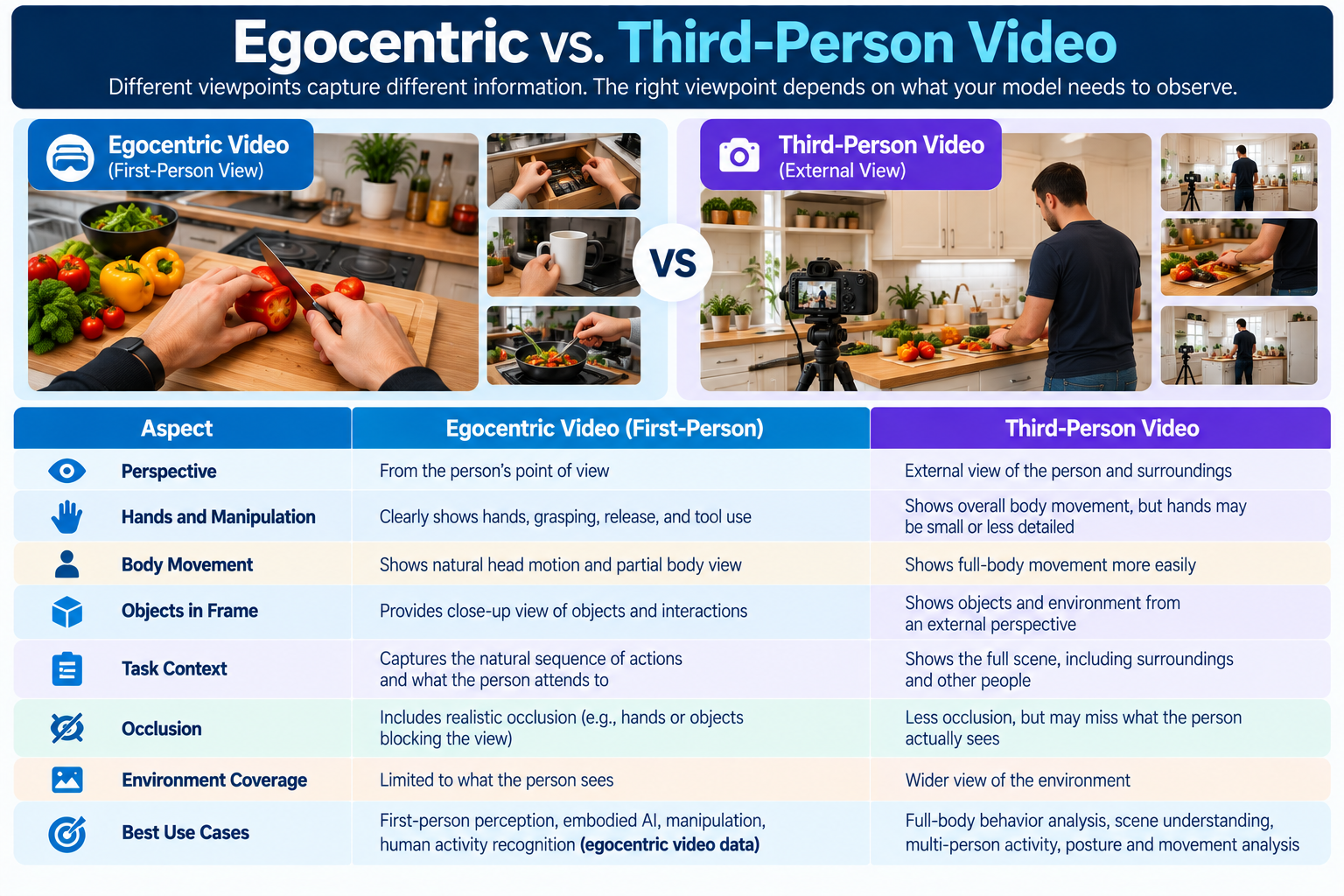
EPIC-KITCHENS-100 uses head-mounted cameras to record unscripted activities in participants' own kitchens, demonstrating how first-person capture can support research into everyday human activity and object interaction.
Firsthand similarly specializes in first-person task footage, while also supporting third-person and multi-view collection when those perspectives better match the target use case.
The correct viewpoint is not the one that is easiest to record.
It is the one that exposes the information the model needs.
Annotations make video more structured by identifying what happens, when it happens, or which objects and body parts are involved. The most useful annotation scheme is the one that directly supports the intended training or evaluation task.
Common annotation types include:
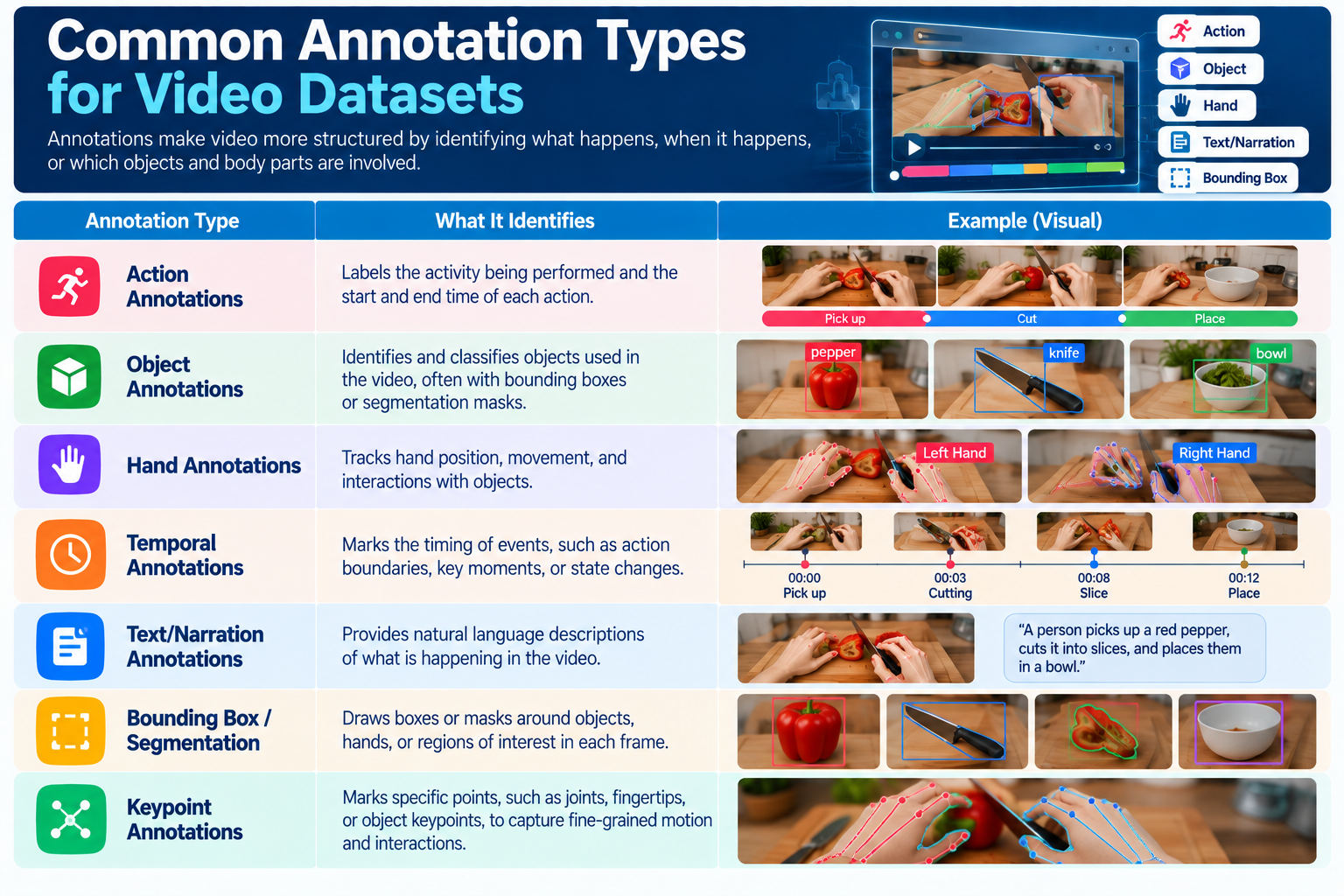
EPIC-KITCHENS demonstrates how rich annotations can support first-person video research. Its current dataset includes action segments, narrations, and additional hand and object annotations.
However, adding every possible annotation does not automatically make a dataset better.
Annotation should follow the model requirement.
A dataset intended for activity classification may need broad labels. A manipulation model may require more granular action boundaries, hand-object information, or contact events.
The right question is:
Which annotation will the model actually use?
Metadata explains how a recording was produced, while synchronization preserves the temporal relationship between multiple data streams. Both become increasingly important as video datasets grow more complex.
Useful metadata may include:
Dataset documentation also helps researchers understand where data came from and what its limitations are.
The Datasheets for Datasets framework recommends documenting factors including a dataset's motivation, composition, collection process, and recommended uses.
Synchronization matters when multiple modalities are recorded together.
For example, an embodied-AI dataset might include:
If those streams are not aligned, a hand pose or motion measurement may correspond to the wrong video frame.
Firsthand's published embodied-AI methodology describes its multimodal streams as synchronized onto a shared clock, with cross-stream timing measured as part of the capture process.
The takeaway is that having multiple modalities is not enough.
They need to describe the same event at the correct time.
Video dataset validation should check both the technical file and the content inside it. A video can pass basic file checks and still fail the actual dataset specification.
A practical QA system may include:
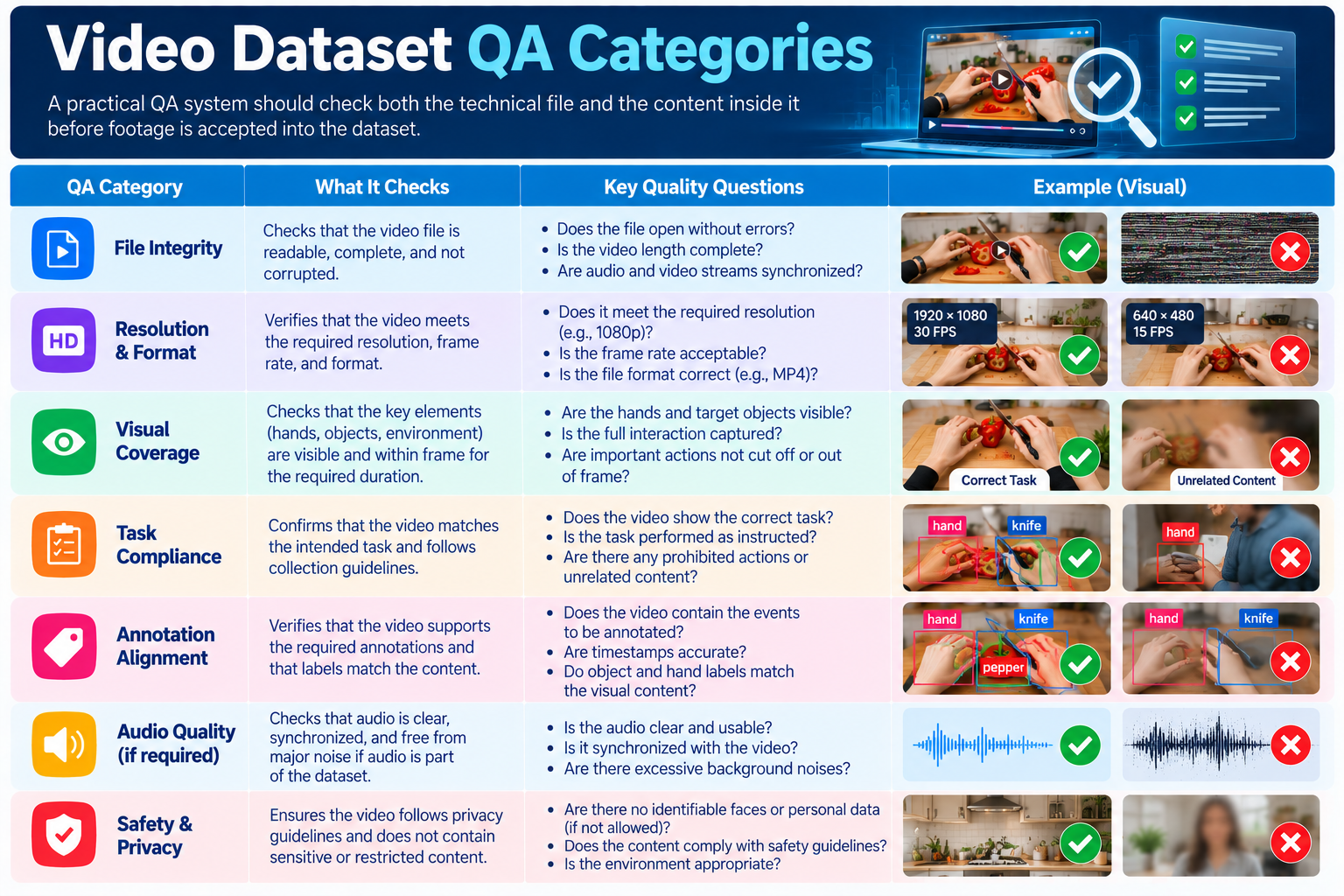
Acceptance criteria should be defined before large-scale collection begins.
For example, if a first-person activity requires hands and manipulated objects to remain visible, recordings where the entire interaction occurs outside the frame should not be counted simply because the file technically uploaded successfully.
Firsthand describes validated hours as footage that has passed synchronization and QA rather than counting rejected or recaptured footage toward delivered totals.
That distinction is important.
Raw captured hours measure production. Validated data measures usable output.
A commercially usable video dataset needs both technical suitability and appropriate usage rights. A dataset can be ideal for a model from a technical perspective but still be unsuitable if the organization cannot determine whether the footage may legally be used for its intended purpose.
Commercial teams should understand:
This is especially important when comparing public research datasets with commercial datasets.
The objective is not simply to find footage that can be downloaded.
The objective is to know what the organization is permitted to do with it.
Firsthand's published video collection methodology includes signed participant consent and commercial licensing as part of its data program.
Detailed licensing questions deserve their own review, but licensing should be considered early because it directly affects whether otherwise useful data can actually be used.
Video dataset collection should begin with a written specification describing the model objective, required activities, environment, viewpoint, meaningful variation, annotations, metadata, QA rules, and delivery requirements.
A practical collection methodology looks like this:
This is where methodology becomes as important as collection capacity.
Collecting more footage does not fix an unclear specification.
Look for a provider that can translate a model requirement into a measurable collection specification and explain how videos will be captured, validated, annotated, documented, licensed, and delivered.
A useful provider checklist includes:
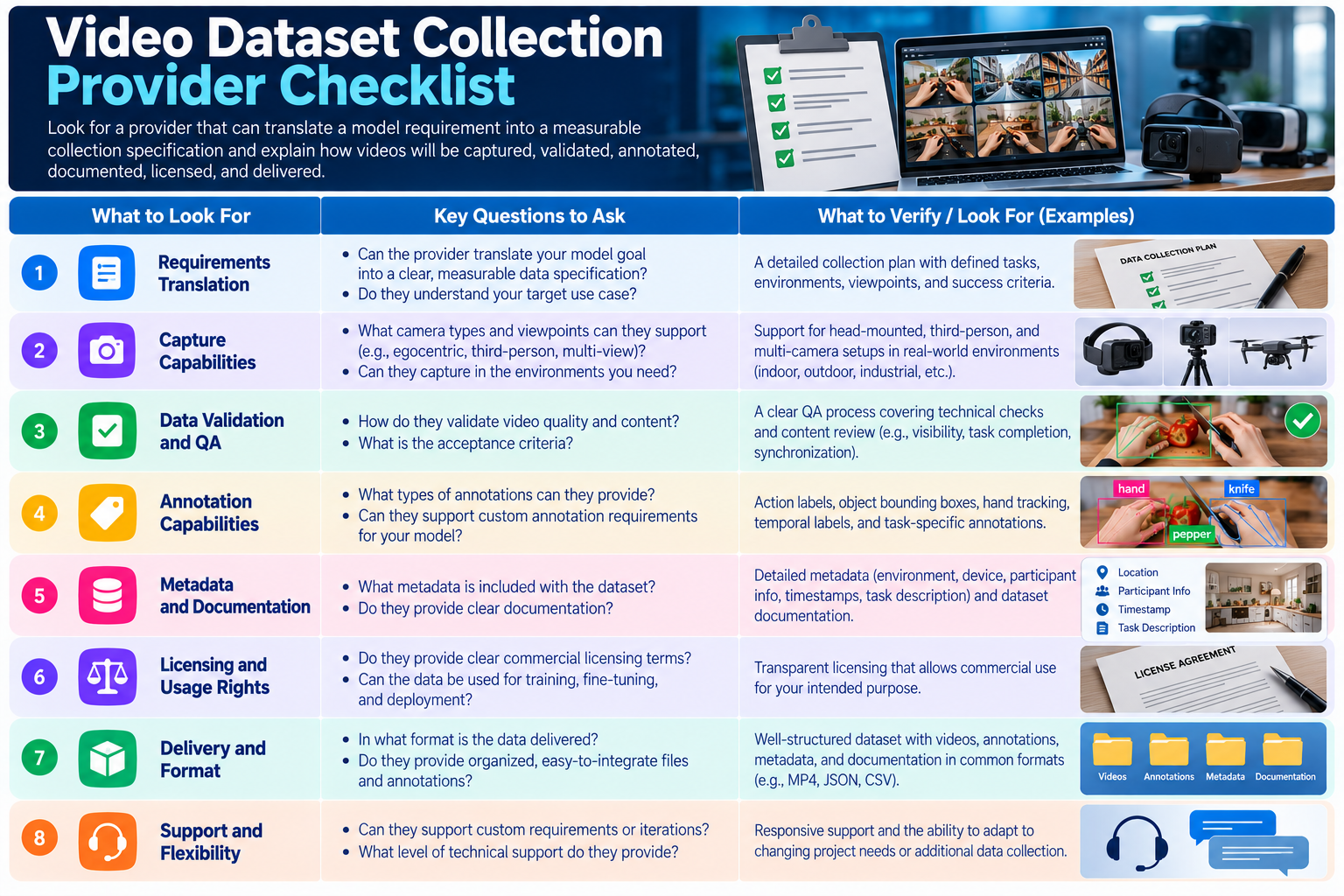
Firsthand's video dataset collection services focus on real-world video for embodied AI, robotics, first-person perception, and multimodal model development.
The goal is not to collect the largest possible number of files.
It is to produce video data whose content, coverage, viewpoint, annotations, synchronization, documentation, validation, and usage rights match the model that will consume it.
What makes a video dataset useful is not its size alone.
A useful dataset represents the problem the model actually needs to solve. Its recordings cover relevant tasks and environments, include meaningful real-world variation, use an appropriate viewpoint, and provide the annotations and metadata required by the training pipeline.
For more complex embodied-AI and robotics applications, usefulness may also depend on reliable multimodal synchronization, hand-object interaction information, temporal continuity, and clear commercial rights.
The best collection programs therefore start with a question:
What does the model need to learn?
Everything else—from camera placement and environment coverage to annotation and validation—should follow from that answer.
For custom egocentric video, embodied-AI data, multimodal capture, and real-world video collection, explore Firsthand's data collection capabilities.
A video dataset is an organized collection of video recordings used for AI training, evaluation, or research. It may include labels, timestamps, metadata, action annotations, object information, or synchronized sensor data. The exact structure depends on what the model needs to learn from the recordings.
A high-quality video dataset matches the intended task, includes relevant real-world variation, follows consistent capture requirements, and contains reliable metadata or annotations. For embodied AI and robotics, quality can also depend on viewpoint, temporal continuity, synchronization, and whether important actions remain clearly visible.
Dataset coverage shows whether the data represents the important tasks, environments, objects, viewpoints, and conditions the model may encounter. A large dataset can still be weak if most recordings are repetitive. Good coverage helps reduce gaps and makes the dataset more representative of the intended use case.
Annotations identify what happens in a video, while metadata explains how and where the recording was created. Together, they make the dataset easier to organize, train on, evaluate, and audit. Useful fields may include action labels, timestamps, object information, environment, viewpoint, and QA status.
Look for clear capture specifications, realistic environment coverage, consistent quality checks, useful annotations, documented consent, and appropriate licensing. For multimodal or embodied AI projects, also ask how sensor streams are synchronized and whether the final dataset can be delivered in a structure that fits your training workflow.


Compact, ready to go anywhere
Interchangeable lens that’s upgradeable
Dual 1-inch sensors for improved clarity and low light performance
Dynamic range and 6K 360° capture
360° photo resolution at 21MP

8K 360° video recording for ultra-detailed visuals.
4K single-lens mode for traditional wide-angle shots.
Invisible selfie stick effect for drone-like perspectives.
2.5-inch touchscreen with Gorilla Glass protection.
Waterproof up to 33ft for underwater shooting.

360° photo resolution in 23MP
Slim design at 24 mm thick
Built-in image stabilization for smooth video capture.
Internal 19GB storage for photo and video storage.
Wireless connectivity for remote control and sharing.

60MP 360° still images for high-resolution photography.
5.7K 360° video recording at 30fps.
2.25-inch touchscreen for intuitive control.
USB Type-C port for fast charging and data transfer.
MicroSD card slot for expandable storage.
.png)

.png)

Try it free. No credit card required. Instant set-up.





.svg)


.svg)