


.png)


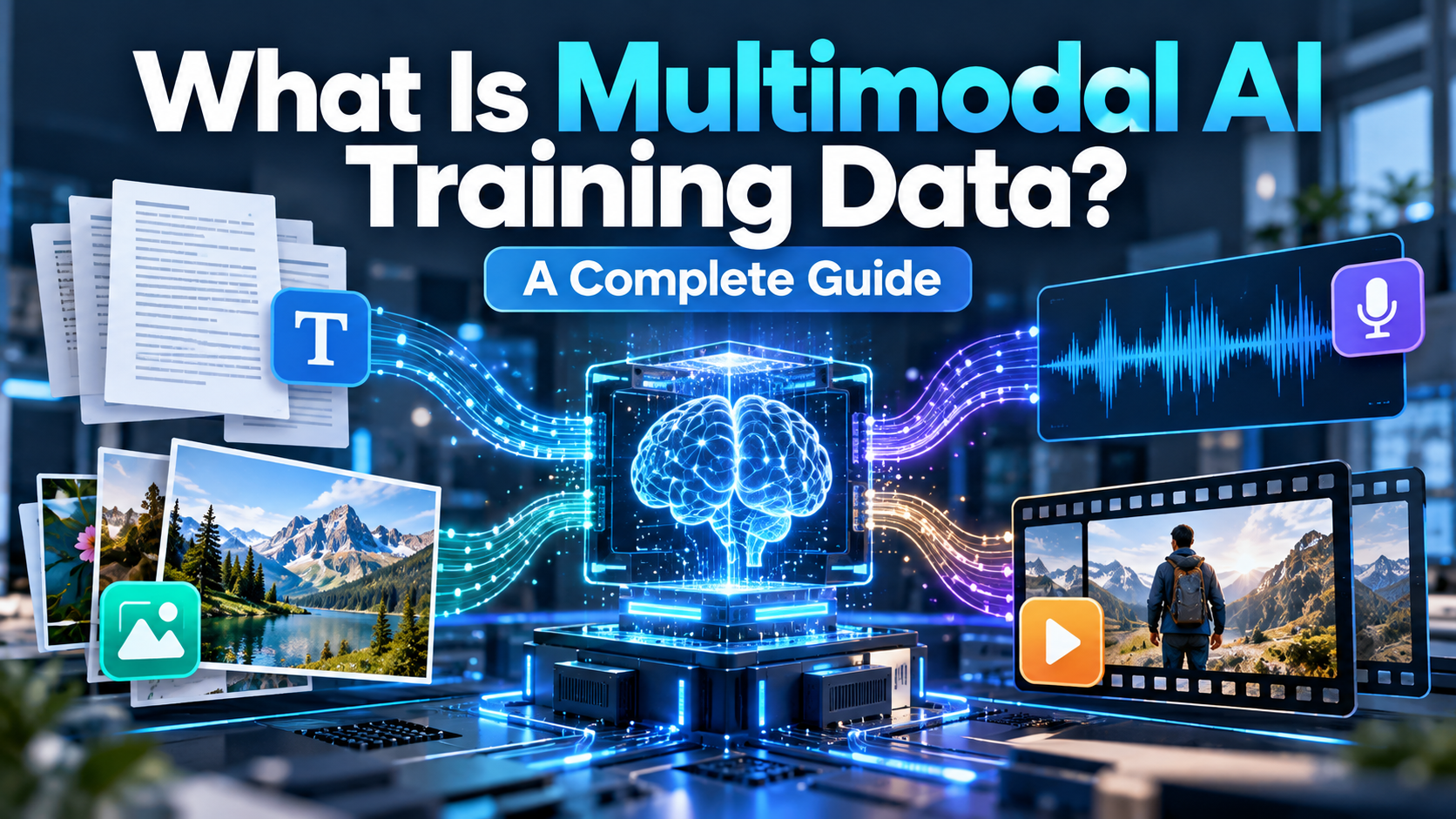
Multimodal AI training data combines two or more types of information, such as text, images, audio, video, and sensor readings, to train AI models. By learning relationships across these data types, models can perform tasks such as image understanding, speech recognition, video analysis, and visual question answering. Effective training requires relevant data, accurate alignment, and consistent quality. Copy quick answer

Artificial intelligence has become remarkably good at understanding written language. It can summarize documents, answer questions, translate conversations, and generate content in seconds. But the real world doesn't communicate through text alone.
We understand our surroundings through a combination of sights, sounds, words, movements, and context. A conversation, for example, involves more than what someone says. Their facial expressions, tone of voice, and gestures can completely change the meaning of their words.
For AI to interpret information in a similarly connected way, it needs exposure to different types of data.
That's where multimodal AI training data comes in.
Instead of teaching artificial intelligence using only text or images, multimodal training introduces several types of information and helps models learn the relationships between them.
This approach supports AI systems that can describe photographs, interpret videos, understand spoken instructions, and respond to questions involving multiple forms of information.
But what exactly makes training data multimodal, and why does it matter?
Let's explore how it works, the challenges involved, and what organizations should consider when building multimodal datasets.
Multimodal AI training data is information from two or more data types, such as text, images, audio, video, or sensor readings, used to train artificial intelligence models to understand relationships across different forms of input.
Each type of information is called a modality.
A traditional language model might learn from written articles, books, and conversations. An image recognition model might learn from photographs labeled with descriptions of the objects they contain.
A multimodal model can learn from both.
For example, imagine an AI system being trained to recognize different dog breeds.
A text-only dataset might contain descriptions of breed characteristics. An image dataset might contain photographs of different dogs.
A multimodal dataset could combine those photographs with breed names, descriptions, and even recordings of barking.
By learning from related information, the model can develop a richer understanding of the subject.
The important distinction is that multimodal training isn't simply about collecting different file formats. It's about helping AI recognize meaningful connections between them.
Multimodal datasets can contain several types of information, depending on what the AI system is designed to accomplish.
Text remains one of the most widely used forms of AI training data.
It includes written documents, conversations, articles, instructions, product descriptions, and transcripts.
In multimodal training, text often provides context for other data types.
For example, an image of a busy intersection might be paired with a description explaining that pedestrians are crossing while vehicles wait at a traffic light.
The text helps the model connect visual information with language.
Image data includes photographs, diagrams, screenshots, scanned documents, medical images, and illustrations.
When combined with text, image data can help AI identify objects, interpret visual relationships, and answer questions about pictures.
An AI system trained on product images and descriptions, for instance, may learn to recognize product characteristics and associate them with written specifications.
Audio training data includes speech recordings, environmental sounds, music, and other acoustic signals.
Audio is particularly valuable for speech recognition, voice assistants, transcription systems, and sound classification.
Consider a recording of someone saying, "Please turn off the lights."
When the audio is paired with an accurate transcript, an AI model can learn the relationship between spoken sounds and written language.
Additional labels may identify speakers, languages, or relevant sound events.
Video introduces another important dimension: time.
Unlike a single photograph, video captures movement, sequences of events, and changes in an environment.
Video training data may include recorded activities, demonstrations, instructional footage, and clips paired with captions or timestamps.
For example, an AI model could learn how a person assembles furniture by studying a video alongside step-by-step instructions.
The model must understand not only what objects appear but also how actions unfold.
Some multimodal AI applications use information beyond traditional media.
Autonomous systems, industrial equipment, and robotics may combine camera footage with GPS coordinates, depth measurements, motion sensors, or temperature readings.
A self-driving vehicle, for example, may use camera images alongside radar or other sensor data to interpret its surroundings.
These additional modalities provide information that visual data alone may not capture reliably.
Multimodal AI training involves preparing different data types and teaching a model how they relate.
Although the exact training process depends on the model architecture and intended application, several steps are common.
The process begins with collecting relevant information from appropriate sources.
These might include licensed image libraries, recorded conversations, video collections, public datasets, or purpose-built data collection projects.
The data should reflect the tasks the AI model is expected to perform.
For example, a system designed to understand cooking instructions might benefit from recipe text, ingredient photographs, and videos demonstrating preparation techniques.
Collecting large amounts of unrelated material would not necessarily produce better results.
Raw datasets often contain inconsistencies.
Images may be blurry, audio recordings may contain excessive background noise, and transcripts may include incorrect words.
Before training, datasets typically undergo cleaning and standardization.
This can involve removing duplicates, correcting labels, validating file formats, and identifying corrupted files.
The goal is to reduce unnecessary errors that could interfere with learning.
One of the most important parts of multimodal training is data alignment.
Alignment means connecting information from different modalities so the model can learn their relationships.
For example, a video of someone opening a door might include:
If the audio and video are incorrectly synchronized, the model may learn misleading relationships.
High-quality annotation and alignment help make the dataset more useful.
Different modalities have different underlying structures.
Text is represented through tokens, images through visual features, and audio through signal-based representations.
AI models use encoding techniques to transform these inputs into numerical representations they can process.
During training, the model learns patterns within individual modalities and connections between them.
Some architectures combine information early in processing, while others integrate representations or predictions at later stages.
The specific approach depends on the model's design and training objectives.
After training, developers evaluate how well the model performs on relevant tasks.
A model trained to answer questions about images, for example, might be tested on photographs and questions it has never encountered.
Evaluation can reveal weaknesses involving accuracy, missing context, bias, or difficulty interpreting certain combinations of data.
These findings help teams improve datasets, training methods, and model performance.
The value of multimodal training comes from its ability to connect different sources of information.
A single data type can be useful, but it may provide only part of the context needed to understand a situation.
Imagine asking an AI assistant, "What's happening in this video?"
A text-only model cannot directly examine the footage.
A model capable of processing video and language can potentially identify visible actions, describe relevant events, and answer follow-up questions.
This broader context enables more natural interactions.
Many real-world tasks require several forms of information.
Healthcare applications may combine medical images with clinical notes. Robotics systems may interpret visual information alongside sensor readings. Accessibility tools may connect speech, images, and written descriptions.
Multimodal training helps support these capabilities.
Different modalities can provide complementary information.
For example, audio may help interpret an event that is difficult to identify visually, while video may provide context missing from a sound recording.
When the information is relevant, properly aligned, and accurately processed, combining modalities can improve performance on certain tasks.
However, multimodal systems are not automatically more accurate. Poor-quality or contradictory inputs can introduce additional errors.
The main difference is the number of information types used and the relationships the model is designed to learn.
Neither approach is universally better.
A text-only classification task may not benefit from adding images or audio. Multimodal training becomes valuable when multiple forms of information contribute meaningfully to the task.

Multimodal training supports applications across industries, from everyday digital tools to specialized systems.
Healthcare AI systems may analyze medical images alongside clinical notes, laboratory results, or patient history.
Combining relevant information can support research into clinical decision-making and medical image interpretation.
Because healthcare applications involve significant risks, these systems also require careful validation, privacy safeguards, and professional oversight.
Autonomous systems operate in environments where conditions change constantly.
Cameras can capture visual details, while other sensors provide information about distance, movement, and positioning.
Multimodal datasets help models learn how these signals relate, supporting tasks such as environmental perception and navigation.
Customer support interactions increasingly involve more than written messages.
A customer might submit a screenshot of an error, explain the issue through a voice recording, or upload a short video demonstrating a problem.
Multimodal AI can help interpret these inputs together, potentially making troubleshooting more efficient.
Retail applications can use product images, descriptions, customer questions, and other information to improve product discovery.
For example, a shopper might upload a photograph of a chair and ask for similar products in a different color.
An AI system that understands both images and text can help interpret that request.
Educational tools may combine spoken explanations, diagrams, text, and video demonstrations.
Accessibility applications can also use multimodal capabilities to generate image descriptions, transcribe speech, or help users interact with visual information.
These applications demonstrate how different modalities can work together to make information more accessible.
Building a useful multimodal dataset is more complicated than gathering text, images, and recordings.
Several challenges can affect the quality of the resulting model.
Each modality introduces its own quality requirements.
An image may be poorly lit, a transcript may contain mistakes, or a video may have missing frames.
When multiple sources contain errors, those problems can become harder to identify.
Consistent quality checks are essential.
Different types of data must be connected correctly.
An image paired with an unrelated caption may teach the model the wrong association.
Similarly, inaccurate timestamps in video and audio data can create confusion about when events occurred.
Reliable alignment is one of the foundations of effective multimodal learning.
Training datasets may not represent all users, environments, languages, or situations equally.
For example, a speech dataset dominated by a narrow range of accents may perform poorly for other speakers.
A visual dataset collected primarily in one environment may struggle with unfamiliar conditions.
Diverse, representative datasets and careful evaluation help identify these limitations.
Multimodal datasets can contain sensitive information, including identifiable faces, voices, locations, or personal records.
Organizations must consider whether they have appropriate rights and permissions to collect, store, and use the data.
Privacy protection, access controls, and clear documentation should be part of the data preparation process.
Video, high-resolution images, and lengthy audio recordings can require substantial storage and computing resources.
Multimodal datasets may also need specialized processing pipelines to handle different file formats and synchronization requirements.
These considerations can influence project cost, scalability, and training efficiency.
Organizations developing multimodal AI systems should focus on dataset relevance and reliability rather than volume alone.
Start with a clear use case. Identify what the model needs to understand before deciding which modalities to collect. Not every project requires text, images, audio, and video.
Prioritize accurate alignment. Ensure that related inputs are correctly paired and, where necessary, synchronized using timestamps or other identifiers.
Establish annotation standards. Clear labeling instructions help reduce inconsistencies between annotators and across datasets.
Document data sources and permissions. Maintain records of where information originated, how it was collected, and whether it can legally be used for training.
Evaluate under realistic conditions. Test the model using examples that reflect actual environments, including noisy audio, unfamiliar images, or incomplete inputs.
Review and improve continuously. Dataset development should include regular quality checks, error analysis, and updates when meaningful gaps are discovered.
These practices help create a stronger foundation for reliable AI development.
As AI systems become capable of working with more forms of information, the importance of well-prepared multimodal datasets will continue.
One important direction is the development of models that can interpret several modalities within a unified system.
Another is self-supervised learning, which allows models to learn useful patterns from data without requiring every example to be manually labeled.
This can help reduce some annotation requirements, although it does not eliminate the need for quality control or evaluation.
There is also growing interest in AI systems that interpret events over time, combine visual and spatial information, and interact with physical environments.
For these applications, relationships between modalities matter just as much as the individual inputs.
The challenge is not simply collecting more data. It is building datasets that accurately represent the situations AI systems need to understand.
Multimodal AI training data plays an important role in developing artificial intelligence systems that can work with more than one type of information.
By combining text, images, audio, video, and other relevant inputs, developers can train models to recognize relationships that may be difficult to understand through a single modality.
However, successful multimodal training depends on more than dataset size.
Accurate alignment, representative examples, reliable annotations, responsible data sourcing, and thorough evaluation all contribute to better results.
For organizations exploring multimodal AI, the most effective starting point is understanding the problem they want to solve and identifying the information needed to solve it.
Ultimately, the value of multimodal AI training data comes from the quality of the connections it teaches a model to make—not simply the number of data types it contains.
An image paired with a written caption is a simple example of multimodal AI training data. Other examples include audio recordings paired with transcripts, videos paired with descriptions, and camera footage combined with sensor readings. These relationships help AI models learn across different information types.
Multimodal AI refers to systems that process or integrate different types of data, while generative AI focuses on creating content such as text, images, audio, or video. A model can be both multimodal and generative when it understands multiple input types and generates new content.
Data alignment ensures that related information from different modalities is correctly connected. For example, an audio transcript must correspond to the correct spoken words. Poor alignment can introduce misleading relationships and reduce model performance.
Not always. Supervised multimodal training often uses labeled or paired examples, but self-supervised approaches can learn useful patterns from large amounts of unlabeled data. The requirements depend on the model architecture, learning objectives, and intended application.
These are authoritative references suitable for the article's source field and contextual external links.
IBM – What Is Multimodal AI?
https://www.ibm.com/think/topics/multimodal-ai
Google Cloud – Multimodal AI
https://cloud.google.com/use-cases/multimodal-ai
IBM – What Is a Multimodal LLM?
https://www.ibm.com/think/topics/multimodal-llm
Foundations and Trends in Multimodal Machine Learning
https://arxiv.org/abs/2209.03430
Self-Supervised Multimodal Learning: A Survey
https://arxiv.org/abs/2304.01008


Compact, ready to go anywhere
Interchangeable lens that’s upgradeable
Dual 1-inch sensors for improved clarity and low light performance
Dynamic range and 6K 360° capture
360° photo resolution at 21MP

8K 360° video recording for ultra-detailed visuals.
4K single-lens mode for traditional wide-angle shots.
Invisible selfie stick effect for drone-like perspectives.
2.5-inch touchscreen with Gorilla Glass protection.
Waterproof up to 33ft for underwater shooting.

360° photo resolution in 23MP
Slim design at 24 mm thick
Built-in image stabilization for smooth video capture.
Internal 19GB storage for photo and video storage.
Wireless connectivity for remote control and sharing.

60MP 360° still images for high-resolution photography.
5.7K 360° video recording at 30fps.
2.25-inch touchscreen for intuitive control.
USB Type-C port for fast charging and data transfer.
MicroSD card slot for expandable storage.
.png)

.png)

Try it free. No credit card required. Instant set-up.






.svg)


.svg)