


.png)


AI data collection is the process of gathering, labeling, and structuring real-world or synthetic information so machine learning models can learn from it. This includes images, video, audio, text, and sensor data that has been captured, verified, and organized into a format a model can actually train on. For most production ML systems, the quality of this underlying data — not just the size of the model — is what determines whether the system performs reliably in the real world.
If you're building or buying training data for computer vision, robotics, autonomous systems, or any perception-based AI, understanding how data collection actually works (and where it commonly goes wrong) will save your team months of rework later.
Model architectures have become largely commoditized — many teams are working from similar transformer or vision-model backbones. What differentiates a production-ready model from one that fails in deployment is usually the data: how it was captured, how representative it is of real-world conditions, and how carefully it was labeled.
Poor data collection shows up later as expensive problems: models that perform well in testing but fail on edge cases, biased outputs from unrepresentative samples, and costly re-labeling cycles. According to NIST's AI Risk Management Framework, data quality and representativeness are called out as a foundational risk category that organizations should manage proactively, rather than something to patch after deployment.
For teams evaluating whether to build a data collection pipeline in-house or work with a partner, it helps to start with a clear picture of what "data collection" actually covers — see our AI data collection services page for how this looks in practice across industries.
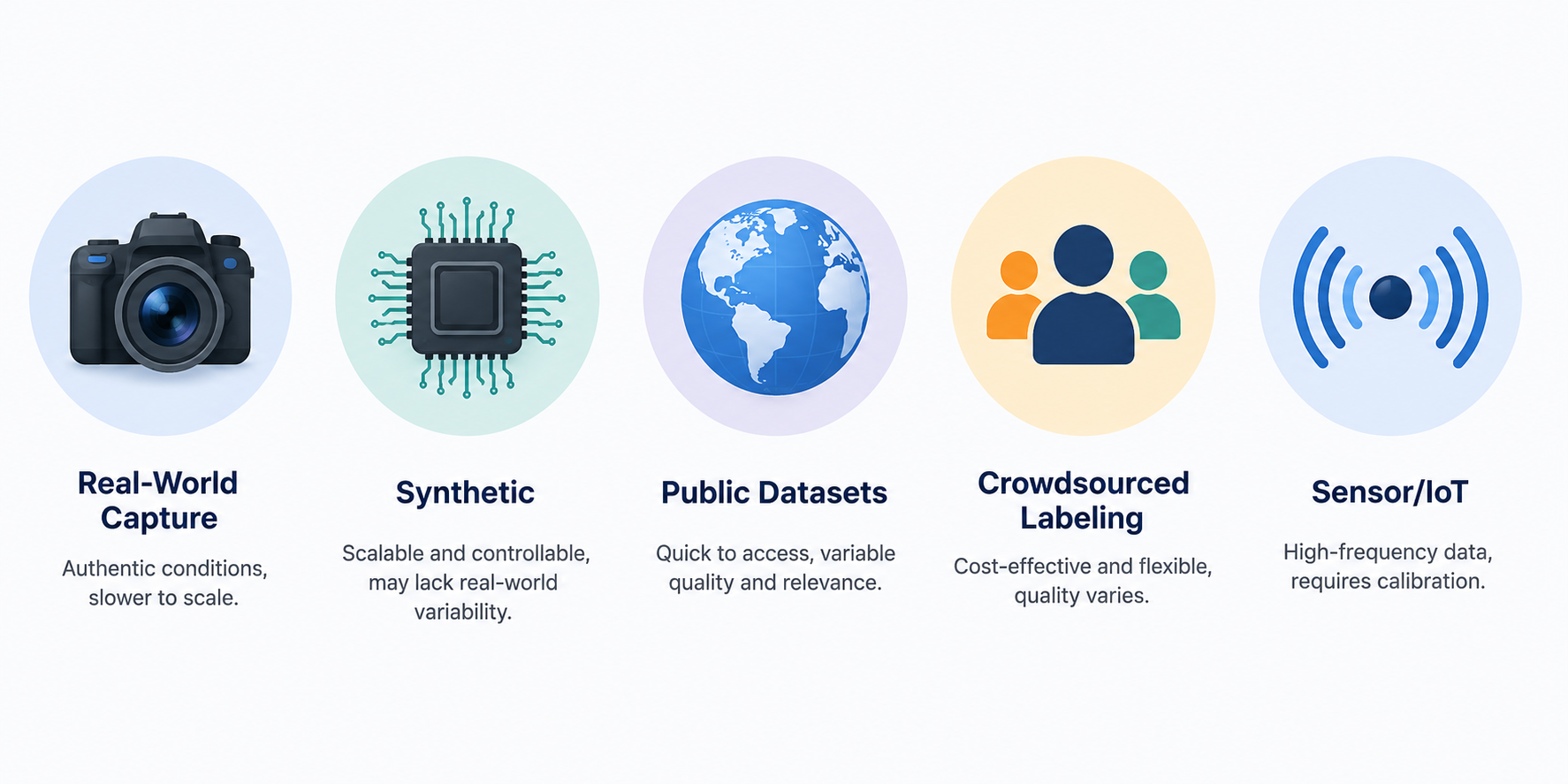
Not all training data is gathered the same way. The right method depends on your use case, budget, and how close to real-world conditions your model needs to perform.
This involves physically capturing footage or images in the actual environments where a model will eventually operate — a warehouse floor, a retail store, a vehicle cabin, a construction site. It's slower and more resource-intensive than other methods, but it produces data with authentic lighting, occlusion, motion, and environmental variability that's difficult to replicate synthetically. For perception models that need to generalize to messy, unpredictable real-world conditions, this remains one of the most reliable inputs.
Synthetic data is computer-generated rather than captured from the physical world — think simulated driving scenes or procedurally generated object images. It's fast to scale and useful for rare edge cases (a pedestrian in unusual weather, for example) that are hard or dangerous to capture live. The tradeoff is a "reality gap": models trained heavily on synthetic data can struggle when deployed against real sensor noise and lighting.
Pre-existing datasets scraped from the web or released by research institutions (ImageNet, COCO, and similar). These are useful for benchmarking and early prototyping but often carry licensing restrictions, unclear provenance, and coverage gaps for niche or proprietary use cases.
Human annotators tag, classify, or verify data points — drawing bounding boxes, transcribing audio, or confirming that a model's output is correct. This is less a "collection" method on its own and more a quality layer applied on top of raw data, which is why it's usually paired with one of the methods above.
Data streamed directly from physical sensors — LiDAR, thermal cameras, accelerometers — often used in robotics and industrial AI. This data typically requires significant preprocessing and synchronization before it's usable for training.
Regardless of which method (or combination of methods) a team uses, most AI data collection pipelines follow a similar sequence:
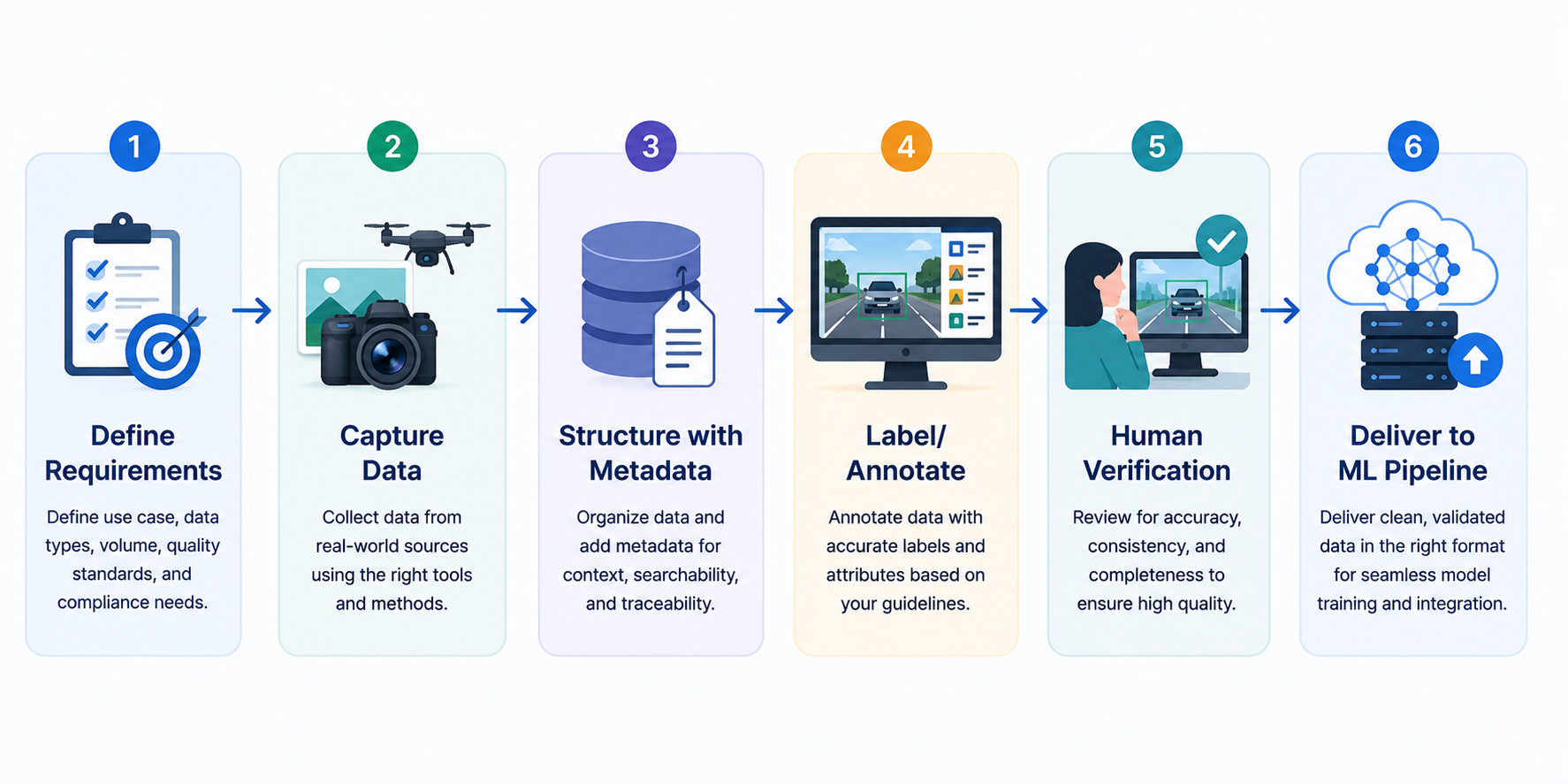
Structured metadata is what separates a raw pile of footage from a genuinely usable training dataset — it's what lets an ML team later filter, query, and audit exactly what's in their data (e.g., "show me all clips captured in low-light warehouse conditions"), which matters both for model performance and for debugging failures after deployment.
Because "AI data collection" spans such different methods, it helps to see them side by side when deciding what fits a specific project.
No single method is universally "best" — most mature ML programs combine real-world capture for core training data with synthetic data to patch edge-case gaps, layered with human verification throughout.
Collecting data is only half the challenge — verifying it's correct is what makes it trustworthy. Even well-captured footage can include mislabeled objects, inconsistent annotation standards between labelers, or gaps in edge-case coverage that only a human reviewer will catch.
A major survey of data-centric AI research highlights data quality as a critical factor in machine-learning performance and describes a growing shift from model-focused development toward systematically improving the data used throughout the AI lifecycle. Source: Zha, D., et al. “Data-centric Artificial Intelligence: A Survey.” ACM Computing Surveys, vol. 57, no. 5, 2025.
This is why human-in-the-loop verification remains a standard part of serious data collection pipelines rather than an optional add-on: it catches errors automated quality checks miss, and it builds an audit trail that matters if a model's behavior is ever questioned later — a growing concern as AI governance regulations expand. For a deeper look at how verification fits into a full training-data pipeline, see our AI training data services.
Teams evaluating data collection — whether building in-house or sourcing externally — tend to run into the same handful of obstacles:
According to Grand View Research, the global data collection and labeling market was valued at USD 3.77 billion in 2024 and is projected to reach USD 17.10 billion by 2030, growing at a 28.4% CAGR. The report attributes this growth to increasing demand for high-quality data used to train AI and machine learning models across industries. Source: https://www.grandviewresearch.com/industry-analysis/data-collection-labeling-market
For teams deciding whether to build this capability internally or work with an external provider, a few questions tend to separate a strong fit from a weak one:
These questions matter more than headline price-per-clip, because rework from poor-quality data is almost always more expensive than paying more upfront for verified, well-structured data.
AI data collection provides the raw material — images, video, audio, sensor readings, or text — that machine learning models are trained on. Without it, a model has nothing to learn patterns from, regardless of how sophisticated its architecture is.
AI training data is typically structured, labeled, and verified specifically so a model can learn from it in a consistent, machine-readable format — unlike raw data, which may lack the metadata, labels, or quality checks needed for training.
It depends on the use case. Synthetic data scales faster and is useful for edge cases that are rare or unsafe to capture live, but it can introduce a "reality gap" where models underperform on real sensor noise, lighting, and physical variability that synthetic environments don't fully replicate.
There's no universal number — it depends on the model's complexity, the diversity of real-world conditions it needs to handle, and how rare the important edge cases are. Teams generally need less data if it's high-quality and well-labeled, and more if the underlying data is noisy or unrepresentative.
High-quality training data is accurate, representative of real-world conditions the model will encounter, consistently labeled, well-documented with metadata, and verified by human review rather than relying solely on automated checks.
Whether your team needs real-world video capture, structured metadata, or human-verified datasets at scale, getting this foundation right shapes everything downstream. Visit our AI Data Collection Services page to see how a scalable, verified provider network can support your next ML project.


Compact, ready to go anywhere
Interchangeable lens that’s upgradeable
Dual 1-inch sensors for improved clarity and low light performance
Dynamic range and 6K 360° capture
360° photo resolution at 21MP

8K 360° video recording for ultra-detailed visuals.
4K single-lens mode for traditional wide-angle shots.
Invisible selfie stick effect for drone-like perspectives.
2.5-inch touchscreen with Gorilla Glass protection.
Waterproof up to 33ft for underwater shooting.

360° photo resolution in 23MP
Slim design at 24 mm thick
Built-in image stabilization for smooth video capture.
Internal 19GB storage for photo and video storage.
Wireless connectivity for remote control and sharing.

60MP 360° still images for high-resolution photography.
5.7K 360° video recording at 30fps.
2.25-inch touchscreen for intuitive control.
USB Type-C port for fast charging and data transfer.
MicroSD card slot for expandable storage.
.png)

.png)

Try it free. No credit card required. Instant set-up.





.svg)


.svg)