


.png)


Real-world data is captured directly from physical environments — cameras, sensors, or recordings of actual conditions — while synthetic data is computer-generated to simulate those same conditions. The right choice depends on what your model needs to generalize to: real-world data tends to win on authenticity and edge-case realism, while synthetic data wins on speed, cost, and scale. Most mature ML programs end up using both, in different proportions depending on the use case.
If you're deciding how to allocate budget and timeline between the two, it helps to understand exactly where each one is strong, where each one breaks down, and how teams typically combine them in practice.
It's tempting to treat "real-world vs. synthetic" as a minor implementation detail decided late in a project. In practice, it's one of the earliest and highest-leverage decisions an ML team makes, because it shapes:
Getting this wrong doesn't usually show up until deployment — a model that scored well in testing but underperforms in the field is a classic symptom of a training data mismatch, not necessarily an architecture problem. For a broader look at how data collection fits into the model development lifecycle, see our guide to AI data collection, which covers the full range of collection methods beyond just these two.
Real-world data collection means physically capturing footage, images, audio, or sensor readings from the actual environments a model will eventually operate in — a retail store, a vehicle cabin, a warehouse aisle, a construction site. It reflects genuine lighting conditions, motion blur, occlusion, background clutter, and the countless small irregularities that are difficult to fully anticipate or recreate artificially.
Strengths:
Limitations:
Synthetic data is generated computationally rather than captured from the physical world — think simulated driving scenes, procedurally generated warehouse layouts, or rendered variations of an object under different lighting. It's created using 3D rendering engines, generative models, or simulation environments designed to approximate real-world conditions.
Strengths:
Limitations:
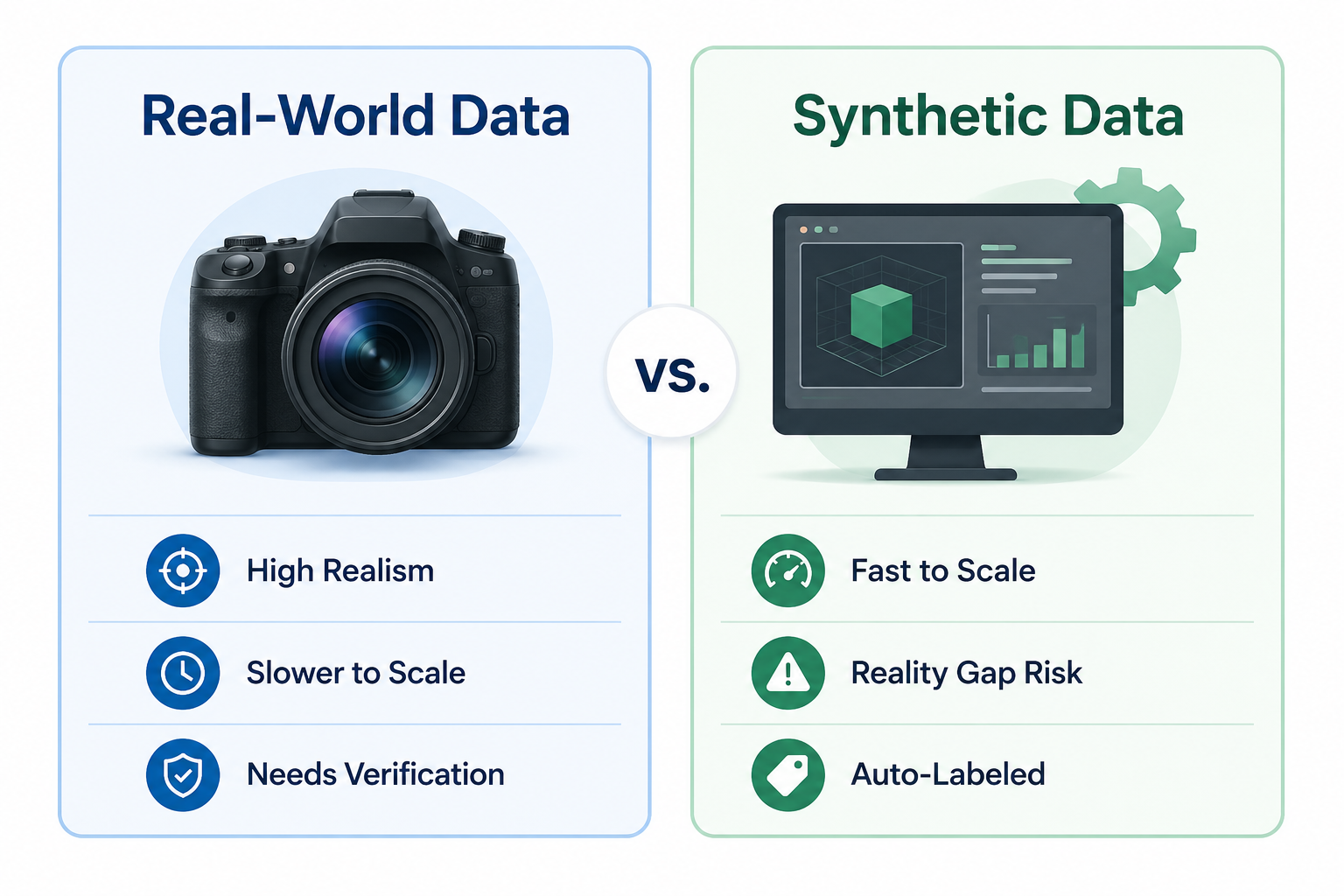
Neither approach is inherently "better" in isolation — the comparison above is really about which tradeoffs match your project's stage, budget, and risk tolerance.
In practice, few production ML teams choose exclusively one or the other. A common pattern looks like this:
Industry experts increasingly recommend combining synthetic and real-world data rather than treating them as substitutes. MIT researchers have noted that synthetic data can accelerate AI development and fill gaps in training data, but it requires careful evaluation to ensure models generalize well in real-world deployments. Source: https://news.mit.edu/2025/3-questions-pros-cons-synthetic-data-ai-kalyan-veeramachaneni-0903
For teams weighing whether to build this blended pipeline internally or work with an external partner for the real-world capture portion specifically, our AI training data services page covers how structured metadata and human verification typically fit into that workflow.
Whether data comes from real-world capture or a synthetic pipeline, unverified data is a liability. Synthetic labels can be systematically incorrect if the simulation's underlying assumptions are flawed, while real-world labels can vary in quality and consistency across annotators. A major survey of data-centric AI research highlights data quality, consistency, and representativeness as fundamental factors in machine learning performance, reflecting a broader shift from optimizing models alone to systematically improving the data used throughout the AI lifecycle. Source: Zha, D., et al. "Data-centric Artificial Intelligence: A Survey." ACM Computing Surveys, vol. 57, no. 5, 2025.
This is why a human verification layer matters across both data types: it catches labeling errors, flags simulation assumptions that don't hold up, and creates an audit trail that becomes increasingly important as AI governance and explainability requirements expand across industries.
Demand for both real-world and synthetic training data has grown as organizations expand their use of AI across computer vision, robotics, and autonomous systems. According to MarketsandMarkets, the synthetic data generation market continues to grow as organizations adopt synthetic data to improve scalability, enhance data diversity, address privacy concerns, and generate scenarios that are difficult or costly to capture in the real world.
It depends on the use case. Synthetic data is excellent for scaling quickly and generating rare edge cases, but it can introduce a "reality gap" where models underperform against real sensor noise and physical conditions that simulations don't fully capture. Most teams use synthetic data to augment, not replace, real-world data.
Synthetic data works well when you need to generate rare, dangerous, or hard-to-capture scenarios quickly, or when you're in early prototyping and don't yet need production-level realism. Real-world data becomes more important as you approach final validation before deployment.
Yes — this is the most common approach among mature ML teams. Real-world data typically forms the core training set, with synthetic data layered in to cover edge cases that are rare or unsafe to capture live.
Yes. Synthetic labels are generated automatically, but the underlying simulation assumptions can introduce systematic errors that carry through the entire dataset. Human verification helps catch these issues before they affect model performance.
Because final model performance is judged against real-world conditions, not simulated ones. Even a large volume of synthetic data can't fully substitute for validating a model against authentic real-world variability before deployment.
Whether your project needs real-world video capture, synthetic augmentation, or a verified blend of both, getting the ratio right early saves significant rework later. Visit our AI Data Collection Services page to see how a scalable, verified provider network can support the real-world capture side of your pipeline.


Compact, ready to go anywhere
Interchangeable lens that’s upgradeable
Dual 1-inch sensors for improved clarity and low light performance
Dynamic range and 6K 360° capture
360° photo resolution at 21MP

8K 360° video recording for ultra-detailed visuals.
4K single-lens mode for traditional wide-angle shots.
Invisible selfie stick effect for drone-like perspectives.
2.5-inch touchscreen with Gorilla Glass protection.
Waterproof up to 33ft for underwater shooting.

360° photo resolution in 23MP
Slim design at 24 mm thick
Built-in image stabilization for smooth video capture.
Internal 19GB storage for photo and video storage.
Wireless connectivity for remote control and sharing.

60MP 360° still images for high-resolution photography.
5.7K 360° video recording at 30fps.
2.25-inch touchscreen for intuitive control.
USB Type-C port for fast charging and data transfer.
MicroSD card slot for expandable storage.
.png)

.png)

Try it free. No credit card required. Instant set-up.






.svg)


.svg)