


.png)


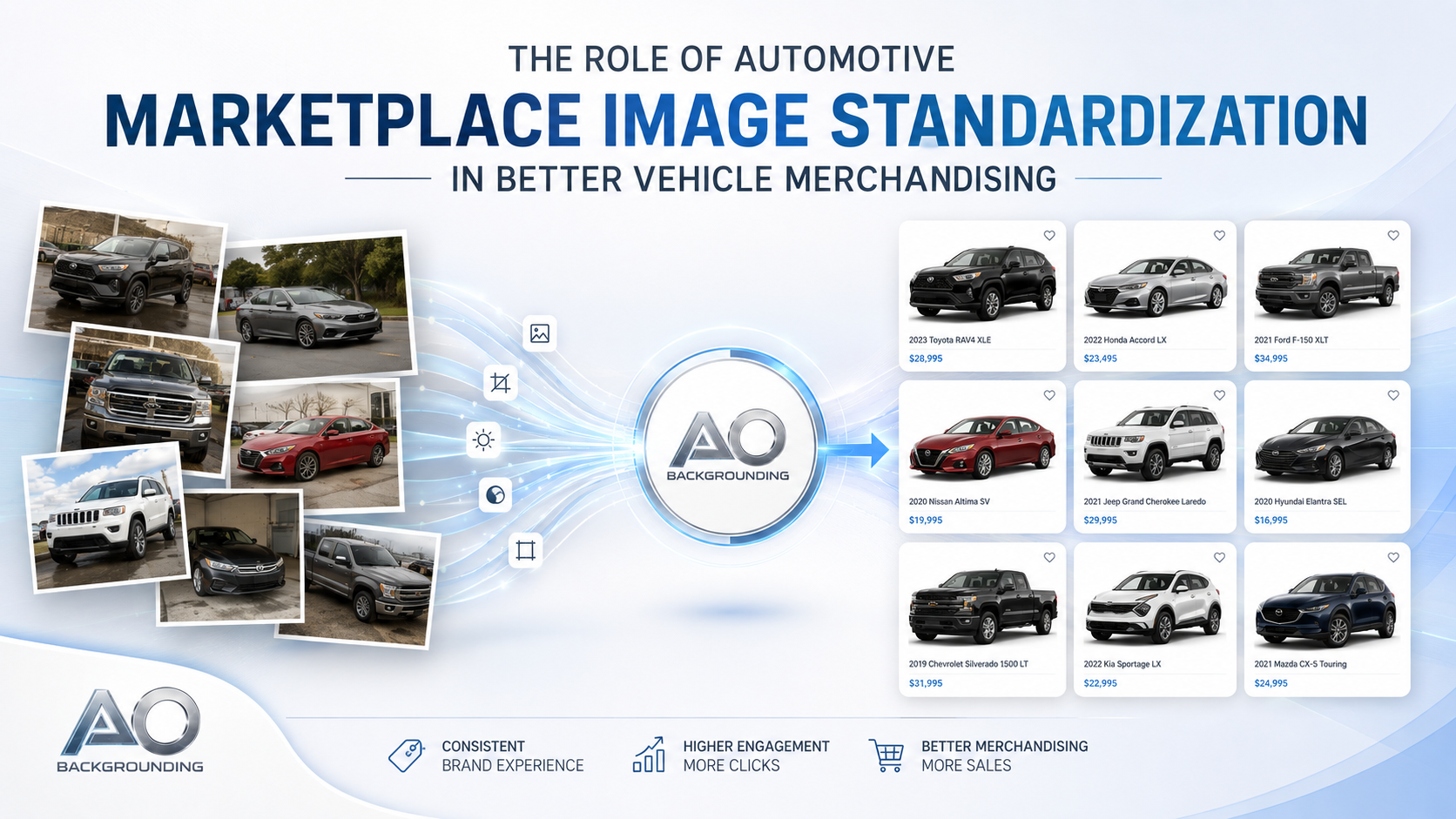
Vehicle merchandising has changed dramatically as more of the car-buying journey moves online.
A shopper may compare dozens of vehicles before ever contacting a dealership. Instead of walking through rows of inventory, buyers increasingly move through search results, vehicle detail pages, marketplace listings, social ads, and recommendation feeds.
In that environment, photography becomes part of the merchandising experience.
The challenge is that automotive marketplaces often receive vehicle images from hundreds or thousands of different sources. One dealership may use professional photographers. Another may rely on sales employees with smartphones. Some vehicles are photographed in dedicated photo areas, while others are captured on crowded lots, beside service departments, or under inconsistent weather conditions.
The result can be a marketplace filled with inventory that looks visually disconnected.
That is where automotive marketplace image standardization becomes valuable.
Rather than requiring every dealership to use the same camera, photography studio, or capture process, marketplaces can standardize how vehicle images are processed and displayed after they enter the system.
Done correctly, that can create a cleaner shopping experience, stronger vehicle merchandising, and a more scalable image workflow.
Price, mileage, trim, equipment, and vehicle history are important parts of an automotive listing.
But images often communicate first.
A shopper scrolling through a marketplace may see several similar vehicles displayed at the same time. Before comparing specifications, the shopper is already reacting to:
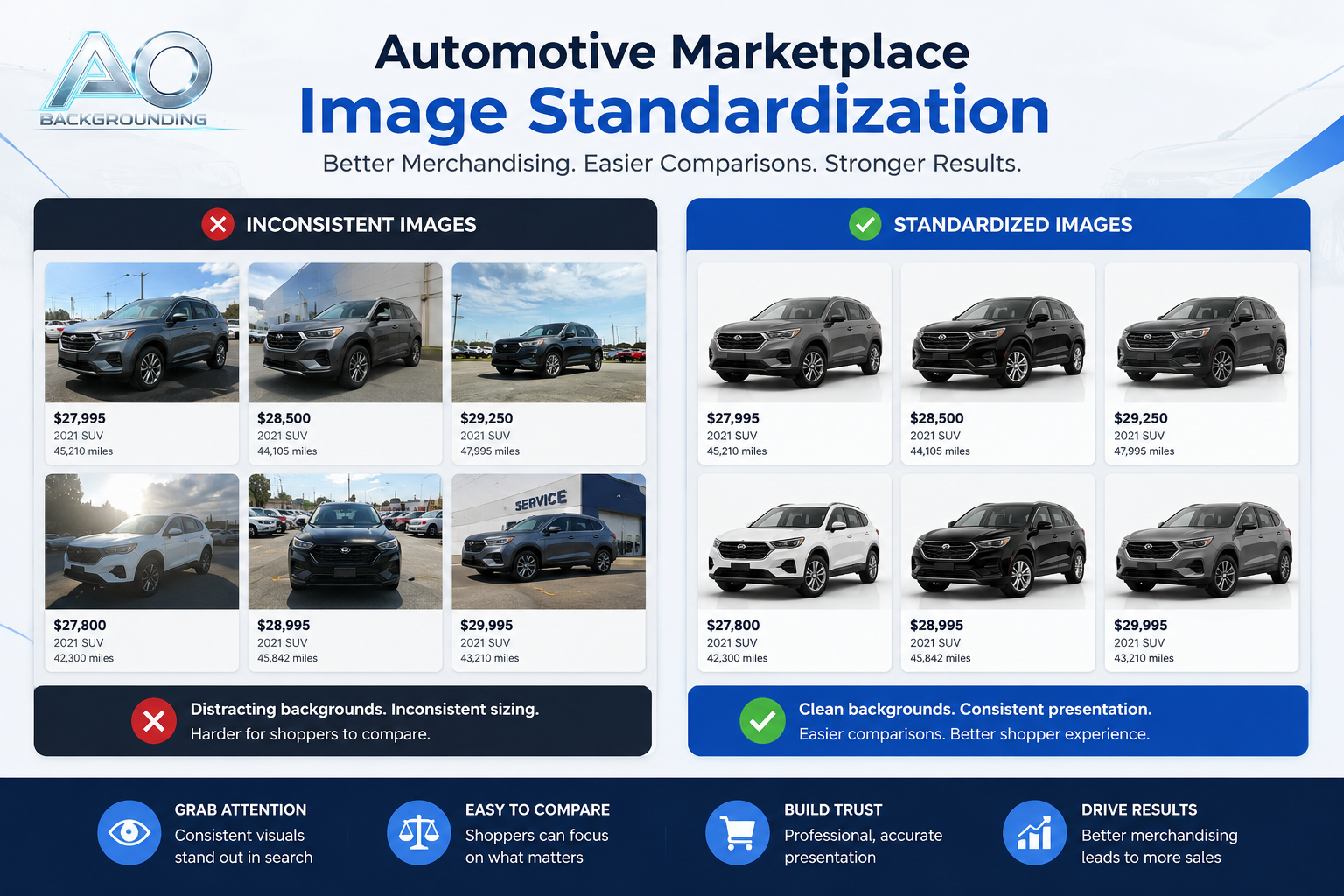
If one vehicle fills the frame correctly while another appears tiny in the corner, the listings immediately feel different.
If one vehicle has a clean background while the next is surrounded by parked cars, signage, employees, and light poles, the shopper's attention is divided.
These inconsistencies can affect how inventory is perceived even when the vehicles themselves are comparable.
Good merchandising reduces unnecessary visual friction.
That makes automotive marketplace image standardization less about making photos attractive and more about creating a predictable environment in which inventory can be compared.
A single dealership may have relatively good control over its photography process.
Employees can be trained to use similar angles.
Vehicles may be photographed in the same area.
The dealership can create guidelines around lighting, distance, camera height, and image order.
A large automotive marketplace operates differently.
Its inventory may come from:
Each source can have a completely different photography workflow.
One dealer may submit 20 carefully photographed images.
Another may submit 60 smartphone photos.
One may use landscape images.
Another may upload images with different aspect ratios.
Some sellers may add logos and promotional banners.
Others may submit completely clean photography.
The larger the marketplace becomes, the harder it is to control every source.
Instead of attempting to standardize every photographer, marketplaces can increasingly standardize the images after they are received.
A marketplace search page is essentially a digital showroom.
Every vehicle occupies a defined visual space.
When images are inconsistent, some listings naturally attract more attention than others for reasons unrelated to the actual vehicle.
Consider a grid of six SUVs.
One SUV is centered and occupies 70% of the frame.
Another occupies only 40%.
One is photographed from a clean front three-quarter angle.
Another is positioned far to one side.
One has a neutral background.
Another includes eight other vehicles behind it.
The interface may be consistent, but the merchandising is not.
Automotive marketplace image standardization can help create a more uniform visual hierarchy.
The goal is not to make every vehicle identical.
The goal is to ensure that shoppers can evaluate inventory without the photography itself becoming a distraction.
Centering may seem like a small photography detail.
At marketplace scale, it becomes much more important.
When vehicles are consistently positioned inside the image canvas, search results look cleaner and easier to scan.
Automated systems can potentially identify the visible boundaries of the vehicle and reposition it within a standardized canvas.
That can help correct situations where a car is:
Consistent centering also makes it easier to create additional image formats later.
A properly positioned source image can be adapted into square, vertical, landscape, and thumbnail formats with less risk of cutting off important parts of the vehicle.
That makes centering both a visual consideration and a distribution consideration.
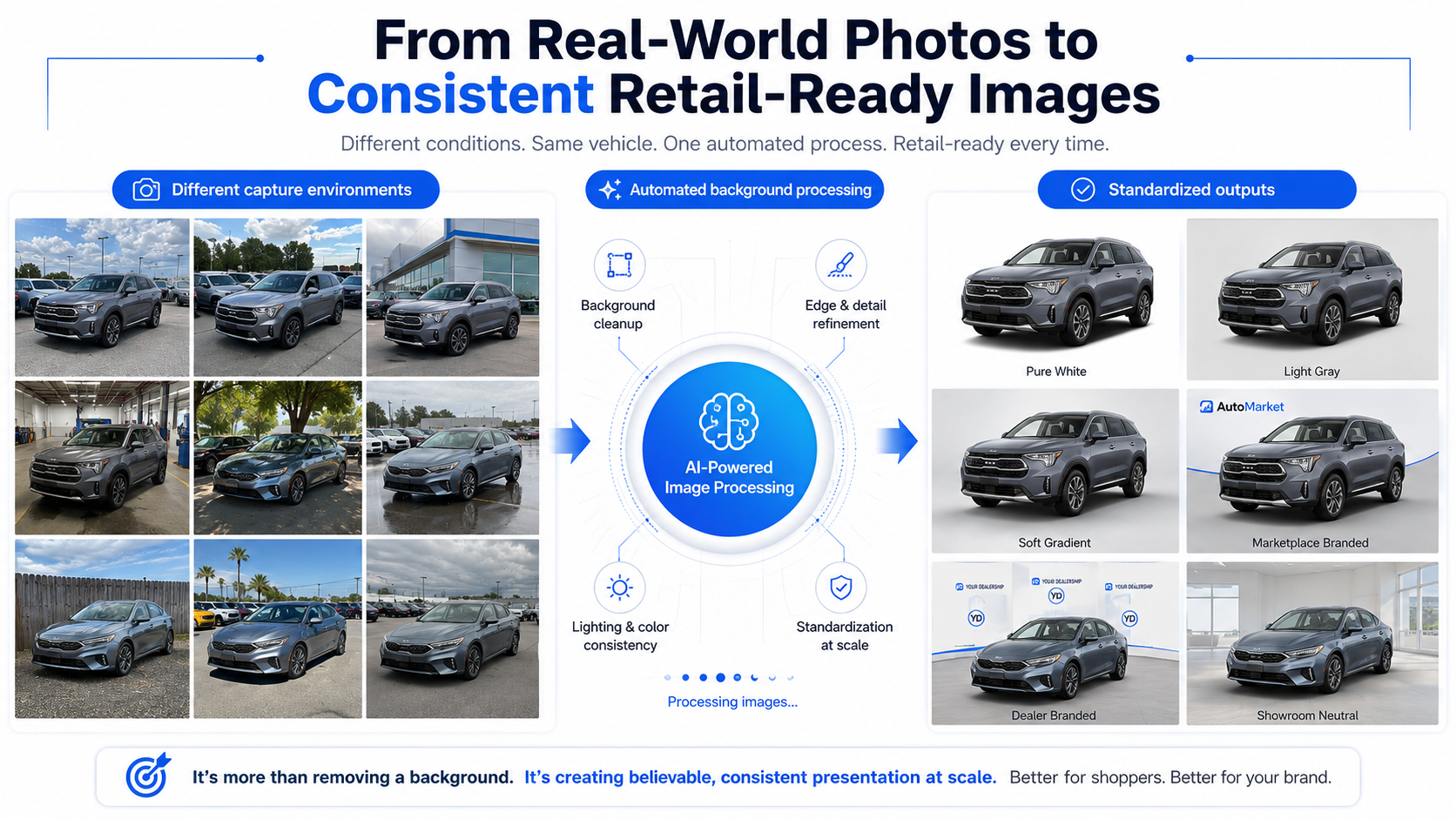
Dealership inventory is rarely photographed under identical conditions.
A vehicle may be photographed:
These environments are normal operational realities.
The marketplace does not necessarily need to eliminate them from the capture process.
Instead, automated background processing can create a standardized presentation afterward.
For example, vehicle images could be placed against:
The important part is consistency.
Good background processing should also preserve natural details around the vehicle, particularly around tires, mirrors, windows, lower body panels, and complex edges.
The goal is not simply to cut out a car.
The goal is to create a retail-ready image that still feels believable.
There is an important distinction between standardizing presentation and altering the vehicle.
Good vehicle merchandising should still represent the actual car.
Processing should not:
Automotive marketplace image standardization should focus on presentation rather than changing the product.
A shopper should receive a clearer view of the vehicle—not a different version of it.
That means the best processing systems prioritize background cleanup, centering, formatting, scaling, and visual consistency while preserving the original vehicle.
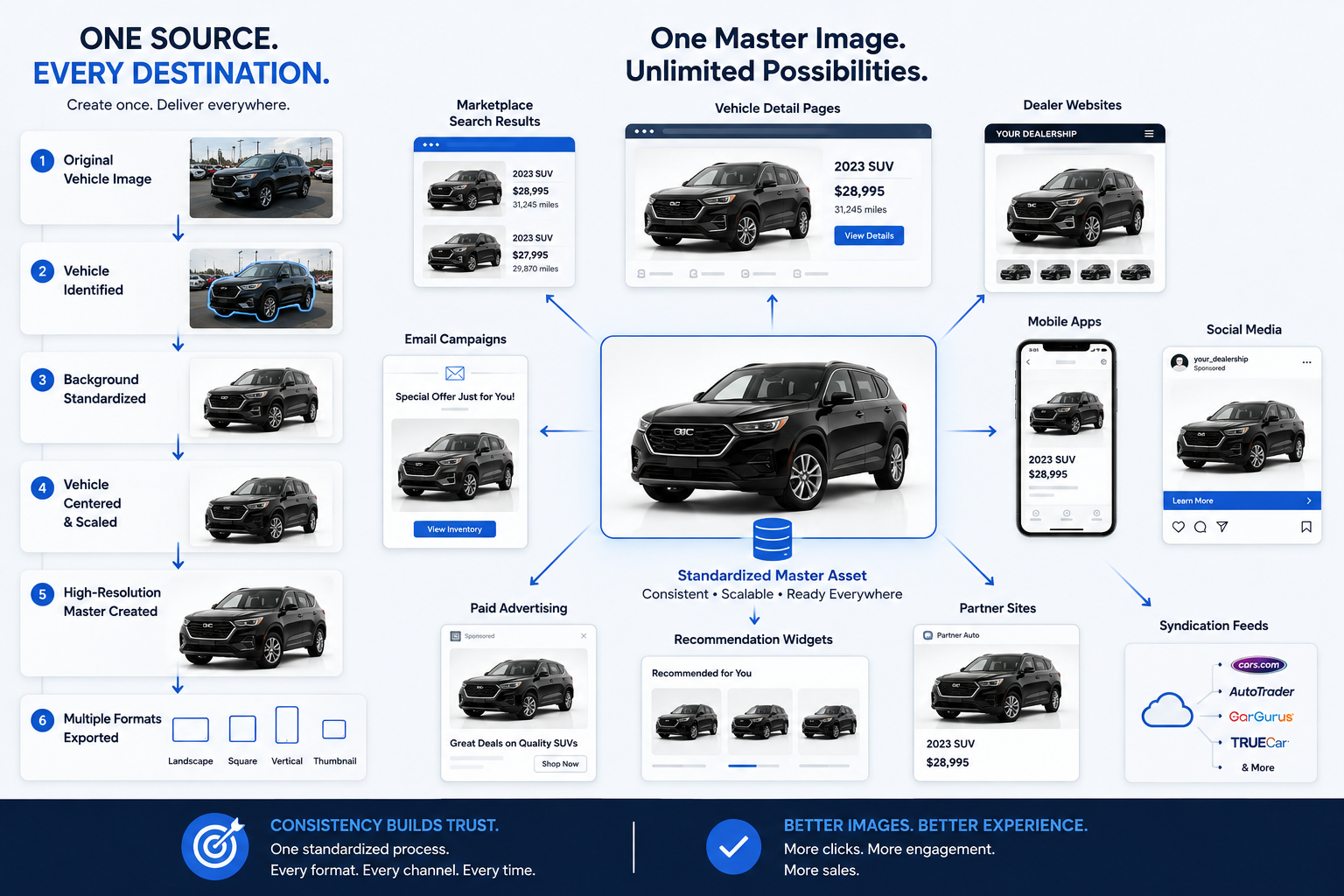
Modern automotive inventory does not stay in one place.
A single vehicle may appear on:
Each destination may display images differently.
A dealer website may prefer wide landscape photography.
A social feed may favor square images.
Mobile advertising may use a vertical format.
Search-result thumbnails may crop the image again.
This creates a strong argument for building a standardized master asset first.
Once the vehicle is properly centered with sufficient space around it, multiple formats can be generated from the same source.
For example:
Original vehicle image
↓
Vehicle identified
↓
Background standardized
↓
Vehicle centered and scaled
↓
High-resolution master created
↓
Landscape, square, vertical, and thumbnail versions exported
This allows the marketplace to adapt the image to the destination instead of repeatedly rebuilding it.
Permanent promotional graphics can make image distribution more difficult.
Dealership-provided images may sometimes include:
These elements may work in a dealership's own marketing environment.
They may not work as well when images are syndicated elsewhere.
A promotional banner can interfere with marketplace interfaces.
A watermark may become enormous after cropping.
Text may become unreadable when converted into a thumbnail.
A better merchandising strategy is to maintain a clean master image and apply branding only when appropriate for the destination.
That gives marketplaces and dealerships far more flexibility.
Manual image editing works differently at 100 vehicles than it does at 100,000.
Imagine manually processing every image by:
Even if each step takes only a small amount of time, the operational cost becomes significant at scale.
Automation changes that equation.
Rather than treating every image as an individual creative project, automotive marketplace image standardization can become a repeatable processing system.
That is a major difference.
The objective is no longer simply "edit this photograph."
It becomes:
Turn every qualifying vehicle image into an asset that follows the marketplace's merchandising standard.
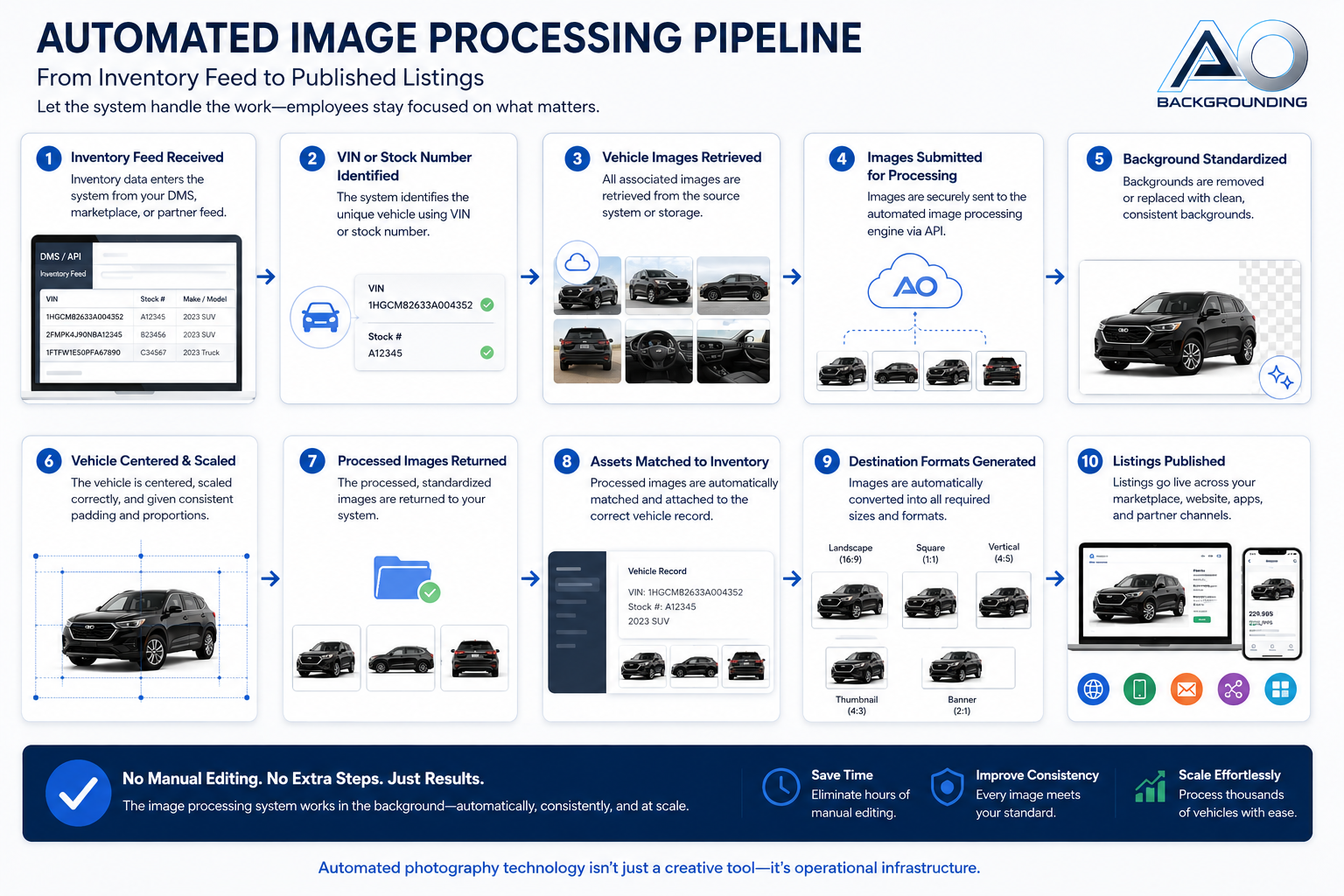
For marketplaces and automotive technology companies, the largest efficiency gains may come when image processing disappears from the employee workflow entirely.
An API can allow processing to happen automatically when inventory enters the system.
A simplified pipeline might look like:
Inventory feed received
↓
VIN or stock number identified
↓
Vehicle images retrieved
↓
Images submitted for processing
↓
Background standardized
↓
Vehicle centered and scaled
↓
Processed images returned
↓
Assets matched to inventory
↓
Destination formats generated
↓
Listings published
Employees may never need to open a separate image editor.
The image-processing system becomes another component of the marketplace infrastructure.
This is where automated photography technology moves beyond being a creative tool and becomes an operational system.
Automation does not mean every image will be perfect.
Source photographs can still present difficult situations.
Examples include:
At scale, the most practical approach is often exception-based quality control.
Most images can move through the automated process normally.
Images with low confidence or unusual processing results can be flagged for review.
That allows human attention to be concentrated where it is most valuable instead of requiring employees to manually inspect and edit everything.
Technology should not determine what a marketplace's vehicle photography looks like.
The marketplace should define that first.
A useful image specification might include requirements for:
Once those rules are documented, different processing systems can be tested against the same standard.
The hardest inventory should be part of that testing.
Do not test only a perfectly photographed white sedan.
Test:
A standard that works only under ideal conditions is not a scalable standard.
The biggest opportunity goes beyond prettier listing photos.
At sufficient volume, automotive marketplace image standardization becomes part of the infrastructure that supports marketplace growth.
More dealerships can contribute inventory.
More photographers can use different capture methods.
More vehicles can enter the platform.
More image formats can be generated.
More partners can receive syndicated assets.
Yet shoppers can continue seeing a consistent visual experience.
That is what makes standardization powerful.
Instead of demanding that every seller build a professional automotive studio, marketplaces can create a processing layer between raw photography and customer-facing inventory.
The marketplace controls the presentation even when it does not control the original photography environment.
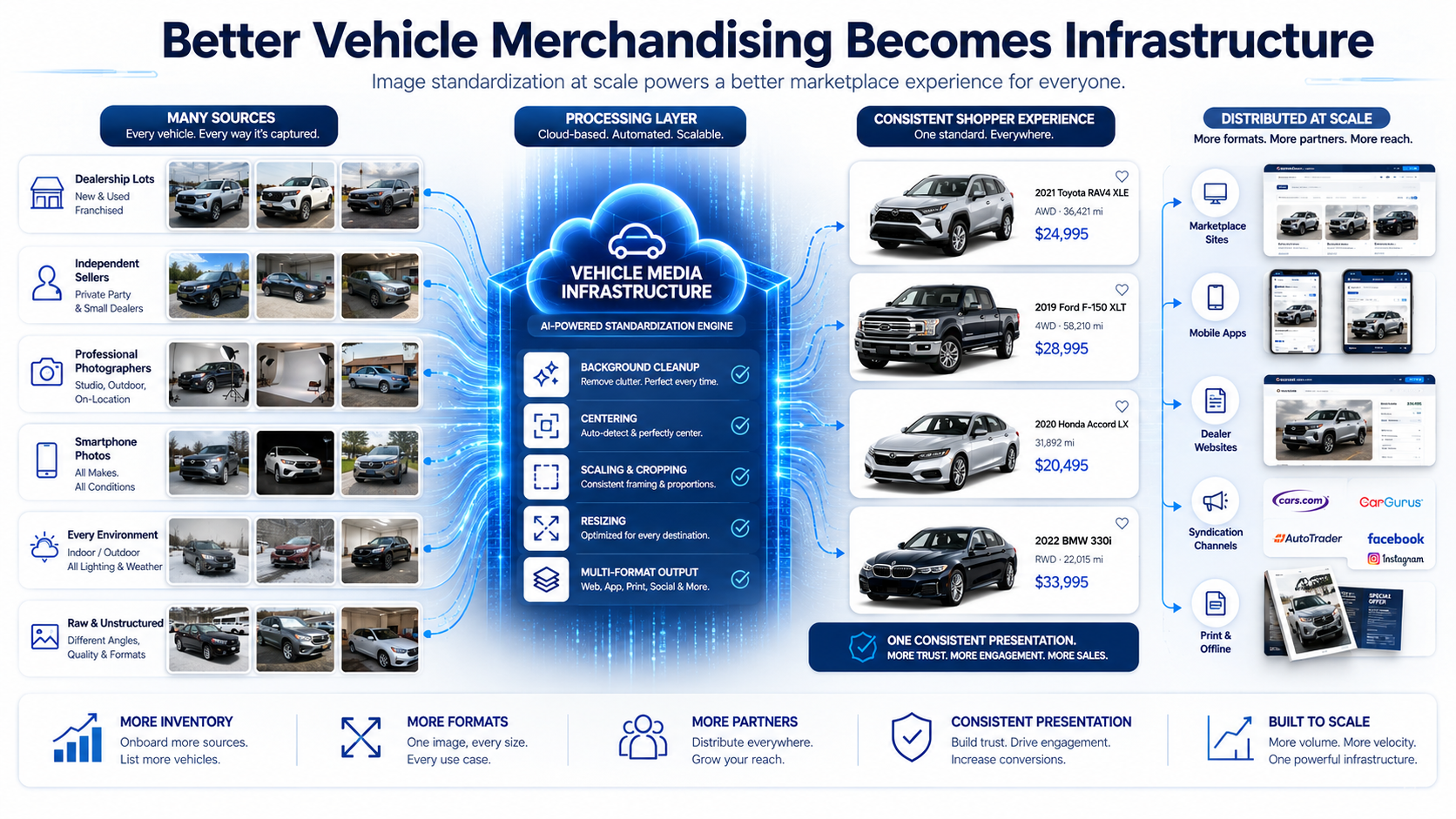
Vehicle merchandising is increasingly a software problem as much as a photography problem.
Marketplaces still need strong source images, but they no longer have to depend entirely on every dealership following an identical capture process.
By combining clear photography standards with automated background processing, vehicle centering, intelligent cropping, multi-format exports, quality control, and API-based workflows, marketplaces can create a repeatable system for presenting inventory consistently.
That is the broader role of automotive marketplace image standardization.
It helps turn varied dealership photography into a unified retail experience.
And as inventory grows from hundreds of vehicles to thousands—or millions—the ability to maintain that consistency without increasing manual work at the same rate can become a meaningful competitive advantage.


Compact, ready to go anywhere
Interchangeable lens that’s upgradeable
Dual 1-inch sensors for improved clarity and low light performance
Dynamic range and 6K 360° capture
360° photo resolution at 21MP

8K 360° video recording for ultra-detailed visuals.
4K single-lens mode for traditional wide-angle shots.
Invisible selfie stick effect for drone-like perspectives.
2.5-inch touchscreen with Gorilla Glass protection.
Waterproof up to 33ft for underwater shooting.

360° photo resolution in 23MP
Slim design at 24 mm thick
Built-in image stabilization for smooth video capture.
Internal 19GB storage for photo and video storage.
Wireless connectivity for remote control and sharing.

60MP 360° still images for high-resolution photography.
5.7K 360° video recording at 30fps.
2.25-inch touchscreen for intuitive control.
USB Type-C port for fast charging and data transfer.
MicroSD card slot for expandable storage.
.png)

.png)

Try it free. No credit card required. Instant set-up.







.svg)


.svg)