


.png)


Real estate marketing has never stood still. From printed flyers and newspaper listings to online photo galleries and virtual tours, each generation of technology has reshaped how properties are presented and sold. Today, the industry is entering its most transformative phase yet: AI video in real estate marketing.
This evolution isn’t about trends or gimmicks. It’s about how buyers consume information, how agents compete for attention, and how technology enables scale. In this guide, we’ll explore the real estate marketing evolution, the rise of photo to video real estate marketing, current real estate video marketing trends, and what all of this means for the future of real estate marketing. 🚀
For decades, real estate marketing revolved around still photography. A strong set of photos was once enough to attract interest and schedule showings. With a real estate video app, agents can quickly produce professional listing videos that attract more buyers.
Photos offered:
As online listings became mainstream, photo galleries replaced printed brochures. This was a major leap forward—but it had limits.
Photos show what a property looks like, but not how it feels.
As buyer behavior changed, the weaknesses of static photos became more obvious.
Photo-only listings often:
At the same time, competition increased. Buyers could scroll through dozens of listings in minutes, making it harder for any single property to stand out.
This pressure sparked the next phase of real estate marketing evolution.
Video was the natural next step.
Walkthrough videos, drone footage, and agent-led tours added motion and storytelling to listings. Video helped buyers:
This marked the beginning of real estate video marketing trends that are now standard.
However, traditional video production came with challenges:
Video worked—but it wasn’t accessible for every listing.
Most agents and teams reserved video for:
Why? Because manual video production requires:
As a result, video became selective instead of universal. The industry needed a way to scale video without increasing workload or cost.
That’s where AI enters the story.
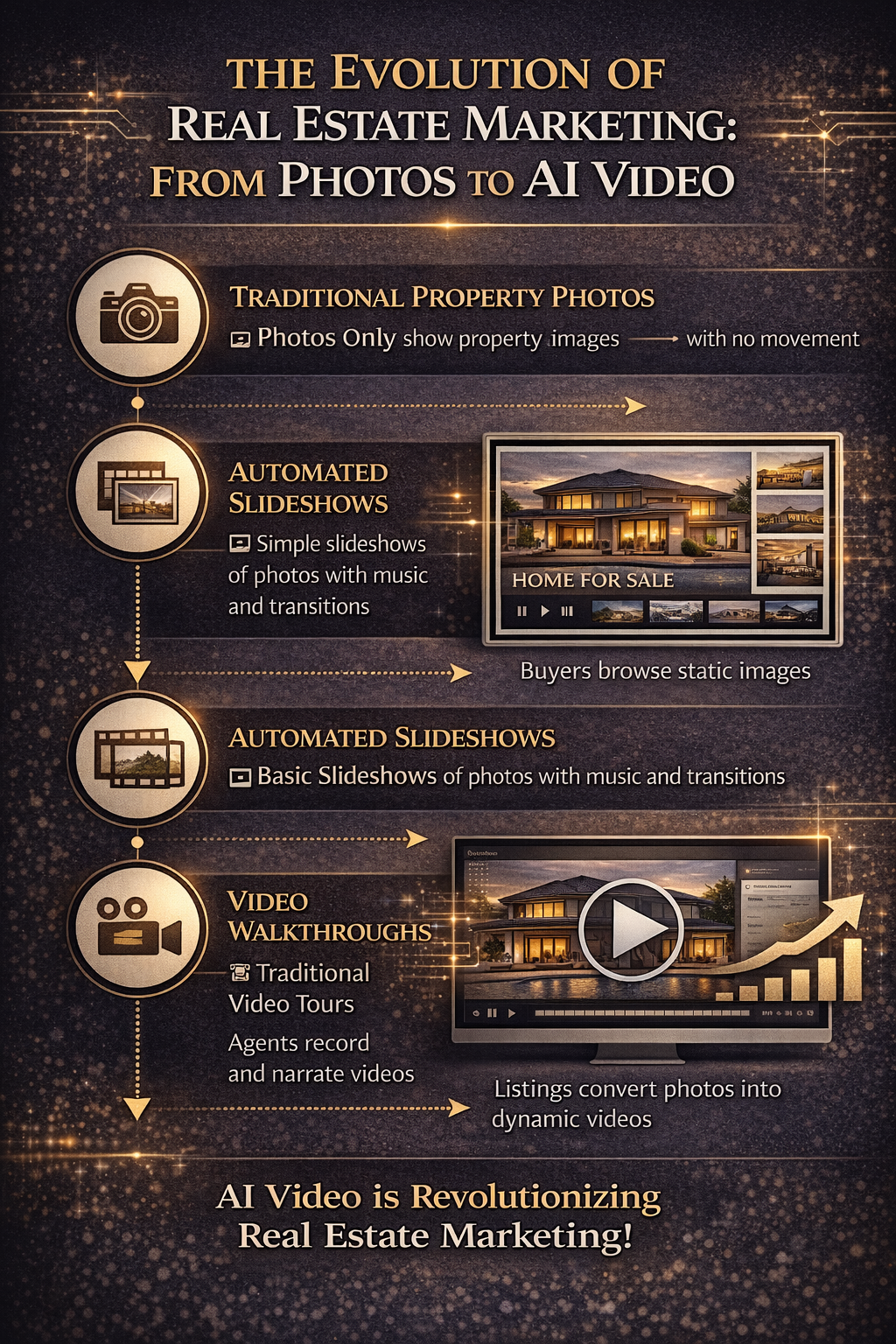
AI video in real estate marketing represents the biggest leap since online listings themselves.
AI-powered systems automatically transform existing assets—like photos, floor plans, and listing data—into polished, professional videos. This is the rise of photo to video real estate marketing.
Instead of manual editing, AI:
This automation removes the bottleneck that held video back for years.
Photo to video real estate marketing doesn’t replace photography—it elevates it.
AI uses photos as raw input and enhances them with:
The result is a guided experience rather than a static gallery.
Buyers don’t just see the property—they experience it.
This shift is central to modern real estate video marketing trends.
AI video adoption is accelerating because it aligns perfectly with today’s demands.
Agents and teams want:
Buyers want:
AI video delivers on both sides.
This is why AI video in real estate marketing is becoming the new baseline.
Another major force driving the evolution is mobile behavior.
Most buyers now:
Static photos struggle in social feeds. AI-generated videos thrive because they:
This makes AI video essential for modern distribution—not just listings.
Automation is what separates AI video from every previous phase.
With AI-powered workflows:
This is a major milestone in the future of real estate marketing.
Marketing stops being a task and becomes a system.
In earlier phases, consistency depended on human effort. AI changes that.
AI video ensures:
Over time, this consistency builds trust and authority—two of the most important factors in real estate success.
Another defining aspect of the current evolution is measurability.
AI-powered video allows professionals to:
This aligns with broader real estate video marketing trends focused on optimization and ROI.
Marketing decisions become informed instead of instinctive.
Buyers adapt quickly to better experiences.
As AI video becomes more common:
This shift in perception accelerates the industry-wide transition.
The bar keeps rising.
Looking ahead, AI will continue to expand its role.
Future developments may include:
The future of real estate marketing isn’t about replacing agents—it’s about empowering them with better tools.
AI video is the foundation of that future.
The evolution of real estate marketing tells a clear story:
AI video in real estate marketing isn’t just the next step—it’s the turning point where video becomes universal, not optional.
For professionals who want to stay relevant, competitive, and efficient, embracing photo to video real estate marketing is no longer a question of if—but when.
The future is already here.
And it’s moving. 🎥🏡✨


Compact, ready to go anywhere
Interchangeable lens that’s upgradeable
Dual 1-inch sensors for improved clarity and low light performance
Dynamic range and 6K 360° capture
360° photo resolution at 21MP

8K 360° video recording for ultra-detailed visuals.
4K single-lens mode for traditional wide-angle shots.
Invisible selfie stick effect for drone-like perspectives.
2.5-inch touchscreen with Gorilla Glass protection.
Waterproof up to 33ft for underwater shooting.

360° photo resolution in 23MP
Slim design at 24 mm thick
Built-in image stabilization for smooth video capture.
Internal 19GB storage for photo and video storage.
Wireless connectivity for remote control and sharing.

60MP 360° still images for high-resolution photography.
5.7K 360° video recording at 30fps.
2.25-inch touchscreen for intuitive control.
USB Type-C port for fast charging and data transfer.
MicroSD card slot for expandable storage.
.png)

.png)

Try it free. No credit card required. Instant set-up.







.svg)


.svg)