


.png)



Real estate teams no longer operate from a single office—or even a single city. Remote agents, hybrid teams, and distributed brokerages are now the norm. While this flexibility opens new opportunities, it also creates new marketing challenges—especially when it comes to video.
Video remains one of the most effective tools in real estate marketing, but traditional production models weren’t designed for remote workflows. Scheduling shoots, coordinating editors, and maintaining consistent branding becomes exponentially harder when teams aren’t physically together.
This is where AI video for remote real estate teams changes the game.
By automating video creation and removing the need for in-person filming, AI makes it possible for teams to stay aligned, visible, and competitive—no matter where their agents are located.
In this guide, we’ll explore how real estate video automation for teams supports remote and hybrid operations, simplifies workflows, and enables scalable marketing without geographic limitations.
Over the last few years, real estate has shifted dramatically. Teams now operate with:
This evolution creates freedom—but also friction.
Marketing, especially video marketing, often becomes fragmented when teams are spread out. Different agents use different tools, vendors, or styles, leading to inconsistent branding and uneven quality.
To succeed long-term, remote teams need centralized, automated solutions—and video is no exception.
Even in a remote-first world, buyers still expect rich visual experiences. Video helps:
For hybrid and remote teams, video isn’t optional—it’s foundational.
The challenge is producing video consistently without relying on physical proximity.
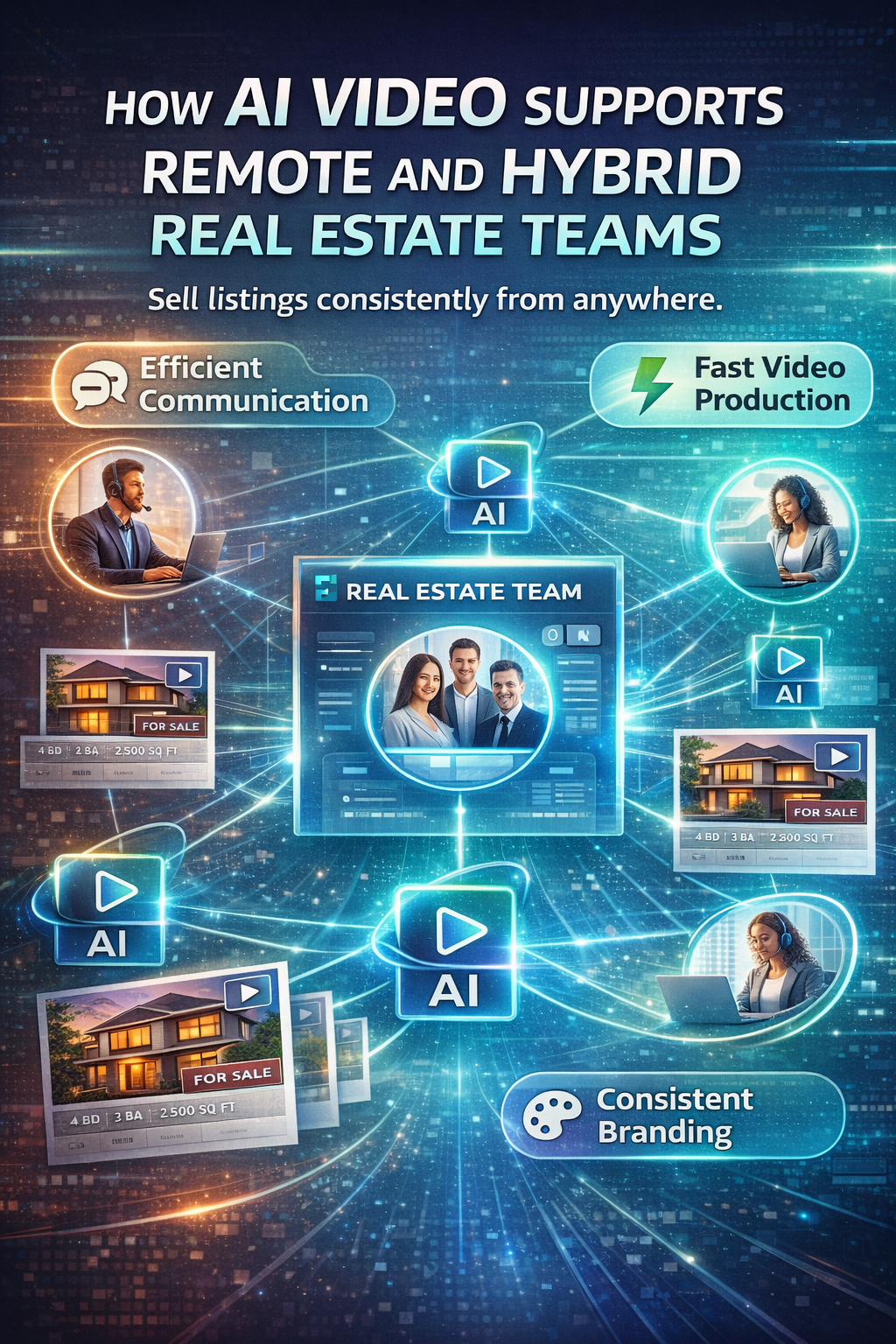
AI video for remote real estate teams allows agents to create professional videos without being in the same location—or even filming at all.
Instead of coordinating shoots, teams can:
This approach eliminates location-based bottlenecks and empowers every agent, regardless of where they work.
AI becomes the bridge that connects remote teams through consistent, scalable video content.
Hybrid real estate team marketing requires tools that work both in-office and remotely.
AI video platforms fit perfectly into hybrid models because they:
Whether an agent is in the office, at home, or on the road, they can access the same video tools and produce the same quality content.
This consistency strengthens the brand while preserving flexibility.
The best AI tools for virtual real estate marketing are designed to support digital-first operations.
They allow teams to:
These tools act as a virtual marketing department—always on, always available.
For remote teams, this means less coordination and more execution.
One of the most powerful advantages of AI is remote property video creation without filming.
Instead of relying on:
Teams can use existing listing photos to generate videos remotely.
This is ideal for:
AI removes geography from the equation.
Real estate video automation for teams allows marketing to operate like a system—not a series of one-off tasks.
Automation enables:
Instead of chasing assets and approvals, teams build workflows that run in the background.
This is especially valuable for remote teams that rely on clarity, structure, and repeatability.
One of the biggest challenges for distributed teams is brand consistency.
Different agents often:
AI solves this by locking in:
Every video follows the same brand rules—no matter who creates it or where they’re located.
This consistency builds trust with sellers and recognition in the market.
Speed matters in real estate. The faster a listing is marketed, the better its chances of early engagement.
AI video reduces turnaround time dramatically:
Remote teams can generate videos in minutes instead of days, ensuring listings go live quickly and consistently.
Speed is a competitive advantage—especially in distributed environments.
Remote teams thrive on autonomy—but they still need alignment.
AI video platforms allow leadership to:
Agents gain independence, while the brand stays intact.
This balance is critical for scaling remote and hybrid teams effectively.
AI-generated videos aren’t limited to listings.
Remote teams can use the same videos for:
This allows teams to maintain a strong digital presence without additional production effort.
One video fuels multiple touchpoints.
Remote and hybrid teams often operate with leaner budgets.
AI video helps reduce costs by:
This makes professional video accessible to every listing—not just high-end properties.
Cost efficiency supports growth without sacrificing quality.
Remote transactions require trust. Video helps bridge the gap between physical distance and emotional connection.
AI-powered videos:
For teams that rarely meet clients in person, video becomes a critical relationship-building tool.
AI video systems improve over time.
As teams scale:
Whether you manage five agents or fifty, AI adapts to your structure.
This makes it a long-term investment—not a temporary solution.
Some teams worry AI video feels impersonal.
In reality, AI handles the repetitive tasks—while agents control messaging, tone, and distribution.
AI enhances consistency and efficiency without replacing human connection.
When used well, AI video feels modern, professional, and intentional.
Remote and hybrid teams are here to stay.
The teams that succeed will be those who adopt tools built for distributed operations—especially when it comes to video.
AI video for remote real estate teams, hybrid real estate team marketing, and real estate video automation for teams aren’t trends—they’re the new foundation.
AI video empowers real estate teams to market listings consistently—no matter where agents work.
By embracing:
remote and hybrid teams can stay competitive, visible, and aligned.
In a distributed world, AI video isn’t just helpful—it’s essential. 🚀🏡


Compact, ready to go anywhere
Interchangeable lens that’s upgradeable
Dual 1-inch sensors for improved clarity and low light performance
Dynamic range and 6K 360° capture
360° photo resolution at 21MP

8K 360° video recording for ultra-detailed visuals.
4K single-lens mode for traditional wide-angle shots.
Invisible selfie stick effect for drone-like perspectives.
2.5-inch touchscreen with Gorilla Glass protection.
Waterproof up to 33ft for underwater shooting.

360° photo resolution in 23MP
Slim design at 24 mm thick
Built-in image stabilization for smooth video capture.
Internal 19GB storage for photo and video storage.
Wireless connectivity for remote control and sharing.

60MP 360° still images for high-resolution photography.
5.7K 360° video recording at 30fps.
2.25-inch touchscreen for intuitive control.
USB Type-C port for fast charging and data transfer.
MicroSD card slot for expandable storage.
.png)

.png)

Try it free. No credit card required. Instant set-up.






.svg)


.svg)