


.png)


If you sell homes for a living, you already know how much a polished property video can add to a listing's story. The question isn't whether video belongs in your marketing strategy — it's how to create it efficiently.
Do you hire a professional videographer for every property, or use a real estate video maker that turns your existing listing photos into a polished video? Both approaches can produce great results, but they differ significantly in cost, turnaround time, creative flexibility, and how easily they can scale across multiple listings.
This isn't about replacing professional videographers. For the right property, a skilled videographer with professional equipment and drone capabilities can absolutely be worth the investment.
But for the steady stream of condos, starter homes, suburban properties, and other everyday listings most agents handle, automation can offer a practical alternative. Let's compare the tradeoffs so you can decide which approach makes the most sense for each listing.
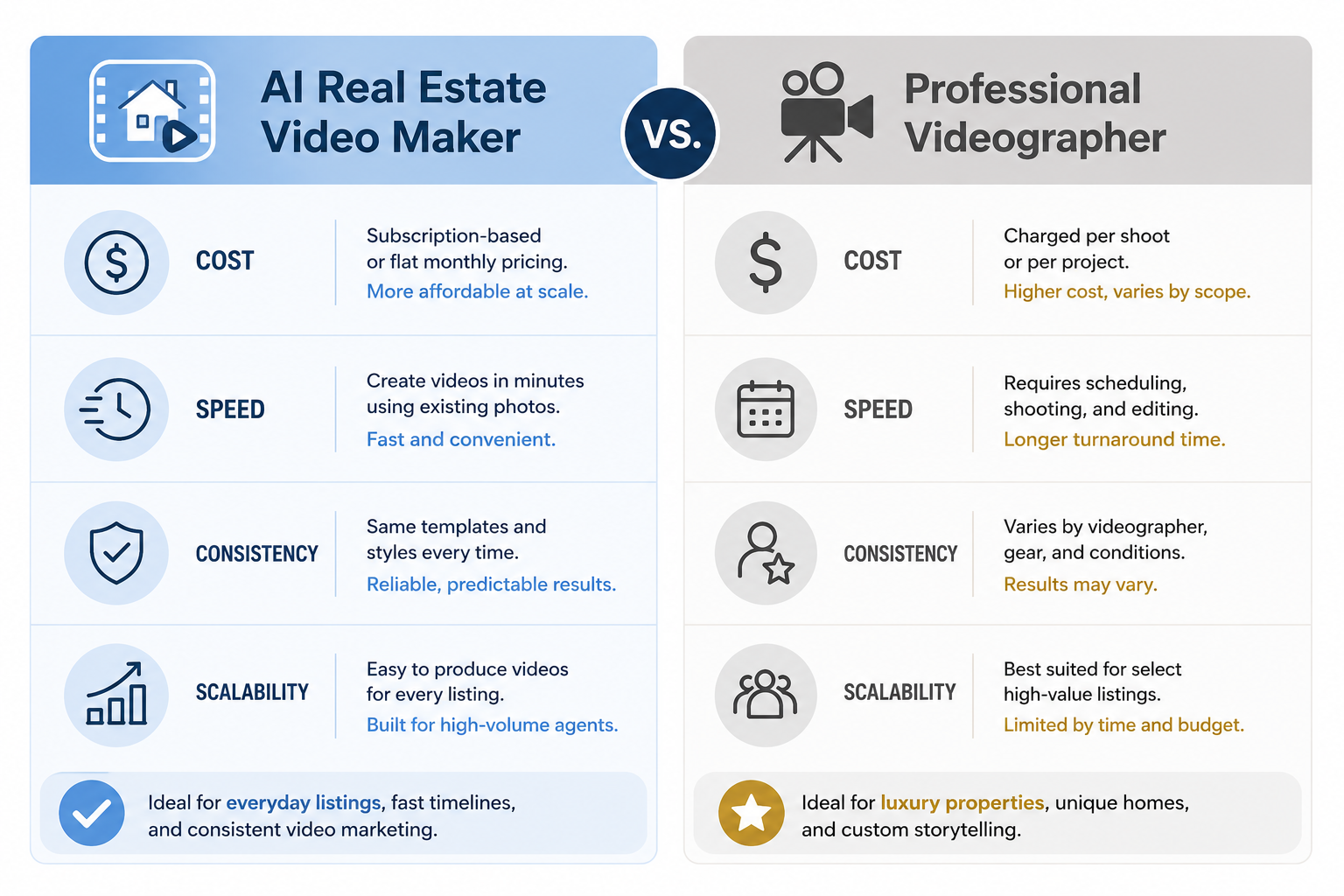
Professional real estate videographers typically charge per shoot, with rates varying significantly depending on the market, property, and scope of the project. A basic walkthrough may cost a few hundred dollars, while adding services such as drone footage, voiceover, advanced editing, or expedited delivery can increase the price considerably.
Multiply that cost across several active listings in a month, and professional video can quickly become a substantial part of your marketing budget. That's one reason some agents reserve professional videography for properties where the additional investment makes the most sense.
A real estate video maker uses a different pricing model. Instead of paying for a separate production for each property, you typically pay for a subscription or usage plan and create videos within the limits of that plan.
PhotoAIVideo, for example, offers a Free plan along with paid Creator and Pro options. You can compare the current features and costs on the PhotoAIVideo pricing page.
This type of pricing can make it easier to incorporate video across more listings without budgeting for a separate professional shoot every time.
Speed is one of the biggest differences between the two approaches.
Hiring a videographer usually means checking availability, coordinating with the seller, preparing the property for a specific shoot date, completing the shoot, and then waiting for editing and revisions.
Depending on the videographer's schedule and workload, the entire process may take several days.
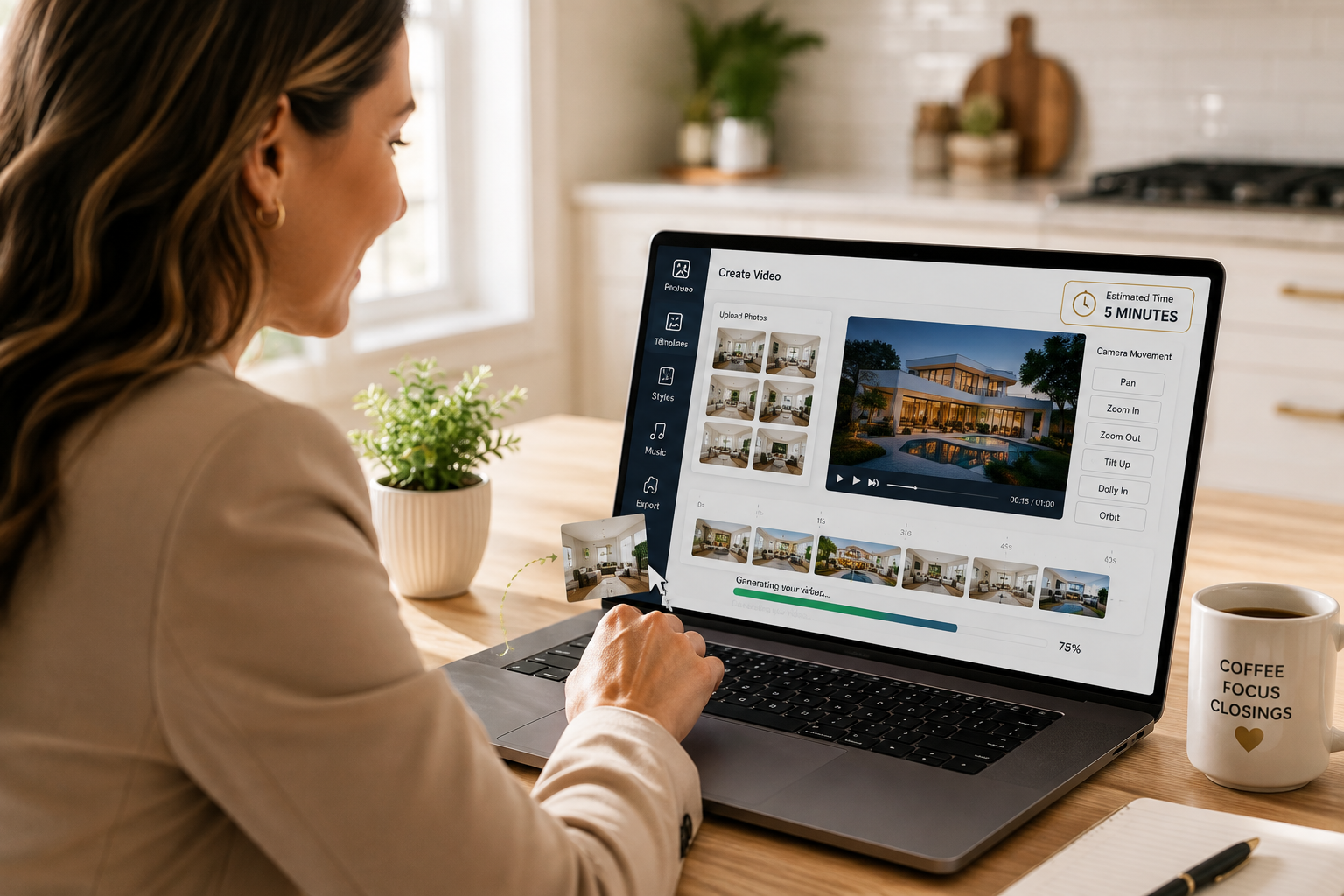
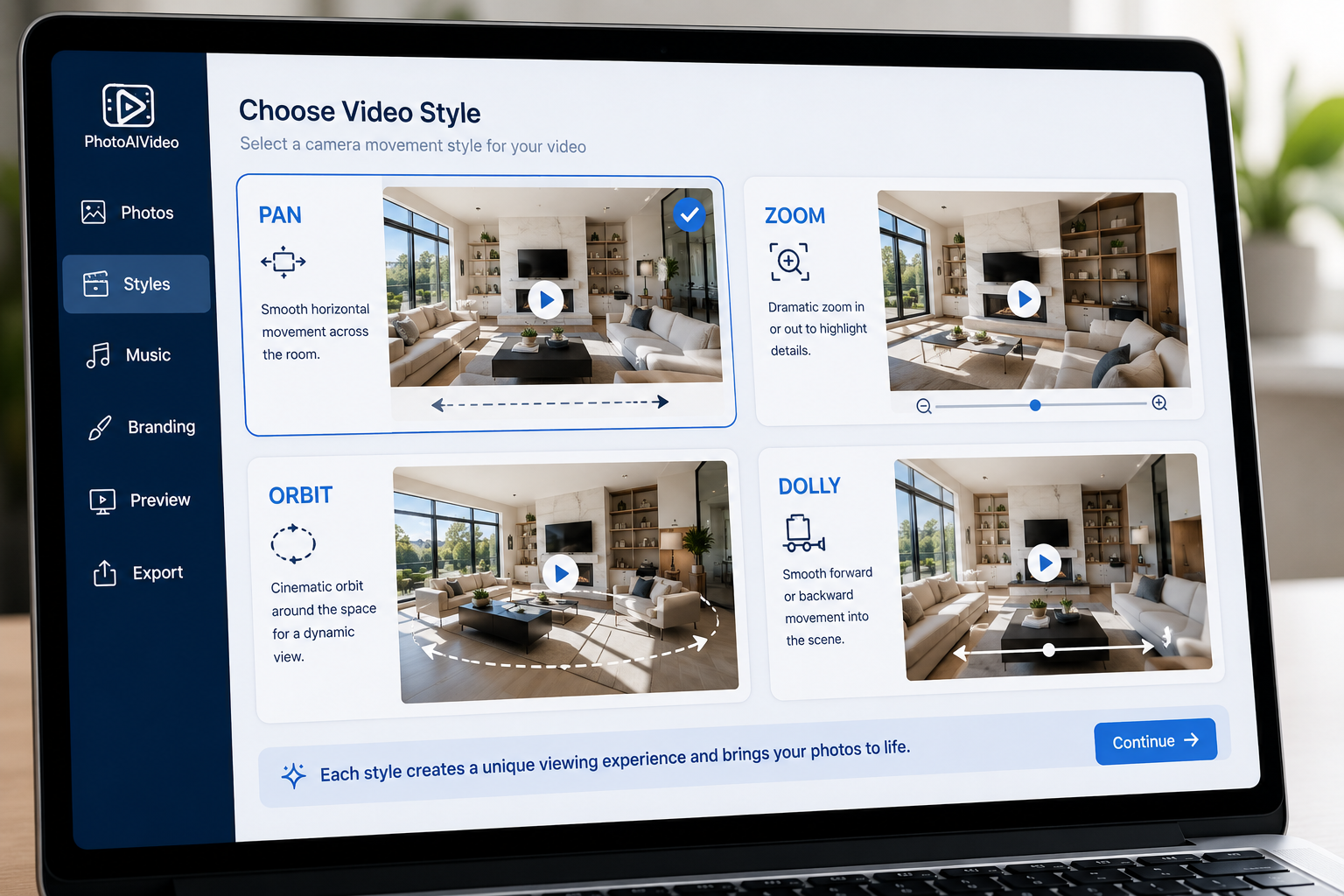
An AI video generator can simplify that workflow by using listing photos you already have. Upload the photos you or your photographer captured, select a style and available camera movements — such as pan, zoom, tilt, dolly, or orbit — and let the platform generate the video.
There's no additional filming day to coordinate and no separate editing schedule to manage.
That can be especially useful when you want your video ready shortly after the listing goes live, while buyer interest is still fresh.
This is an area where a skilled professional videographer still has a clear advantage.
An experienced videographer can make real-time decisions about lighting, movement, framing, composition, and storytelling that a photo-to-video tool can't fully replicate. For architecturally distinctive homes, luxury properties, or listings where premium marketing is a major part of the strategy, that additional creative control can be worth the investment.
AI-generated video offers a different advantage: repeatability.
A real estate video maker can apply the same camera-movement styles, branding, and overall presentation across multiple properties. That can help agents maintain a more consistent visual identity from one listing to the next.
If you're curious about how AI-generated property videos compare with the original listing photos, browse PhotoAIVideo's before-and-after examples and judge the results for yourself.
One of the most important questions when building a real estate video marketing strategy is whether your workflow can realistically scale across your entire pipeline.
Professional videography can be an excellent investment, but paying for and scheduling a separate shoot for every property may not be practical for every agent or brokerage.
That's where AI-powered video creation becomes useful.
Industry research on buyer behavior, including ongoing work from the National Association of Realtors, continues to show how important digital media has become throughout the home-search process.
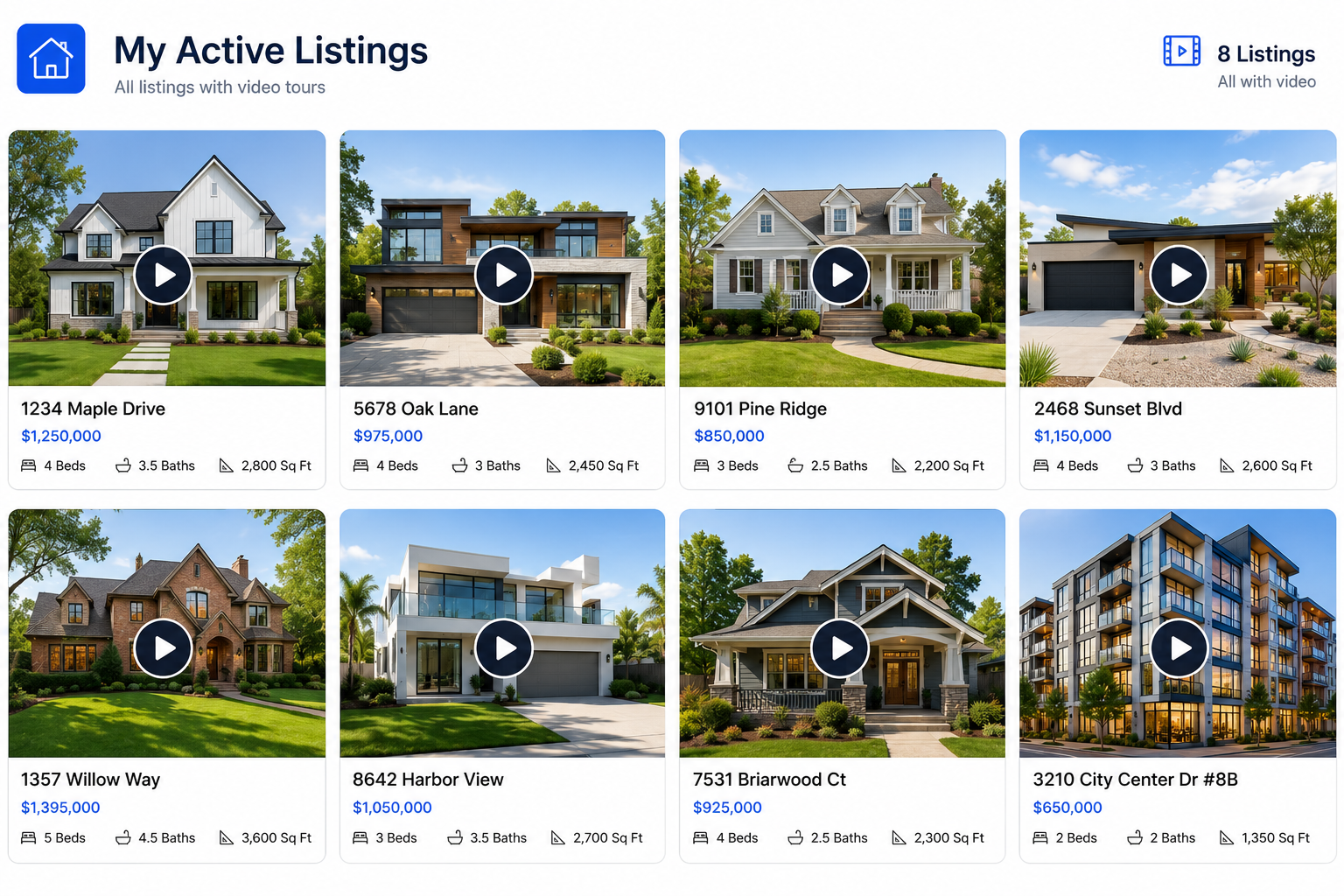
Rather than limiting video to a handful of flagship properties, an AI real estate video maker can make it more practical to create video content for a larger portion of your inventory.
For high-volume agents in particular, that scalability can be one of the strongest advantages of an automated workflow.
Hiring a videographer also requires coordination.
You need to find a time that works for the seller and videographer, prepare the home for filming, account for weather if exterior or drone footage is involved, and potentially be available during the shoot.
If the seller reschedules or weather conditions change, the shoot — and your marketing timeline — may need to move with it.
A real estate video maker avoids many of those logistical steps because it can work with listing photos already captured as part of your normal marketing process.
There's no separate video shoot to schedule, no additional property visit solely for filming, and less dependency on another person's calendar.
You can also create a new version later if the listing changes, you want to highlight different features, or you're preparing a fresh marketing push.
A professional videographer brings creative judgment that software can't completely reproduce.
They can adapt to unusual lighting, recognize interesting architectural details, change angles on the spot, and capture continuous movement through a property in ways that static photos simply can't provide.
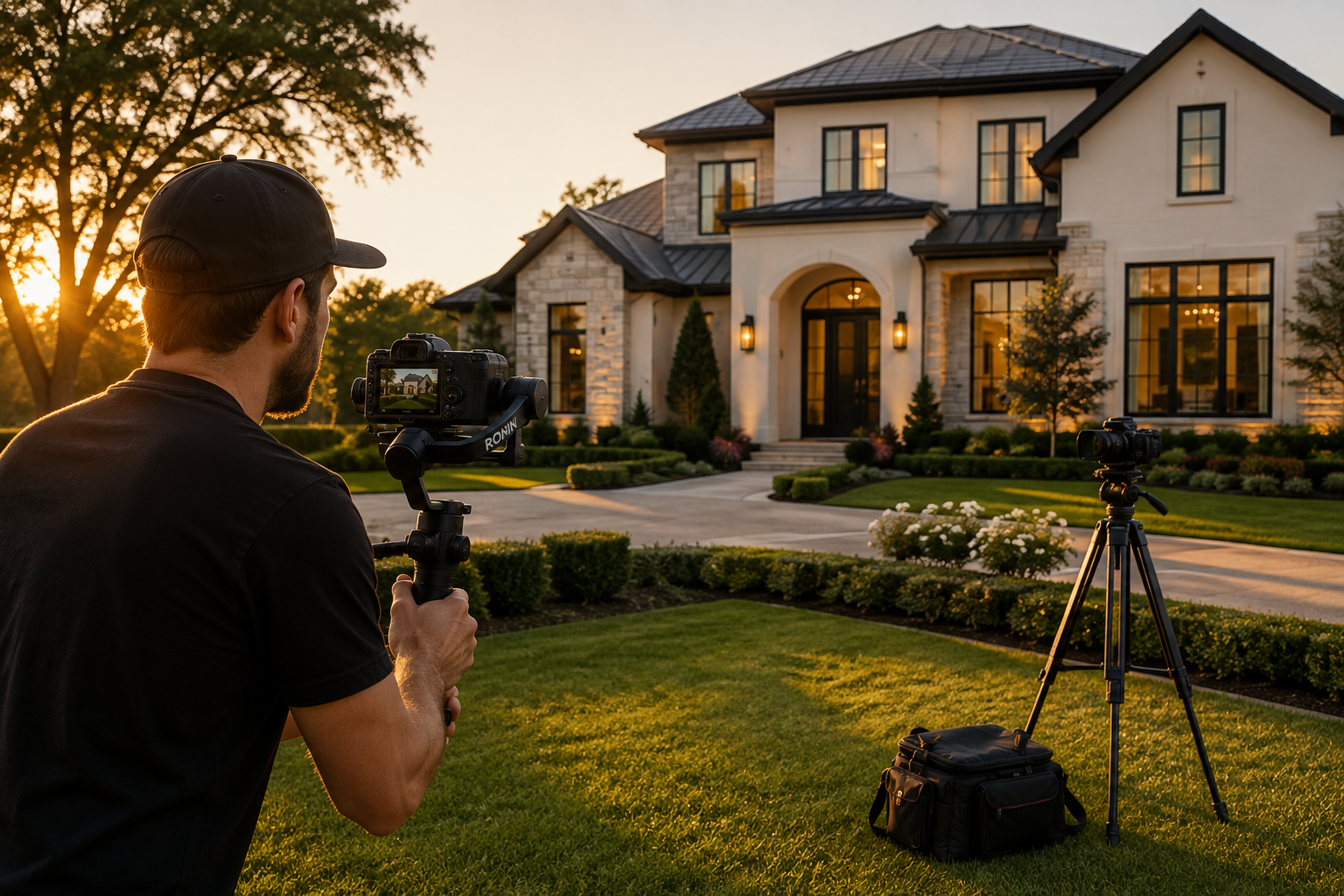
If bespoke storytelling is a priority for a particular listing, that human perspective can be extremely valuable.
A real estate video maker provides a different kind of creative control: speed and repeatability.
Depending on the platform and plan you choose, you may be able to select camera movements, customize the presentation, add branding, and adjust other elements without coordinating every revision with an outside editor.
For agents who want a consistent visual identity across their listing videos, that repeatability can be an important advantage.
Most agents don't necessarily need to choose one approach exclusively.
The better strategy is often to match the production method to the property.
A luxury flagship listing, a builder's signature model home, or a property with a substantial marketing budget may justify hiring a professional videographer. The additional cost and production time can deliver bespoke storytelling, custom cinematography, drone footage, and other creative elements that help showcase an exceptional property.
For everyday listings, an AI real estate video maker can be the more practical option.
Instead of deciding whether each property is worth the cost and scheduling involved in a professional shoot, you can use the listing photos you already have to create additional marketing content.
Platforms designed specifically for real estate, such as PhotoAIVideo's tools for real estate agents, are built around this type of workflow: upload your property photos, customize the presentation, and turn them into video content without organizing another on-site production.
The two approaches can also complement each other.
You might use AI-generated videos as your standard workflow for everyday properties while reserving professional videography for a smaller number of premium listings where custom production provides additional value.
Can a real estate video maker really replace professional videography?
For some listings, yes — particularly when your primary goal is to turn existing property photos into polished video content quickly and efficiently.
For luxury homes, architecturally unique properties, or campaigns requiring custom cinematography, drone footage, narration, or more complex storytelling, a professional videographer may still be the better choice.
Is video worth using for typical listings, not just luxury homes?
Video can be useful well beyond luxury properties. Buyers increasingly research homes online before deciding which properties deserve an in-person visit, making strong digital presentation important across many types of listings.
The right level of video production, however, should still match the property, audience, budget, and marketing strategy.
Do I need to be on camera to use an AI video generator?
No. Photo-to-video tools can create listing videos using property images without requiring you to appear on camera.
If appearing personally in your marketing is important to you, check whether your chosen platform currently offers features such as narration, voiceover, presenters, or other personalization options.
How much time does it take to make an AI listing video?
The exact time depends on the platform, number of photos, selected options, processing time, and any customization you add.
The main advantage is that you're working from existing listing photos, which eliminates the need to schedule and complete a separate video shoot before production can begin.
There's no universally "right" choice between an AI real estate video maker and a professional videographer. The better option depends on the property, budget, timeline, and type of marketing you're trying to create.
Professional videographers continue to offer significant value for signature properties where custom cinematography and storytelling matter.
For the everyday reality of an agent's business — multiple listings, tight timelines, and a marketing budget that needs to stretch across different properties — an AI-powered real estate video maker can offer a practical and scalable alternative.
The strongest strategy may ultimately be to use both.
Reserve professional production for listings where the additional creative investment makes sense, while using AI-powered video to make consistent video marketing more practical across the rest of your inventory.
If you've been reserving video for only a handful of listings, try PhotoAIVideo and see how your existing property photos can be transformed into polished video content.


Compact, ready to go anywhere
Interchangeable lens that’s upgradeable
Dual 1-inch sensors for improved clarity and low light performance
Dynamic range and 6K 360° capture
360° photo resolution at 21MP

8K 360° video recording for ultra-detailed visuals.
4K single-lens mode for traditional wide-angle shots.
Invisible selfie stick effect for drone-like perspectives.
2.5-inch touchscreen with Gorilla Glass protection.
Waterproof up to 33ft for underwater shooting.

360° photo resolution in 23MP
Slim design at 24 mm thick
Built-in image stabilization for smooth video capture.
Internal 19GB storage for photo and video storage.
Wireless connectivity for remote control and sharing.

60MP 360° still images for high-resolution photography.
5.7K 360° video recording at 30fps.
2.25-inch touchscreen for intuitive control.
USB Type-C port for fast charging and data transfer.
MicroSD card slot for expandable storage.
.png)

.png)

Try it free. No credit card required. Instant set-up.






.svg)


.svg)