


.png)


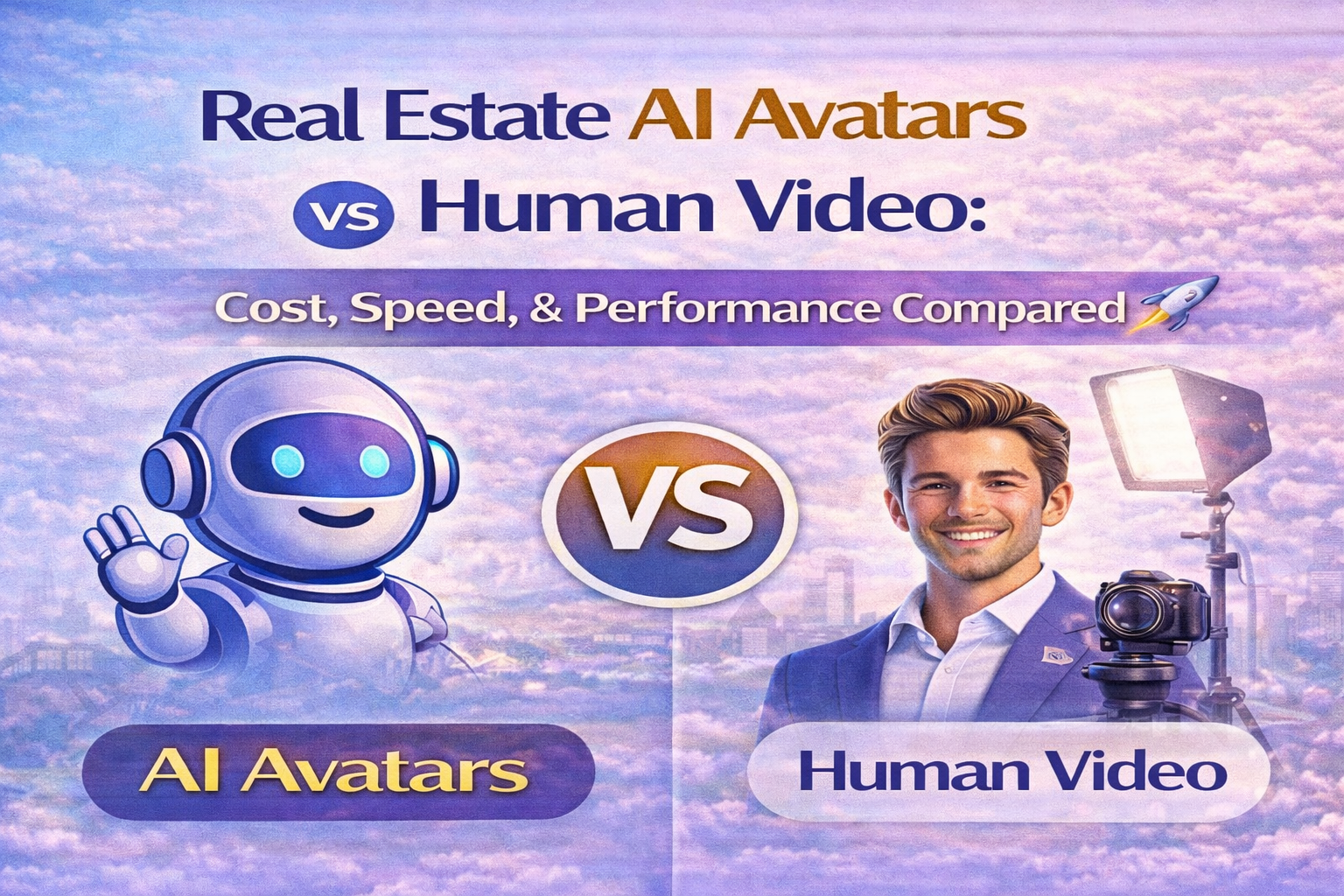
Video has become one of the most powerful tools in real estate marketing. Listings with video get more attention, social platforms prioritize video content, and buyers and sellers expect agents to explain properties visually—not just with text and photos.
But as video demand increases, so do the challenges.
Recording human videos takes time. Editing costs money. Consistency is hard. And for many agents and teams, keeping up with video marketing becomes exhausting.
That’s why the conversation around real estate AI avatars vs human video is heating up.
In this evergreen guide, we’ll compare cost, speed, and performance to help agents, teams, and brokerages understand when a real estate AI avatar makes more sense than traditional human-recorded video—and why many professionals are now using both strategically 📈.
Over the last decade, video has gone from a “nice-to-have” to a requirement. Agents use video for:
But producing high-quality human video at scale is harder than most agents anticipate.
This pressure has opened the door for AI-powered alternatives.
A real estate AI avatar is an AI-generated digital presenter that delivers scripted video content on behalf of an agent or brand.
Instead of filming:
The avatar can resemble the agent’s likeness or follow a branded spokesperson style, depending on the use case.
Human-recorded video involves:
While human video feels personal, it comes with trade-offs—especially when agents are expected to produce content consistently.
Human video often includes:
Even DIY video has hidden costs in time, energy, and inconsistency.
A real estate AI avatar typically involves:
Once set up, generating new videos is fast and affordable, making it easier to justify video for every listing, update, or campaign.
Winner for cost efficiency: AI avatars ✅
With human video:
Busy agents often delay or skip video altogether because of these steps.
With a real estate AI avatar:
This speed allows agents to respond to market changes, new listings, and trends almost instantly.
Winner for speed: AI avatars ⚡
This is where nuance matters.
Human video excels at:
Live presence and personality can be powerful for relationship-building.
AI avatars perform exceptionally well for:
Viewers value clarity and consistency. For informational content, avatars often perform just as well—or better—than rushed human videos.
Performance takeaway:

Consistency is one of the biggest predictors of marketing success.
Human video struggles with consistency because:
A real estate AI avatar delivers:
Over time, this consistency builds recognition and trust.
AI avatars outperform human video in situations that require:
Common examples include:
These are functional videos where clarity matters more than emotion.
Human video remains ideal for:
The most successful agents don’t choose one—they blend both.
Rather than asking “AI avatar or human video?”, the better question is:
👉 Which one fits this specific job?
A hybrid strategy looks like this:
This approach maximizes performance while minimizing burnout.
For teams and brokerages, AI avatars offer massive advantages:
Human video across teams often leads to uneven quality and off-brand messaging. AI avatars solve this at scale.
Search engines reward:
Real estate AI avatars make it easier to:
This strengthens SEO over time—especially for local and niche markets.
A common objection is that AI avatars feel “less authentic.”
In reality:
When scripts are transparent and helpful, avatars build trust—not reduce it.
Human video scales linearly: more effort equals more output.
A real estate AI avatar scales exponentially:
This makes avatars ideal for long-term growth strategies.
To get the best results:
AI avatars are tools, not replacements for relationships.
As AI technology improves:
In the near future, AI avatars won’t feel “alternative”—they’ll feel normal.
The comparison isn’t about replacing humans—it’s about replacing inefficiency.
A real estate AI avatar wins on:
Human video wins on:
Agents and teams who understand this balance will outperform those who rely on one approach alone.
The future of real estate marketing isn’t about working harder—it’s about working smarter.
By using real estate AI avatars alongside human video, agents can:
In a competitive market where attention drives opportunity, leveraging AI isn’t optional—it’s strategic.


Compact, ready to go anywhere
Interchangeable lens that’s upgradeable
Dual 1-inch sensors for improved clarity and low light performance
Dynamic range and 6K 360° capture
360° photo resolution at 21MP

8K 360° video recording for ultra-detailed visuals.
4K single-lens mode for traditional wide-angle shots.
Invisible selfie stick effect for drone-like perspectives.
2.5-inch touchscreen with Gorilla Glass protection.
Waterproof up to 33ft for underwater shooting.

360° photo resolution in 23MP
Slim design at 24 mm thick
Built-in image stabilization for smooth video capture.
Internal 19GB storage for photo and video storage.
Wireless connectivity for remote control and sharing.

60MP 360° still images for high-resolution photography.
5.7K 360° video recording at 30fps.
2.25-inch touchscreen for intuitive control.
USB Type-C port for fast charging and data transfer.
MicroSD card slot for expandable storage.
.png)

.png)

Try it free. No credit card required. Instant set-up.




.svg)


.svg)