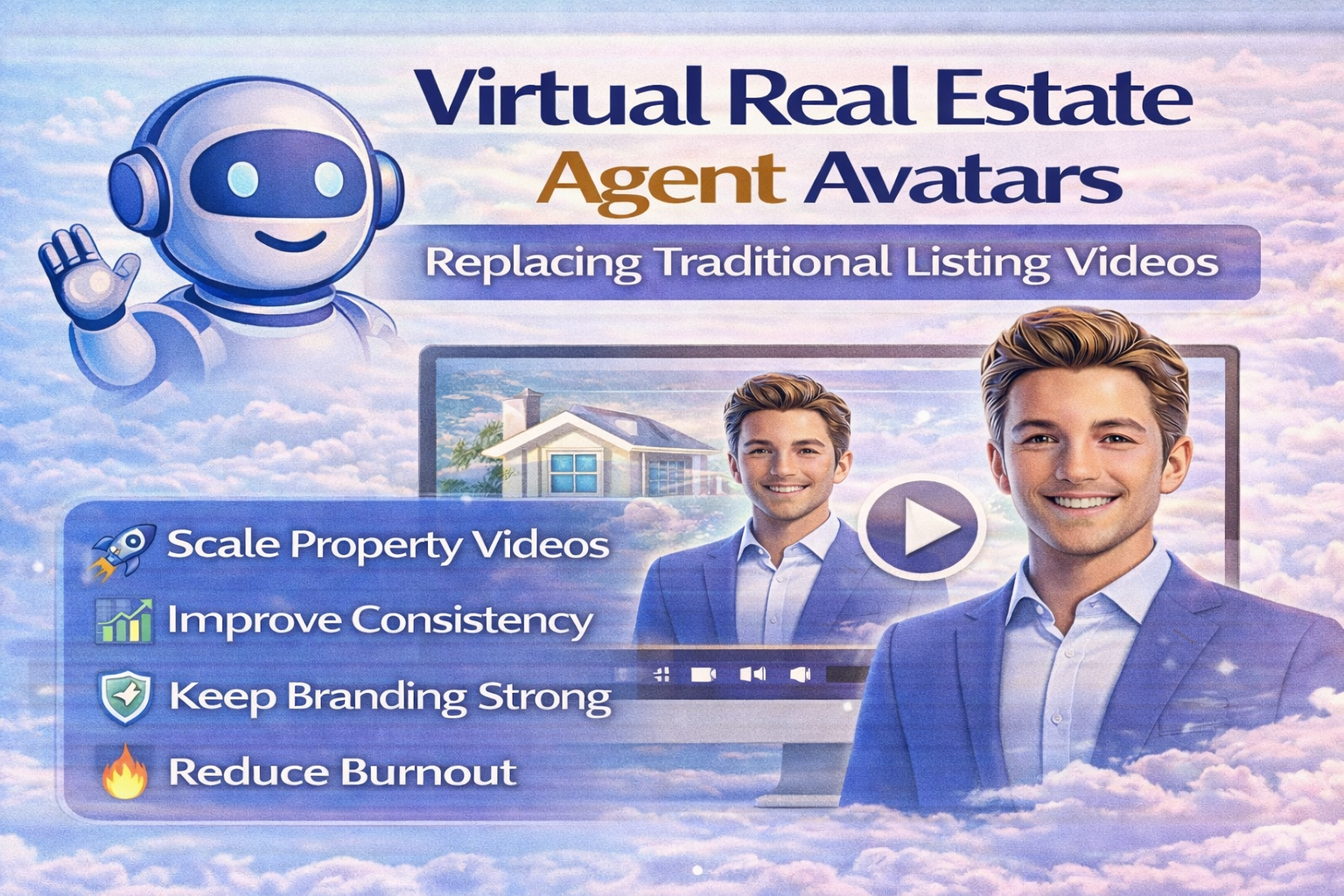
Virtual Real Estate Agent Avatars: Replacing Traditional Listing Videos

Cloudpano
February 10, 2026
5 min read
Share this post

Virtual Real Estate Agent Avatars: Replacing Traditional Listing Videos 🚀

Listing videos have become a standard expectation in real estate marketing. Sellers want them. Buyers engage with them. Platforms reward them. But there’s a growing problem that most agents won’t admit out loud:

👉 Traditional listing videos don’t scale.

Between filming, re-takes, editing, scheduling, and staying consistent, many agents burn out or simply stop producing videos altogether. That’s exactly why the virtual real estate agent avatar is emerging as a powerful alternative—and in many cases, a full replacement—for traditional listing videos.

This evergreen guide explains what virtual real estate agent avatars are, how they work, and why more agents, teams, and brokerages are using them to modernize listing marketing without increasing workload 📈.

What Is a Virtual Real Estate Agent Avatar? 🤔

A virtual real estate agent avatar is an AI-powered digital version of a real estate professional that can present listings, explain features, and deliver video content without requiring the agent to film every time.

Instead of recording a new video for each listing, agents can:

  • Write a short script
  • Select their avatar
  • Generate a professional video in minutes

The avatar can resemble the agent’s likeness or follow a branded spokesperson style, while maintaining a consistent, polished delivery.

Why Traditional Listing Videos Are Breaking Down 📉

Traditional listing videos sound great in theory, but they come with hidden friction:

  • Filming takes time
  • Lighting and sound matter
  • Retakes are common
  • Editing slows everything down
  • Consistency drops during busy periods

As a result:

  • Some listings get videos, others don’t
  • Quality varies widely
  • Agents feel pressure instead of leverage

A virtual real estate agent avatar solves this by turning listing videos into a repeatable system instead of a recurring task.

How Virtual Real Estate Agent Avatars Work ⚙️

The technology behind avatars is sophisticated, but the workflow is simple:

1. Avatar setup

The agent provides a photo or short training video to create a realistic digital presence.

2. Voice and style selection

A natural voice is paired with the avatar, matching tone and pacing.

3. Script creation

Agents write short scripts describing:

  • Property highlights
  • Layout
  • Unique selling points
  • Calls to action

4. Video generation

The avatar delivers the script as a clean, professional listing video—without filming.

This repeatable process is what allows avatars to replace traditional listing videos at scale.

Why Virtual Real Estate Agent Avatars Work for Listings 🏠

Listing videos are largely informational, not emotional.

They typically cover:

  • Property size
  • Features
  • Flow
  • Highlights
  • Next steps

These are ideal use cases for avatars because:

  • Information stays accurate
  • Messaging remains consistent
  • Delivery doesn’t depend on mood, lighting, or energy levels

Agents still bring personal connection through showings and calls—avatars simply handle the repeatable explanation.

Key Benefits Over Traditional Listing Videos ✅

Speed ⏱️

Listing videos can be created in minutes, not hours.

Consistency 📅

Every listing gets a polished video, not just the “important” ones.

Scalability 📈

High-volume agents and teams can produce videos for every property.

Reduced burnout 🧠

Agents no longer feel pressure to constantly be on camera.

Virtual Avatars vs Live Video: It’s Not Either/Or 🎥

A common misconception is that avatars replace agents entirely. They don’t.

The smartest agents use:

This hybrid approach maximizes efficiency while keeping marketing human.

Use Cases Where Avatars Replace Traditional Listing Videos 🔄

MLS and property websites

Avatars introduce the property and explain features clearly.

Social media previews 📱

Short avatar videos highlight listings consistently.

Email marketing 📧

Listings can be introduced with a video thumbnail instead of plain text.

Buyer funnels

Prospects see clear explanations before scheduling showings.

In all these cases, avatars perform the same role as traditional videos—with less effort.

Seller Perception: Do Avatars Still Impress? 🤝

Sellers care about results, not production methods.

They want:

  • Their home marketed professionally
  • Clear video explanations
  • Maximum exposure

A virtual real estate agent avatar delivers all three—often more consistently than manual videos. Many sellers actually prefer the clean, polished presentation avatars provide.

Branding and Trust With Virtual Avatars 💡

Trust comes from clarity and consistency, not from holding a camera.

When avatars are used correctly:

  • Messaging matches the agent’s voice
  • Branding stays consistent
  • Information is easy to understand

Instead of weakening trust, avatars often strengthen it by removing rushed or low-quality videos from the equation.

SEO Advantages of Replacing Listing Videos With Avatars 🔍

From an SEO perspective, avatars make it easier to create:

  • More listing pages with video
  • More embedded video content
  • Better engagement metrics
  • Longer time-on-page

Search engines reward pages that:

  • Keep users engaged
  • Provide multimedia explanations
  • Are updated consistently

Virtual avatars enable agents to meet those expectations at scale.

Common Concerns (and Why They’re Fading) ❌

“Avatars feel fake”

Modern avatars are increasingly realistic, especially for informational content.

“Buyers want real people”

Buyers want clarity first. Personal connection happens later.

“This replaces agents”

Avatars replace tasks, not professionals.

The Future of Listing Videos 🔮

As AI improves, expect:

  • More realistic avatars
  • Faster video generation
  • Personalized listing versions
  • Multi-language avatar listings

Traditional listing videos won’t disappear—but avatars will become the default for efficiency-focused agents.

Getting Started With Virtual Listing Avatars 🛠️

To transition smoothly:

  1. Start with one listing type
  2. Use clear, simple scripts
  3. Test performance against traditional videos
  4. Expand to all listings

Consistency matters more than perfection.

Final Thoughts: Replace the Work, Not the Value 🏁

The goal of a virtual real estate agent avatar isn’t to remove personality—it’s to remove friction.

By replacing traditional listing videos with avatars, agents can:

  • Market every listing professionally
  • Stay consistent across platforms
  • Reduce burnout
  • Scale without sacrificing quality

In a competitive market where attention is everything, virtual real estate agent avatars give agents a smarter, more sustainable way to present listings—every time 🌟.

🚀 Your All-In-One Virtual Experience Stack Starts Here

Share this post
Cloudpano

Choose The Right 360° Camera

Insta360 ONE RS 1-Inch 360 Edition

  • Compact, ready to go anywhere

  • Interchangeable lens that’s upgradeable

  • Dual 1-inch sensors for improved clarity and low light performance

  • Dynamic range and 6K 360° capture

  • 360° photo resolution at 21MP

Learn More

Insta360 X4

  • 8K 360° video recording for ultra-detailed visuals.

  • 4K single-lens mode for traditional wide-angle shots.

  • Invisible selfie stick effect for drone-like perspectives.

  • 2.5-inch touchscreen with Gorilla Glass protection.

  • Waterproof up to 33ft for underwater shooting.

Learn More

Ricoh Theta Z1

  • 360° photo resolution in 23MP

  • Slim design at 24 mm thick

  • Built-in image stabilization for smooth video capture.

  • Internal 19GB storage for photo and video storage.

  • Wireless connectivity for remote control and sharing.

Learn More

Ricoh Theta X

  • 60MP 360° still images for high-resolution photography.

  • 5.7K 360° video recording at 30fps.

  • 2.25-inch touchscreen for intuitive control.

  • USB Type-C port for fast charging and data transfer.

  • MicroSD card slot for expandable storage.

Learn More
Property Marketing
Allows potential buyers to explore properties in detail from anywhere, enhancing the real estate marketing process.
Automotive Spins
Create an interactive virtual showroom and engage affluent digital buyers with live 360º video calls, all through the CloudPano mobile app for a complete automotive sales solution.
Interactive Floor Plans
Create 2D and 3D floor plans with measurements in 4 minutes or less, all from your phone. Download the Floor Plan Scanner app and get your first scan free.

360 Virtual Tours With CloudPano.com. Get Started Today.

Try it free. No credit card required. Instant set-up.
Try it free
Latest posts

See our other posts

Interviews, tips, guides, industry best practices, and news.

Property Manager Video Hub: Scaling Rental Visibility with AI Photo-to-Video Workflows

This article explains how property managers can use PhotoAIVideo to build a property manager video hub: a repeatable system for turning rental photos, amenity images, floor plans, exterior shots, and neighborhood visuals into reusable rental marketing videos. The main idea is that property managers do not just need more listing exposure. They need clearer visual answers that help renters decide whether to schedule a tour. PhotoAIVideo is positioned as a practical tool for creating: Unit availability videos Amenity highlight videos Neighborhood videos Tour reminder clips Leasing follow-up videos Owner marketing proof videos Social media rental teasers Application or availability reminder videos Key takeaways: Property managers already have the media they need; the challenge is organizing it and turning it into reusable video assets. A video hub helps teams create consistent videos across units, floor plans, amenities, communities, and owner updates. Rental videos can reduce friction by answering renter questions about layout, condition, amenities, parking, pet features, and community feel. One rental photo set can become multiple video outputs for listings, social media, email, text follow-up, tour reminders, and owner reporting. Photographers can sell AI rental video packages to property managers as an upsell. Brokerages with property management divisions can use the same workflow to standardize leasing content. The article ends with a step-by-step process, video hub framework, mistakes to avoid, visual recommendations, FAQs, and a CTA encouraging readers to use PhotoAIVideo to turn rental photos into a scalable video system for rental visibility.
Read post

YouTube Shorts Listing Teasers: The 3-Scene Structure for Higher Property Clicks

This article explains how real estate agents, photographers, brokerages, and property managers can use YouTube Shorts listing teasers to drive more property clicks and showing requests. The main idea is that a YouTube Short should not try to show the entire house. Instead, it should use a simple 3-scene structure: Scene 1: Hook — stop the scroll with the strongest property feature. Scene 2: Proof — show the visuals that support the hook. Scene 3: Click Path — tell the viewer what to do next. The article positions PhotoAIVideo as a practical tool for turning listing photos into short vertical videos for YouTube Shorts, Reels, open house promotion, and listing campaigns. Key takeaways: YouTube Shorts should create curiosity, not replace the full listing video. The strongest property feature should appear first, not necessarily the front exterior. Agents should build each Short around one click reason, such as backyard, kitchen, layout, neighborhood, open house, or price point. One listing can become multiple Shorts instead of one generic video. Photographers can offer YouTube Shorts teaser packs as a video upsell. Brokerages can standardize the 3-scene structure across agents. Property managers can use the same structure to promote rentals and tours. The article ends with practical scripts, visual recommendations, FAQs, a visual placement guide, and a CTA encouraging readers to use PhotoAIVideo to create YouTube Shorts listing teasers from property photos.
Read post

Video Retargeting for Listings: Turning Photo-Based AI Videos into Appointment Follow-Up

This article explains how Realtors, photographers, brokerages, and property managers can use photo-based AI videos as follow-up assets after someone shows interest in a listing. The main idea is that most real estate marketing focuses on getting the first click, but many buyers and sellers need multiple touchpoints before booking a showing or appointment. Video retargeting helps agents re-engage people who already clicked a listing, watched a Reel, opened an email, attended an open house, asked about a property, or went quiet after showing interest. PhotoAIVideo is positioned as a practical tool for turning listing photos into short follow-up videos, including: Feature reminder videos Layout explainer videos Neighborhood fit videos Open house recap videos Price update videos Seller proof videos Showing request videos Rental tour recovery videos Key takeaways: A first-touch listing video introduces the property, while a retargeting video answers the next likely question. Follow-up videos should be short, usually 10–30 seconds, and focused on one action. Agents should send different videos based on behavior, such as email clicks, open house attendance, listing views, or showing interest. A good video follow-up feels helpful, not pushy. Photographers can package retargeting video clips as an upsell. Brokerages can standardize video retargeting workflows across agents. Property managers can use the same strategy to recover rental leads and book tours. The article ends with a simple retargeting sequence, visual recommendations, FAQs, and a CTA encouraging readers to use PhotoAIVideo to turn listing photos into appointment-driving follow-up videos.
Read post