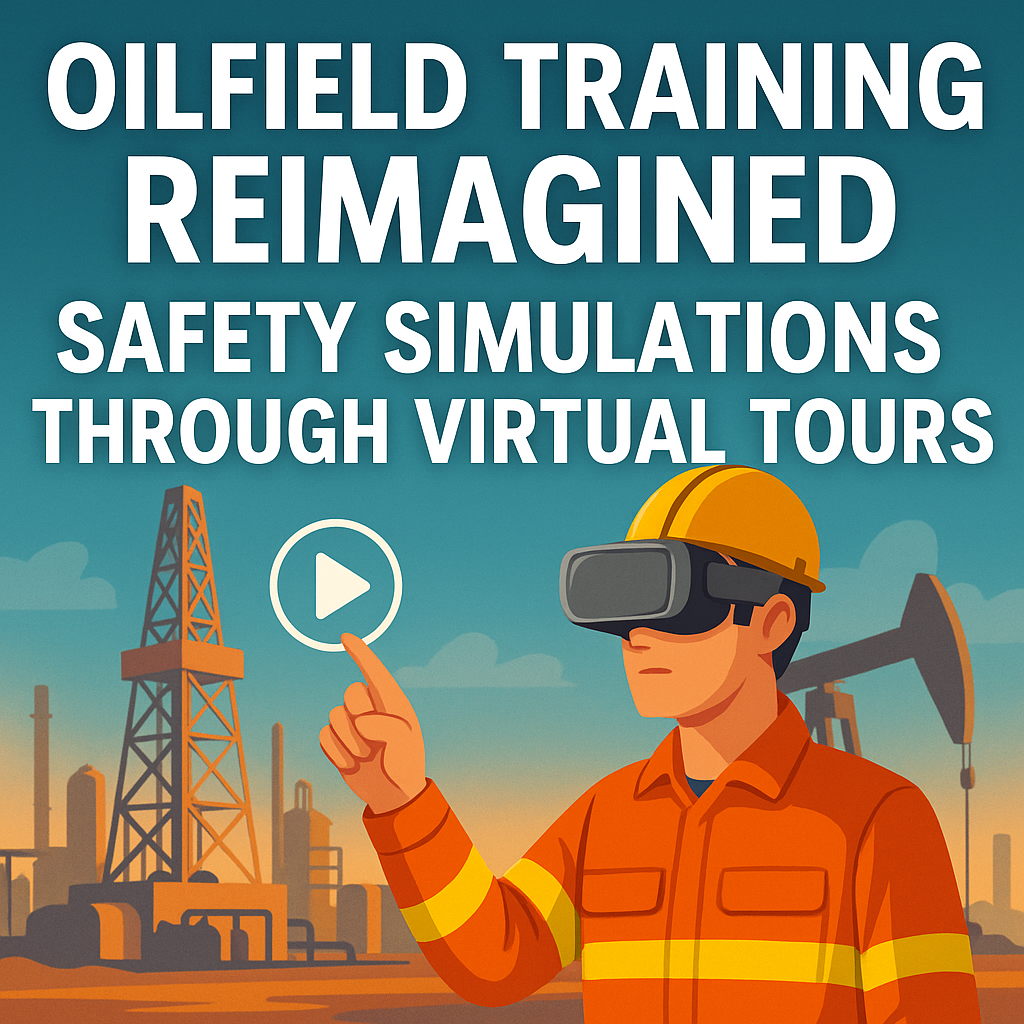
Oilfield Training Reimagined: Safety Simulations Through Virtual Tours

Cloudpano
July 20, 2025
5 min read
Share this post

🛢️ Oilfield Training Reimagined: Safety Simulations Through Virtual Tours

The oilfield is a complex, high-risk environment — where one mistake can lead to serious injuries, environmental damage, or worse. That’s why modern energy companies are rethinking safety training from the ground up. 🚧⚠️

Enter: virtual tours with built-in safety simulations. 🖥️👷‍♂️

This cutting-edge approach gives workers a chance to walk through rigs, fields, and terminals — virtually — before they ever step foot onsite. They can explore hazards, watch safety procedures, and respond to emergency scenarios in real time… from anywhere. 🌍

In this post, we’ll show you how virtual safety simulations are changing oilfield training, reducing incidents, and cutting onboarding time in half — with links to more great resources.

🔍 What Are Safety Simulations via Virtual Tours?

A virtual safety tour is an interactive, 360° experience of a real-world oilfield site (like a rig, tank farm, or compressor station). With simulations, you go one step further:

✅ Workers click on hazard zones
✅ Watch emergency response videos
✅ Complete quizzes after SOP walkthroughs
✅ Simulate shut-offs, spill responses, and evacuations

It’s like a video game — but it saves lives. 🎮➡️🛡️

🔗 Learn more: Virtual Tours for Oil and Gas Safety Training: What You Need to Know

💥 The Problem With Traditional Oilfield Safety Training

Let’s face it — classroom-based safety briefings and outdated onboarding videos don’t cut it anymore.

Here’s why:

  • ❌ Limited engagement (low retention)
  • ❌ Can’t replicate real environments
  • ❌ Hard to scale across remote teams
  • ❌ Doesn’t prepare for real-time decisions under pressure

🔗 See how companies are adapting: Why Oil and Gas Companies Are Adopting Virtual Tours for Safety Training

🚀 The Benefits of Virtual Tour-Based Safety Simulations

🎯 1. Train Before They Arrive

Workers can virtually explore:

  • Pipeline corridors
  • Control panels
  • H2S-prone zones
  • High-voltage areas

They see it, not just hear about it.

🔗 Related: Virtual Safety Tours: Reducing On-Site Risk Before Workers Arrive

🧠 2. Scenario-Based Learning

Instead of memorizing safety procedures, workers react to scenarios:

  • Emergency button? ✅
  • Lockout procedure? ⚙️
  • Evacuation route? 🏃‍♂️

This boosts retention and makes onboarding interactive and repeatable.

🔗 Deep dive: Revolutionizing Safety: Virtual Tour Technology in Oil and Gas Training

📈 3. Measurable, Audit-Proof Compliance

Track every click, quiz score, and tour completion.
Export safety records before workers ever arrive.

Perfect for audits. 🗂️✅

🔗 Learn more: Boost Safety Compliance with 360° Virtual Training in Oil and Gas

🛠️ How to Build Oilfield Simulations With Virtual Tours

🖼️ 1. Capture 360° Footage

Use a camera like:

  • Insta360 ONE X2
  • Ricoh Theta Z1
  • GoPro Max

Document:

  • Hazard areas
  • Emergency exits
  • Equipment access zones

🔗 Related: How 3D Virtual Tours Improve Hazard Awareness in Oil and Gas Sites

🔗 2. Upload to a Platform

Use a system like CloudPano to:

  • Create interactive hotspots
  • Embed training materials
  • Add quizzes and form captures
  • Build custom safety workflows

CloudPano lets you white-label the experience and train globally. 🌍

🔗 More here: Train Your Oil and Gas Workforce Remotely with Interactive Virtual Tours

🎓 3. Add Simulation Elements

Example safety modules:

  • “Gas Leak: Respond in 3 Steps”
  • “Lockout/Tagout: Interactive Walkthrough”
  • “Evacuation Drill: Navigate to Muster Point”
  • “Confined Space Entry Quiz”

🔗 See another use case: Immersive Safety Training for Oil and Gas Teams Using Virtual Tours

🔍 Real-World Applications in the Field

🏭 Refineries

  • Simulate process unit shutdown
  • Emergency exit pathfinding
  • PPE reminders via hotspots

🌊 Offshore Rigs

  • Helicopter arrival prep
  • Lifeboat muster drills
  • Electrical arc flash scenarios

🏞️ Well Pads & Pipelines

  • Leak containment
  • Valve operation training
  • Environmental response prep

🔗 Related: Using VR and 360 Tours for Safer Oil and Gas Work Environments

💡 Bonus: Connect to Digital Twins

Want to go further?

Integrate virtual tours into your digital twin system. Sync with real-time data. Simulate site-specific risks. Deliver custom training per worker.

🔗 Full guide: Digital Twins and Safety: Virtual Tour Integration in Oil and Gas Training

🔮 The Future: AI in Safety Simulations

  • AI analyzes user behavior
  • Flags who is “ready” vs who needs more practice
  • Predicts risk factors based on tour interaction
  • Auto-translates safety materials into any language 🌐

✅ Final Thoughts

Oilfield safety training is no longer limited to binders and bootcamps. 🎒 Now, your team can walk the field before they work it, experience real scenarios, and learn faster — thanks to immersive virtual tours with interactive simulations.

You’ll:

  • Cut incident rates
  • Reduce onboarding time
  • Scale consistent training globally
  • Impress regulators and auditors

Share this post
Cloudpano

Choose The Right 360° Camera

Insta360 ONE RS 1-Inch 360 Edition

  • Compact, ready to go anywhere

  • Interchangeable lens that’s upgradeable

  • Dual 1-inch sensors for improved clarity and low light performance

  • Dynamic range and 6K 360° capture

  • 360° photo resolution at 21MP

Learn More

Insta360 X4

  • 8K 360° video recording for ultra-detailed visuals.

  • 4K single-lens mode for traditional wide-angle shots.

  • Invisible selfie stick effect for drone-like perspectives.

  • 2.5-inch touchscreen with Gorilla Glass protection.

  • Waterproof up to 33ft for underwater shooting.

Learn More

Ricoh Theta Z1

  • 360° photo resolution in 23MP

  • Slim design at 24 mm thick

  • Built-in image stabilization for smooth video capture.

  • Internal 19GB storage for photo and video storage.

  • Wireless connectivity for remote control and sharing.

Learn More

Ricoh Theta X

  • 60MP 360° still images for high-resolution photography.

  • 5.7K 360° video recording at 30fps.

  • 2.25-inch touchscreen for intuitive control.

  • USB Type-C port for fast charging and data transfer.

  • MicroSD card slot for expandable storage.

Learn More
Property Marketing
Allows potential buyers to explore properties in detail from anywhere, enhancing the real estate marketing process.
Automotive Spins
Create an interactive virtual showroom and engage affluent digital buyers with live 360º video calls, all through the CloudPano mobile app for a complete automotive sales solution.
Interactive Floor Plans
Create 2D and 3D floor plans with measurements in 4 minutes or less, all from your phone. Download the Floor Plan Scanner app and get your first scan free.

360 Virtual Tours With CloudPano.com. Get Started Today.

Try it free. No credit card required. Instant set-up.

Try it free
Latest posts

See our other posts

Interviews, tips, guides, industry best practices, and news.

Property Manager Video Hub: Scaling Rental Visibility with AI Photo-to-Video Workflows

This article explains how property managers can use PhotoAIVideo to build a property manager video hub: a repeatable system for turning rental photos, amenity images, floor plans, exterior shots, and neighborhood visuals into reusable rental marketing videos. The main idea is that property managers do not just need more listing exposure. They need clearer visual answers that help renters decide whether to schedule a tour. PhotoAIVideo is positioned as a practical tool for creating: Unit availability videos Amenity highlight videos Neighborhood videos Tour reminder clips Leasing follow-up videos Owner marketing proof videos Social media rental teasers Application or availability reminder videos Key takeaways: Property managers already have the media they need; the challenge is organizing it and turning it into reusable video assets. A video hub helps teams create consistent videos across units, floor plans, amenities, communities, and owner updates. Rental videos can reduce friction by answering renter questions about layout, condition, amenities, parking, pet features, and community feel. One rental photo set can become multiple video outputs for listings, social media, email, text follow-up, tour reminders, and owner reporting. Photographers can sell AI rental video packages to property managers as an upsell. Brokerages with property management divisions can use the same workflow to standardize leasing content. The article ends with a step-by-step process, video hub framework, mistakes to avoid, visual recommendations, FAQs, and a CTA encouraging readers to use PhotoAIVideo to turn rental photos into a scalable video system for rental visibility.
Read post

YouTube Shorts Listing Teasers: The 3-Scene Structure for Higher Property Clicks

This article explains how real estate agents, photographers, brokerages, and property managers can use YouTube Shorts listing teasers to drive more property clicks and showing requests. The main idea is that a YouTube Short should not try to show the entire house. Instead, it should use a simple 3-scene structure: Scene 1: Hook — stop the scroll with the strongest property feature. Scene 2: Proof — show the visuals that support the hook. Scene 3: Click Path — tell the viewer what to do next. The article positions PhotoAIVideo as a practical tool for turning listing photos into short vertical videos for YouTube Shorts, Reels, open house promotion, and listing campaigns. Key takeaways: YouTube Shorts should create curiosity, not replace the full listing video. The strongest property feature should appear first, not necessarily the front exterior. Agents should build each Short around one click reason, such as backyard, kitchen, layout, neighborhood, open house, or price point. One listing can become multiple Shorts instead of one generic video. Photographers can offer YouTube Shorts teaser packs as a video upsell. Brokerages can standardize the 3-scene structure across agents. Property managers can use the same structure to promote rentals and tours. The article ends with practical scripts, visual recommendations, FAQs, a visual placement guide, and a CTA encouraging readers to use PhotoAIVideo to create YouTube Shorts listing teasers from property photos.
Read post

Video Retargeting for Listings: Turning Photo-Based AI Videos into Appointment Follow-Up

This article explains how Realtors, photographers, brokerages, and property managers can use photo-based AI videos as follow-up assets after someone shows interest in a listing. The main idea is that most real estate marketing focuses on getting the first click, but many buyers and sellers need multiple touchpoints before booking a showing or appointment. Video retargeting helps agents re-engage people who already clicked a listing, watched a Reel, opened an email, attended an open house, asked about a property, or went quiet after showing interest. PhotoAIVideo is positioned as a practical tool for turning listing photos into short follow-up videos, including: Feature reminder videos Layout explainer videos Neighborhood fit videos Open house recap videos Price update videos Seller proof videos Showing request videos Rental tour recovery videos Key takeaways: A first-touch listing video introduces the property, while a retargeting video answers the next likely question. Follow-up videos should be short, usually 10–30 seconds, and focused on one action. Agents should send different videos based on behavior, such as email clicks, open house attendance, listing views, or showing interest. A good video follow-up feels helpful, not pushy. Photographers can package retargeting video clips as an upsell. Brokerages can standardize video retargeting workflows across agents. Property managers can use the same strategy to recover rental leads and book tours. The article ends with a simple retargeting sequence, visual recommendations, FAQs, and a CTA encouraging readers to use PhotoAIVideo to turn listing photos into appointment-driving follow-up videos.
Read post