


.png)


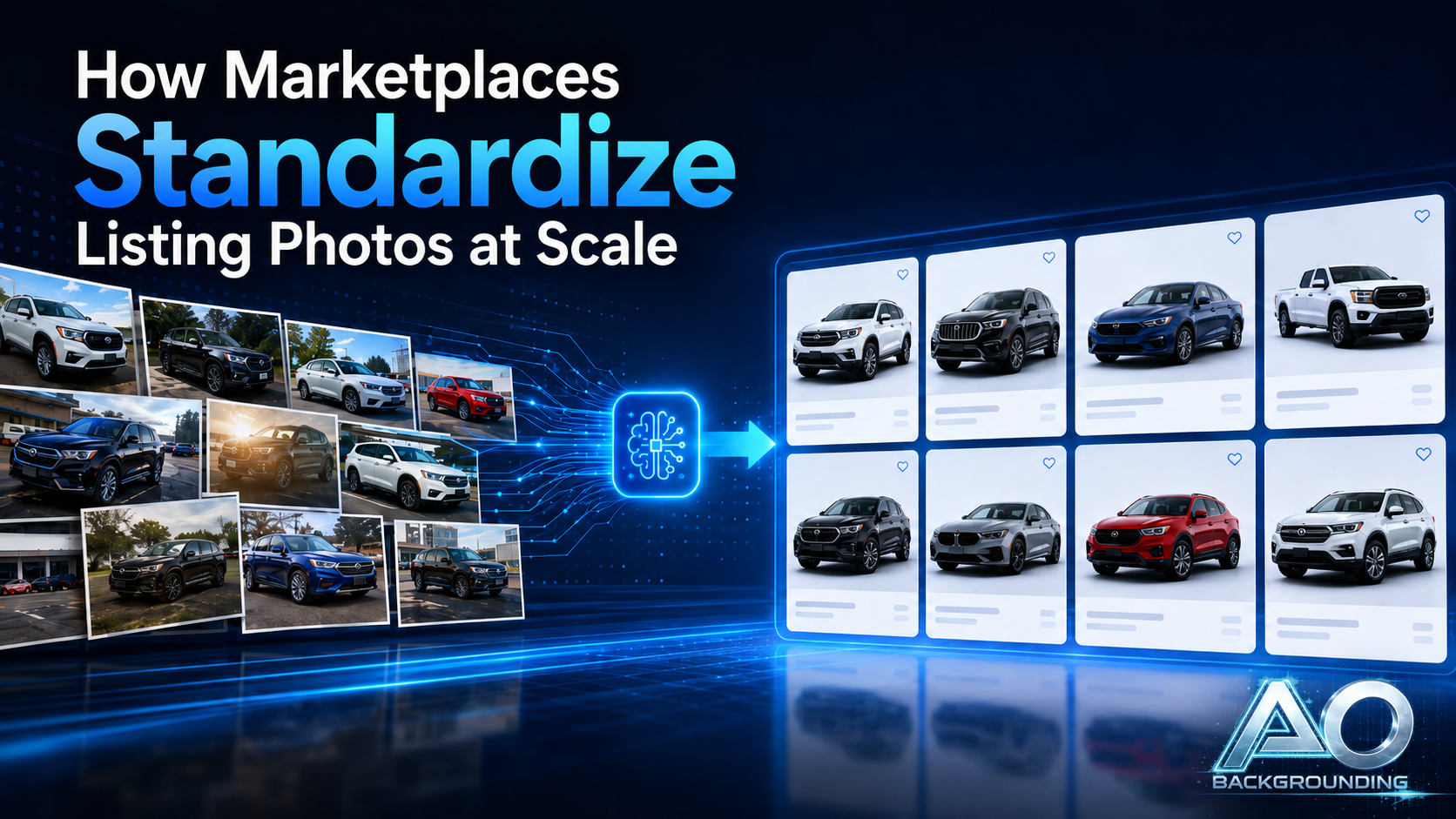
Online automotive marketplaces face a challenge that individual dealerships rarely experience at the same scale.
Thousands—or even millions—of vehicle images may arrive from different dealerships, photographers, inventory systems, geographic regions, and camera devices.
One dealership photographs inventory on a clean section of pavement.
Another shoots vehicles beside the service department.
A third captures cars on a crowded lot.
Some images arrive under bright sunlight. Others are photographed under cloudy skies, beside buildings, or on wet pavement.
The vehicles may all be perfectly good inventory, but visually, the listings can feel like they came from completely different websites.
That is why automotive marketplace image standardization has become an important part of building a professional online shopping experience.
Marketplaces cannot necessarily control how every vehicle is photographed.
What they can control is how those images are processed, presented, resized, cropped, and distributed after they enter the platform.
At scale, consistency becomes less about photography alone and more about infrastructure.
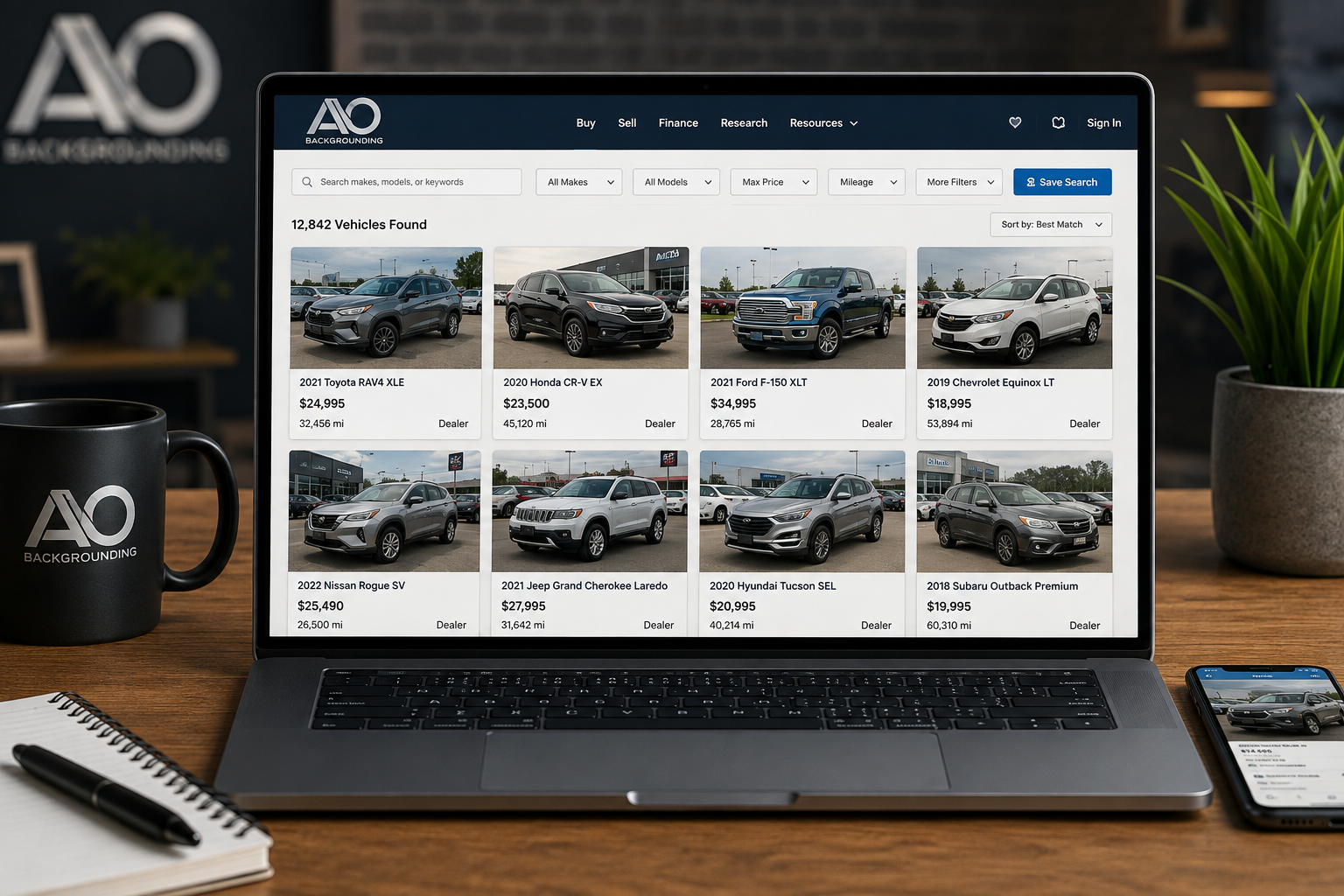
When shoppers browse a dealership website, they are usually viewing vehicles from a relatively small number of locations.
Marketplace shoppers may be comparing vehicles from hundreds or thousands of sellers at once.
That changes the visual experience.
Imagine a search results page containing twenty similar SUVs.
One vehicle fills nearly the entire frame.
Another appears tiny because it was photographed from too far away.
A third has a giant dealership logo covering the corner.
Another sits against a clean white background.
The next image shows service bays, employees, light poles, and ten other cars behind it.
Even when the marketplace itself has a polished interface, inconsistent listing images can make the experience feel fragmented.
The purpose of automotive marketplace image standardization is not to make every vehicle identical.
It is to create enough visual consistency that shoppers can focus on comparing the inventory instead of noticing differences in how every seller photographs a car.
Automotive marketplaces are fundamentally comparison environments.
Shoppers compare:
Photography becomes another part of that comparison.
When vehicles use similar framing, scale, backgrounds, and hero angles, shoppers can visually scan inventory much faster.
The vehicle becomes the variable.
The photography becomes consistent.
That distinction matters.
A standardized image library can help create search pages where each vehicle receives approximately the same visual importance.
Instead of one listing dominating because its image is dramatically larger or brighter, the marketplace can create a more balanced presentation.
Consistency often communicates professionalism before a shopper consciously thinks about it.
Retailers understand this.
Hotels understand it.
Travel marketplaces understand it.
Ecommerce platforms understand it.
Automotive marketplaces face the same challenge.
If every listing looks dramatically different, the marketplace can begin to feel like a collection of unrelated classified advertisements.
If imagery follows a consistent visual system, the experience can feel more like a unified shopping platform.
That can be particularly important when inventory originates from independent businesses.
The marketplace may not control the seller's showroom, lot design, signage, or photography process.
But it can create standards for what shoppers eventually see.
This is one reason automotive marketplace image standardization becomes increasingly valuable as inventory volume grows.
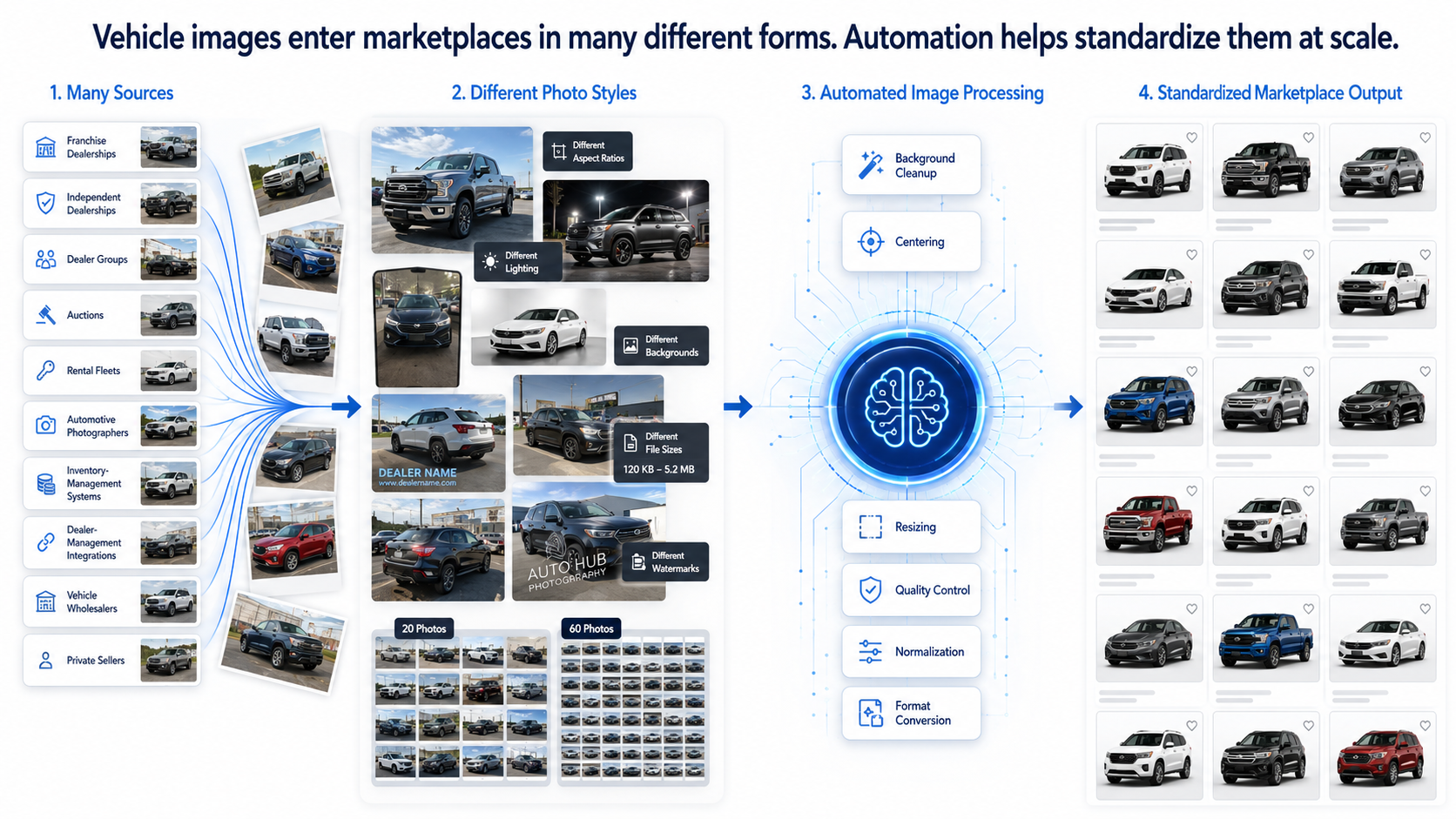
The challenge is that vehicle images rarely enter a marketplace in a standardized form.
A marketplace might receive photography from:
Each source may have its own photography process.
Some may send professional images.
Others may send ordinary smartphone photos.
Image dimensions can vary.
Angles can vary.
Backgrounds can vary.
Lighting can vary.
File sizes can vary.
Watermarks can vary.
Some sellers may provide twenty images per vehicle while others provide sixty.
The larger the marketplace becomes, the less realistic it is to expect every seller to follow exactly the same capture process.
That is where automated image processing becomes useful.
A marketplace does not necessarily need to control the photography environment to create a consistent presentation.
Instead, it can standardize the output.
A simplified workflow might look like this:
Vehicle photographed
↓
Images uploaded by seller or inventory system
↓
Images processed automatically
↓
Vehicle identified and centered
↓
Background adjusted or removed
↓
Image resized and formatted
↓
Standardized asset stored
↓
Image published across marketplace surfaces
This approach shifts standardization from a manual photography problem to a software problem.
The source photography still matters.
Better source images generally produce better final results.
But the marketplace gains more control over what shoppers ultimately see.
Backgrounds create some of the most noticeable differences between dealership images.
Vehicles may be photographed against:
An automated background-removal system can separate the vehicle from the original environment and place it on a standardized background.
That background might be:
The objective is not simply to remove the original background.
The objective is consistency.
A good result should preserve natural edges, tires, mirrors, windows, and vehicle reflections while keeping the vehicle visually grounded.
If the vehicle appears to float unnaturally on the new background, the standardization process has created a different problem.
Professional processing needs to account for details such as shadows, tire contact, brightness, vehicle scale, and positioning.
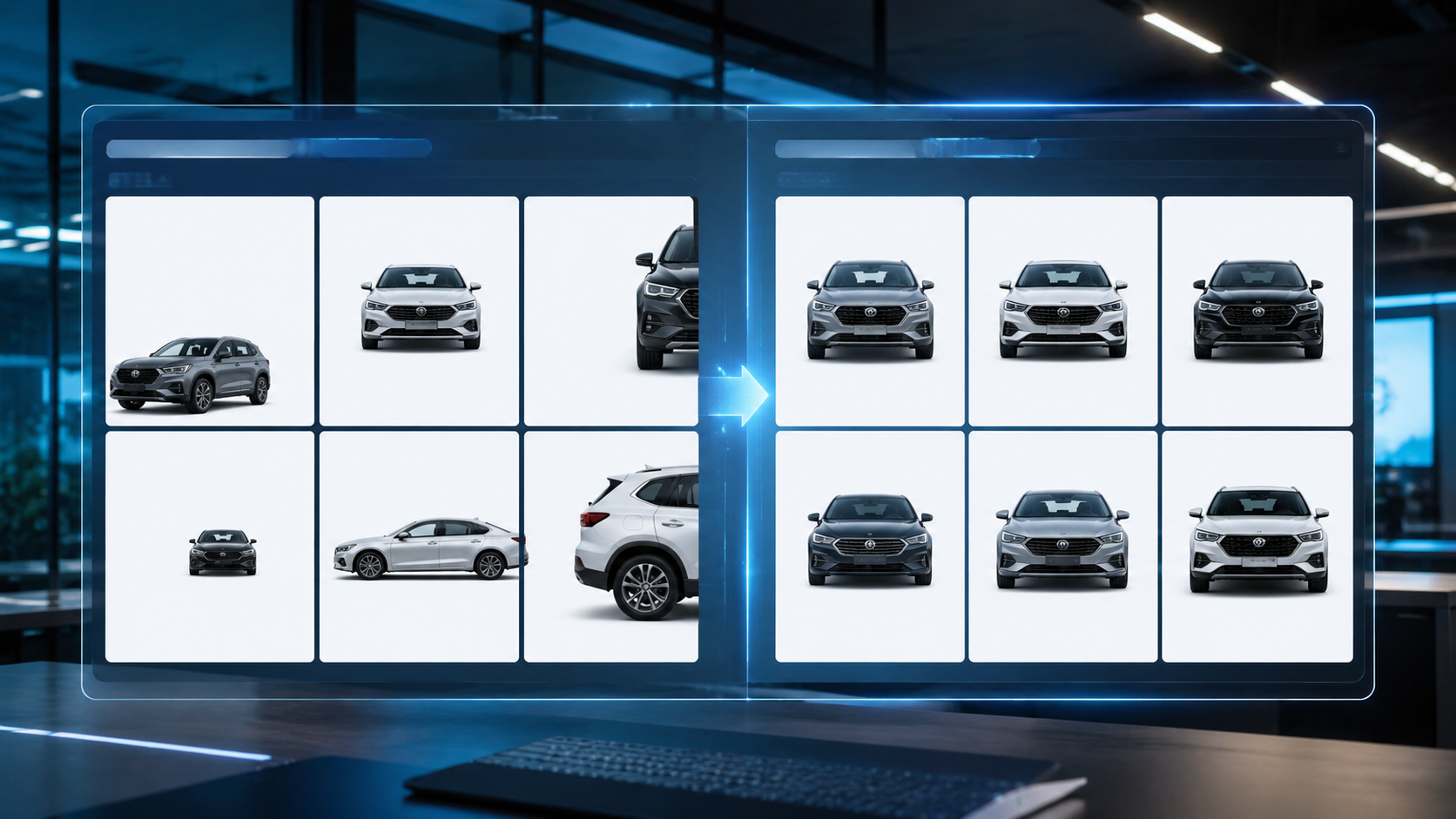
Even with the same background, marketplace listings can look inconsistent if vehicles appear at different sizes and positions.
One vehicle may sit near the bottom-left corner.
Another may appear centered.
Another may nearly touch the edges of the image.
Automated centering can help create more uniform hero images.
The system can identify the vehicle bounds, determine the available canvas, and position the car according to a marketplace standard.
That makes grids, search results, recommendations, and vehicle detail pages feel more intentional.
Small differences become much more noticeable when hundreds of listings appear inside the same design.
At marketplace scale, centering is not simply a cosmetic feature.
It becomes part of the overall merchandising system.
Marketplaces rarely use a single image format everywhere.
The same vehicle may appear in:
Each destination may use a different crop or aspect ratio.
That creates another reason to standardize source assets carefully.
If the vehicle is centered with sufficient breathing room around it, the marketplace can create multiple versions without accidentally cutting off mirrors, bumpers, roofs, or wheels.
A standardized master image can then be exported into different destination formats.
For example:
Master vehicle image
→ Landscape version
→ Square version
→ Vertical version
→ Thumbnail
→ High-resolution VDP image
The marketplace does not need to manually rebuild each image.
It can generate destination-specific assets automatically.
Seller-provided images sometimes contain permanent overlays such as:
These elements may be useful in certain environments, but they reduce flexibility.
A large promotional banner designed for a dealership website may look awkward inside a marketplace thumbnail.
Text may become unreadable after resizing.
Logos may compete with marketplace interface elements.
Heavy branding can also prevent the marketplace from creating a consistent visual experience.
A better strategy is to maintain a clean master image and apply promotional or branded elements only when a specific destination requires them.
Clean source assets create more options later.
Manual editing can work when a business processes fifty vehicles.
It becomes difficult when a platform processes fifty thousand.
Imagine manually:
At marketplace scale, even a few minutes of manual work per vehicle can become a major operational expense.
This is why automated processing is closely connected to automotive marketplace image standardization.
The objective is not merely faster editing.
The objective is creating predictable image output regardless of how many vehicles enter the system.
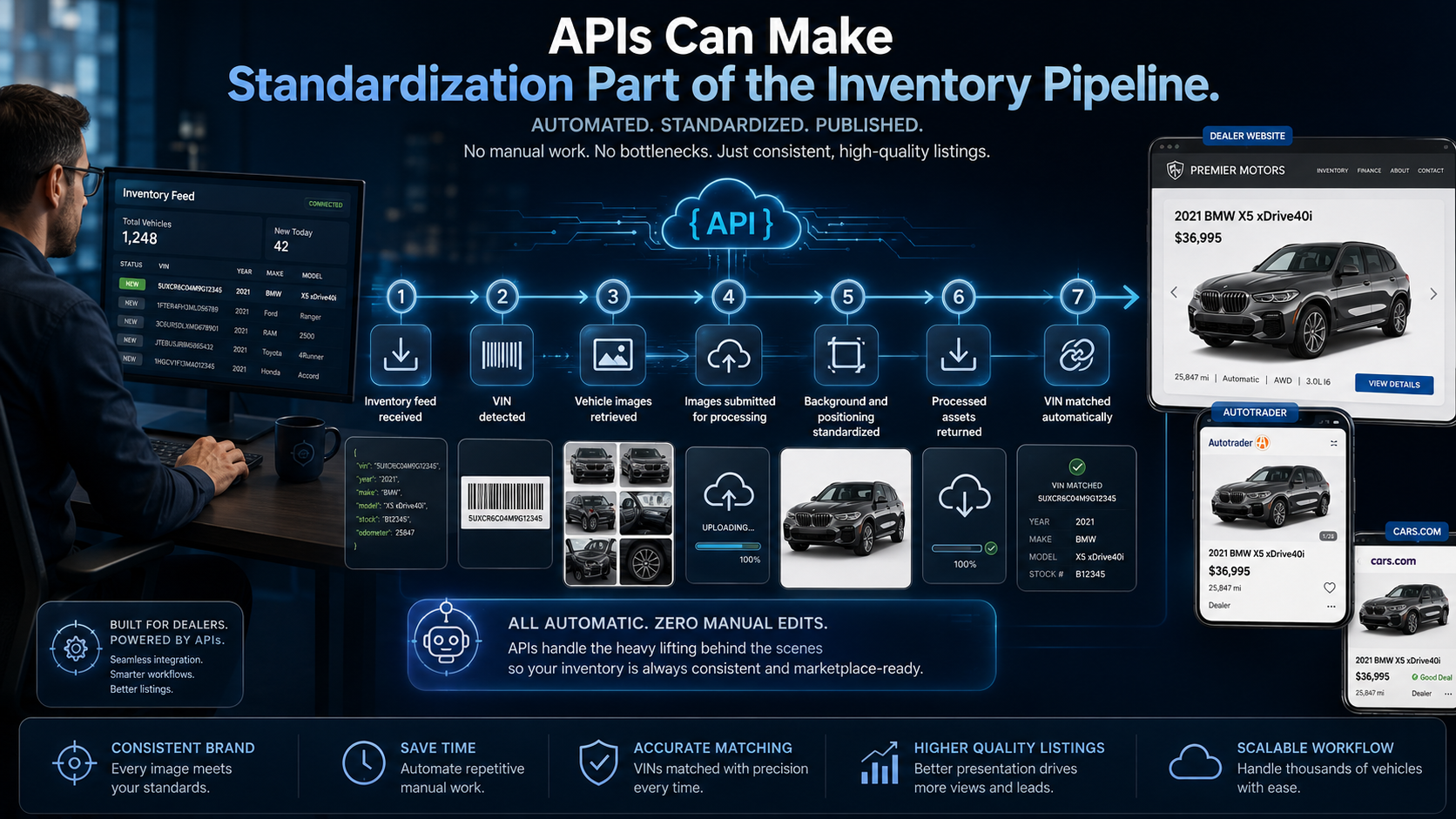
For larger marketplaces, dealer website providers, and automotive SaaS platforms, image processing can become part of the software infrastructure itself.
Instead of employees downloading photographs, opening an editing tool, processing the images, and uploading them again, an API can automate the workflow.
For example:
Inventory feed received
↓
VIN detected
↓
Vehicle images retrieved
↓
Images submitted for processing
↓
Background and positioning standardized
↓
Processed assets returned
↓
VIN matched automatically
↓
Images published
Processing can happen behind the scenes.
The employee managing inventory may never need to interact with a separate image-editing application.
This is where automated image tools can move from being creative utilities to infrastructure.
There is an important distinction between standardizing photography and making every vehicle look artificial.
The marketplace still needs to represent the actual inventory accurately.
Processing should not hide damage, modify body panels, change vehicle color, or create features that are not present.
The objective should be presentation consistency.
Clean background.
Consistent positioning.
Proper scale.
Useful crops.
High resolution.
Clear vehicle visibility.
Standardization should make it easier to evaluate the vehicle—not distort what is being sold.
Automation does not eliminate the need for quality control.
Large marketplaces should still identify unusual outputs.
Potential problems can include:
The difference is that quality control can become exception-based.
Instead of employees manually editing every image, automated systems process the majority of images while questionable outputs are flagged for review.
That model is much easier to scale.
Before implementing automation, marketplaces should define what the final output should look like.
That might include rules for:
The technology should enforce the standard.
It should not define the standard by accident.
A clear visual specification makes it easier to test processing providers, evaluate image quality, and maintain consistency as inventory volume increases.
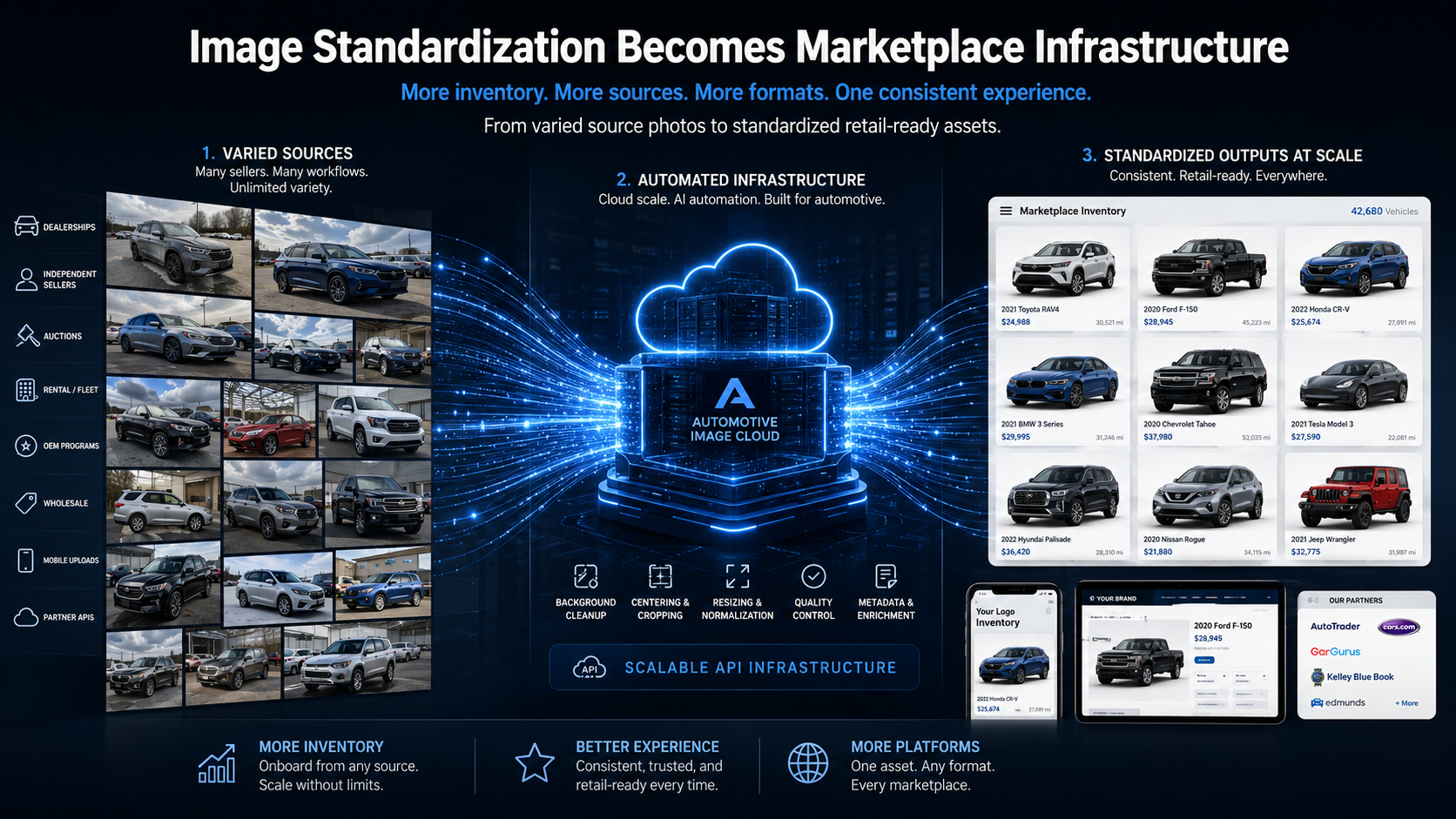
The real value of automotive marketplace image standardization goes beyond cleaner photographs.
It creates infrastructure that helps a marketplace grow without allowing presentation quality to deteriorate.
More dealerships can submit inventory.
More photography styles can enter the system.
More vehicles can be processed.
More destination formats can be created.
More partners can receive images.
Yet the customer-facing experience can remain consistent.
That is the shift.
Instead of asking every dealership to become a professional automotive photography studio, the marketplace can build an automated processing layer that turns varied source photography into standardized retail-ready assets.
For marketplaces, dealer groups, inventory companies, and automotive technology providers, that can turn vehicle photography from a manual operational challenge into a repeatable software workflow.
The best place to begin is simple:
Define what a professional listing image should look like.
Test the standard against difficult real-world inventory.
Then determine how much of the transformation can happen automatically.
At sufficient volume, image standardization is no longer only a design decision.
It becomes part of the marketplace infrastructure.


Compact, ready to go anywhere
Interchangeable lens that’s upgradeable
Dual 1-inch sensors for improved clarity and low light performance
Dynamic range and 6K 360° capture
360° photo resolution at 21MP

8K 360° video recording for ultra-detailed visuals.
4K single-lens mode for traditional wide-angle shots.
Invisible selfie stick effect for drone-like perspectives.
2.5-inch touchscreen with Gorilla Glass protection.
Waterproof up to 33ft for underwater shooting.

360° photo resolution in 23MP
Slim design at 24 mm thick
Built-in image stabilization for smooth video capture.
Internal 19GB storage for photo and video storage.
Wireless connectivity for remote control and sharing.

60MP 360° still images for high-resolution photography.
5.7K 360° video recording at 30fps.
2.25-inch touchscreen for intuitive control.
USB Type-C port for fast charging and data transfer.
MicroSD card slot for expandable storage.
.png)

.png)

Try it free. No credit card required. Instant set-up.







.svg)


.svg)