


.png)


EgoDex is publicly released under CC BY-NC-ND terms, which restrict commercial use. Companies should not assume the dataset can be used for commercial AI training simply because it is publicly accessible. Review the EgoDex license commercial license terms and obtain appropriate permission before using EgoDex in commercial model development or deployment.
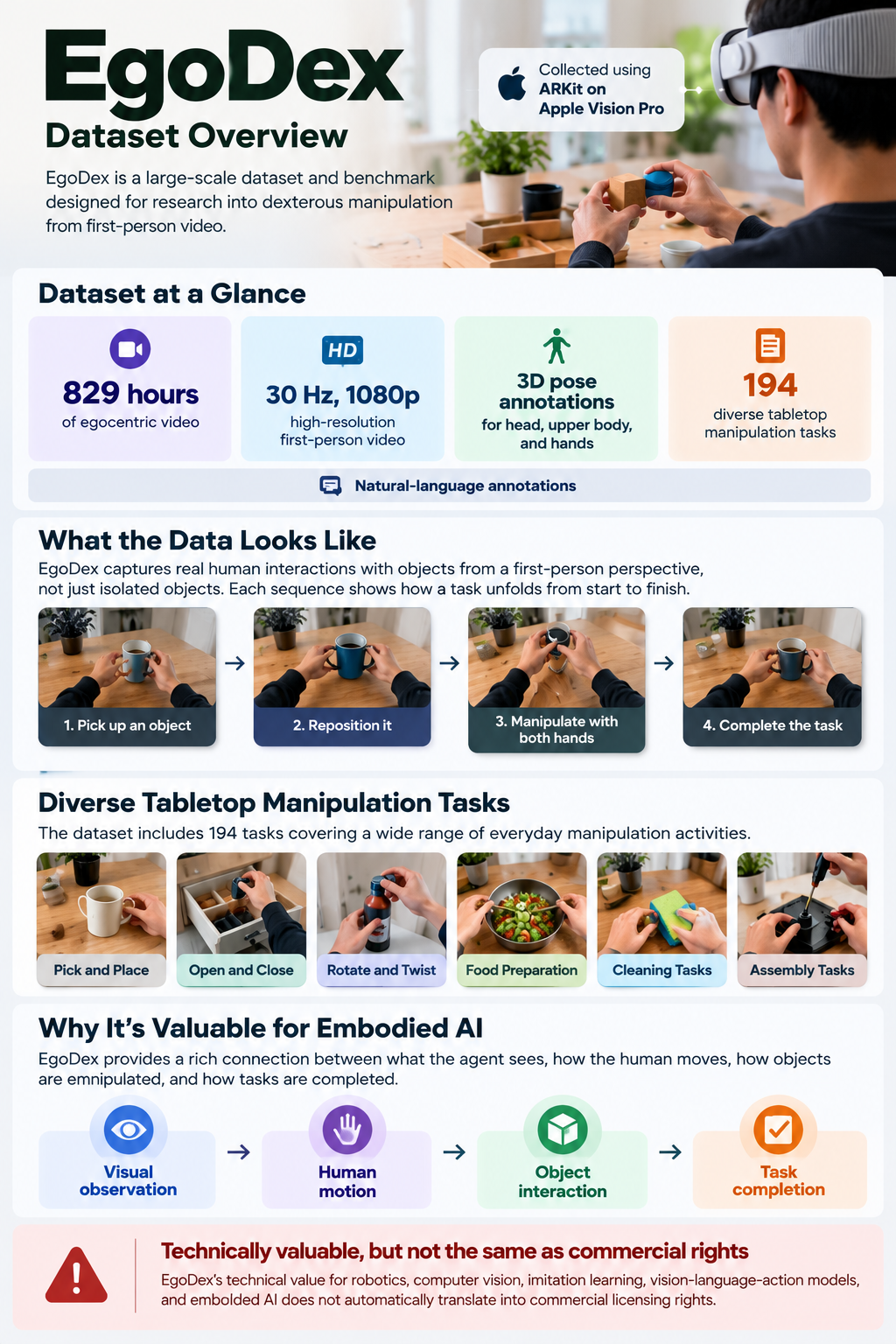
EgoDex is a large-scale dataset and benchmark designed for research into dexterous manipulation from first-person video.
Apple researchers collected EgoDex using ARKit on Apple Vision Pro. According to the official repository, it contains 829 hours of 30 Hz, 1080p egocentric video, along with paired 3D pose annotations for the head, upper body, and hands and natural-language annotations.
The dataset covers 194 diverse tabletop manipulation tasks, making it particularly relevant to researchers working on robotics, computer vision, imitation learning, vision-language-action models, and embodied AI.
Instead of only showing objects in isolation, egocentric video captures how people interact with those objects from a first-person perspective.
A sequence might show someone picking up an object, repositioning it, manipulating it with both hands, and completing a task.
For embodied AI researchers, these sequences can provide valuable information about the relationship between:
visual observation → human motion → object interaction → task completion
That makes EgoDex technically valuable. But technical value does not automatically translate into commercial licensing rights.
Apple's official EgoDex repository states that the dataset is available under CC-by-NC-ND terms.
This refers to the Creative Commons Attribution-NonCommercial-NoDerivatives framework.
Each component matters.
The attribution requirement means users need to provide appropriate credit according to the applicable license terms.
For researchers, this normally means maintaining proper attribution and citing the dataset or associated research as required.
The NonCommercial restriction is especially important for AI companies.
Under Creative Commons' standard CC BY-NC-ND 4.0 license, users may copy and redistribute the material for noncommercial purposes, subject to the license conditions.
That means public availability should not be interpreted as blanket authorization to incorporate EgoDex into a commercial AI product.
The NoDerivatives element places restrictions on distributing modified or adapted versions of the licensed material.
This introduces another important distinction for machine-learning teams: using a dataset internally, transforming it during preprocessing, sharing a modified dataset, and distributing a resulting model are not necessarily identical licensing activities.
Those questions should be evaluated separately for the actual workflow.
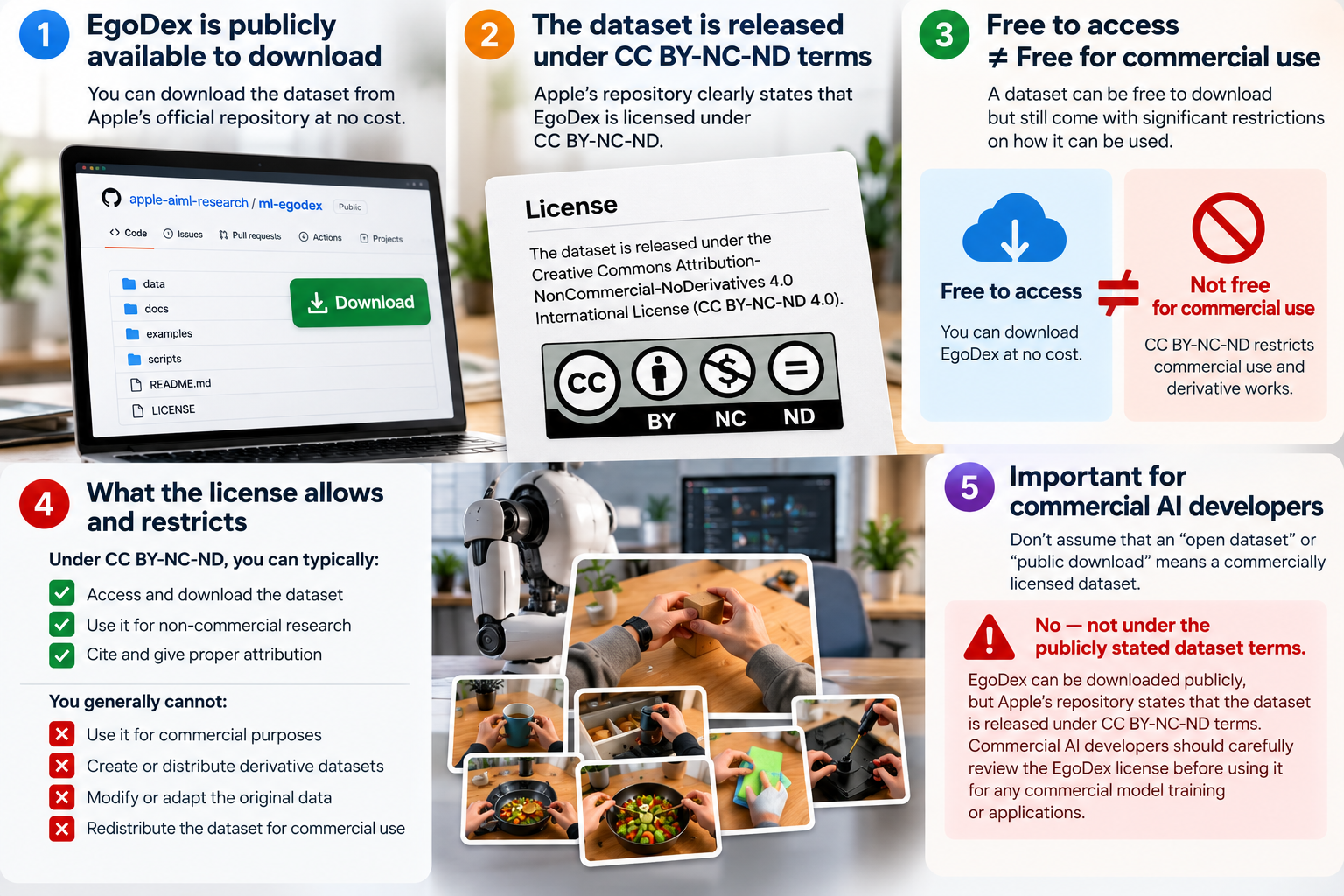
No—not under the publicly stated dataset terms.
EgoDex can be downloaded publicly, but Apple's repository states that the dataset is released under CC BY-NC-ND terms.
This is an important distinction.
Free to access ≠ free for commercial use.
A dataset can cost nothing to download while still carrying substantial restrictions on what organizations may do with it.
When evaluating an EgoDex license commercial license, commercial AI developers should therefore avoid interpreting "open dataset" or "public download" as "commercially licensed dataset."
These are different concepts.
EgoDex was explicitly created for machine-learning research.
Apple's repository describes third-party research projects that use EgoDex, including projects involving robot foundation models and vision-language-action models.
However, the licensing question changes when training becomes commercial.
Consider two scenarios.
A university laboratory downloads EgoDex and conducts experiments investigating whether human hand movements can improve robotic manipulation.
The project is conducted for qualifying noncommercial research.
A robotics company downloads EgoDex and incorporates the footage into the training pipeline for a foundation model intended to power a paid robotic product.
The second scenario introduces commercial-purpose questions that are directly relevant to the NC restriction.
Commercial teams should obtain legal guidance or additional authorization appropriate to their particular use rather than assuming that research-oriented model training establishes commercial rights.
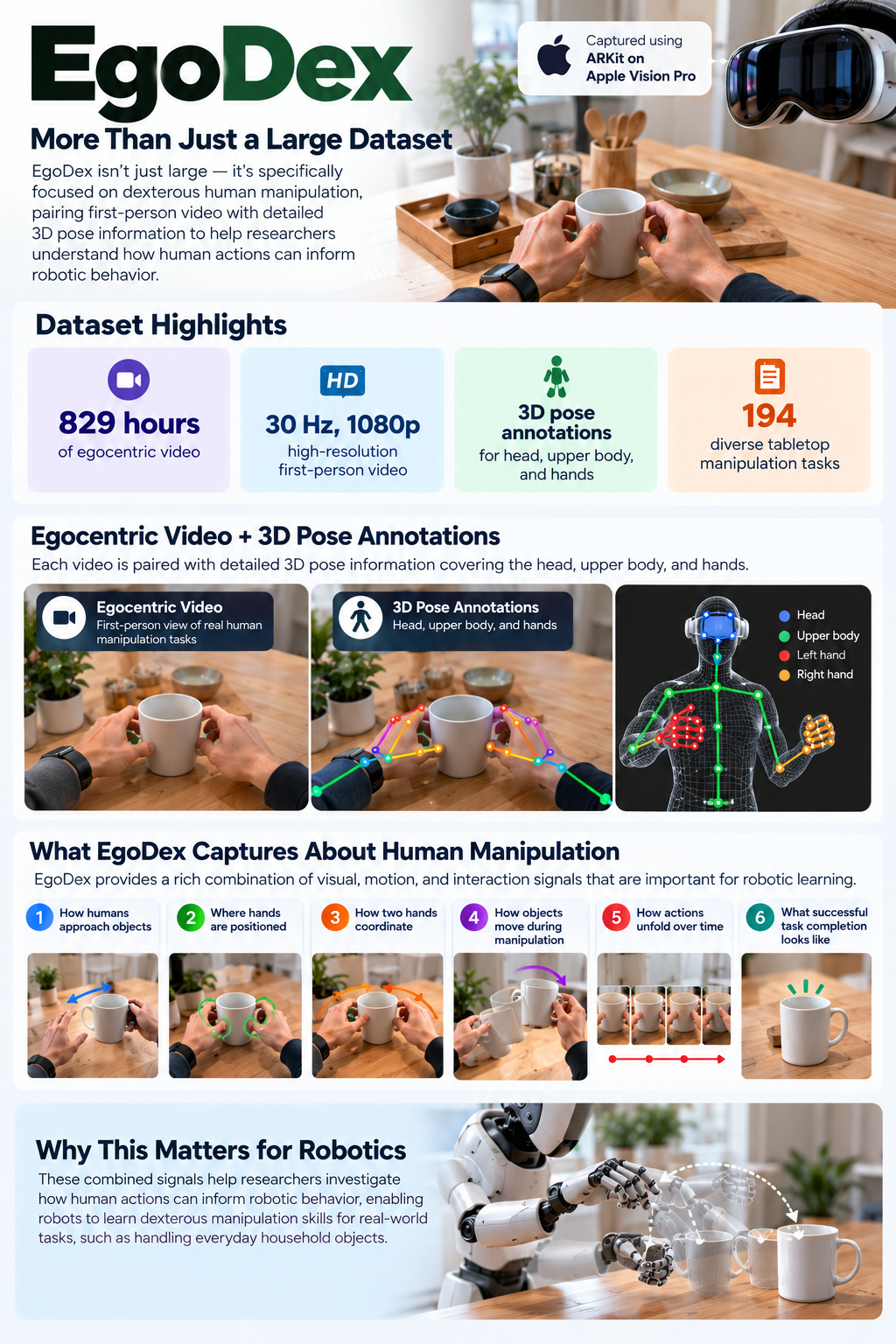
The appeal of EgoDex comes from more than its size.
Its data is specifically focused on dexterous human manipulation.
The dataset pairs egocentric video with detailed 3D pose information. According to Apple's documentation, these pose annotations cover the head, upper body, and hands.
This combination can help researchers investigate how human actions might inform robotic behavior.
For example, a robot learning to manipulate household objects needs more than images of those objects.
It may need examples showing:
EgoDex captures many of these signals together.
EgoDex contains approximately 829 total hours of video.
Apple divides the release into roughly:
The official repository also notes that the training set is divided into five large archives for easier distribution.
Each episode contains paired MP4 and HDF5 files. The video is stored in the MP4 file, while corresponding pose annotations are provided through HDF5 data.
This structure makes EgoDex useful for multimodal experimentation where visual information can be aligned with human pose and task descriptions.
This is an important detail.
Do not assume it does.
Apple's official repository distinguishes between the repository's code and the EgoDex dataset itself. It says the code is released under the terms specified in the repository's LICENSE file, while the dataset is available under CC-by-NC-ND terms.
This illustrates a broader lesson for AI dataset licensing.
A project may contain several separately licensed components:
Source code → one license
Training videos → another license
Annotations → dataset terms
Pretrained models → potentially separate terms
Third-party dependencies → their own licenses
Checking only the GitHub repository's software license can therefore provide an incomplete picture.
This is one of the more complicated aspects of evaluating an EgoDex license commercial license.
AI pipelines rarely consume raw datasets without processing them.
Teams may resize video, extract frames, calculate embeddings, transform annotations, generate labels, create clips, or convert files into new formats.
The CC BY-NC-ND framework places restrictions on sharing adapted material. However, whether a particular technical transformation constitutes an adaptation—and how those terms interact with trained model artifacts—can involve legal interpretation.
Commercial teams should therefore avoid making broad assumptions such as:
"Our model isn't a video, so the dataset license doesn't matter anymore."
The relationship between dataset rights and trained-model rights can be complex.
For high-value commercial projects, these questions deserve a dataset-specific legal review.
This distinction is particularly important for generative AI and robotics.
Think of the pipeline as:
EgoDex dataset → preprocessing → model training → trained weights → commercial application
There may be different licensing questions at every stage.
For example:
Dataset access: Are you permitted to download and use the data?
Training: Does the applicable license permit your intended training activity?
Transformation: What preprocessing or derived materials are created?
Model ownership: What rights apply to the resulting weights?
Deployment: Can the model be incorporated into a commercial product?
Redistribution: Can any original or transformed dataset material be distributed?
Answering one question does not automatically answer all the others.
Always verify licensing against the publisher's documentation rather than relying entirely on a dataset directory, blog post, or third-party mirror.
Apple's official EgoDex repository identifies the dataset as CC BY-NC-ND.
Document exactly which files and dataset release entered your pipeline.
Your records should include the source, download date, version, applicable terms, and project using the data.
A model that begins as a research experiment may later become part of a product.
When that transition happens, perform another licensing review.
Permission appropriate for research should not automatically be assumed to cover commercialization.
Document any transformed artifacts created from EgoDex, including extracted frames, converted annotations, embeddings, clips, or processed datasets.
This makes it easier to understand your data lineage later.
Copies of EgoDex may appear on other platforms. For example, some Hugging Face mirrors also identify the dataset as CC BY-NC-ND 4.0.
However, redistributing a dataset does not give a third party the ability to grant rights beyond those held under the original license.
Always trace the dataset back to its authoritative source.
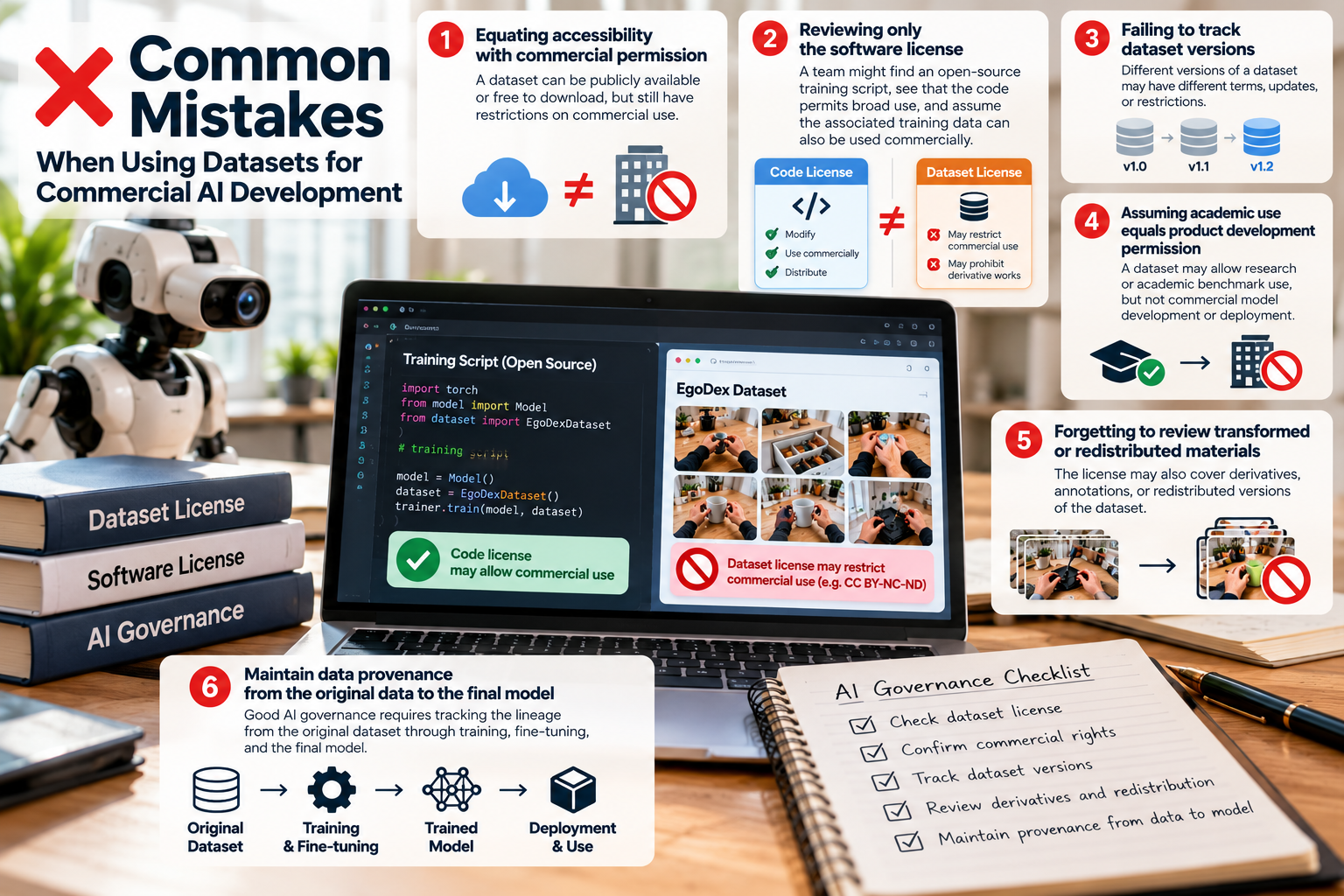
One of the biggest mistakes is equating accessibility with commercial permission.
Another is reviewing only the software license.
A team might find an open-source training script, see that the code permits broad use, and conclude that all associated training data can also be used commercially.
That conclusion may be incorrect.
Other common mistakes include failing to track dataset versions, assuming academic benchmark use equals product-development permission, and forgetting to review transformed or redistributed dataset materials.
Good AI governance requires maintaining provenance from the original data through the final model.
EgoDex offers an unusually rich collection of real-world human manipulation data for researchers working on robotics, computer vision, imitation learning, and embodied AI. Its 829 hours of first-person video, detailed pose annotations, and 194 manipulation tasks make it technically valuable for studying how humans interact with objects.
But technical usefulness and commercial usability are different questions.
The key point for anyone researching an EgoDex license commercial license is that Apple's public release is identified as CC BY-NC-ND, meaning it should not be treated as an unrestricted commercial training dataset.
Before using EgoDex in a product-oriented pipeline, document the exact dataset and assets being used, review the applicable terms, separate dataset rights from software and model rights, and obtain additional authorization where necessary.
That licensing work may seem less exciting than model training, but it is an essential part of building AI systems that can move safely from research experiments to real-world commercial deployment.
Apple's official EgoDex repository states that the dataset is available under CC BY-NC-ND terms. This framework includes attribution, noncommercial, and no-derivatives conditions. The repository separately identifies its code as being governed by the terms in its software LICENSE file.
The publicly released dataset should not be treated as commercially licensed because Apple identifies it as CC BY-NC-ND. Organizations interested in commercial use should obtain appropriate permission rather than assuming that downloading the dataset provides commercial rights.
EgoDex was designed for research into dexterous manipulation and is relevant to robotics and embodied AI. Apple specifically notes that the dataset includes extensive pick-and-place data useful to researchers interested in robot deployment. Commercial deployment, however, raises separate licensing considerations.
EgoDex contains approximately 829 hours of 30 Hz, 1080p egocentric video across 194 tabletop manipulation tasks. It also provides paired 3D pose annotations covering the head, upper body, and hands, together with natural-language annotations.
Not necessarily. Apple's repository explicitly distinguishes its code license from the dataset terms. The code is governed by the repository's LICENSE, while the dataset is identified as being available under CC BY-NC-ND terms.


Compact, ready to go anywhere
Interchangeable lens that’s upgradeable
Dual 1-inch sensors for improved clarity and low light performance
Dynamic range and 6K 360° capture
360° photo resolution at 21MP

8K 360° video recording for ultra-detailed visuals.
4K single-lens mode for traditional wide-angle shots.
Invisible selfie stick effect for drone-like perspectives.
2.5-inch touchscreen with Gorilla Glass protection.
Waterproof up to 33ft for underwater shooting.

360° photo resolution in 23MP
Slim design at 24 mm thick
Built-in image stabilization for smooth video capture.
Internal 19GB storage for photo and video storage.
Wireless connectivity for remote control and sharing.

60MP 360° still images for high-resolution photography.
5.7K 360° video recording at 30fps.
2.25-inch touchscreen for intuitive control.
USB Type-C port for fast charging and data transfer.
MicroSD card slot for expandable storage.
.png)

.png)

Try it free. No credit card required. Instant set-up.





.svg)


.svg)