


.png)


The right Ego4D alternative depends on the model, capture environment, viewpoints, annotations, privacy requirements, and commercial rights your project needs. Before replacing Ego4D, first verify whether its existing license already covers your intended development. Teams needing different tasks, proprietary capture, clearer buyer-specific rights, or production-specific data may benefit from commercially licensed or custom-collected egocentric datasets.
Egocentric video has become increasingly valuable for training AI systems to understand human actions, object interactions, and real-world environments from a first-person perspective. While Ego4D is one of the best-known datasets in this space, commercial AI teams may need different task coverage, clearer usage rights, specialized annotations, or data collected for specific deployment environments. Choosing the right Ego4D alternative means looking beyond dataset size and evaluating both technical quality and commercial licensing.
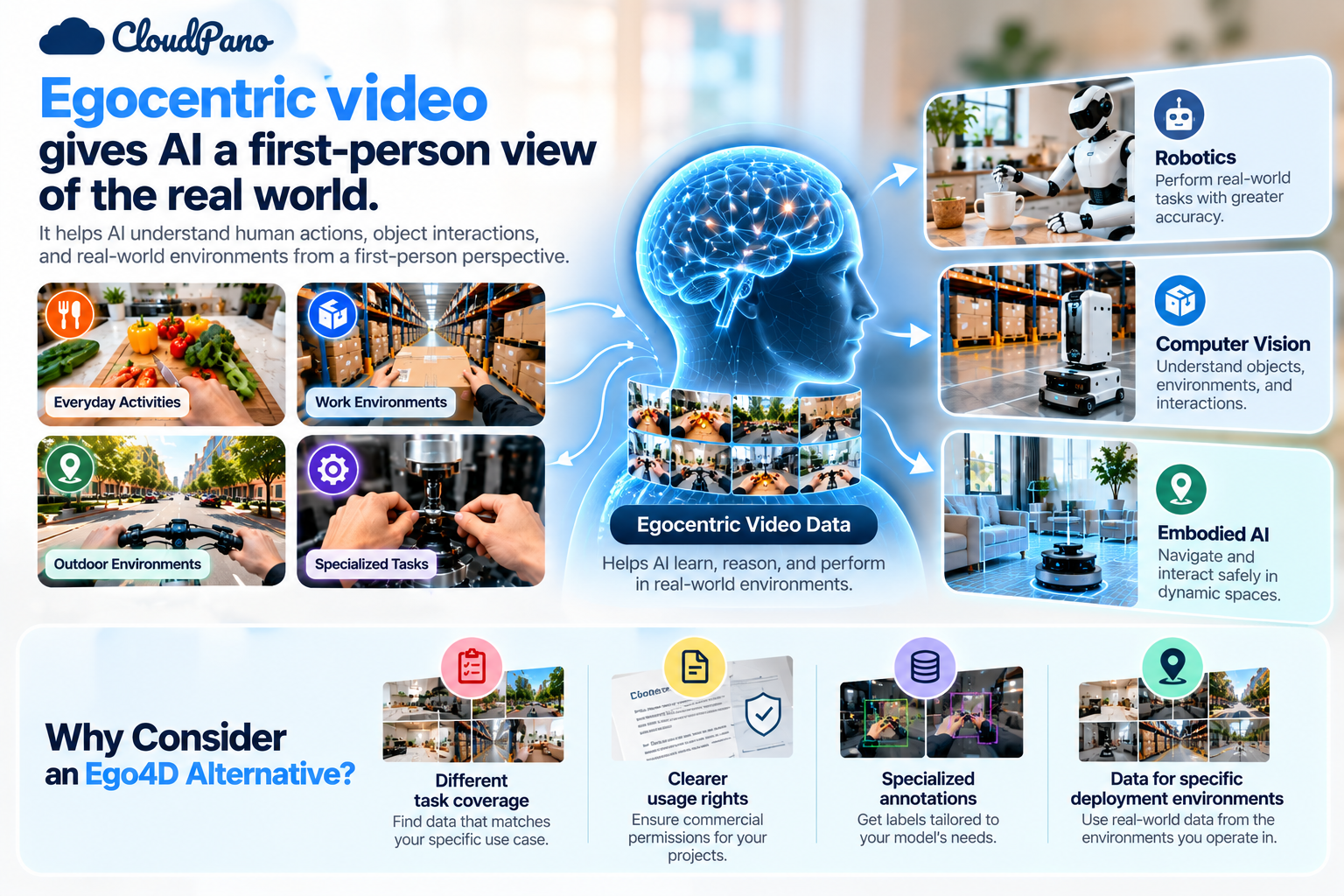
Ego4D is one of the most important resources in egocentric computer vision. Its official documentation describes thousands of hours of first-person video spanning household, workplace, outdoor, leisure, and other daily-life scenarios, with annotations supporting multiple machine-learning benchmarks.
That makes it extremely useful for research and model development.
But commercial AI teams often have requirements that go beyond dataset size.
A robotics company might need hundreds of hours of repetitive manipulation in warehouses. A wearable-AI developer might need footage captured using hardware close to its production device. A vision-language-action team might need synchronized hand pose, trajectories, language annotations, or external camera views.
There are also contractual questions:
This means searching for an Ego4D alternative should begin with requirements—not simply a search for another giant video dataset.
A common mistake is treating “academic dataset” and “commercially usable dataset” as opposites.
Licensing is more nuanced.
Ego4D requires users to review and accept its license agreement before accessing the dataset or annotations. The official documentation also notes that licenses can be executed individually or on behalf of an institution.
Therefore, a company shouldn't automatically reject Ego4D because it originated as a research resource. It should examine the applicable agreement against its intended workflow.
This distinction matters:
Dataset access → training rights → model rights → deployment rights → redistribution rights
These are related questions, but they are not necessarily the same right.
Practical tip: Have the applicable license reviewed against the actual intended use—not merely the fact that your organization is commercial.
“Commercially licensed” should never be treated as a vague marketing label.
Ask what the agreement explicitly permits.
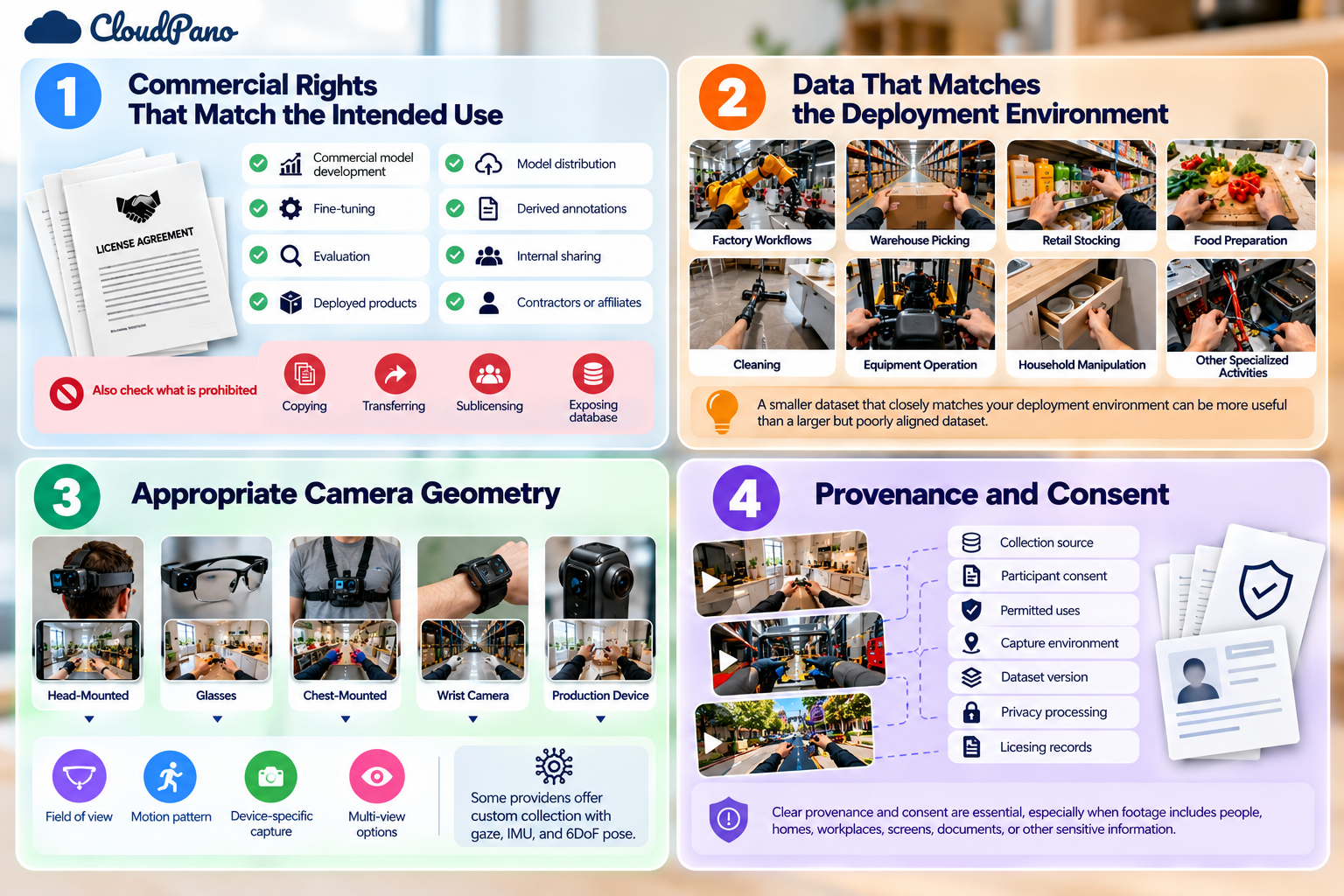
For example, does it cover:
Also identify what remains prohibited.
A useful example is Ego-Exo4D's model license. It states that covered uses can include academic research and commercial or noncommercial product development, while imposing significant restrictions on copying, transferring, sublicensing, and exposing the underlying database.
That illustrates why “commercial use allowed” is only the beginning of the licensing analysis.
Imagine training a warehouse manipulation system almost entirely on kitchen footage.
Both environments involve hands, objects, and actions, but the distributions are very different.
Production models may need:
A smaller dataset closely matching deployment conditions can sometimes be more useful than a much larger but poorly aligned corpus.
Egocentric video isn't interchangeable simply because it is first-person.
Head-mounted cameras, glasses, chest-mounted cameras, wrist cameras, and production wearable devices create different fields of view and motion patterns.
Commercial providers increasingly offer device-specific or multi-view capture. For example, LXT advertises custom egocentric collection using client devices with options including gaze, IMU, and 6DoF pose.
If hardware characteristics matter to your model, include them in the dataset specification.
Commercial AI teams should be able to answer a basic question:
Where did every training video come from?
Strong provenance documentation may include collection source, participant consent, permitted uses, capture environment, dataset version, privacy processing, and licensing records.
This becomes particularly important when footage contains people, homes, workplaces, screens, documents, or other potentially sensitive information.
There isn't one universally best alternative. The following options illustrate several different licensing and procurement models.
Ego-Exo4D is particularly relevant when synchronized first- and third-person views are important. Its official documentation describes time-synchronized ego and exo video alongside resources such as language, 3D body and hand pose, object segmentation, keysteps, procedural dependencies, and proficiency ratings.
Its model license explicitly discusses commercial product development and states that compliant licensees retain intellectual-property rights in software, algorithms, machine-learning models, annotations, techniques, and technologies they develop from the database. The underlying database remains protected and subject to restrictions.
For teams considering an Ego4D alternative, this is worth evaluating when multi-view skilled human activity is relevant.
EPIC-KITCHENS is an influential egocentric dataset centered on kitchen activities.
Its public release is not an unrestricted commercial dataset. The official materials state that the dataset is published under Creative Commons Attribution-NonCommercial 4.0, which prohibits commercial use under that public license.
However, there is an important detail for commercial teams: the official EPIC-KITCHENS site specifically instructs organizations interested in commercial licenses for EPIC-KITCHENS and its annotations to contact the project.
So the correct conclusion is not simply “EPIC-KITCHENS cannot be used commercially.”
Instead:
The public license is noncommercial, while separate commercial licensing may be available from the rights holder.
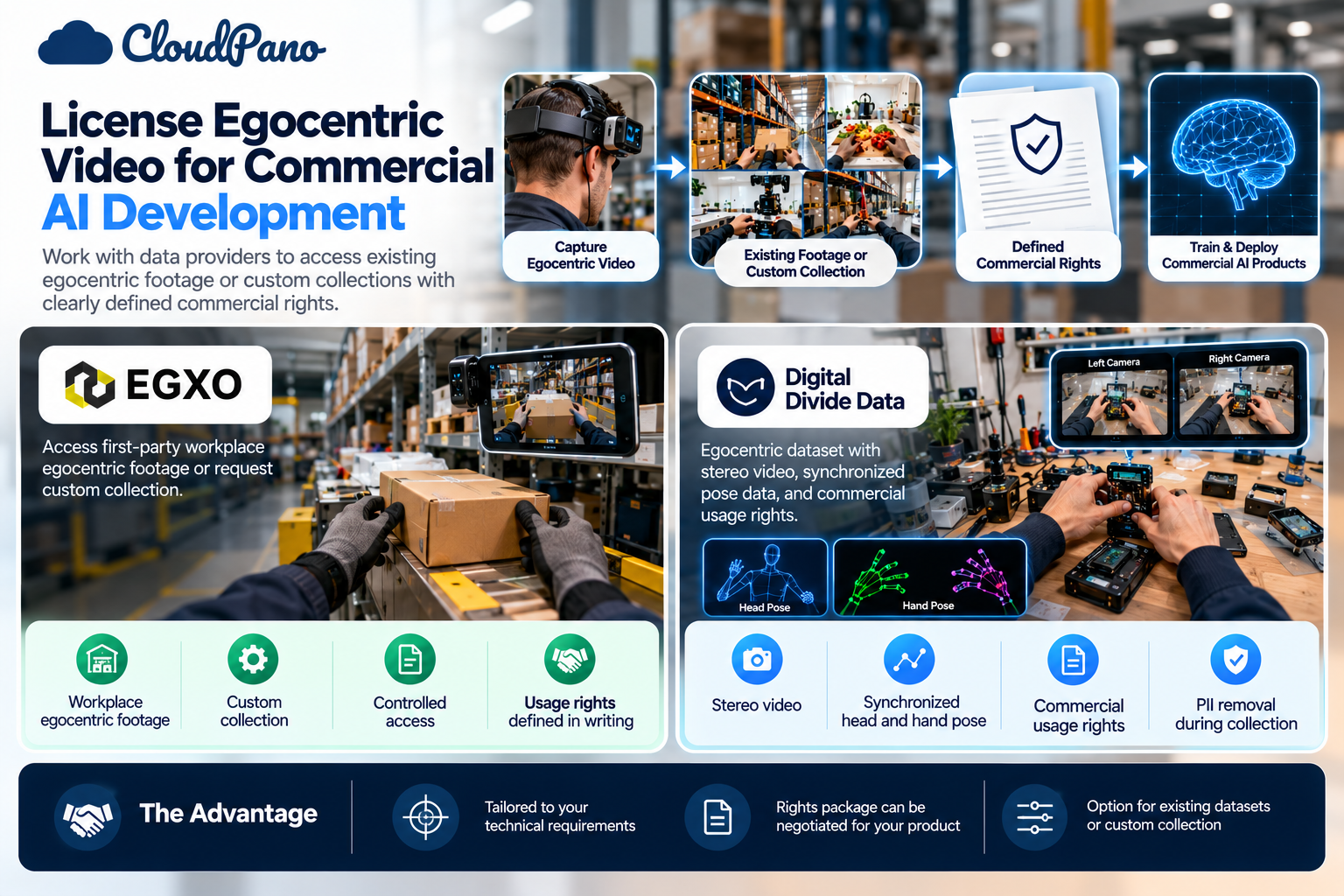
Another option is to license data specifically collected for commercial AI development.
For example, EGXO advertises controlled commercial access to existing first-party workplace egocentric footage and custom collection. Its materials explicitly state that permitted use is defined in writing for each delivery rather than assuming that footage captured in a commercial environment automatically carries commercial AI rights.
Digital Divide Data similarly advertises an egocentric dataset with stereo video, synchronized head and hand pose, commercial usage rights, and PII removal during collection.
These vendor claims should still be independently verified during procurement, but they illustrate the primary advantage of commercial collection: the technical specification and rights package can potentially be negotiated around the intended product.
Clearer rights for a defined use case
A negotiated commercial agreement can explicitly address model development, deployment, internal access, derivatives, and other downstream requirements.
Better domain alignment
Custom collection can focus on the actual tasks, environments, objects, failures, and camera viewpoints your model needs.
Stronger provenance
Commercial procurement can require documented consent, capture origin, privacy review, dataset versions, and chain-of-rights records.
Custom annotations
Teams can specify hand pose, object states, action labels, natural-language descriptions, timestamps, trajectories, or other signals needed by their training pipeline.
Higher cost
Rights-cleared collection and annotation can be considerably more expensive than downloading an existing academic benchmark.
Smaller initial scale
A custom dataset may begin with hundreds or thousands of hours rather than the enormous volume available from mature public datasets.
Longer procurement cycle
Legal review, capture design, consent documentation, security reviews, pilots, and quality assurance can slow initial access.
Vendor claims still require verification
The phrase “commercially licensed” alone isn't enough. Your organization should review the actual agreement and provenance documentation before training.
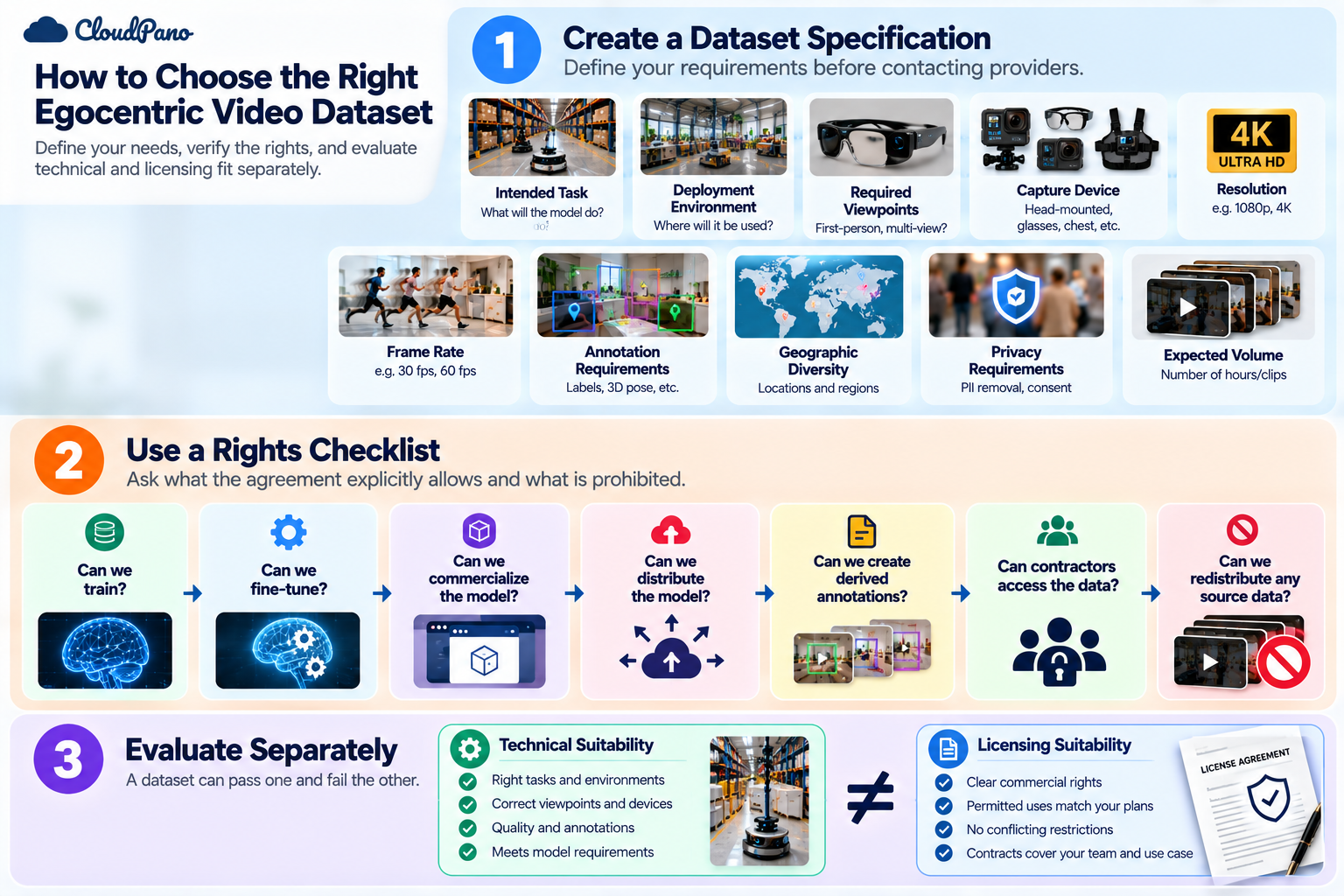
Start by writing a dataset specification before contacting providers.
Define the model's intended task, deployment environment, required viewpoints, capture device, resolution, frame rate, annotation requirements, geographic diversity, privacy requirements, and expected volume.
Then create a separate rights checklist:
Can we train? → Can we fine-tune? → Can we commercialize the model? → Can we distribute the model? → Can we create derived annotations? → Can contractors access the data? → Can we redistribute any source data?
Keep technical suitability and licensing suitability as separate review tracks.
A dataset can pass one and fail the other.
Don't purchase thousands of hours solely from a specification sheet.
Test a representative sample through your real pipeline.
Look at:
The pilot should tell you whether the dataset produces useful training signal—not merely whether the videos look impressive.
Finding an Ego4D alternative isn't simply about locating another collection of first-person videos.
For commercial AI, the stronger question is:
Which dataset provides both the training signal and the rights required for the product we intend to build?
Ego4D itself should be evaluated under its actual license rather than dismissed based on assumptions. Ego-Exo4D offers explicit provisions relevant to commercial model development, EPIC-KITCHENS provides a route for requesting separate commercial licensing, and commercial data providers can offer existing or custom datasets under buyer-specific agreements.
Before committing to a dataset, document the required tasks, viewpoints, annotations, provenance, privacy controls, model rights, deployment rights, and redistribution restrictions. Then validate both the license and a representative sample.
If your production model needs rights-cleared egocentric video beyond what public research datasets provide, the next step is to define a commercial dataset specification and evaluate existing inventory or a custom collection against it.
Ego4D requires acceptance of its own license agreement, so teams should evaluate the applicable terms against their specific intended use rather than assuming it is either unrestricted or research-only. Commercial organizations should also distinguish rights to develop models from rights involving the underlying videos, annotations, redistribution, and other database uses.
There is no universal best dataset. Robotics teams should prioritize footage matching their target tasks, environments, camera geometry, manipulation patterns, annotation needs, and commercial-rights requirements. Ego-Exo4D may be relevant for multi-view skilled activity, while commercially collected datasets can be better suited to proprietary workflows.
The standard public EPIC-KITCHENS release is under CC BY-NC 4.0 and therefore does not grant commercial use under that public license. However, the official project explicitly provides contact information for organizations seeking a separate commercial license.
No. “Commercial” doesn't answer every legal or technical question. Review the actual contract, permitted uses, provenance, consent, privacy handling, redistribution restrictions, model rights, and contractor access. Legal counsel should review terms where licensing risk is material.
Not necessarily. Public datasets can provide excellent scale, diversity, benchmarks, and research value. Custom data becomes especially useful when production requires specific hardware, environments, workflows, annotations, privacy controls, or rights that existing datasets cannot provide.


Compact, ready to go anywhere
Interchangeable lens that’s upgradeable
Dual 1-inch sensors for improved clarity and low light performance
Dynamic range and 6K 360° capture
360° photo resolution at 21MP

8K 360° video recording for ultra-detailed visuals.
4K single-lens mode for traditional wide-angle shots.
Invisible selfie stick effect for drone-like perspectives.
2.5-inch touchscreen with Gorilla Glass protection.
Waterproof up to 33ft for underwater shooting.

360° photo resolution in 23MP
Slim design at 24 mm thick
Built-in image stabilization for smooth video capture.
Internal 19GB storage for photo and video storage.
Wireless connectivity for remote control and sharing.

60MP 360° still images for high-resolution photography.
5.7K 360° video recording at 30fps.
2.25-inch touchscreen for intuitive control.
USB Type-C port for fast charging and data transfer.
MicroSD card slot for expandable storage.
.png)

.png)

Try it free. No credit card required. Instant set-up.




.svg)


.svg)