Best Practices for Using AI Video in Real Estate Listings

Cloudpano
December 31, 2025
5 min read
Share this post

Best Practices for Using AI Video in Real Estate Listings 🏡🎥

AI video is no longer a futuristic concept in real estate—it’s quickly becoming a competitive advantage.

From faster content creation to stronger buyer engagement, AI video real estate tools are reshaping how properties are presented online. When used correctly, AI property videos can dramatically improve real estate video marketing, enhance real estate listing optimization, and align perfectly with modern AI marketing best practices.

But simply using AI video isn’t enough. To get real results, agents and teams must use it strategically. With a real estate video app, agents can quickly produce professional listing videos that attract more buyers.

In this guide, we’ll break down the best practices for using AI video in real estate listings—so your videos don’t just look good, but actually drive clicks, showings, and sales.

Why AI Video Matters in Real Estate Today 🚀

Today’s buyers are digital-first.

Before booking a showing, they:

  • Scroll listings on mobile 📱
  • Compare multiple homes quickly
  • Expect video, not just photos
  • Want clarity without friction

AI video helps meet these expectations by creating:

  • Faster, scalable video content
  • Consistent, professional presentation
  • Better storytelling for each listing

When used properly, AI video supports every stage of the buying journey.

Start With Clear Listing Goals 🎯

Before creating any AI video, define what success looks like.

Ask yourself:

  • Is this video meant to increase clicks?
  • Improve time spent on listings?
  • Qualify buyers before showings?
  • Stand out on social media?

Clear goals guide better decisions around:

  • Video length
  • Messaging
  • Visual emphasis
  • Distribution channels

Strong real estate listing optimization always starts with intent.
Focus on Flow, Not Flash 🧭

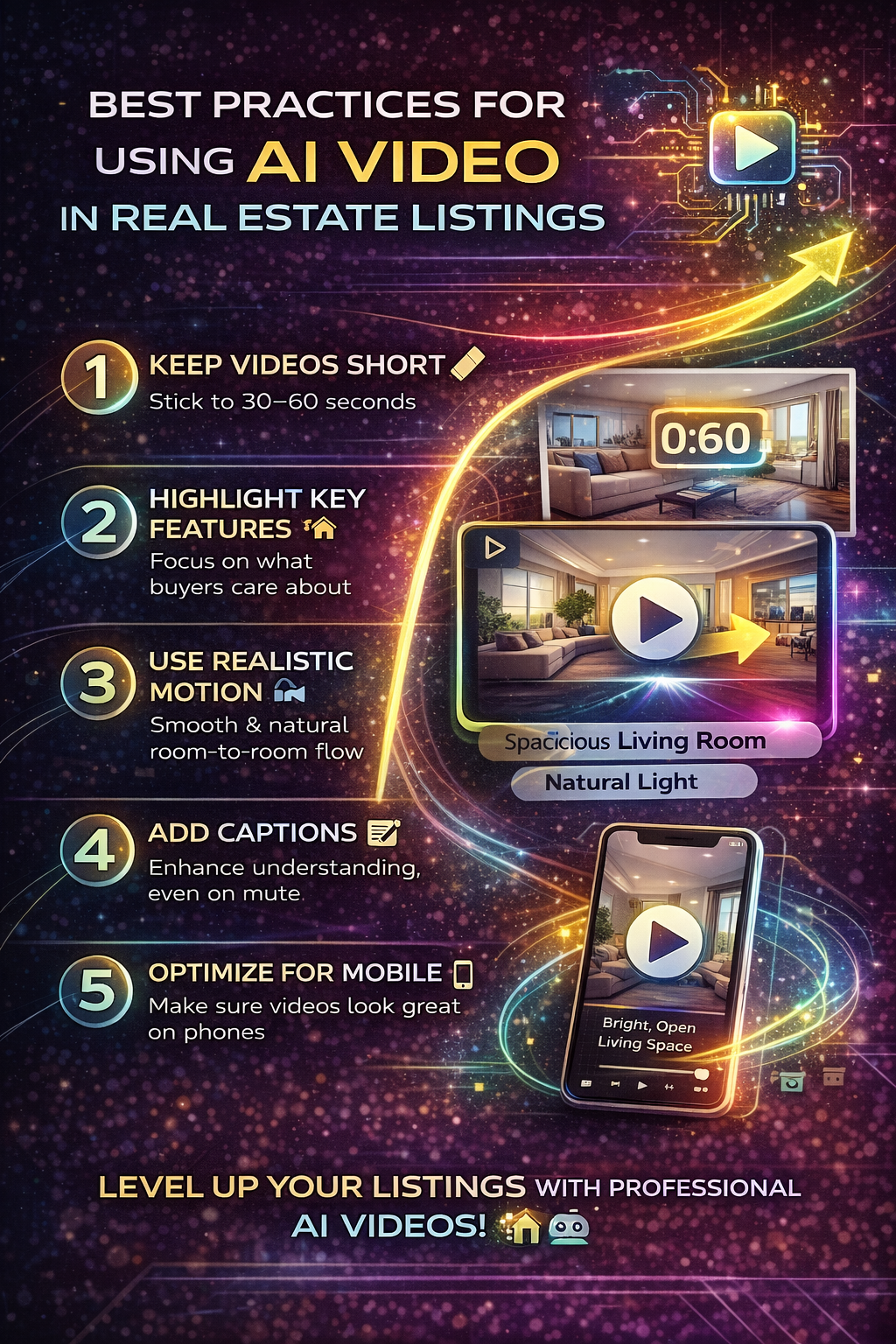
One of the biggest mistakes in real estate video marketing is overdoing effects.

AI video works best when it:

  • Shows natural room-to-room flow
  • Helps viewers understand layout
  • Feels intuitive and calm
  • Enhances—not distracts from—the property

Best practice:

  • Use smooth transitions
  • Maintain logical room order
  • Avoid overly aggressive animations

The goal is clarity, not spectacle.

Optimize AI Videos for Mobile First 📱✨

Most buyers discover listings on their phones.

That means AI video real estate content should be:

  • Vertical or square-friendly
  • Easy to watch without sound
  • Clear on small screens
  • Quick to load

Mobile-first optimization improves:

  • Engagement rates
  • Watch time
  • Social performance
  • Overall listing visibility

If it works on mobile, it works everywhere.

Keep Videos Short and Purposeful ⏱️

Attention spans are limited.

The best-performing AI property videos are:

  • Short (30–60 seconds)
  • Focused on key features
  • Designed to spark interest—not explain everything

Think of AI video as:

  • A visual preview
  • A digital first showing
  • A decision-filtering tool

Long explanations belong later in the buying process.

Highlight What Buyers Actually Care About 🏠❤️

AI video is most effective when it emphasizes buyer priorities.

These often include:

  • Layout and flow
  • Natural light
  • Kitchen and living areas
  • Outdoor space
  • Unique features

Avoid trying to show everything.

Instead:

  • Lead with emotional impact
  • Highlight lifestyle moments
  • Show how spaces connect

This improves visualization and emotional engagement.

Maintain Brand Consistency Across Listings 🎨

One of the biggest advantages of AI video is consistency.

With the right setup, AI video helps ensure:

  • Consistent colors
  • Unified pacing
  • Predictable quality
  • Recognizable style

Brand consistency:

  • Builds trust
  • Looks professional
  • Strengthens your marketing presence
  • Makes listings feel cohesive

This is a key AI marketing best practice for teams and brokerages.

Pair AI Video With Strong Photography 📸🎬

AI video doesn’t replace good photos—it enhances them.

Best results come from:

  • Clean, well-lit photography
  • Decluttered spaces
  • Neutral color balance
  • Consistent framing

High-quality inputs lead to high-quality AI outputs.

Think of AI video as an amplifier—not a fixer.

Use AI Video to Improve Listing Optimization 🔍

Search engines and platforms reward engagement.

AI video helps improve real estate listing optimization by:

  • Increasing time-on-page
  • Encouraging repeat views
  • Boosting click-through rates
  • Reducing bounce rates

Listings with video often:

  • Rank higher
  • Attract more serious buyers
  • Convert faster

This makes AI video a powerful SEO and performance tool.

Distribute Videos Everywhere Buyers Are 🌐

AI video should never live in just one place.

Best practice is omnichannel distribution:

  • MLS (where allowed)
  • Property websites
  • Email campaigns
  • Social media feeds
  • Landing pages

Each platform increases exposure and reinforces interest.

Smart real estate video marketing multiplies reach without extra effort.

Customize Video Messaging by Property Type 🏘️

Not all listings need the same approach.

Tailor AI video style based on:

  • Residential vs luxury
  • Condos vs single-family homes
  • Investment properties vs owner-occupied
  • New builds vs resales

Customization improves relevance and engagement.

AI tools make this scalable without extra production time.

Use AI Video to Pre-Qualify Buyers ✅

One underrated benefit of AI property videos is buyer filtering.

Clear visualization helps buyers:

  • Decide faster if a home fits
  • Avoid wasted showings
  • Arrive more informed

This saves time for both buyers and agents—and leads to smoother transactions.

Avoid Over-Automation Pitfalls ⚠️

AI is powerful—but it still needs human oversight.

Best practices include:

  • Reviewing every video before publishing
  • Checking for visual accuracy
  • Ensuring room order makes sense
  • Avoiding misleading representations

Trust matters in real estate. Accuracy builds confidence.

Leverage AI Video for Faster Content Turnaround ⚡

Speed is a major advantage of AI video.

With AI:

  • Listings go live faster
  • Marketing launches sooner
  • Momentum builds earlier
  • First impressions improve

Fast content creation is a key differentiator in competitive markets.

Combine AI Video With Virtual Property Tours 🌐🏡

AI video works beautifully alongside virtual property tours.

Together, they:

  • Provide quick overviews (video)
  • Offer deep exploration (tour)
  • Support different buyer preferences

This layered approach enhances the buyer experience without overwhelming them.

Measure Performance and Optimize 📊

AI marketing best practices always include feedback loops.

Track metrics such as:

  • Video views
  • Watch time
  • Click-through rates
  • Showing requests
  • Conversion paths

Use insights to refine:

  • Video length
  • Visual emphasis
  • Distribution strategy

AI video gets more powerful when paired with data.

The Future of AI Video in Real Estate 🔮🎥

AI video adoption is accelerating.

Trends point toward:

  • Video-first listings
  • Smarter personalization
  • Deeper integration with CRM and MLS tools
  • Enhanced buyer visualization experiences

Agents and teams who adopt best practices now will be better positioned as expectations continue to rise.

Don’t Miss These Articles:

Final Thoughts: Strategy Makes the Difference 🎯

AI video is not just a tool—it’s a strategy.

When used correctly, AI video real estate solutions:

  • Elevate real estate video marketing
  • Improve listing optimization
  • Enhance buyer confidence
  • Scale content creation efficiently
  • Align with modern AI marketing best practices

The agents and teams who win with AI video are the ones who use it thoughtfully—not just frequently.

The Complete Virtual Experience Stack Starts Here:

Share this post
Cloudpano

Choose The Right 360° Camera

Insta360 ONE RS 1-Inch 360 Edition

  • Compact, ready to go anywhere

  • Interchangeable lens that’s upgradeable

  • Dual 1-inch sensors for improved clarity and low light performance

  • Dynamic range and 6K 360° capture

  • 360° photo resolution at 21MP

Learn More

Insta360 X4

  • 8K 360° video recording for ultra-detailed visuals.

  • 4K single-lens mode for traditional wide-angle shots.

  • Invisible selfie stick effect for drone-like perspectives.

  • 2.5-inch touchscreen with Gorilla Glass protection.

  • Waterproof up to 33ft for underwater shooting.

Learn More

Ricoh Theta Z1

  • 360° photo resolution in 23MP

  • Slim design at 24 mm thick

  • Built-in image stabilization for smooth video capture.

  • Internal 19GB storage for photo and video storage.

  • Wireless connectivity for remote control and sharing.

Learn More

Ricoh Theta X

  • 60MP 360° still images for high-resolution photography.

  • 5.7K 360° video recording at 30fps.

  • 2.25-inch touchscreen for intuitive control.

  • USB Type-C port for fast charging and data transfer.

  • MicroSD card slot for expandable storage.

Learn More
Property Marketing
Allows potential buyers to explore properties in detail from anywhere, enhancing the real estate marketing process.
Automotive Spins
Create an interactive virtual showroom and engage affluent digital buyers with live 360º video calls, all through the CloudPano mobile app for a complete automotive sales solution.
Interactive Floor Plans
Create 2D and 3D floor plans with measurements in 4 minutes or less, all from your phone. Download the Floor Plan Scanner app and get your first scan free.

360 Virtual Tours With CloudPano.com. Get Started Today.

Try it free. No credit card required. Instant set-up.
Try it free
Latest posts

See our other posts

Interviews, tips, guides, industry best practices, and news.

Property Manager Video Hub: Scaling Rental Visibility with AI Photo-to-Video Workflows

This article explains how property managers can use PhotoAIVideo to build a property manager video hub: a repeatable system for turning rental photos, amenity images, floor plans, exterior shots, and neighborhood visuals into reusable rental marketing videos. The main idea is that property managers do not just need more listing exposure. They need clearer visual answers that help renters decide whether to schedule a tour. PhotoAIVideo is positioned as a practical tool for creating: Unit availability videos Amenity highlight videos Neighborhood videos Tour reminder clips Leasing follow-up videos Owner marketing proof videos Social media rental teasers Application or availability reminder videos Key takeaways: Property managers already have the media they need; the challenge is organizing it and turning it into reusable video assets. A video hub helps teams create consistent videos across units, floor plans, amenities, communities, and owner updates. Rental videos can reduce friction by answering renter questions about layout, condition, amenities, parking, pet features, and community feel. One rental photo set can become multiple video outputs for listings, social media, email, text follow-up, tour reminders, and owner reporting. Photographers can sell AI rental video packages to property managers as an upsell. Brokerages with property management divisions can use the same workflow to standardize leasing content. The article ends with a step-by-step process, video hub framework, mistakes to avoid, visual recommendations, FAQs, and a CTA encouraging readers to use PhotoAIVideo to turn rental photos into a scalable video system for rental visibility.
Read post

YouTube Shorts Listing Teasers: The 3-Scene Structure for Higher Property Clicks

This article explains how real estate agents, photographers, brokerages, and property managers can use YouTube Shorts listing teasers to drive more property clicks and showing requests. The main idea is that a YouTube Short should not try to show the entire house. Instead, it should use a simple 3-scene structure: Scene 1: Hook — stop the scroll with the strongest property feature. Scene 2: Proof — show the visuals that support the hook. Scene 3: Click Path — tell the viewer what to do next. The article positions PhotoAIVideo as a practical tool for turning listing photos into short vertical videos for YouTube Shorts, Reels, open house promotion, and listing campaigns. Key takeaways: YouTube Shorts should create curiosity, not replace the full listing video. The strongest property feature should appear first, not necessarily the front exterior. Agents should build each Short around one click reason, such as backyard, kitchen, layout, neighborhood, open house, or price point. One listing can become multiple Shorts instead of one generic video. Photographers can offer YouTube Shorts teaser packs as a video upsell. Brokerages can standardize the 3-scene structure across agents. Property managers can use the same structure to promote rentals and tours. The article ends with practical scripts, visual recommendations, FAQs, a visual placement guide, and a CTA encouraging readers to use PhotoAIVideo to create YouTube Shorts listing teasers from property photos.
Read post

Video Retargeting for Listings: Turning Photo-Based AI Videos into Appointment Follow-Up

This article explains how Realtors, photographers, brokerages, and property managers can use photo-based AI videos as follow-up assets after someone shows interest in a listing. The main idea is that most real estate marketing focuses on getting the first click, but many buyers and sellers need multiple touchpoints before booking a showing or appointment. Video retargeting helps agents re-engage people who already clicked a listing, watched a Reel, opened an email, attended an open house, asked about a property, or went quiet after showing interest. PhotoAIVideo is positioned as a practical tool for turning listing photos into short follow-up videos, including: Feature reminder videos Layout explainer videos Neighborhood fit videos Open house recap videos Price update videos Seller proof videos Showing request videos Rental tour recovery videos Key takeaways: A first-touch listing video introduces the property, while a retargeting video answers the next likely question. Follow-up videos should be short, usually 10–30 seconds, and focused on one action. Agents should send different videos based on behavior, such as email clicks, open house attendance, listing views, or showing interest. A good video follow-up feels helpful, not pushy. Photographers can package retargeting video clips as an upsell. Brokerages can standardize video retargeting workflows across agents. Property managers can use the same strategy to recover rental leads and book tours. The article ends with a simple retargeting sequence, visual recommendations, FAQs, and a CTA encouraging readers to use PhotoAIVideo to turn listing photos into appointment-driving follow-up videos.
Read post