


.png)


Video has become one of the most powerful tools in modern real estate marketing. Buyers expect it. Sellers ask for it. Platforms reward it. And real estate teams that leverage video consistently win more attention, engagement, and listings.
With platforms like PhotoAIVideo, teams can now create professional listing videos in minutes—without cameras, crews, or editing delays.
But as video becomes non-negotiable, teams face a critical strategic decision:
This isn’t just a creative choice. It’s an operational one.
In this guide, we’ll break down AI video vs traditional video for real estate, explain how each fits into modern real estate marketing technology, and help teams decide which approach makes sense long-term.
Before comparing formats, it’s important to understand why video matters so much right now.
Video helps real estate teams:
That’s why real estate video marketing has shifted from a “nice-to-have” to a baseline expectation.
The real question is no longer if teams should use video — it’s how.
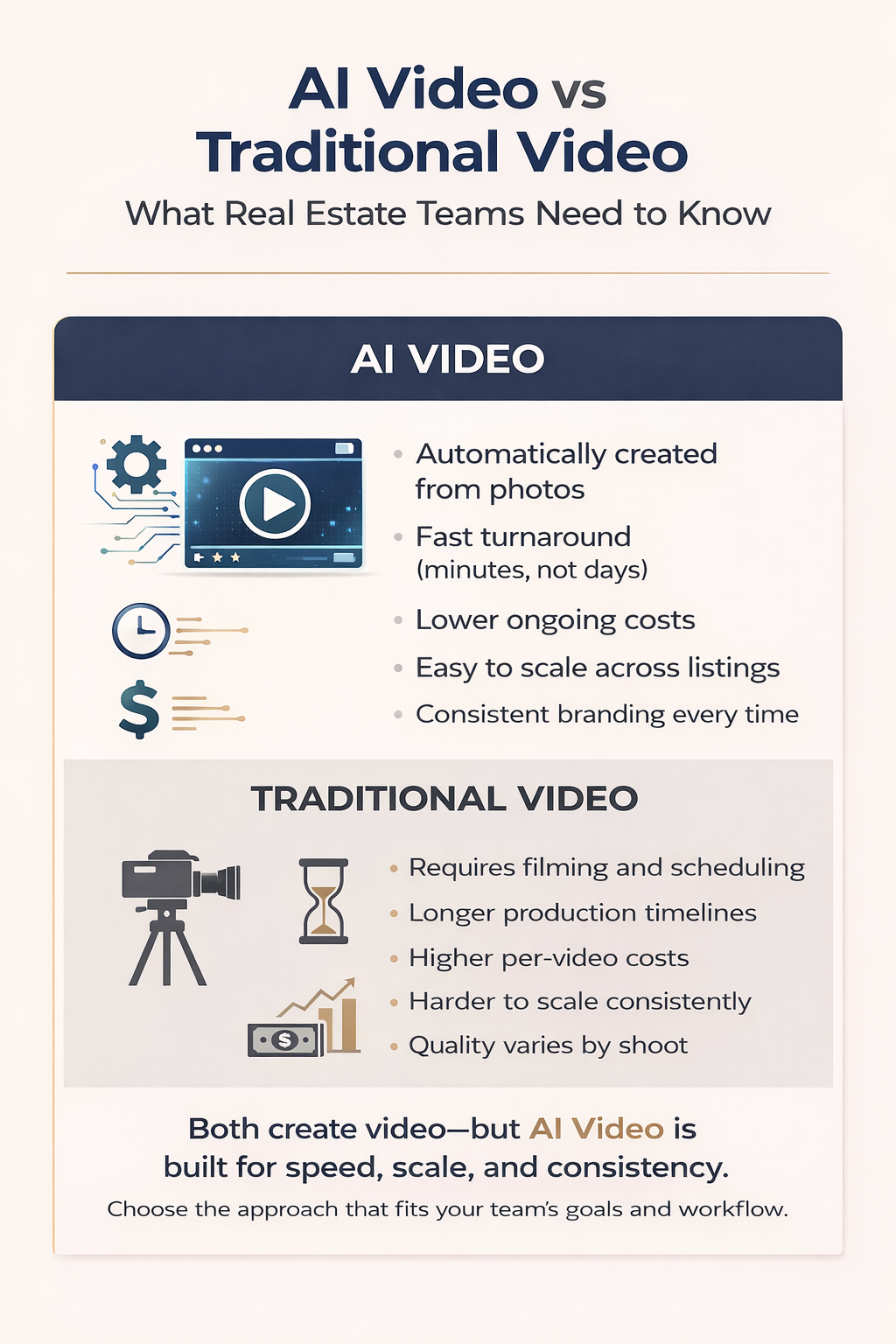
Traditional real estate video typically includes:
For years, this was the gold standard—especially for luxury properties and brand storytelling.
Traditional video still shines when:
When executed well, it can be emotional, immersive, and visually stunning.
For teams managing volume, traditional video introduces serious constraints:
This is where AI vs traditional video real estate comparisons become critical.
AI video for real estate uses automation and artificial intelligence to turn listing photos into professional-quality videos—without manual filming or editing.
Instead of starting with cameras, AI systems:
The result is fast, scalable video marketing for real estate teams—without production bottlenecks.
This is exactly what PhotoAIVideo is built for.
Speed is one of the biggest differences between AI and traditional video.
Traditional video speed:
AI video speed 🚀:
For teams managing multiple listings, speed directly impacts results, exposure, and seller satisfaction.
Cost is often the deciding factor.
Traditional video costs:
AI video costs 💡:
For most teams, AI video for real estate teams delivers far better ROI when applied across dozens or hundreds of listings.
Scalability is where traditional video struggles most.
As teams grow, they face:
Traditional video scales linearly: more listings mean more cost, coordination, and friction.
AI video scales exponentially.
With AI video marketing for real estate teams, you can ensure:
Brand consistency is one of the hardest problems for growing teams.
Traditional video issues:
AI video advantages 🎯:
This is why AI video fits naturally into modern real estate marketing technology stacks.
Modern platforms prioritize video, especially short, mobile-friendly formats.
AI video performs exceptionally well on:
Traditional video often requires:
AI systems automatically generate multiple formats, making real estate video marketing faster and more adaptable.
Engagement depends on context.
Traditional video excels when:
AI video excels when 📈:
For most teams, AI video generates more total engagement simply because it’s used more often.
The biggest shift isn’t video quality — it’s automation.
With AI-driven real estate marketing technology:
Traditional video rarely integrates this cleanly into automated workflows.
That’s why efficiency-focused teams choose AI.
Sellers want exposure—and confidence their listing will be marketed aggressively.
Teams using AI video win more listings because they can promise:
Traditional video may still be used selectively, but AI becomes the baseline offering.
This isn’t always an either/or decision.
Many top teams use:
This hybrid strategy balances:
Understanding AI vs traditional video real estate allows teams to deploy each where it performs best.
The future of video is:
AI will continue improving in:
Traditional video won’t disappear—but it will become specialized.
For day-to-day marketing, AI video is becoming the foundation.
The AI vs traditional video debate isn’t about replacing creativity—it’s about evolving strategy.
Traditional video still has a place.
But for teams focused on:
AI video is the smarter default.
As real estate marketing technology advances, teams that adopt scalable video systems today will lead tomorrow’s market.
The real question isn’t if AI video will dominate—it’s when your team will make the switch.


Compact, ready to go anywhere
Interchangeable lens that’s upgradeable
Dual 1-inch sensors for improved clarity and low light performance
Dynamic range and 6K 360° capture
360° photo resolution at 21MP

8K 360° video recording for ultra-detailed visuals.
4K single-lens mode for traditional wide-angle shots.
Invisible selfie stick effect for drone-like perspectives.
2.5-inch touchscreen with Gorilla Glass protection.
Waterproof up to 33ft for underwater shooting.

360° photo resolution in 23MP
Slim design at 24 mm thick
Built-in image stabilization for smooth video capture.
Internal 19GB storage for photo and video storage.
Wireless connectivity for remote control and sharing.

60MP 360° still images for high-resolution photography.
5.7K 360° video recording at 30fps.
2.25-inch touchscreen for intuitive control.
USB Type-C port for fast charging and data transfer.
MicroSD card slot for expandable storage.
.png)

.png)

Try it free. No credit card required. Instant set-up.






.svg)


.svg)