


.png)



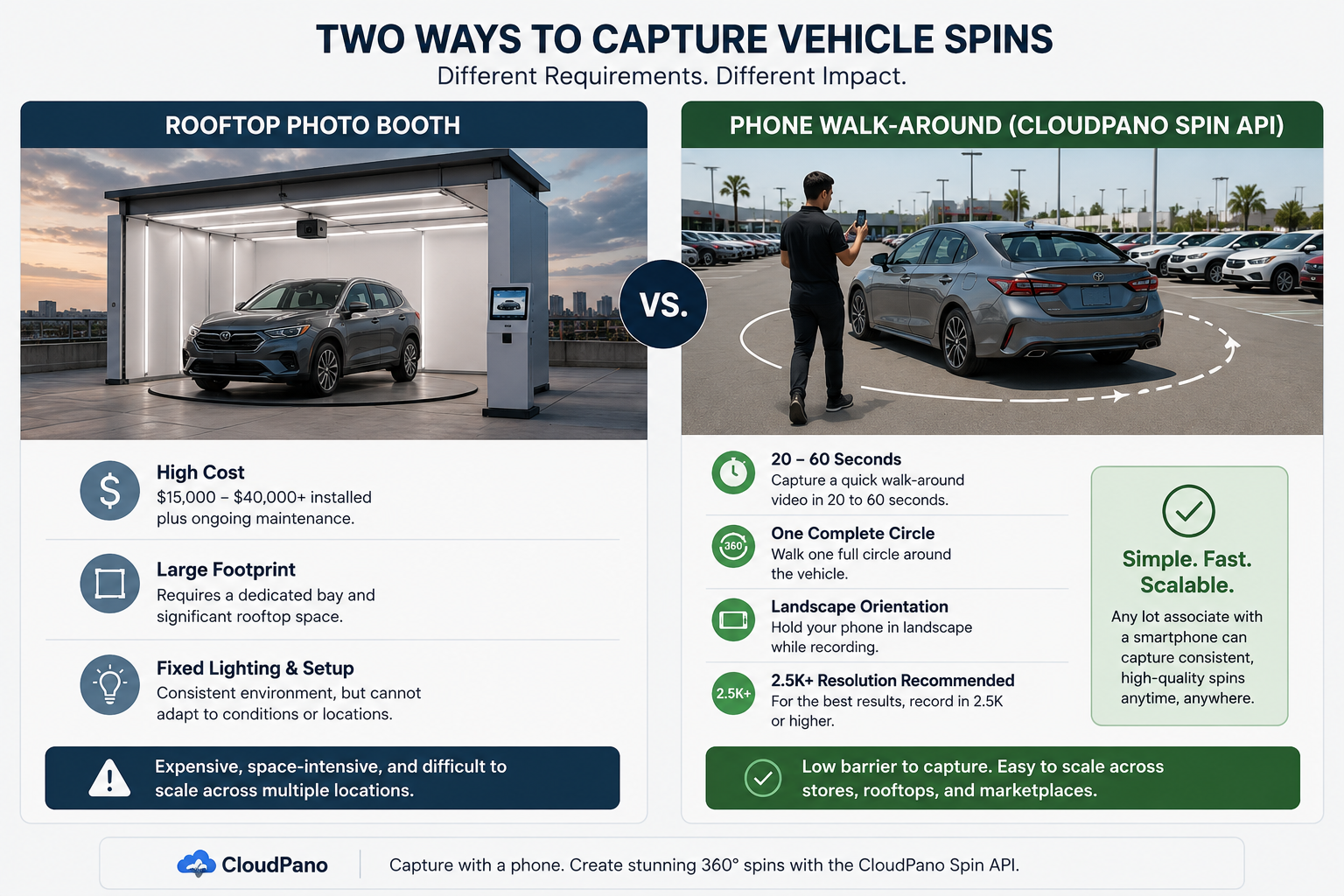
A rooftop photo booth can require a significant upfront investment, dedicated space, and a standardized capture process. Multiply that across a dealer group with a dozen stores — or a marketplace ingesting listings from hundreds of independent sellers — and maintaining consistent vehicle imagery becomes increasingly difficult.
Lighting, frame counts, capture quality, and overall vehicle presentation can vary from one location or photographer to another.
An automotive imaging API offers a different approach, but “API” can describe a wide range of capabilities and levels of maturity. The difference between a smooth integration and months of additional engineering work often shows up in the implementation details rather than the marketing page.
This guide gives you nine concrete questions to ask any automotive imaging API vendor before committing engineering time or signing a contract.
We'll use CloudPano's Spin API documentation as a real-world example because its workflow — from raw vehicle walk-around footage to a hosted 360° spin — is documented from input through output.
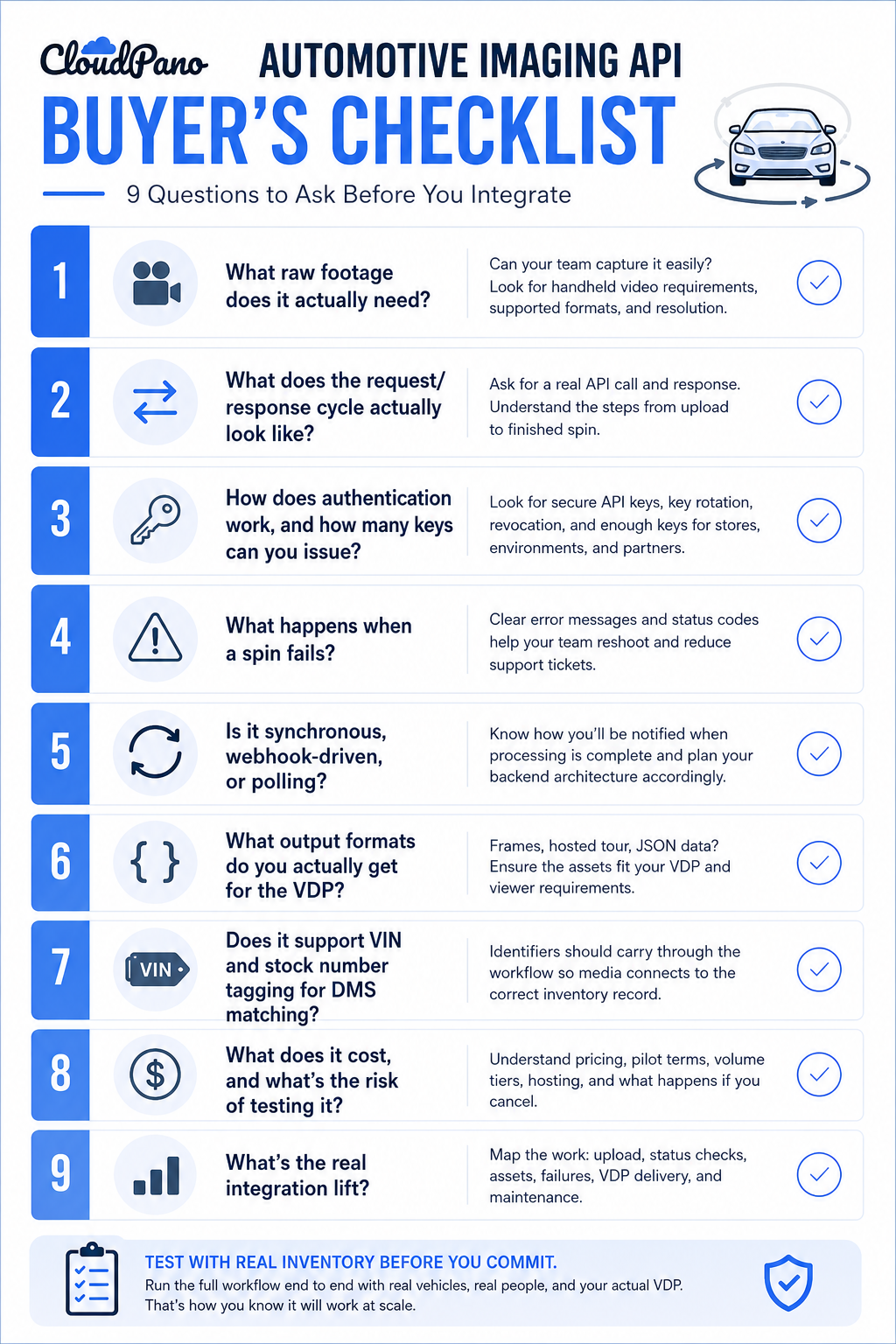
Every automotive imaging API has an input contract, and that contract determines whether your field teams can realistically use it.
Some workflows may require specialized equipment, a turntable, or a fixed series of carefully captured photos.
CloudPano's Spin API instead accepts a single handheld vehicle walk-around video. According to the current documentation, supported uploads include MP4, MOV, or WebM footage captured as one complete circle around the vehicle in landscape orientation.
That's an important operational distinction.
The question isn't simply whether an API can create a 360° vehicle spin. It's whether the people responsible for capturing inventory can consistently provide the input it needs.
Ask for a real request — not just a workflow diagram.
For CloudPano's Spin API, the upload is a multipart request containing the video and any optional vehicle information or processing settings.
The API accepts the request and creates a processing job rather than requiring the connection to remain open until the spin is finished.
For an engineering team evaluating a vendor, this is the important part:
How many steps does your application need to manage between uploading the original vehicle media and receiving usable output?
Ask the vendor to show you that entire cycle.
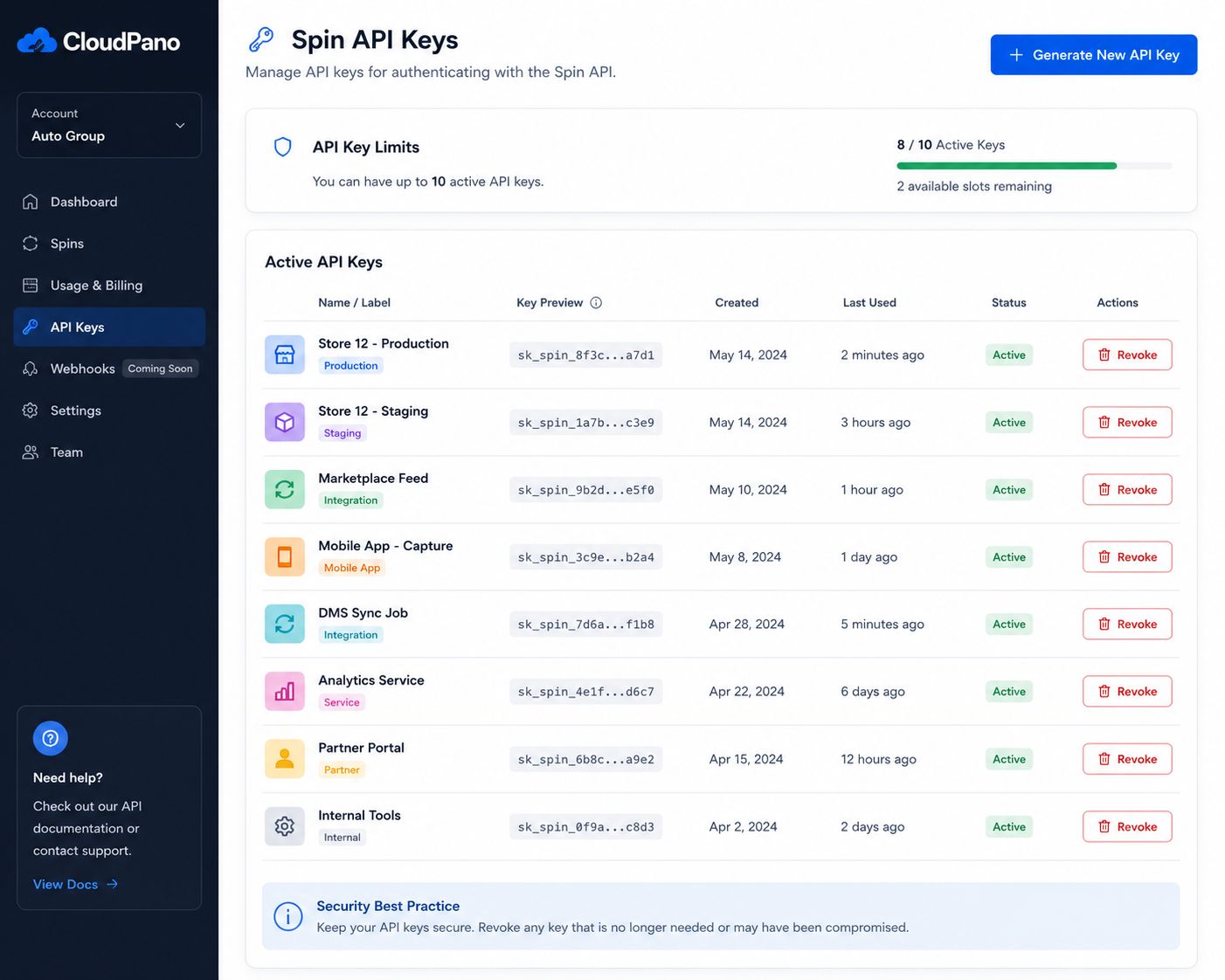
Authentication sounds like a minor implementation detail until you're managing multiple stores, environments, applications, or integration partners.
Ask vendors:
CloudPano uses bearer-token authentication and currently supports multiple active API keys per account.
For a dealer group, separate credentials can make it easier to isolate different rooftops or integration surfaces rather than sharing one credential across the entire organization.
Ask this before spending too much time discussing the happy path.
Failure handling has a direct effect on both your engineering workload and your support-ticket volume.
A processing workflow should make it possible for your application to distinguish between a vehicle that's still being processed and one that needs attention or a reshoot.
CloudPano's documented workflow includes processing states as well as a failed state that can return information about what went wrong.
When evaluating another vendor, ask what happens when:
Good error handling doesn't just help developers debug an integration. It helps the dealership tell the person capturing the vehicle what needs to happen next.
This question directly affects your backend architecture.
Some APIs return the finished result synchronously. Others notify your application through webhooks. Others require your application to check the status of a processing job periodically.
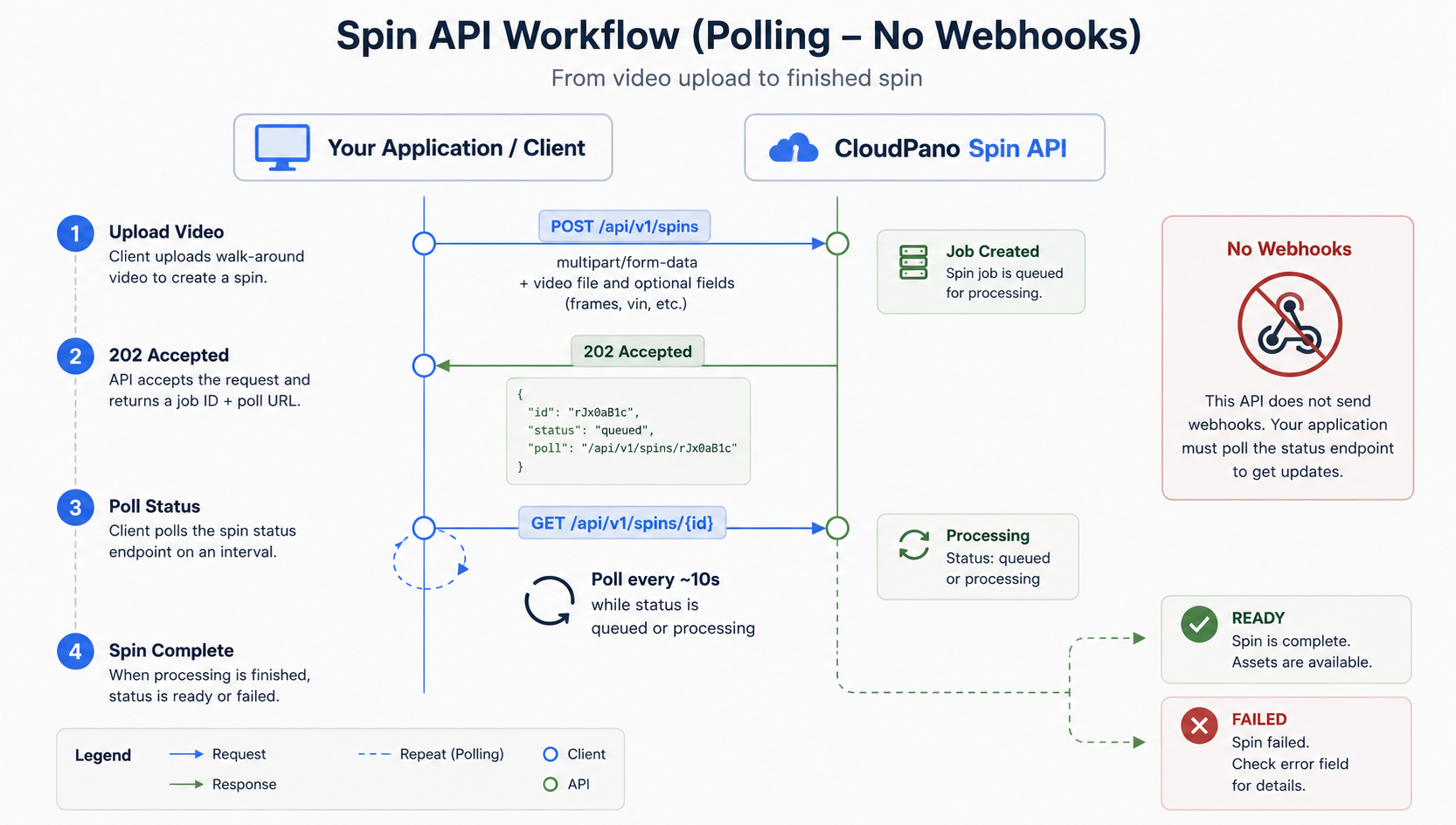
CloudPano's currently documented Spin API workflow uses polling: your system checks the spin's status while processing is underway and responds once the job reaches a completed or failed state.
The important lesson isn't that one architecture is automatically better.
It's that your engineering team should know exactly how job completion is communicated before designing the integration around it.
Don't scope an integration around a feature that only exists on a vendor's roadmap. Build against what the API supports today.
This is one of the most important questions in the entire evaluation.
Creating a vehicle spin is only useful if the resulting assets can actually fit into your VDP, inventory platform, marketplace, or media workflow.
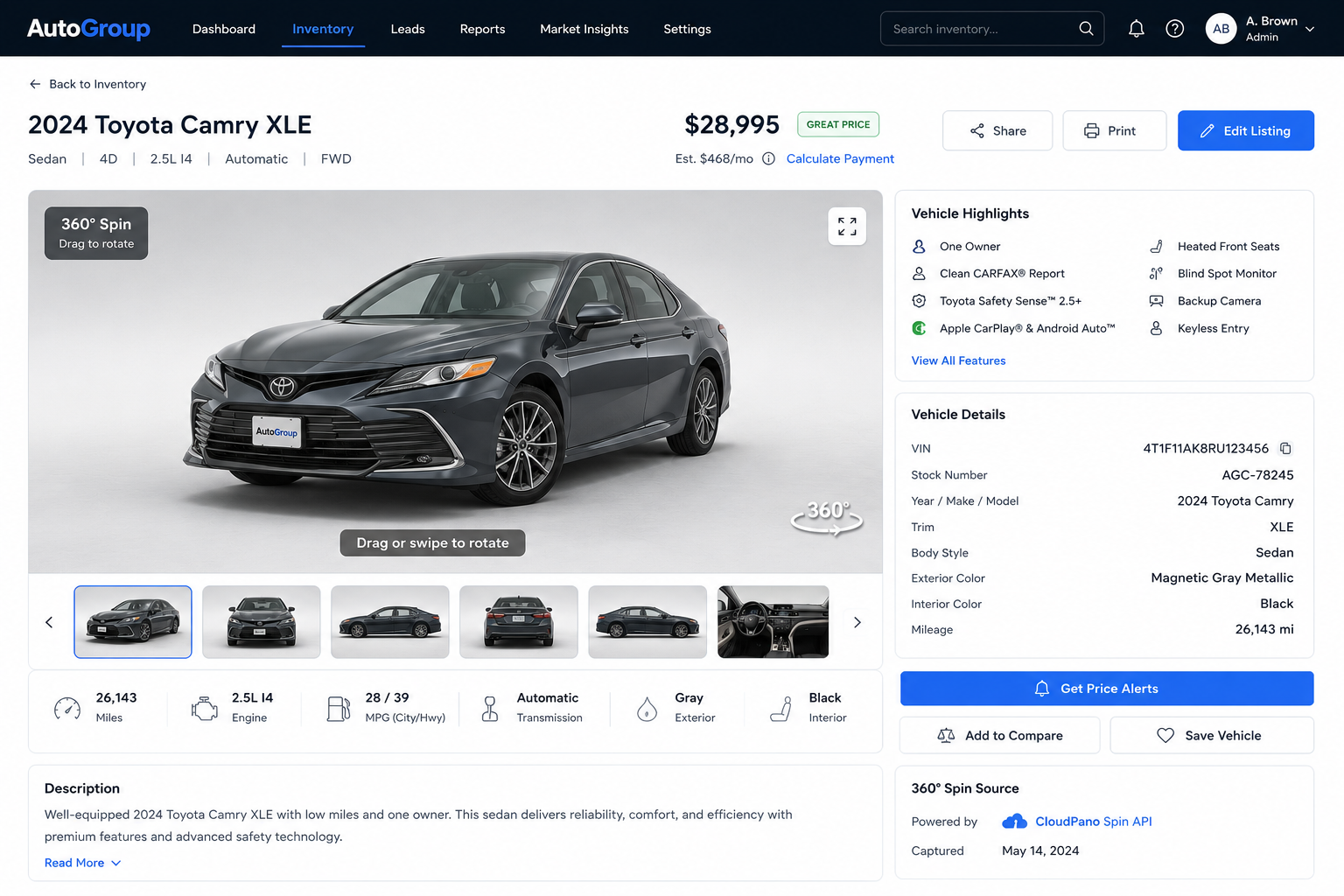
CloudPano's documented output can include processed vehicle frames, assets intended for efficient web viewing, a hosted tour, and additional result data depending on the requested configuration.
For your own evaluation, ask:
Can we embed the result in our existing viewer?
Do we receive individual frames?
Is there a hosted experience available?
Are the resulting assets hosted for us or do we need to download and store them?
Can we determine which processing settings were applied?
Can our system associate the returned media with the correct inventory record?
If a vendor can't clearly show you its output schema, it's difficult to accurately estimate the work required to integrate that output into your VDP.
For a dealership group or automotive marketplace operating at scale, creating the spin is only half the problem.
The finished media also needs to make its way back to the correct vehicle.
CloudPano's documented upload workflow allows vehicle identifiers such as VIN and stock number to be associated with a submitted spin and returned with the resulting data.
That can make DMS and inventory matching considerably simpler.
When evaluating a vendor, ask whether identifiers can travel through the entire workflow:
Inventory record → media upload → processing → finished spin → VDP.
If the API doesn't preserve your inventory identifiers, your team may need to build and maintain its own reconciliation layer.
Don't evaluate pricing based solely on the advertised per-spin or monthly rate.
The more useful question is:
What will it cost us to determine whether this actually works with our inventory and workflow?
Ask vendors about:
CloudPano's documentation currently describes the Spin API as being available during a preview period. Because pricing and preview terms can change, confirm the current terms before basing a procurement decision on them.
The goal of a pilot should be to test the system with real vehicles, real employees, and real VDP workflows before making a larger commitment.
Strip away the marketing language and count the systems your engineering team actually needs to build.
At minimum, ask:
How is media uploaded?
How do we know processing has finished?
What assets come back?
How do we associate those assets with inventory?
How are failed jobs handled?
How do those assets reach the VDP?
CloudPano's Spin API is structured around submitting the vehicle footage, monitoring the resulting processing job, and consuming the resulting assets once they're available.
If you're still deciding whether an API-based workflow makes more sense than physical imaging infrastructure, car photography API vs. turntable booth covers that comparison in more detail.
A few operational details are easy to overlook when evaluating an imaging API.
First, capture requirements matter. A processing API can correct certain inconsistencies, but it can't recreate vehicle angles that were never captured.
Second, upload limits matter. High-resolution vehicle video can become large quickly, so your capture application should account for the vendor's current limits before uploads begin.
Third, processing isn't necessarily instantaneous. Your system needs to handle jobs that take longer than expected without incorrectly treating them as failures.
Finally, the workflow needs to be usable by the people capturing inventory.
A technically impressive API isn't particularly useful if dealership employees struggle to consistently provide acceptable source footage.
Those operational considerations should be tested during the pilot rather than discovered after deployment.
A buyer's guide can tell you what questions to ask, but your engineering team should still work from the vendor's current documentation when estimating implementation effort.
For CloudPano, the Spin API developer documentation provides the current request schema, processing workflow, response structure, and implementation requirements.
Before committing to a larger rollout, run the workflow end to end with actual dealership inventory.
Upload a real walk-around.
Follow it through processing.
Inspect the returned assets.
Connect the result to a test VDP.
Then hand the capture process to someone who isn't on the engineering team and see whether they can repeat it successfully.
Nine questions answered in documentation are useful.
Nine questions answered by a successful real-world pilot are much better.


Compact, ready to go anywhere
Interchangeable lens that’s upgradeable
Dual 1-inch sensors for improved clarity and low light performance
Dynamic range and 6K 360° capture
360° photo resolution at 21MP

8K 360° video recording for ultra-detailed visuals.
4K single-lens mode for traditional wide-angle shots.
Invisible selfie stick effect for drone-like perspectives.
2.5-inch touchscreen with Gorilla Glass protection.
Waterproof up to 33ft for underwater shooting.

360° photo resolution in 23MP
Slim design at 24 mm thick
Built-in image stabilization for smooth video capture.
Internal 19GB storage for photo and video storage.
Wireless connectivity for remote control and sharing.

60MP 360° still images for high-resolution photography.
5.7K 360° video recording at 30fps.
2.25-inch touchscreen for intuitive control.
USB Type-C port for fast charging and data transfer.
MicroSD card slot for expandable storage.
.png)

.png)

Try it free. No credit card required. Instant set-up.







.svg)


.svg)