How Much Does AI Data Collection Cost? Pricing Models Explained
Cloudpano
July 15, 2026
•
5 min read
Share this post
How Much Does AI Data Collection Cost? Pricing Models Explained
The question "how much does this cost" is almost always the wrong first question when budgeting a data collection project — not because cost doesn't matter, but because the answer depends entirely on variables most teams haven't defined yet. AI data collection pricing swings by an order of magnitude between a simple image classification task and multi-frame video segmentation requiring domain expertise, which makes a single benchmark number close to useless without context.
This variability has become more pronounced, not less, as data needs have diversified. Stanford's AI Index Report has tracked how data requirements have grown more specialized alongside model capability, and specialization is one of the strongest cost drivers in this market (Stanford HAI, AI Index Report).
Why It Matters
Budgeting data collection incorrectly has consequences beyond a line-item overrun. Underestimating cost typically means cutting corners on quality assurance or annotator expertise midway through a project, which is exactly the kind of shortcut that produces the inconsistent labels and coverage gaps that degrade model performance later.
📊 AI Training Data Cost Drivers
Relative weight of factors affecting pricing
Values shown as qualitative relative rankingfor illustration only
Relative ranking for illustration only — confirm against your internal data or cited sources.
Google Research's work on production ML pipelines found that data-related failures frequently trace back to under-resourced collection efforts — the direct downstream effect of a budget built on an unrealistic per-unit estimate (Sambasivan et al., "Data Cascades in High-Stakes AI," ACM CHI 2021). Getting the pricing model and cost drivers right upfront isn't a procurement nicety — it's part of what determines whether the resulting dataset is actually usable.
NIST's AI Risk Management Framework also treats adequately resourced data operations as part of responsible AI development, since under-resourcing tends to produce exactly the quality and provenance gaps the framework flags as risks (NIST AI RMF 1.0).
How It Works
AI training data pricing is built from a handful of core variables that combine differently depending on the project and the provider:
Task complexity — simple classification costs less per unit than multi-object segmentation, video annotation, or 3D point cloud labeling.
Required expertise — general annotators cost less than domain specialists (radiologists reviewing medical imaging, for example), and specialized skill is usually the single largest cost multiplier.
Volume and timeline — larger volumes typically bring per-unit costs down, while compressed timelines usually bring them up due to added staffing.
Quality assurance depth — multi-stage review with inter-annotator agreement checks costs more per unit than single-pass annotation, but reduces rework cost later.
Geography and labor model — provider location and whether annotators are in-house, crowdsourced, or contracted specialists all affect the base rate.
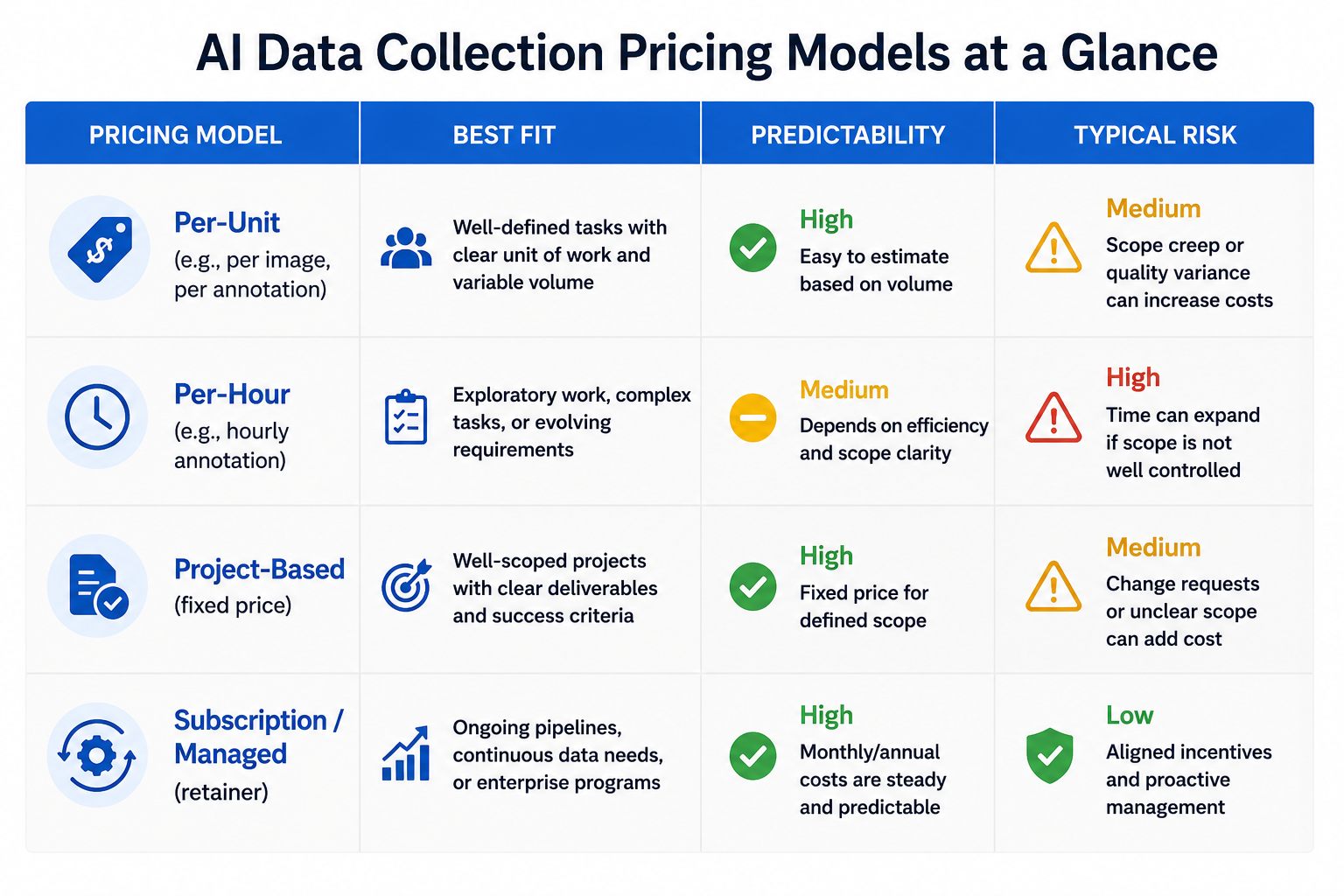
Providers combine these variables into one of several pricing models, and the model itself changes what you're actually paying for.
Step-by-Step Workflow
A practical approach to building an accurate data collection budget:
Define task complexity precisely before requesting quotes. A vague brief ("we need images labeled") produces wildly inconsistent quotes because providers are pricing different assumptions about complexity.
Identify whether the work requires domain expertise. Specialized annotation (clinical, legal, technical) should be budgeted separately from general-purpose labeling, since the cost gap is typically substantial.
Choose the pricing model that fits your volume and timeline. Per-unit pricing suits well-defined, high-volume tasks; project-based pricing suits complex, lower-volume work; subscription models suit ongoing, continuous collection needs.
Request quotes that itemize QA separately from raw annotation. A quote that bundles everything into one number makes it hard to evaluate where cost is actually going and what happens if quality falls short.
Run a paid pilot batch to validate the estimate. A pilot at the quoted rate reveals whether the price holds up against real task complexity, not just the sample data used in the sales process.
Build in a contingency for rework and edge cases. Even well-scoped projects encounter labeling ambiguity that requires spec revision and re-annotation of a subset of data.
Reassess pricing at scale, not just at pilot volume. Per-unit rates negotiated for a small pilot don't always hold at full production volume — confirm pricing at the volume you'll actually need.
📋 AI Data Collection Budgeting Process
Seven‑step sequence — accurate pricing is a process, not a single lookup
01📋Define Task ComplexityScope & specification
→
02🧠Identify Expertise NeedsSkill & domain fit
→
03💰Choose Pricing ModelPer‑unit, hourly, project
→
04📄Request Itemized QuotesBreakdown by line item
→
05🧪Run Paid PilotTest & calibrate
→
06🔄Add Rework ContingencyBuffer for revisions
→
07📊Reassess at Full ScaleReview & adjust
Industry Use Cases
Computer vision and robotics: Bounding box and segmentation work sits at the more affordable end of the per-unit spectrum unless multi-object or occlusion-heavy scenes push complexity — and cost — higher.
Autonomous vehicles: Multi-sensor annotation (LIDAR, radar, camera fusion) commands some of the highest per-unit AI dataset pricing in the market due to the specialized tooling and expertise required.
Healthcare AI: Clinical annotation expertise is typically the dominant cost driver, since credentialed medical annotators command materially higher rates than general-purpose labelers.
Retail AI: Product image tagging and catalog data collection tend to sit toward the lower-complexity, higher-volume end, where per-unit pricing usually drops meaningfully at scale.
Manufacturing: Defect annotation costs are shaped less by volume and more by rarity — sourcing enough real examples of uncommon defects often costs more than the labeling itself.
Government and defense AI: Security clearance and accreditation requirements for annotators narrow the provider pool and typically raise costs beyond what task complexity alone would suggest.
📈 Per‑Unit Cost vs. Task Complexity
Relative annotation cost across complexity tiers
Values shown as relative magnitudefor illustration only
Relative magnitude for illustration only — confirm against your internal benchmarks or cited sources.
Benefits
Understanding pricing models and cost drivers before budgeting delivers concrete advantages:
More accurate budgets, since costs are built from actual project variables rather than a generic industry benchmark
Better vendor comparisons, since itemized quotes reveal what's actually being paid for instead of a single opaque number
Fewer mid-project surprises, since realistic contingency planning accounts for rework and edge cases upfront
Stronger negotiating position, since understanding which variables drive cost lets budget owners push back on pricing that doesn't reflect actual task complexity
Better long-term cost control, since adequately resourced QA at the outset reduces the far more expensive cost of retraining after a model underperforms in production
McKinsey's research on enterprise AI adoption has repeatedly identified underinvestment in data operations as a factor slowing AI initiatives from reaching production scale — a pattern that traces directly back to budgets built on unrealistic cost assumptions (McKinsey, "The State of AI").
Common Mistakes
Anchoring on a single industry benchmark number. A per-label rate quoted for simple classification tasks doesn't transfer to segmentation, video, or specialized domains — using it as a planning baseline produces budgets that miss by a wide margin.
Requesting quotes before defining task complexity. Vague briefs produce quotes based on the provider's assumptions rather than the actual project, making comparisons across vendors meaningless.
Bundling QA into the per-unit rate without itemization. This makes it impossible to evaluate whether quality assurance is actually adequate or just priced in as a thin margin.
Skipping the pilot batch to save time. Committing to full-volume pricing without validating it against real task complexity is how budgets end up requiring a mid-project renegotiation.
Ignoring the cost of rework in the original budget. Treating the first-pass quote as the final cost, with no contingency for spec revisions or re-annotation, consistently underestimates real project spend.
Best Practices
Define task complexity and required expertise before requesting quotes, so pricing comparisons are apples-to-apples across providers.
Ask providers to itemize annotation and QA costs separately rather than accepting a single bundled rate.
Choose a pricing model — per-unit, project-based, or subscription — that actually matches your volume and timeline, rather than defaulting to whatever a provider offers first.
Validate quoted pricing with a paid pilot batch before committing to full volume.
Build a rework and edge-case contingency into the budget from the start, not as an afterthought.
Treat AI data collection cost as an investment in avoiding retraining cycles, not just a line item to minimize — this is how these workflows operate when the budget actually holds up against real project demands.
📋 Quote Evaluation Checklist
Bring this to every vendor conversation — six items to confirm before you sign
✓📋
Task Complexity DefinedSpecification matches your actual use case, not a generic template
✓🧠
Expertise Requirements SpecifiedDomain knowledge needs are clearly stated and priced
✓🔍
QA Costs Itemized SeparatelyQuality assurance line items shown, not buried in per‑unit fees
✓💰
Pricing Model Matched to VolumePer‑unit, hourly, or project — fits your expected throughput
✓🧪
Paid Pilot IncludedSmall test batch to validate quality before full production
✓🔄
Rework Contingency AddressedRevision cycles and error correction are clearly scoped
FAQ
What factors most affect AI data collection pricing?
Task complexity, required annotator expertise, data volume, timeline, quality assurance depth, and provider geography or labor model are the primary drivers. Specialized expertise and QA depth typically have the largest impact on per-unit cost.
What pricing models are common for AI training data pricing?
Per-unit (per label, image, or item), per-hour, project-based flat fee, and subscription or managed-service models are the most common. Which one fits best depends on task predictability, volume, and whether the need is one-time or ongoing.
Why do quotes for the same task vary so much between providers?
Providers often price against different assumptions about task complexity, required QA depth, and annotator expertise unless the brief specifies these precisely — which is why a detailed, standardized brief is essential for comparing quotes meaningfully.
Is per-unit pricing always cheaper than project-based pricing?
Not necessarily. Per-unit pricing suits well-defined, high-volume, low-ambiguity tasks. Project-based pricing often works out more cost-effective for complex or evolving scopes, since per-unit models can accumulate unpredictable costs when task definitions shift mid-project.
How much should be budgeted for quality assurance within total data collection cost?
There's no universal ratio, since it depends on task risk and complexity — but QA should always be itemized and evaluated on its own terms rather than absorbed silently into a single per-unit rate.
Does outsourcing always cost less than in-house data collection?
Not automatically. Outsourcing typically wins on speed and access to specialized expertise, but total cost depends on volume, complexity, and how much internal oversight and rework contingency the outsourced arrangement requires.
How does data specialization affect AI dataset pricing models?
Specialized domains (medical imaging, legal documents, multi-sensor autonomous vehicle data) command a narrower pool of qualified annotators, which drives per-unit and project-based pricing meaningfully higher than general-purpose annotation tasks.
What's the biggest budgeting mistake teams make with AI data collection pricing?
Anchoring on a single benchmark rate without adjusting for their specific task's complexity, required expertise, and QA depth — producing a budget that doesn't reflect the actual project.
Conclusion
There's no single number that answers "how much does AI data collection cost," because the honest answer depends on variables that are specific to each project — task complexity, required expertise, volume, timeline, and how much quality assurance the work actually needs. Teams that budget accurately are the ones that define those variables before requesting quotes, itemize QA separately from raw annotation, and validate pricing with a real pilot batch rather than a sales estimate. That discipline is what turns a rough industry benchmark into a budget that actually holds.
Share this post
Cloudpano
Choose The Right 360° Camera
Insta360 ONE RS 1-Inch 360 Edition
Compact, ready to go anywhere
Interchangeable lens that’s upgradeable
Dual 1-inch sensors for improved clarity and low light performance
Create an interactive virtual showroom and engage affluent digital buyers with live 360º video calls, all through the CloudPano mobile app for a complete automotive sales solution.
Create 2D and 3D floor plans with measurements in 4 minutes or less, all from your phone. Download the Floor Plan Scanner app and get your first scan free.
AI teams are training models on huge amounts of everyday footage, from cooking to laundry. This guide explains what a daily activity video dataset is, how models use it, which public datasets exist, and what to check before using one..
Robots and vision models learn manipulation by watching hands grasp, move and use objects. This guide explains what an object interaction dataset contains, compares seven well-known datasets and their licenses, and covers what to check before training a commercial model.
Adding listing videos to a real estate CRM makes it easier to share property content with leads, organize marketing assets, and build personalized follow-up campaigns. Whether you're using a video link, an email thumbnail, or an automated workflow, connecting listing videos to your CRM can simplify how you market properties. This step-by-step guide explains how to organize, upload, link, and distribute real estate videos through a CRM while keeping your workflow efficient and scalable.


.png)




.png)

.png)








.svg)


.svg)