


.png)


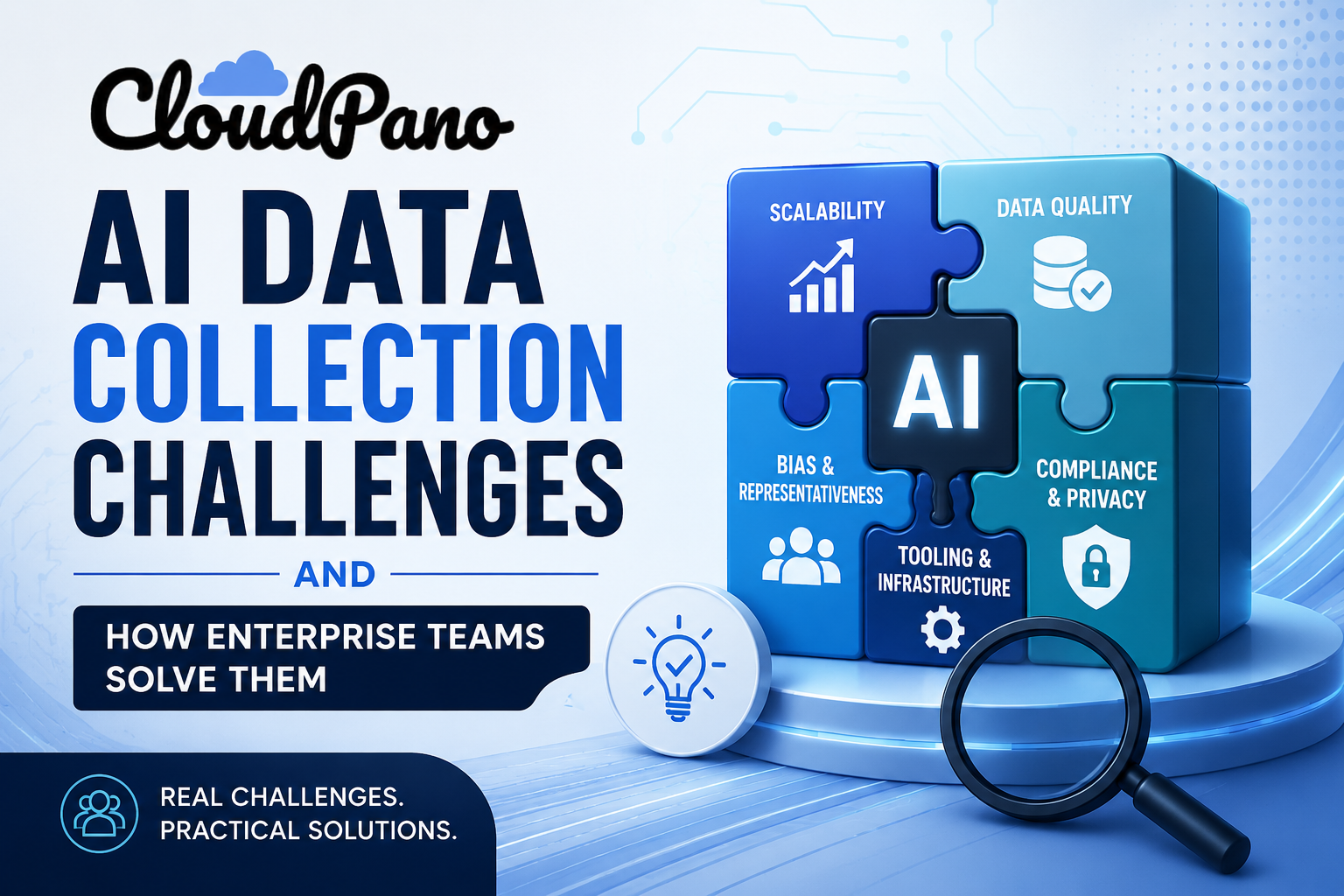
Every AI team runs into the same handful of walls eventually. Annotation can't keep pace with the model roadmap. Two labelers interpret the same instruction differently and nobody notices until performance dips on a specific category. A dataset that looked fine in testing turns out to underrepresent exactly the conditions the model hits in production. These aren't edge cases — they're the standard set of AI data collection challenges that show up across nearly every enterprise AI program, regardless of industry.
The stakes for getting past these challenges have gone up, not down. Stanford's AI Index Report has tracked data increasingly functioning as the binding constraint on model performance, ahead of architecture in many cases — which means unresolved data collection problems now show up directly in the bottom line, not just in engineering timelines (Stanford HAI, AI Index Report).
Each of these challenges, left unaddressed, doesn't fail in an obvious way. It shows up as a model that performs fine in evaluation and then degrades in ways that are hard to trace back to a root cause.

Google Research's study of production ML teams documented this directly, describing how a single upstream data issue — a labeling inconsistency, a sourcing gap — can pass through the pipeline unnoticed and surface much later as a production failure, a pattern they termed a "data cascade" (Sambasivan et al., "Data Cascades in High-Stakes AI," ACM CHI 2021). The researchers found this was common enough across teams to be treated as a structural issue, not a rare mistake.
NIST's AI Risk Management Framework names data quality and representativeness as specific risk categories precisely because these challenges recur consistently enough across organizations to warrant a formal governance response (NIST AI RMF 1.0).
Enterprise AI data collection problems tend to cluster into a few recognizable categories, and naming the category is usually the first real step toward fixing it:

Most teams experience some blend of these rather than just one, which is why treating "we have a data problem" as a single issue usually leads to the wrong fix.
A practical approach to working through these challenges tends to follow a consistent diagnostic sequence:

Naming and addressing these challenges systematically — rather than reacting to symptoms — produces compounding advantages:

McKinsey's research on enterprise AI adoption continues to identify data-related issues as the most common reason initiatives stall before reaching production scale — underscoring that these aren't cosmetic problems but the actual bottleneck for many programs (McKinsey, "The State of AI").

Scale (volume exceeding capacity), consistency (annotator disagreement), representativeness (unbalanced or unrepresentative sampling), compliance (inadequate provenance or consent documentation), and tooling friction (manual handoffs between systems).
Trace the symptom back to its origin stage. Inconsistent model performance on specific categories usually points to a consistency or representativeness issue; audit friction usually points to a compliance gap; slow turnaround usually points to a scale or tooling issue.
They overlap significantly, but data quality challenges typically refer to the state of the dataset itself (accuracy, consistency), while data collection challenges include process-level issues like scale, sourcing, tooling, and compliance that produce those quality problems in the first place.
Because a dataset can look complete and balanced in aggregate while still underrepresenting specific rare conditions that only become visible once the model faces them in production — testing against the same dataset doesn't reveal a gap the dataset itself contains.
Rarely on its own. Tooling reduces friction at handoffs, but it doesn't fix an undocumented labeling spec or a sourcing plan that skews toward convenient data — those require process changes, not just better software.
Through a documented, versioned labeling specification, inter-annotator agreement tracking on sampled batches, and periodic retraining of annotators when the spec is updated to cover new edge cases.
They're most visible there, but any organization collecting data from users or the public has some provenance and consent obligations. Regulated industries just tend to have them formally codified and audited.
Audit against the challenge categories individually rather than trying to solve everything at once — most teams find that fixing the root-cause issue in one category (often representativeness or consistency) resolves symptoms that looked like separate problems.
Most AI data collection challenges aren't unique to a particular team or industry — they're recurring patterns: scale outpacing capacity, inconsistent labeling, unrepresentative sourcing, thin compliance documentation, and tooling friction at the handoffs. What separates teams that get past these challenges from teams that keep hitting the same wall isn't luck. It's naming the specific problem accurately, tracing it to where it actually originates, and fixing the cause rather than managing the symptom indefinitely.


Compact, ready to go anywhere
Interchangeable lens that’s upgradeable
Dual 1-inch sensors for improved clarity and low light performance
Dynamic range and 6K 360° capture
360° photo resolution at 21MP

8K 360° video recording for ultra-detailed visuals.
4K single-lens mode for traditional wide-angle shots.
Invisible selfie stick effect for drone-like perspectives.
2.5-inch touchscreen with Gorilla Glass protection.
Waterproof up to 33ft for underwater shooting.

360° photo resolution in 23MP
Slim design at 24 mm thick
Built-in image stabilization for smooth video capture.
Internal 19GB storage for photo and video storage.
Wireless connectivity for remote control and sharing.

60MP 360° still images for high-resolution photography.
5.7K 360° video recording at 30fps.
2.25-inch touchscreen for intuitive control.
USB Type-C port for fast charging and data transfer.
MicroSD card slot for expandable storage.
.png)

.png)

Try it free. No credit card required. Instant set-up.







.svg)


.svg)