


.png)


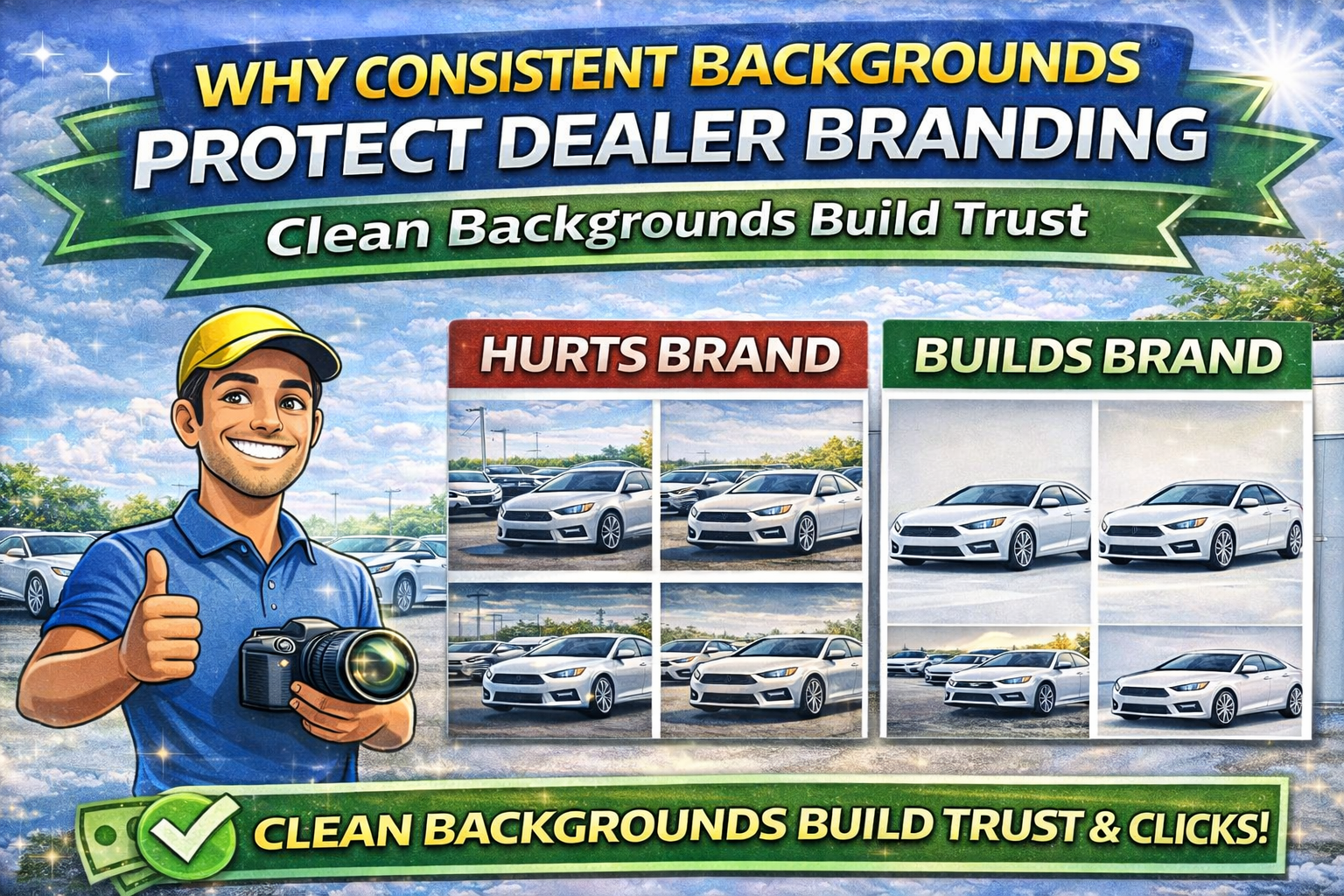
When it comes to online vehicle listings, most dealerships focus on the obvious things:
✅ pricing
✅ inventory selection
✅ financing offers
✅ reviews
✅ lead response time
But there’s one factor that quietly influences all of those…
📌 How your photos look as a collection.
Not just one photo.
Not just one vehicle.
Your entire inventory gallery is essentially your dealership’s digital showroom—and the background of your photos is one of the biggest signals customers see first.
That’s why consistent backgrounds are one of the most powerful tools for improving dealer branding listing photos.
In this evergreen guide, you’ll learn why background consistency matters, how it protects your brand, and what systems dealerships can use to keep listing photos clean and uniform across every platform.
Car buyers don’t just shop listings.
They shop dealerships.
Even if a buyer is looking at a specific vehicle, they subconsciously evaluate:
And a huge part of that perception comes from the photos.
Your background is either:
✅ supporting your dealership’s brand
or
❌ hurting it
Messy lot backgrounds create friction. Clean backgrounds create confidence.

In marketplaces like:
Your photo appears first as a small thumbnail.
At thumbnail size, buyers can’t see:
They mostly see:
✅ the car shape
✅ the lighting
✅ the background
That means backgrounds influence CTR (click-through rate).
And CTR influences:
📈 listing visibility
📈 lead volume
📈 sales velocity
So improving background consistency is a performance strategy—not just a design choice.
Let’s break it down. When your dealership inventory has inconsistent backgrounds, it creates these problems:
Some cars are shot near the service bay, others near the dumpster, others near busy roads.
Even if the cars are great, the inventory page feels messy.
Buyers associate messy backgrounds with:
❌ sloppy dealership
❌ poor attention to detail
❌ questionable quality control
Top-performing dealers create a catalog effect.
If photos aren’t consistent, your inventory doesn’t feel curated.
Even if your pricing is strong, your photos can make you look weaker than competitors with cleaner listings.
Consistency becomes a competitive advantage.
The best way to describe the benefit is this:
✅ Consistent backgrounds create the illusion that every vehicle was photographed in the same studio.
This makes the shopper experience smoother.
And it makes your dealership feel premium.
Your online showroom should feel like:
📌 a curated inventory catalog
not
📌 random phone photos on a messy lot
That showroom effect increases:
In online vehicle sales, trust is everything.
A buyer may never step foot on the lot unless they trust you first.
Consistent backgrounds send subtle trust signals like:
✅ “This dealership is organized.”
✅ “Their process is professional.”
✅ “They care about presentation.”
✅ “They probably care about their vehicles too.”
That’s what branding really is:
Perception at scale.
Think about the biggest brands.
Apple doesn’t show random backgrounds for product photos.
Nike doesn’t.
Tesla doesn’t.
They use consistent visuals because consistency becomes identity.
Your dealership photo background becomes:
✅ part of your brand signature
✅ part of your customer experience
✅ part of your digital reputation
When a buyer scrolls and sees a recognizable style, they start remembering your dealership.
That’s branding.
This matters most in:
Where listings compete side-by-side.
Where buyers scan quickly.
Where clean photos outperform cluttered photos.
Where a consistent style builds recognition over time.
In short:
Everywhere that buyers see multiple listings.
Inconsistent backgrounds lead to:
And the hidden cost?
The listing sits longer.
That means:
You don’t want your photos to be the reason a car doesn’t move.
There are 3 main ways dealerships build consistency:
A fixed location on the lot with:
This is the easiest operational improvement.
Some dealers create a branded wall or zone:
This can work well, but requires maintenance and space.
AI-powered background removal and studio replacement.
This is the fastest way to scale consistency across:
For high-volume dealerships, automation is often the best option.
If your goal is dealer branding listing photos consistency, pick a background that:
✅ looks clean
✅ feels natural
✅ doesn’t distract
✅ works on every vehicle type
✅ matches your brand tone
Avoid backgrounds that are:
❌ too dramatic
❌ too “fake”
❌ too dark
❌ too busy
The car should be the hero.
Some dealers worry that consistent backgrounds remove personality.
But here’s the truth:
Consistency doesn’t make your photos boring.
It makes them premium.
Your branding still shows through:
✅ pricing strategy
✅ vehicle quality
✅ copywriting
✅ customer reviews
✅ response speed
Background consistency just increases trust and conversion.
This is huge.
A vehicle shot in front of:
…looks less valuable.
The same vehicle on a clean background looks:
✅ newer
✅ cleaner
✅ more premium
✅ better maintained
That means consistent backgrounds can actually support:
📈 higher perceived value
📈 stronger pricing confidence
That’s the branding impact.
To protect branding, your dealership should enforce these simple guidelines:
✅ 1 approved background style
✅ 1 crop ratio
✅ same lighting/exposure rules
✅ no clutter behind vehicles
✅ consistent vehicle placement and framing
✅ no extreme filters
Make it easy:
Consistency is built through systems.
If you want stronger dealer branding listing photos, don’t start with logos and watermarks.
Start with the background.
Because the background is what buyers see first.
And what buyers see first shapes what they believe.
✅ clean backgrounds
✅ consistent templates
✅ showroom-level presentation
✅ inventory that looks curated
That’s how you protect your dealer branding—and generate more clicks, more leads, and more sales.
Your inventory is your digital showroom.
Make it look like one. 🚗🔥


Compact, ready to go anywhere
Interchangeable lens that’s upgradeable
Dual 1-inch sensors for improved clarity and low light performance
Dynamic range and 6K 360° capture
360° photo resolution at 21MP

8K 360° video recording for ultra-detailed visuals.
4K single-lens mode for traditional wide-angle shots.
Invisible selfie stick effect for drone-like perspectives.
2.5-inch touchscreen with Gorilla Glass protection.
Waterproof up to 33ft for underwater shooting.

360° photo resolution in 23MP
Slim design at 24 mm thick
Built-in image stabilization for smooth video capture.
Internal 19GB storage for photo and video storage.
Wireless connectivity for remote control and sharing.

60MP 360° still images for high-resolution photography.
5.7K 360° video recording at 30fps.
2.25-inch touchscreen for intuitive control.
USB Type-C port for fast charging and data transfer.
MicroSD card slot for expandable storage.
.png)

.png)

Try it free. No credit card required. Instant set-up.






.svg)


.svg)