


.png)


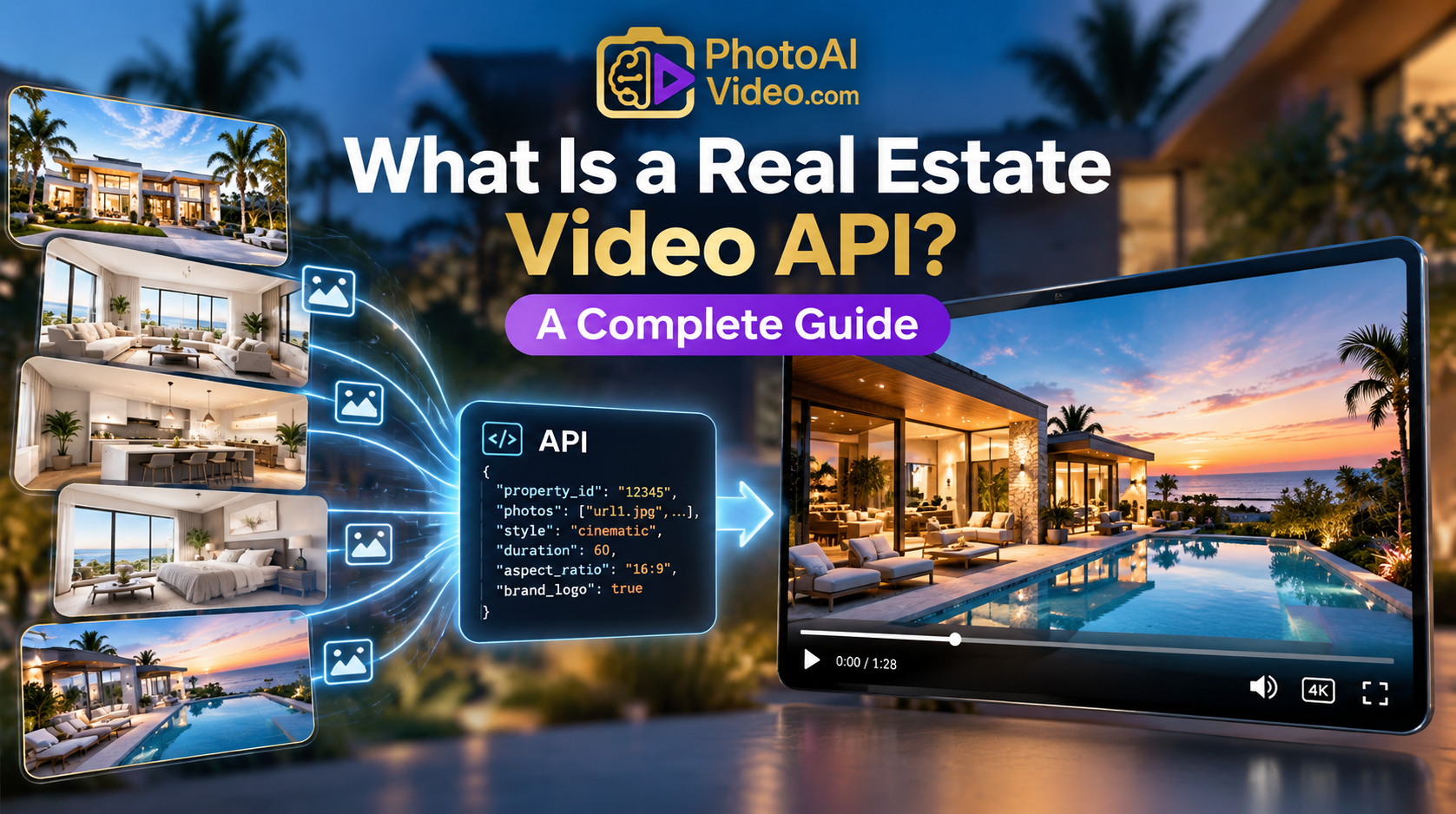
A real estate video API is a software interface that allows applications to automatically create property videos from listing photos. Developers can use it to upload property images, generate cinematic video clips, monitor processing, combine clips into branded reels, and return finished videos to CRMs, MLS platforms, listing portals, property-management systems, or other real estate applications.
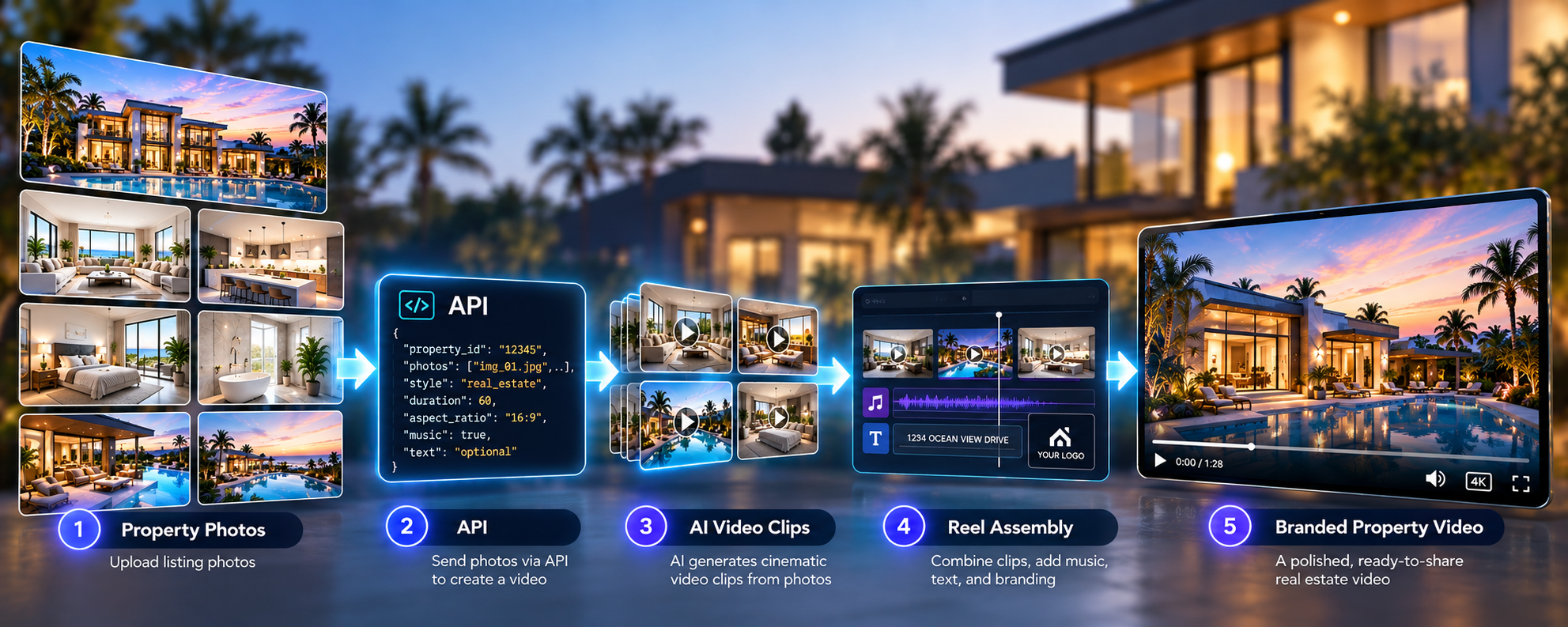
A real estate video API is a software interface that allows applications to automatically create property videos from listing photos and other property data.
Instead of asking an agent, photographer, or marketing team to manually create every video, developers can connect video generation directly to a real estate CRM, MLS platform, property-management system, listing portal, media platform, or other application.
With the PhotoAiVideo Real Estate Video API, property photos can be uploaded programmatically, transformed into cinematic video clips, and combined into branded listing reels. Applications can add elements such as music, property text, ending cards, and logos while generating video in portrait or landscape formats.
The result is a video workflow that can operate inside the software real estate professionals already use.
For platforms managing hundreds or thousands of listings, that can turn video production from a manual creative task into an automated software workflow.
At a high level, a real estate video API connects property data already stored in an application with a video-generation service.
The workflow looks like this:
Property Photos → Upload → Generate Video Clips → Monitor Processing → Merge Clips → Finished Property Video
Imagine a real estate CRM already has 15 professional photographs associated with a new listing.
Instead of asking the agent to download those images and upload them to a separate video editor, the CRM could send selected photos directly into a video-generation workflow.
Individual photos are transformed into short video clips. Once those clips are complete, they can be assembled into a longer listing video with branding and other presentation elements.
The finished video can then be returned to the CRM and associated with the original property.
From the user's perspective, this could be as simple as clicking Generate Video.
Behind that button, the API handles the communication between the real estate application and the video-generation infrastructure.
Traditional property-video creation often exists outside the software used to manage the listing.
An agent may need to download photos, open another application, upload the files, choose video settings, wait for processing, download the finished video, and then upload it again wherever the video needs to appear.
That may be manageable for one listing.
It becomes much harder to scale when a platform manages hundreds or thousands of properties.
An API changes the workflow because video generation can happen programmatically.
Instead of making video creation another application the user has to learn, developers can make it a feature of an existing product.
A CRM could generate a video after a listing is published.
An MLS platform could offer video creation directly from the property's existing media library.
A real estate photography company could automatically create a video after delivering the listing photos.
A property-management platform could generate marketing videos when units become available.
The user does not necessarily need to understand the technology behind the process. The API simply becomes part of the product workflow.
The biggest difference between an API workflow and traditional video creation is automation.
Traditional video tools are generally designed around a person performing a series of actions.
Someone selects the images, opens the editor, chooses the settings, creates the video, and exports the result.
An API allows software to perform many of those actions.
The application can decide when generation begins, which property photos are used, what settings should be applied, where the resulting video should be stored, and what should happen after generation finishes.
That doesn't mean every decision has to be automated.
A platform could still give users control.
For example, an agent might select eight photos and click Generate Video. The software then handles everything after that point.
Another platform might automate the entire process as soon as a listing becomes active.
The API gives the product developer the flexibility to decide where human interaction ends and automation begins.
Listing photography is particularly well suited to automated video generation because those images already exist inside most real estate workflows.
A typical property record may contain photographs of the exterior, living room, kitchen, bedrooms, bathrooms, outdoor spaces, and other features.
A real estate photo-to-video workflow can use those existing images as its source material.
With PhotoAiVideo, individual property photos can be transformed into short cinematic video clips.
The platform currently provides 19 camera movement options, allowing different types of motion to be applied to still photographs.
For example, a wide interior photograph might use a pan or truck movement, while a hero image of the property could use a push-in or aerial-style movement.
This allows software to create a sense of motion from photographs without requiring a separate video shoot for every generated clip.
Animating a single property photo creates a clip.
A listing video usually needs several.
Once individual video jobs have completed, PhotoAiVideo can combine multiple clips into one reel.
Between 2 and 20 completed clips can be assembled into a finished video.
For a property listing, the sequence might begin with the exterior before moving through the living room, kitchen, primary bedroom, outdoor space, and closing scene.
The order can be determined by the application.
This makes it possible to create repeatable video structures across many properties while still using the unique photography associated with each listing.
A real estate video often needs to represent more than the property itself.
Brokerages, agents, photography companies, SaaS platforms, and marketing agencies may also need branding.
PhotoAiVideo's reel workflow supports presentation elements including background music, text overlays, property address text, ending cards, and logo watermarks.
This means a platform can move beyond generating unbranded AI clips and create a more complete marketing asset.
For example, a real estate media company could generate property videos that include the customer's logo and property information.
A brokerage platform could apply consistent branding across its listings.
A white-label software provider could build video generation into its own interface while controlling how the finished output is presented to customers.
Property video is no longer limited to traditional landscape formats.
Different channels require different types of content.
Landscape video works naturally on property websites, listing pages, presentations, and many desktop experiences.
Vertical video is designed for mobile-first channels such as Instagram Reels, TikTok, and YouTube Shorts.
A real estate video API can make format selection part of the generation workflow.
PhotoAiVideo supports both portrait and landscape reel creation.
That gives applications the flexibility to create video for different destinations without building separate video-generation systems.
A platform could generate a landscape version for a listing page and a portrait version for social media.
A brokerage could include vertical reels as part of its listing-marketing workflow.
A photography company could offer social video as an additional deliverable alongside listing photography.
The underlying property assets remain the same while the output adapts to the intended channel.
A real estate video API can automate several parts of the video-production process.
Property photos can be transferred programmatically rather than uploaded manually through a video editor.
Each selected property photo can become an AI-generated video job.
Applications can choose supported camera movements for individual images.
Because video generation takes time, applications can monitor processing in the background instead of requiring the user to wait on the same screen.
Completed video clips can be combined into a longer property video.
Music, text, property information, ending cards, and logos can be incorporated into the finished reel.
Once processing finishes, the resulting video can be returned to the application and connected to the relevant listing or workflow.
Together, these capabilities allow developers to treat property-video generation as part of a larger automated system.
Real estate video APIs are primarily designed for businesses and developers that want to integrate video into an existing product or workflow.
A CRM could allow agents to generate property videos without leaving the listing record.
The video can become another marketing asset associated with the property alongside photos, descriptions, documents, and other media.
Platforms already receiving listing photos can use those assets as the input for video generation.
This can reduce the number of steps required for agents to create additional media.
Photography businesses can turn existing shoots into additional video products.
Instead of manually editing every property video, a company can create a workflow that processes selected images after a shoot is completed.
Property managers frequently need marketing content for units and properties becoming available.
Video generation can become part of the process for preparing those listings.
Organizations handling many listings can use automation to produce more consistent branded property videos across teams.
Software companies can add video creation as a feature without building their own AI video-generation infrastructure from scratch.
An AI video generator is generally a product a person uses directly.
An API is infrastructure another product can communicate with.
That distinction matters.
If an agent uses a standalone AI video generator, the agent interacts with that product's interface.
If a real estate CRM integrates a video API, the agent may never interact with the underlying video-generation platform at all.
The CRM controls the user experience.
The API performs the requested generation behind the scenes.
For businesses building software, that makes APIs particularly useful because video creation can become part of their own product rather than a separate destination.
AI video rendering takes longer than a typical software request.
For that reason, PhotoAiVideo uses asynchronous generation jobs.
When an application requests a video, the API returns a job ID instead of forcing the application to keep the original connection open until rendering finishes.
The application stores that job ID and checks the video's status separately.
When processing completes, the application can retrieve the resulting video.
This structure is especially useful when several property images are being processed at the same time.
Instead of forcing one image to finish before the next begins, an application can manage multiple generation jobs and monitor their progress in the background.
For larger platforms, these jobs can be coordinated through queues and background workers.
PhotoAiVideo uses a credit-based API model.
One individual video-generation job consumes one credit.
Combining completed clips into one reel consumes one additional credit.
Supporting actions such as requesting image-upload URLs, checking job status, listing jobs, and checking the available credit balance do not consume generation credits.
Consider a property video created from eight images.
Generating eight individual clips uses eight credits.
Combining those completed clips into one listing reel uses another credit.
The complete workflow therefore uses nine credits.
This structure allows developers to estimate the generation cost of a workflow based on how many clips they plan to create.
If a generation fails, PhotoAiVideo automatically refunds the credit consumed by that failed generation.
Generating a video is only one part of a production video workflow.
A company building everything internally may also need to manage image uploads, file storage, generation infrastructure, rendering jobs, queues, processing status, retries, video assembly, audio, overlays, branding, output hosting, usage tracking, and failure handling.
That can turn one product feature into a substantial infrastructure project.
Using an API allows developers to separate responsibilities.
The video API handles the underlying generation workflow.
The real estate application controls the business logic and user experience around it.
Developers can decide when a video should be created, which photos should be used, which customers have access, how many videos users can generate, how the feature is presented, and where the completed video should go.
That lets teams focus engineering resources on their own product rather than recreating the entire video-processing stack.
The broader opportunity is not simply creating videos faster.
It is connecting video generation to the listing lifecycle.
Imagine a new property is added to a platform.
Its photographs are uploaded.
The listing becomes active.
That event triggers video generation.
Selected images become cinematic clips in the background.
Those clips are combined into a branded property video.
The finished video is attached to the listing and made available for marketing.
A vertical version could then be generated for social distribution.
Instead of video production being a separate task someone has to remember to complete, it becomes part of the software workflow.
That is what makes a real estate video API different from simply having access to an AI video tool.
It makes video programmable.
A real estate video API makes the most sense when your product already manages property photos and video would add value to the existing workflow.
It may be useful if your users repeatedly move images between your application and external video tools, if your team manually produces similar property videos at scale, or if you want to add video creation without operating the underlying generation infrastructure yourself.
The key question is not simply whether your customers want video.
It is whether video generation should become a native part of the product experience.
If the answer is yes, an API gives your development team a way to connect existing property assets to automated video generation while keeping control of the customer-facing workflow.
PhotoAiVideo's Real Estate Video API is designed for exactly that type of integration: turning property photos into cinematic clips and branded listing reels through a programmable workflow.
A real estate video API is a software interface that allows developers to programmatically create property videos from listing photos. It can connect automated video generation directly to real estate CRMs, MLS platforms, listing portals, property-management systems, and other applications.
A real estate video API typically receives property images, creates video-generation jobs, processes those images into video clips, monitors the jobs until completion, and returns the finished output. PhotoAiVideo can also combine multiple completed clips into a branded property reel.
Yes. PhotoAiVideo can transform individual property photos into AI-generated video clips. Multiple completed clips can then be combined into a longer listing video with elements such as music, text, ending cards, and logos.
Real estate CRMs, MLS and listing platforms, property-management systems, real estate photography companies, brokerages, marketing platforms, and SaaS developers can integrate a real estate video API into their products or automated workflows.
Yes. PhotoAiVideo supports portrait and landscape reel workflows, allowing applications to generate traditional property videos as well as vertical content for platforms such as Instagram Reels, TikTok, and YouTube Shorts.
PhotoAiVideo — Real Estate Video API
Real Estate Video API
PhotoAiVideo — Developer Implementation Guide
How to Build a Real Estate Video App With the PhotoAiVideo API
PhotoAiVideo — Authentication & Credits Guide
API Keys, Authentication and Credits Guide


Compact, ready to go anywhere
Interchangeable lens that’s upgradeable
Dual 1-inch sensors for improved clarity and low light performance
Dynamic range and 6K 360° capture
360° photo resolution at 21MP

8K 360° video recording for ultra-detailed visuals.
4K single-lens mode for traditional wide-angle shots.
Invisible selfie stick effect for drone-like perspectives.
2.5-inch touchscreen with Gorilla Glass protection.
Waterproof up to 33ft for underwater shooting.

360° photo resolution in 23MP
Slim design at 24 mm thick
Built-in image stabilization for smooth video capture.
Internal 19GB storage for photo and video storage.
Wireless connectivity for remote control and sharing.

60MP 360° still images for high-resolution photography.
5.7K 360° video recording at 30fps.
2.25-inch touchscreen for intuitive control.
USB Type-C port for fast charging and data transfer.
MicroSD card slot for expandable storage.
.png)

.png)

Try it free. No credit card required. Instant set-up.





.svg)


.svg)