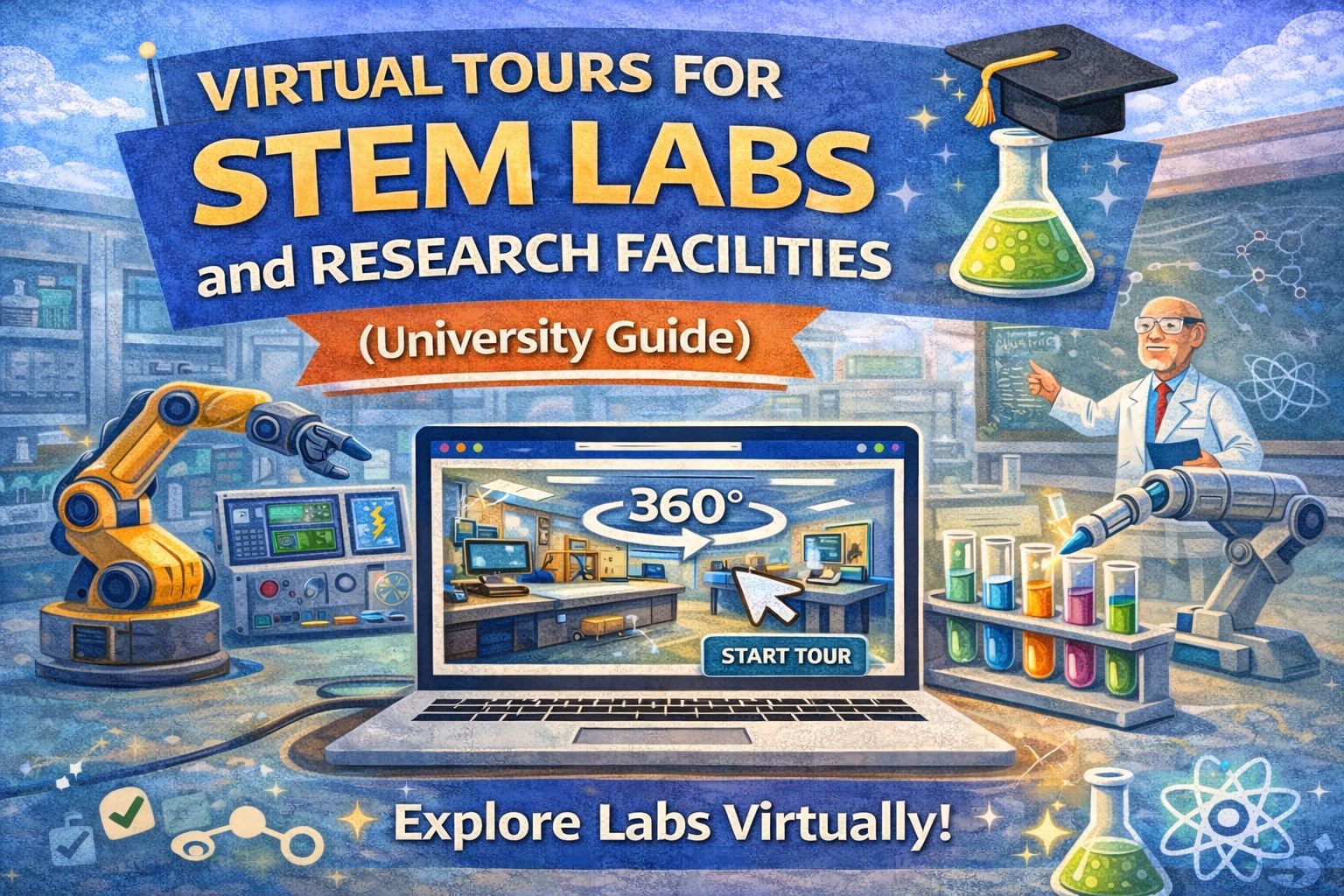
Virtual Tours for STEM Labs and Research Facilities

Cloudpano
January 16, 2026
5 min read
Share this post

Virtual Tours for STEM Labs and Research Facilities 🎓🔬

How STEM Virtual Tours Help Universities Showcase Innovation, Labs, and Research Facilities

When students are choosing a university, they’re not just picking a campus…

They’re choosing their future.

And for STEM-focused students (science, technology, engineering, math), one of the biggest deciding factors is simple:

What kind of labs, equipment, and research opportunities will I have access to?

That’s why STEM virtual tours for universities are quickly becoming one of the most powerful recruiting tools in higher education. A virtual tour doesn’t just show what your labs look like—it proves your university is modern, capable, innovative, and serious about research.

In this evergreen guide, you’ll learn:

  • Why lab virtual tours are especially persuasive for STEM enrollment
  • What to include in tours for labs and research facilities
  • How universities use tours to support grants, partnerships, and recruitment
  • Best practices to deliver professional University Virtual Tour Services

Let’s dive in. 🚀

Why STEM Virtual Tours Matter More Than Ever 🔥

STEM students are detail-oriented.

They care about:

  • equipment quality
  • lab space
  • safety protocols
  • innovation environments
  • faculty research programs
  • collaboration opportunities

And the truth is…

Most university marketing doesn’t show this clearly.

A few photos on a department page aren’t enough anymore—especially when other schools are offering immersive experiences.

✅ STEM virtual tours universities help solve 3 major challenges:

1) Students can’t visit in person 🧳🌍

International students and out-of-state applicants can’t always travel.

2) Labs are hard to explain with words ✍️

A robotics lab, clean room, or wet lab is highly visual.

3) Schools need stronger differentiation 🎯

Many STEM programs look identical online—tours change that instantly.

What Makes a STEM Lab Virtual Tour Different? 🔬✨

A typical “campus tour” focuses on:

  • student life
  • dorms
  • dining
  • main buildings

But a STEM lab tour is different.

STEM tours need to communicate:

✅ credibility
✅ complexity
✅ modern infrastructure
✅ hands-on learning
✅ research seriousness

A strong lab virtual tour gives prospective students a “wow moment” that tells them:

“This is where I want to build my future.”

Who Benefits from Lab Virtual Tours? 🎓🤝

STEM tours aren’t only for prospective undergrads.

They help multiple audiences:

👩‍🎓 Prospective students

  • admissions conversion
  • program confidence
  • emotional buy-in

👨‍👩‍👧 Parents

  • trust in campus quality
  • safety reassurance

🎓 Graduate / PhD candidates

  • research fit
  • faculty alignment
  • facility access

🏢 Industry partners

  • collaboration potential
  • sponsored research
  • internships pipelines

💰 Grants, donors, and funding groups

  • funding justification
  • “proof” of investment
  • storytelling for impact

In other words:
STEM lab tours serve recruitment and institutional strategy.
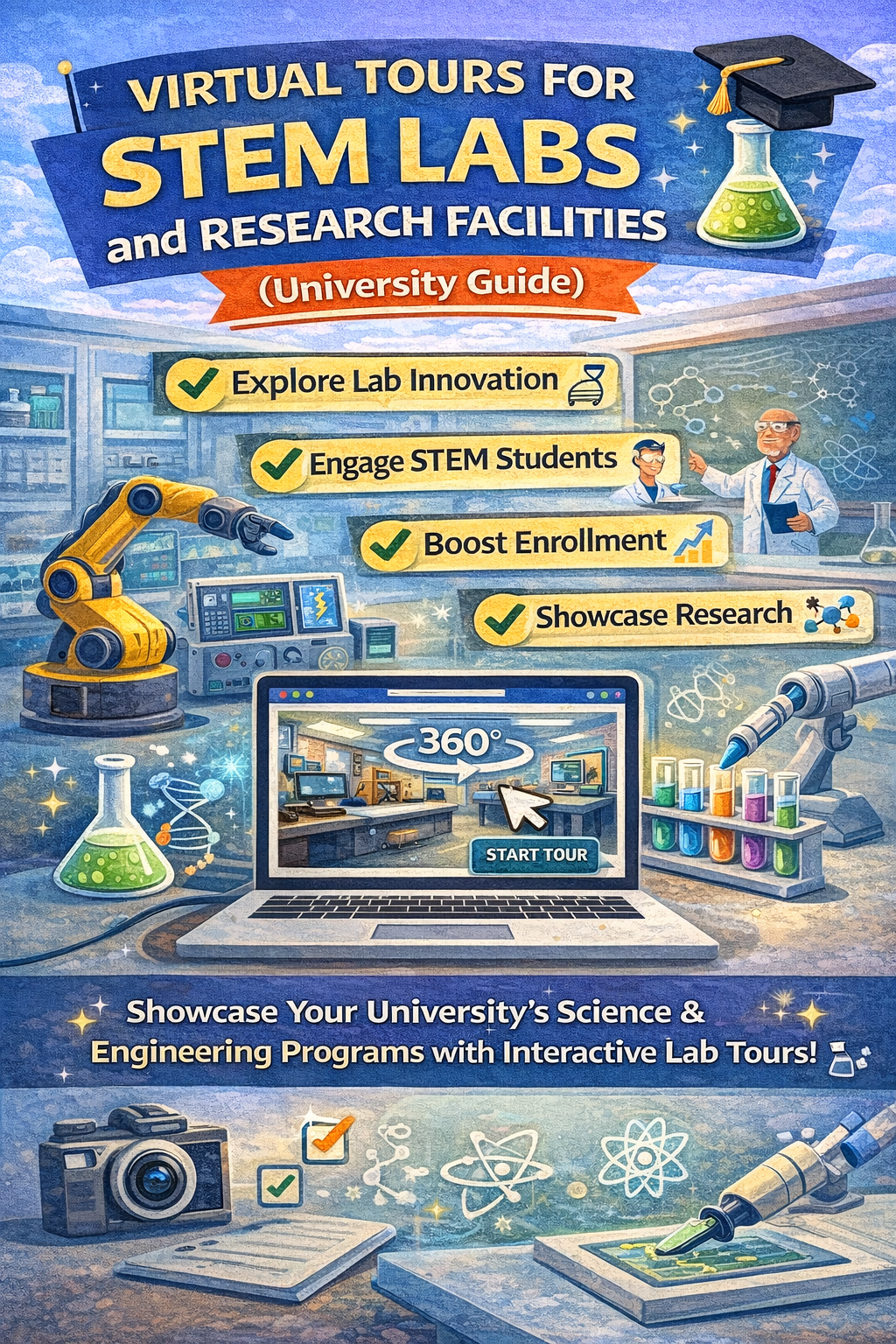
Best STEM Lab Spaces to Include in Virtual Tours 🧪🏗️

Not sure what to show? Here are the highest-impact lab tour locations universities should consider.

🔬 Wet Labs (Biology / Chemistry)

These spaces look impressive and high-stakes.

Show:

  • lab benches
  • safety showers / eyewash stations
  • fume hoods
  • instrument stations
  • refrigerated storage rooms

Tip: Add short explanations inside the tour like:
🧫 “This lab supports microbiology research and hands-on experimentation.”

⚡ Engineering Labs

Engineering labs are huge conversion drivers.

Include:

  • electronics benches
  • machining tools
  • industrial-grade prototyping areas
  • testing equipment
  • CNC machines / fabrication tools

Engineering tours help answer:
“Will I actually get hands-on experience?”

🤖 Robotics & AI Labs

These are some of the most clickable spaces.

Show:

  • robotics bays
  • drones
  • machine vision setups
  • sensor testing stations
  • student prototypes

These tours perform very well on social media too. 📱🔥

🧠 Neuroscience / Psychology Research Rooms

These spaces build credibility quickly.

Show:

  • brain imaging setups (if allowed)
  • data collection rooms
  • observation spaces
  • participant labs

Even if the equipment is specialized, the atmosphere communicates research seriousness.

💻 Computer Science / Cybersecurity Labs

Even if these spaces are “less visual,” they still matter.

Show:

  • collaborative workspaces
  • security simulation rooms
  • student project areas
  • server racks (if allowed)
  • digital ops environments

Include a quick overlay:
🛡️ “This lab supports hands-on cyber defense simulations.”

🛰️ Aerospace / Simulation Labs

If your university has simulation or aerospace programs, this is a huge differentiator.

Show:

  • simulators
  • wind tunnels
  • flight systems
  • aerospace prototyping rooms
  • satellite research spaces

These tours build immediate prestige. 🚀

🧼 Clean Rooms (If Available)

This is next-level.

Clean rooms signal:

  • advanced engineering
  • semiconductor manufacturing
  • materials science depth

Tour must include:

  • gowning area
  • entry protocol signage
  • key equipment (if allowed)

Pro tip:
Keep sensitive equipment limited, but show enough for impact.

What to Include in a Great STEM Lab Virtual Tour 📸✅

It’s not just about walking through a room.

A top-level STEM tour should include layers of storytelling.

Here are the key ingredients.

1) 360° Interactive Views 🔄

Prospects want to look around freely.

360 panoramas make the tour feel:

  • immersive
  • real
  • modern

This is the foundation of strong University Virtual Tour Services.

2) Clickable Hotspots 🧭

Let students navigate naturally:

  • lab → hallway → classroom
  • lab → student workspace
  • lab → project display area

This increases watch time and engagement dramatically.

3) Info Spots (Micro-Explanations) 🧠

Students may not know what they’re looking at.

Use quick info overlays:

  • “This scanner measures material surfaces at microscopic levels.”
  • “Students build prototypes here for capstone projects.”
  • “This lab supports research partnerships with industry.”

These tooltips make tours educational—not just visual.

4) Short Video Clips 🎥

Drop in short (15–45 second) clips like:

  • professor explaining lab purpose
  • student describing their research project
  • quick demo of lab equipment (safe/approved)

This adds a human element that boosts trust.

5) Student Project Showcase 🏆

This is one of the most powerful tour upgrades.

Include:

  • posters of student research
  • project boards
  • prototypes on display
  • competition awards

It transforms your lab tour into proof of outcomes.

6) Clear Calls-to-Action 📝

The tour should guide visitors to action:

✅ Request Information
✅ Explore STEM Programs
✅ Schedule a Visit
✅ Apply Now

Even a simple button near the tour embed increases conversions.

Best Practices for STEM Virtual Tours Universities Should Follow 🎯

Lab tours have unique challenges: privacy, safety, and complexity.

Here are best practices to keep tours effective and professional.

✅ Keep it clean and staged

Labs should appear:

  • organized
  • safe
  • functional

Even small clutter can change perception.

✅ Avoid sensitive research areas

If research is confidential, tour public-facing lab spaces only.

A strong lab virtual tour can still work without revealing everything.

✅ Use signage + labels

Simple signs help users understand space instantly:

  • “Materials Science Lab”
  • “Robotics Research Facility”
  • “Biomedical Engineering Lab”

Good signage also makes tours feel more legitimate.

✅ Include adjacent spaces

Labs are more impressive when shown in context.

Add:

  • hallways
  • waiting areas
  • collaboration rooms
  • student project zones

This shows the full ecosystem.

✅ Don’t make it too technical

Prospective students are excited—but not experts yet.

Use simple, clear descriptions:

  • “Hands-on equipment”
  • “Student-led research”
  • “Industry-grade tools”
  • “Capstone project space”

How STEM Virtual Tours Help Enrollment 📈🎓

A lab tour increases enrollments by reducing uncertainty.

Students ask:

  • “Will I get access to equipment?”
  • “Is the program modern?”
  • “Is this school serious about STEM?”
  • “Are research opportunities real?”

A virtual tour answers these instantly.

🧠 Psychology of enrollment:

The more a student can imagine themselves in the space, the more likely they apply.

Lab tours give that “I can see myself here” moment.

How Universities Use Lab Virtual Tours Beyond Admissions 💡

STEM tours aren’t only marketing assets—they’re strategic tools.

🤝 Industry Partnership Outreach

If you want partnerships, show facilities.

Companies want to see:

  • equipment capability
  • space readiness
  • research seriousness

A virtual tour shortens the trust-building process.

💰 Donor and Grant Storytelling

A 360 tour supports fundraising because it shows impact.

Example use:

  • embed in donor portal
  • grant application supplement pages
  • annual reports
  • alumni outreach

🧑‍🏫 Faculty recruitment

Hiring top STEM faculty is competitive.

Tours show:

  • lab resources
  • research environment quality
  • available equipment

This influences hiring decisions more than you think.

Don’t Miss These Articles:

Final Thoughts: STEM Lab Tours Showcase the Future 🔬✨

Universities that invest in strong STEM virtual tours gain an advantage in:

✅ enrollment
✅ program prestige
✅ partnerships
✅ fundraising
✅ trust

A high-quality lab virtual tour is one of the best ways to communicate what makes your STEM programs different—especially when students can’t visit in person.

If your goal is to compete in modern higher education recruitment, your labs and research facilities shouldn’t be hidden on a page with 3 photos.

They should be immersive.

Because for STEM students, the lab is the campus. 🎓🔬

🚀 Your All-In-One Virtual Experience Stack Starts Here

Share this post
Cloudpano

Choose The Right 360° Camera

Insta360 ONE RS 1-Inch 360 Edition

  • Compact, ready to go anywhere

  • Interchangeable lens that’s upgradeable

  • Dual 1-inch sensors for improved clarity and low light performance

  • Dynamic range and 6K 360° capture

  • 360° photo resolution at 21MP

Learn More

Insta360 X4

  • 8K 360° video recording for ultra-detailed visuals.

  • 4K single-lens mode for traditional wide-angle shots.

  • Invisible selfie stick effect for drone-like perspectives.

  • 2.5-inch touchscreen with Gorilla Glass protection.

  • Waterproof up to 33ft for underwater shooting.

Learn More

Ricoh Theta Z1

  • 360° photo resolution in 23MP

  • Slim design at 24 mm thick

  • Built-in image stabilization for smooth video capture.

  • Internal 19GB storage for photo and video storage.

  • Wireless connectivity for remote control and sharing.

Learn More

Ricoh Theta X

  • 60MP 360° still images for high-resolution photography.

  • 5.7K 360° video recording at 30fps.

  • 2.25-inch touchscreen for intuitive control.

  • USB Type-C port for fast charging and data transfer.

  • MicroSD card slot for expandable storage.

Learn More
Property Marketing
Allows potential buyers to explore properties in detail from anywhere, enhancing the real estate marketing process.
Automotive Spins
Create an interactive virtual showroom and engage affluent digital buyers with live 360º video calls, all through the CloudPano mobile app for a complete automotive sales solution.
Interactive Floor Plans
Create 2D and 3D floor plans with measurements in 4 minutes or less, all from your phone. Download the Floor Plan Scanner app and get your first scan free.

360 Virtual Tours With CloudPano.com. Get Started Today.

Try it free. No credit card required. Instant set-up.

Try it free
Latest posts

See our other posts

Interviews, tips, guides, industry best practices, and news.

Property Manager Video Hub: Scaling Rental Visibility with AI Photo-to-Video Workflows

This article explains how property managers can use PhotoAIVideo to build a property manager video hub: a repeatable system for turning rental photos, amenity images, floor plans, exterior shots, and neighborhood visuals into reusable rental marketing videos. The main idea is that property managers do not just need more listing exposure. They need clearer visual answers that help renters decide whether to schedule a tour. PhotoAIVideo is positioned as a practical tool for creating: Unit availability videos Amenity highlight videos Neighborhood videos Tour reminder clips Leasing follow-up videos Owner marketing proof videos Social media rental teasers Application or availability reminder videos Key takeaways: Property managers already have the media they need; the challenge is organizing it and turning it into reusable video assets. A video hub helps teams create consistent videos across units, floor plans, amenities, communities, and owner updates. Rental videos can reduce friction by answering renter questions about layout, condition, amenities, parking, pet features, and community feel. One rental photo set can become multiple video outputs for listings, social media, email, text follow-up, tour reminders, and owner reporting. Photographers can sell AI rental video packages to property managers as an upsell. Brokerages with property management divisions can use the same workflow to standardize leasing content. The article ends with a step-by-step process, video hub framework, mistakes to avoid, visual recommendations, FAQs, and a CTA encouraging readers to use PhotoAIVideo to turn rental photos into a scalable video system for rental visibility.
Read post

YouTube Shorts Listing Teasers: The 3-Scene Structure for Higher Property Clicks

This article explains how real estate agents, photographers, brokerages, and property managers can use YouTube Shorts listing teasers to drive more property clicks and showing requests. The main idea is that a YouTube Short should not try to show the entire house. Instead, it should use a simple 3-scene structure: Scene 1: Hook — stop the scroll with the strongest property feature. Scene 2: Proof — show the visuals that support the hook. Scene 3: Click Path — tell the viewer what to do next. The article positions PhotoAIVideo as a practical tool for turning listing photos into short vertical videos for YouTube Shorts, Reels, open house promotion, and listing campaigns. Key takeaways: YouTube Shorts should create curiosity, not replace the full listing video. The strongest property feature should appear first, not necessarily the front exterior. Agents should build each Short around one click reason, such as backyard, kitchen, layout, neighborhood, open house, or price point. One listing can become multiple Shorts instead of one generic video. Photographers can offer YouTube Shorts teaser packs as a video upsell. Brokerages can standardize the 3-scene structure across agents. Property managers can use the same structure to promote rentals and tours. The article ends with practical scripts, visual recommendations, FAQs, a visual placement guide, and a CTA encouraging readers to use PhotoAIVideo to create YouTube Shorts listing teasers from property photos.
Read post

Video Retargeting for Listings: Turning Photo-Based AI Videos into Appointment Follow-Up

This article explains how Realtors, photographers, brokerages, and property managers can use photo-based AI videos as follow-up assets after someone shows interest in a listing. The main idea is that most real estate marketing focuses on getting the first click, but many buyers and sellers need multiple touchpoints before booking a showing or appointment. Video retargeting helps agents re-engage people who already clicked a listing, watched a Reel, opened an email, attended an open house, asked about a property, or went quiet after showing interest. PhotoAIVideo is positioned as a practical tool for turning listing photos into short follow-up videos, including: Feature reminder videos Layout explainer videos Neighborhood fit videos Open house recap videos Price update videos Seller proof videos Showing request videos Rental tour recovery videos Key takeaways: A first-touch listing video introduces the property, while a retargeting video answers the next likely question. Follow-up videos should be short, usually 10–30 seconds, and focused on one action. Agents should send different videos based on behavior, such as email clicks, open house attendance, listing views, or showing interest. A good video follow-up feels helpful, not pushy. Photographers can package retargeting video clips as an upsell. Brokerages can standardize video retargeting workflows across agents. Property managers can use the same strategy to recover rental leads and book tours. The article ends with a simple retargeting sequence, visual recommendations, FAQs, and a CTA encouraging readers to use PhotoAIVideo to turn listing photos into appointment-driving follow-up videos.
Read post