


.png)


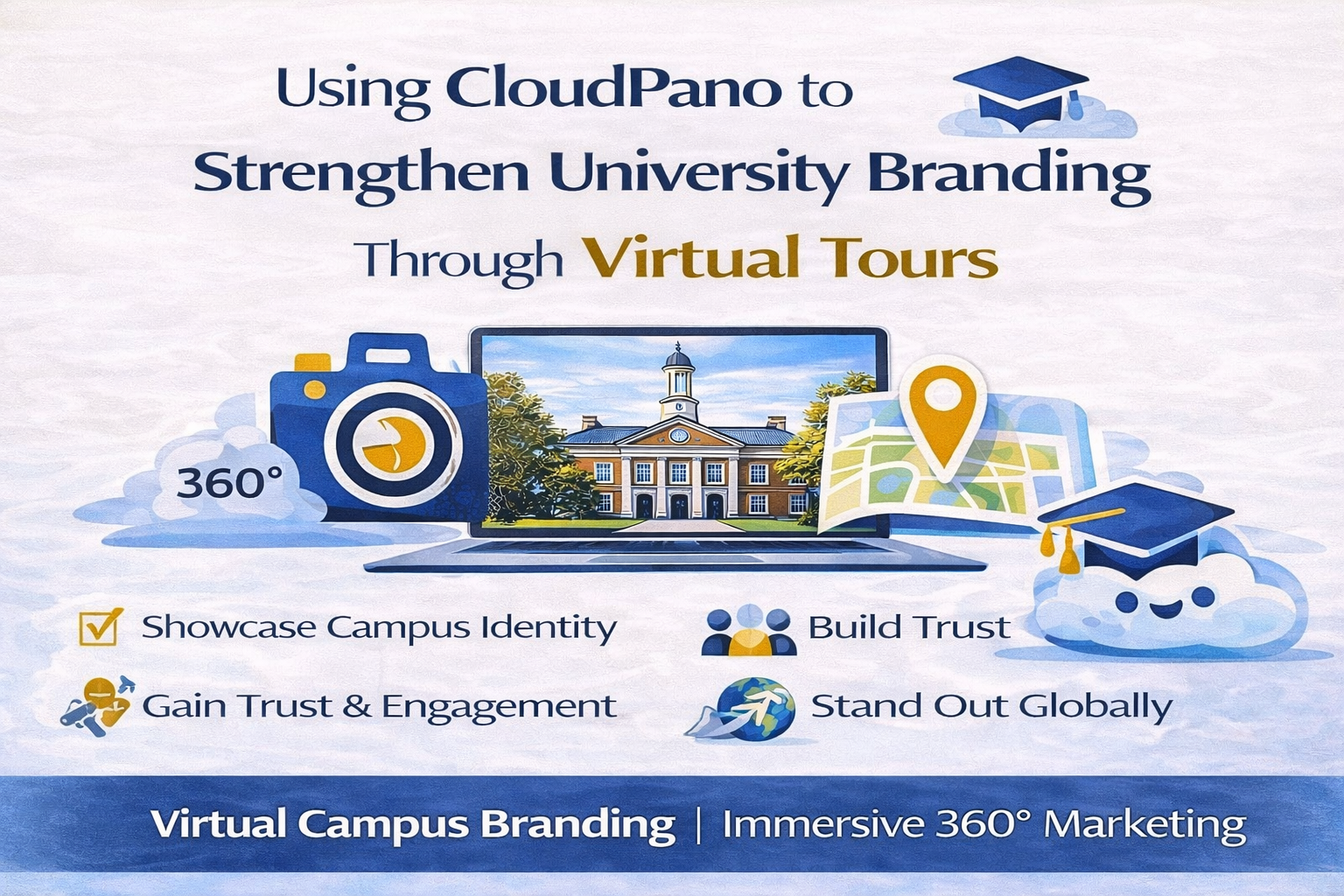
University branding has entered a new era.
Prospective students no longer experience a university first through a brochure, campus banner, or admissions office visit. Instead, their first impression is digital—formed through websites, social media, search results, and online exploration.
In this digital-first environment, university virtual tours have become one of the most powerful higher education branding tools available. They do more than show buildings—they communicate identity, culture, and values.
With platforms like CloudPano, universities can transform their campuses into immersive, always-available brand experiences that influence perception long before a student applies.
This guide explores how CloudPano virtual tour software helps institutions strengthen virtual campus branding, elevate immersive campus marketing, and compete effectively in an increasingly crowded higher education landscape.
Brand perception used to be shaped primarily on campus—through guided tours, events, and personal interactions.
Today, the brand experience starts online.
Prospective students:
This means branding is no longer just visual identity—it’s experience design.
Universities that fail to deliver strong digital experiences risk being perceived as outdated, inaccessible, or less engaging, regardless of academic quality.
University virtual tours serve as one of the most direct expressions of an institution’s brand.
Unlike static pages, virtual tours allow students to:
Every interaction—navigation, visuals, information placement—reinforces brand perception.
In other words, a virtual tour is branding.

Traditional campus marketing assets often operate in isolation:
Virtual tours unify these elements into a single, cohesive experience.
With CloudPano virtual tour software, universities can centralize their visual storytelling and ensure consistency across departments, programs, and recruitment campaigns.
This creates a strong, recognizable digital presence that supports long-term brand equity.
Branding is emotional.
Students don’t just choose a university for its programs—they choose it for how it makes them feel:
Immersive campus marketing works because it places students inside the environment instead of asking them to imagine it.
Through interactive exploration, students begin to visualize themselves as part of the campus community—an essential step in the enrollment decision.
One of the biggest advantages of virtual campus branding is scalability.
A well-designed virtual tour can support:
Instead of creating separate assets for each audience, universities can adapt the same immersive experience across multiple initiatives.
This makes virtual tours one of the most efficient higher education branding tools available.
Brand consistency is a challenge for large institutions.
Different departments often present:
With CloudPano, universities can:
This consistency strengthens brand recognition and reinforces credibility at every touchpoint.
Modern branding isn’t just about aesthetics—it’s about inclusion.
Accessible digital experiences communicate values clearly.
Virtual tours support inclusive branding by:
Universities that prioritize accessibility in their digital experiences signal a commitment to diversity, equity, and student success.
Effective branding evolves based on insight.
Virtual tours can provide universities with valuable engagement data, such as:
These insights help institutions refine their immersive campus marketing strategies and align branding with what resonates most with prospective students.
Strong brands tell strong stories.
With CloudPano virtual tour software, universities can guide users through a narrative:
Each hotspot becomes part of a story—not just a location.
This narrative approach helps students understand why the university exists, not just what it offers.
As competition for students increases, differentiation becomes critical.
Universities that invest in immersive digital experiences gain a clear advantage by:
In many cases, the quality of a university’s virtual experience influences perception before academic rankings or brochures are even considered.
Unlike short-term campaigns, virtual tours are long-term brand assets.
Once created, they:
This makes virtual tours one of the highest-ROI investments in higher education branding.
Student expectations continue to evolve.
The future of university virtual tours and branding is:
Institutions that embrace experiential branding now will be better positioned to adapt as digital engagement becomes the norm rather than the exception.
University branding is no longer defined solely by logos, slogans, or printed materials.
It’s defined by experience.
By using CloudPano virtual tour software, universities can:
The institutions that win tomorrow’s students will be those that invite them to experience campus before they ever arrive.


Compact, ready to go anywhere
Interchangeable lens that’s upgradeable
Dual 1-inch sensors for improved clarity and low light performance
Dynamic range and 6K 360° capture
360° photo resolution at 21MP

8K 360° video recording for ultra-detailed visuals.
4K single-lens mode for traditional wide-angle shots.
Invisible selfie stick effect for drone-like perspectives.
2.5-inch touchscreen with Gorilla Glass protection.
Waterproof up to 33ft for underwater shooting.

360° photo resolution in 23MP
Slim design at 24 mm thick
Built-in image stabilization for smooth video capture.
Internal 19GB storage for photo and video storage.
Wireless connectivity for remote control and sharing.

60MP 360° still images for high-resolution photography.
5.7K 360° video recording at 30fps.
2.25-inch touchscreen for intuitive control.
USB Type-C port for fast charging and data transfer.
MicroSD card slot for expandable storage.
.png)

.png)

Try it free. No credit card required. Instant set-up.






.svg)


.svg)