


.png)


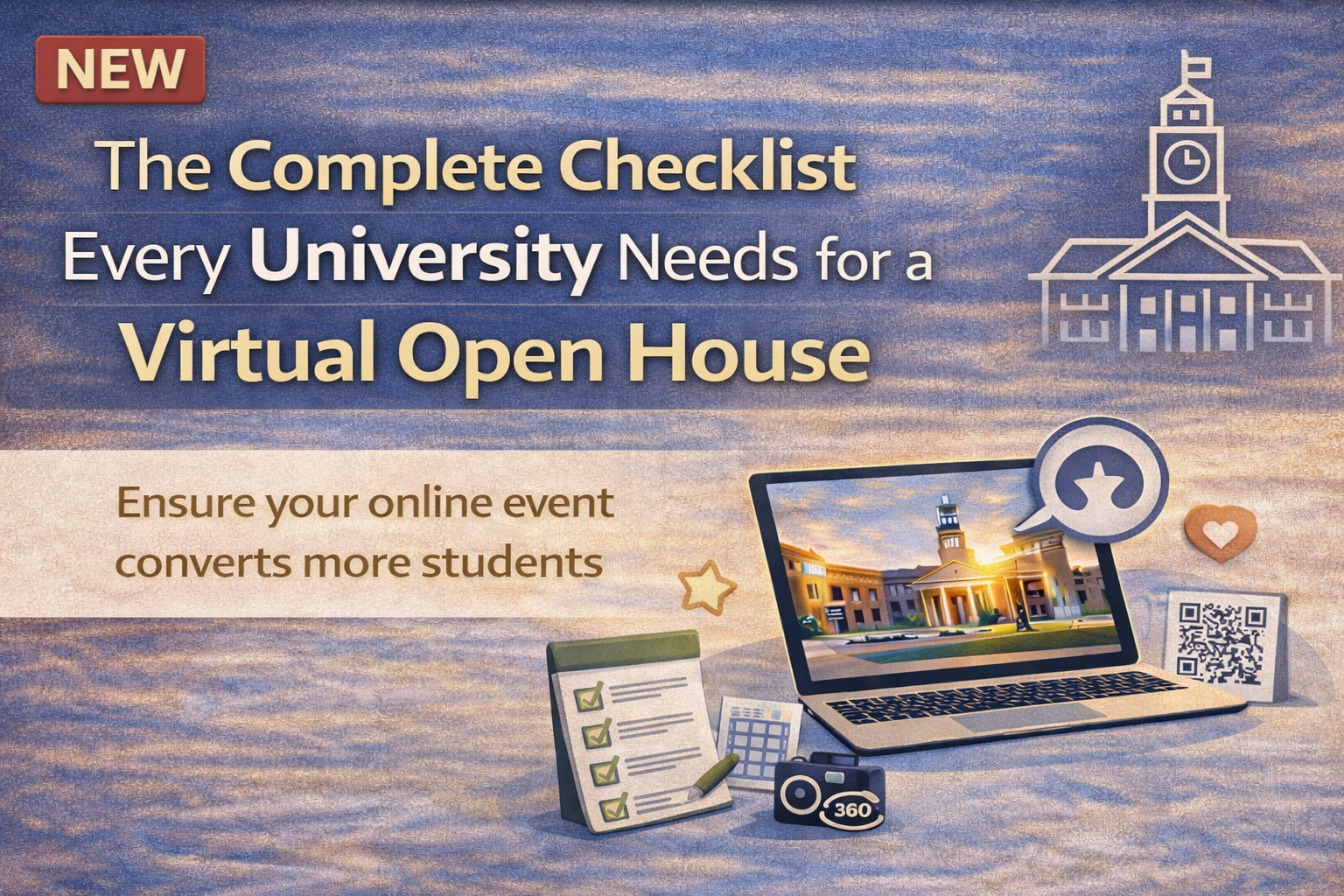
(Virtual Open House Checklist + University Virtual Tour Services)
Virtual open houses are no longer a temporary trend.
They’ve become a permanent and powerful part of university recruitment.
Today, prospective students expect to explore a campus without needing to travel. They want to experience the university environment from their phone, ask questions instantly, and make confident decisions without waiting for an in-person visit.
That’s why universities everywhere are upgrading their recruitment strategies with:
✅ interactive events
✅ digital admissions funnels
✅ and especially university virtual tours
But here’s the challenge…
Many schools run virtual open houses like a webinar.
Students show up, listen, and leave.
That’s not a campus experience.
To make your virtual open house actually convert, you need two things:
In this guide, you’ll get the complete virtual open house checklist every university needs — plus how to integrate University Virtual Tour Services so your open house feels real, interactive, and unforgettable. 🌍✨
Virtual open houses solve a major admissions problem:
Not every student can visit campus.
Between travel costs, school schedules, family responsibilities, international distance, and accessibility barriers — your in-person open house may only reach a fraction of your potential applicants.
A strong virtual open house allows you to:
🌍 reach students anywhere
🎓 engage more prospects
📩 collect more inquiries
✅ increase student confidence
📈 increase applications
And when paired with immersive university virtual tours, a virtual open house becomes a true digital campus experience — not just a slideshow.
A successful virtual open house doesn’t just “deliver information.”
It creates:
✅ clarity
✅ trust
✅ excitement
✅ belonging
Students want to know:
🏫 What does campus look like?
🏠 Where will I live?
📚 What resources exist?
🎭 What is student life like?
👨🏫 Who will support me?
💼 What happens after graduation?
So your open house must be structured to answer those questions quickly and visually.
Let’s break this into sections you can use every semester.
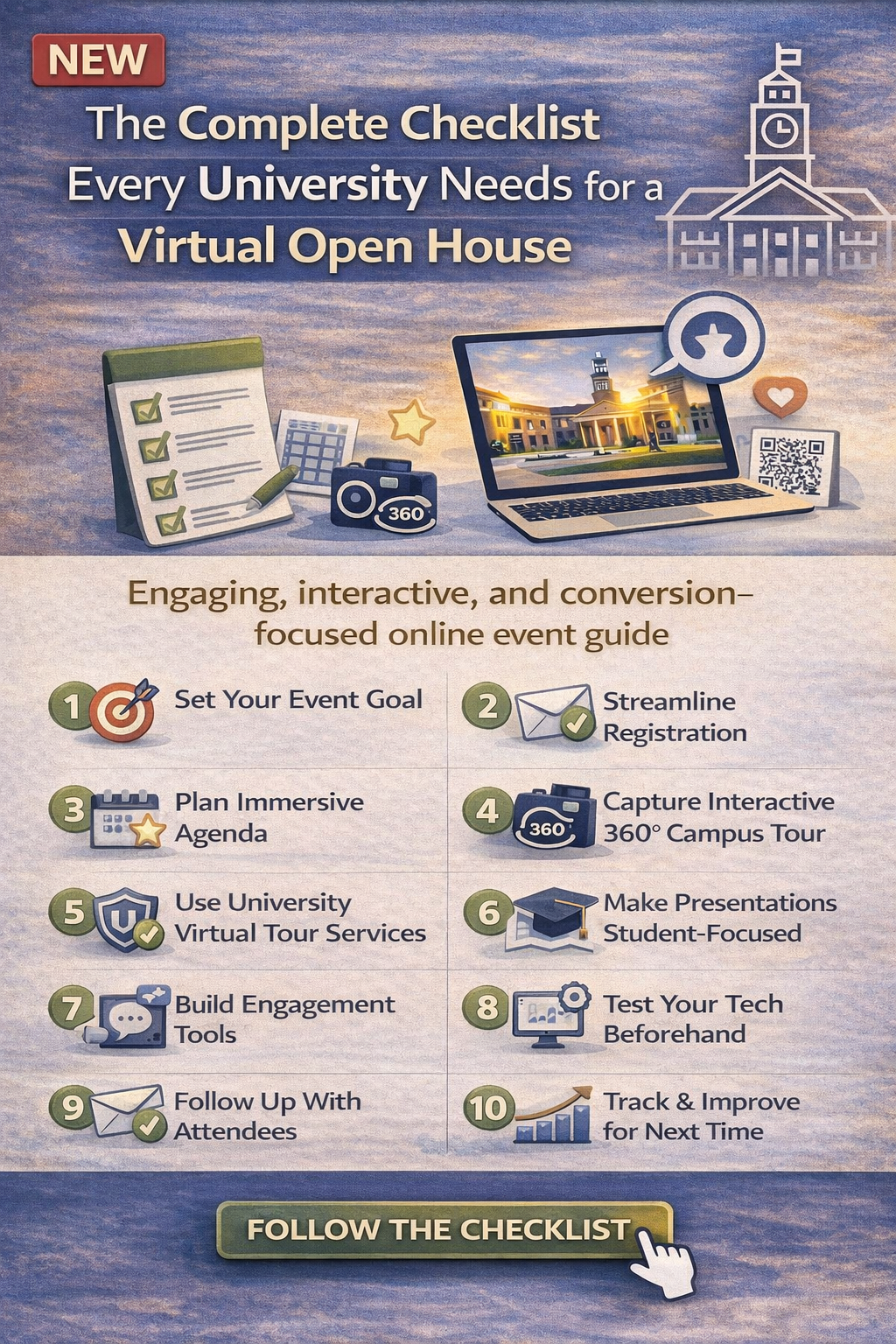
This is the evergreen virtual open house checklist every admissions team should follow.
Before you think about tech, start with strategy.
Your open house should focus on ONE main goal:
Your event may attract:
👶 first-year freshmen
🔄 transfer students
🌍 international students
🎓 graduate applicants
🚗 commuter students
🏀 student athletes
Your content must match the audience.
Examples:
🎓 “Explore Campus Life & Student Experience”
🧪 “STEM Programs + Labs Open House”
🏥 “Healthcare & Nursing Virtual Open House”
🌍 “International Student Welcome Day”
Themes improve attendance and conversions.
Most universities lose conversions here.
Your registration process should be:
✅ short
✅ mobile-friendly
✅ easy to complete in under 60 seconds
That data lets you personalize follow-up — which increases conversion.
Students don’t want a long presentation.
They want a guided experience.
✅ Welcome (high energy)
✅ Campus overview
✅ Academic programs spotlight
✅ Student life + housing
✅ Admissions next steps
✅ Financial aid clarity
✅ Live Q&A
✅ Tour experience / virtual walkthrough
The #1 missing piece?
Immersion.
This is why university virtual tours should be the centerpiece of the experience — not an afterthought.
A virtual open house without a tour feels incomplete.
A tour is where students create emotional connection.
🏛️ Main entrance / welcome center
🏠 dorm room sample
🍽️ dining hall
📚 library
🏫 classroom buildings
🧪 labs / facilities
🏋️ athletics
🎭 student union / community spaces
Don’t overwhelm students with one massive tour.
Instead use micro tours:
🏠 Housing Tour
📚 Academic Success Tour
🎭 Student Life Tour
🧪 Program Facilities Tour
This keeps students engaged and lets them choose what they care about.
Here’s where University Virtual Tour Services make a difference.
Many universities make basic tours and stop there.
But the best schools use virtual tour services to create interactive experiences with:
📌 hotspots
🎥 videos
🔗 links
📩 CTAs
🧭 guided navigation menus
📌 “Apply Now”
📌 “Request More Info”
📌 “Schedule a Visit”
📌 “Meet the Department”
📌 “Scholarships & Financial Aid”
📌 “Student Support Resources”
With interactive tours, the open house continues working long after the event is over.
That’s evergreen conversion power.
Your agenda should be structured, short, and engaging.
👋 Welcome & introductions (5 min)
🏫 Campus overview (10 min)
🎓 Program spotlight (15 min)
🏠 Student life + housing (10 min)
💰 Financial aid clarity (10 min)
🎥 Live virtual tour walkthrough (15 min)
💬 Live Q&A (15–20 min)
✅ Next steps + CTA (5 min)
Reminder: students will not stay for 2+ hours.
Shorter + clearer wins.
Who should be involved?
✅ admissions counselor (main host)
✅ student ambassadors (social proof)
✅ program rep / faculty member
✅ financial aid rep
✅ housing rep (optional but powerful)
Students want real people, not corporate scripts.
Student ambassadors especially increase conversions because they make the school feel relatable.
Engagement is the difference between attendance and applications.
Ways to increase engagement:
✅ polls (“Where are you joining from?”)
✅ Q&A chat prompts
✅ emoji reactions
✅ quick “choose your path” tour links
✅ breakout rooms by program interest
✅ “ask a student” segments
Your goal: interaction every 3–5 minutes.
Virtual open houses fall apart when the tech fails.
✅ stable internet for hosts
✅ backup internet hotspot
✅ tested mic audio levels
✅ tested screen share for tours
✅ tested links
✅ backup host/administrator
✅ event recording enabled
✅ live captions enabled (ADA compliance)
Also: everything should be mobile-safe.
Many students join from phones.
Your virtual open house isn’t the finish line.
Follow-up is where applications happen.
✅ thank-you email within 2 hours
✅ link to university virtual tours
✅ replay link
✅ “apply now” CTA
✅ department-specific tour link
✅ invite to speak to admissions
If a student selects “engineering interest” in registration, send:
🧪 engineering lab tour
📩 apply link
📅 schedule advisor chat
This personalization increases applications dramatically.
To increase conversion, include:
✅ “Apply Now” link prominently
✅ “Request Info” form
✅ scheduling calendar
✅ program-specific landing pages
✅ tour CTA inside the tour itself
A tour without CTAs is a missed opportunity.
Every open house should get better each time.
Track:
📊 registration conversion rate
📊 attendance rate
📊 engagement rate (questions asked, polls answered)
📊 tour clicks
📊 application starts
📊 application submissions
Then refine:
✅ shorten sections that lose attention
✅ improve CTA timing
✅ highlight the most-viewed tour scenes
✅ add more interactive hotspots
Virtual open houses aren’t going away.
They’re expanding.
Even students who can visit campus still want a virtual tour experience because:
That makes university virtual tours one of the most valuable recruitment assets universities can invest in.
Especially when built using high-quality University Virtual Tour Services that make tours interactive and conversion-driven.
A virtual open house can either be:
❌ a webinar people forget
or
✅ a campus experience students remember
If you use this virtual open house checklist, your university will be able to:
✅ create better digital experiences
✅ engage more prospective students
✅ build trust faster
✅ increase student confidence
✅ increase applications and enrollment
And when you combine your open house with immersive, interactive university virtual tours, your campus becomes accessible, persuasive, and unforgettable — no matter where a student lives.


Compact, ready to go anywhere
Interchangeable lens that’s upgradeable
Dual 1-inch sensors for improved clarity and low light performance
Dynamic range and 6K 360° capture
360° photo resolution at 21MP

8K 360° video recording for ultra-detailed visuals.
4K single-lens mode for traditional wide-angle shots.
Invisible selfie stick effect for drone-like perspectives.
2.5-inch touchscreen with Gorilla Glass protection.
Waterproof up to 33ft for underwater shooting.

360° photo resolution in 23MP
Slim design at 24 mm thick
Built-in image stabilization for smooth video capture.
Internal 19GB storage for photo and video storage.
Wireless connectivity for remote control and sharing.

60MP 360° still images for high-resolution photography.
5.7K 360° video recording at 30fps.
2.25-inch touchscreen for intuitive control.
USB Type-C port for fast charging and data transfer.
MicroSD card slot for expandable storage.
.png)

.png)

Try it free. No credit card required. Instant set-up.





.svg)


.svg)