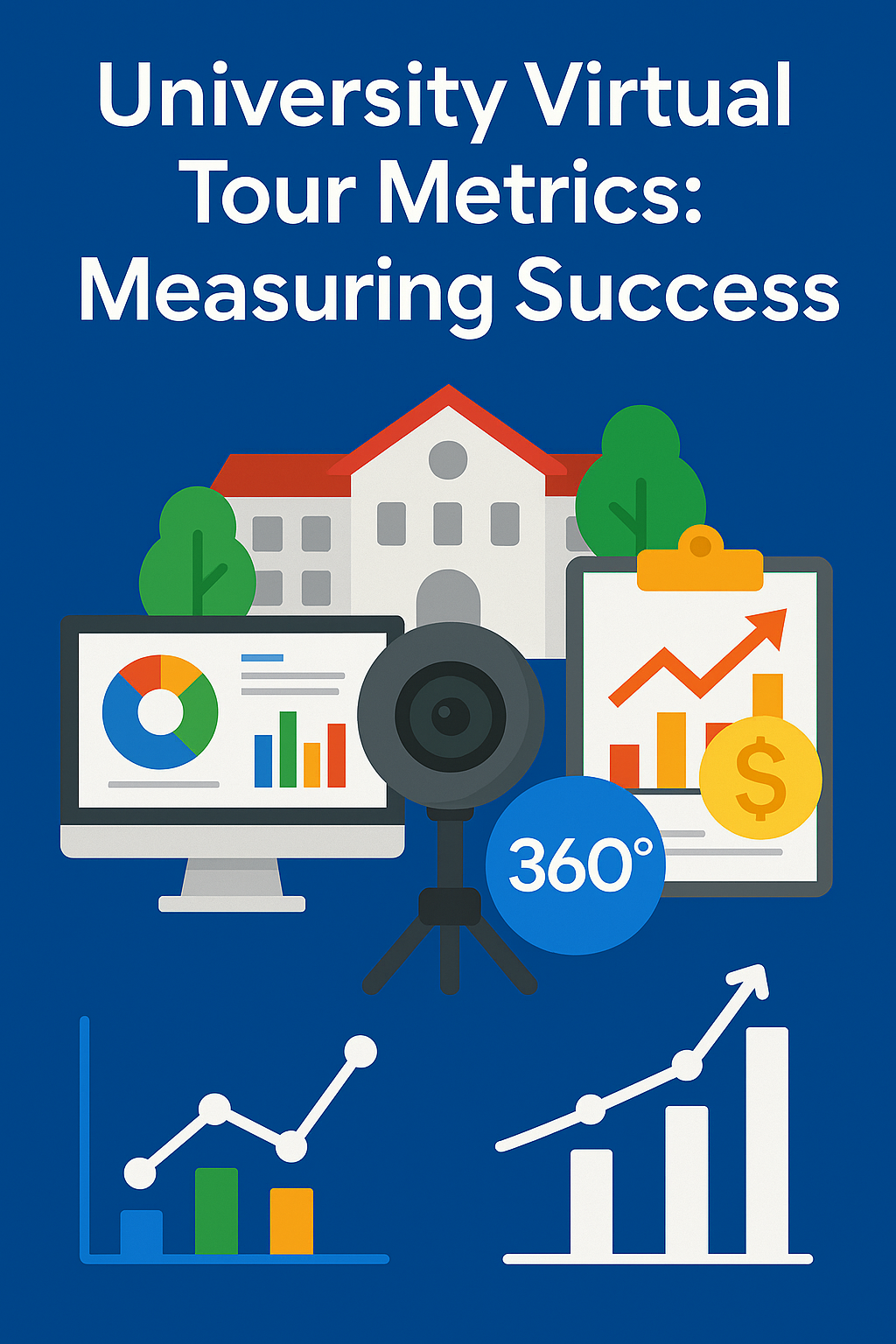
Measuring Success: Metrics You Should Track in University Virtual Tours

Cloudpano
October 18, 2025
5 min read
Share this post

🎓 Measuring Success: Metrics You Should Track in University Virtual Tours

In today’s digital-first world, virtual campus tours have become an essential part of the university recruitment strategy. 🌍✨ Whether your institution attracts international students or local applicants, immersive 360° experiences give prospects a feel of campus life before they ever set foot on campus. Check out how CloudPano is transforming campus tours in higher education → CloudPano for Universities

But creating a beautiful virtual tour isn’t enough. The real magic happens when you track the data — the metrics that reveal how your tours are performing and how they’re driving student engagement and enrollment. 📈 With a real estate video app, agents can quickly produce professional listing videos that attract more buyers.

In this post, we’ll explore the key performance indicators (KPIs) universities should monitor to measure success and continuously improve their virtual campus experiences.

Read: How Universities Use Virtual Tours to Stay Ahead in Digital Marketing

🔍 Why Measuring Virtual Tour Performance Matters

A virtual tour is more than a marketing tool — it’s a data-driven storytelling platform. Every view, click, and engagement gives insight into student interest, preferences, and decision-making behavior.

Here’s why you need to track your performance:

  • 🎯 Optimize conversion funnels — Find out which parts of your tour inspire students to apply or schedule visits.
  • 💬 Understand engagement — Learn which scenes, hotspots, or videos attract the most attention.
  • 💡 Refine your content — Use analytics to identify underperforming areas or pages.
  • 🚀 Show ROI — Prove the value of your virtual tour investment to administrators and marketing teams.

When powered by platforms like CloudPano, these insights become easily accessible — helping you make smarter marketing decisions.

👀 1. View Count: Who’s Visiting and How Often

The first and simplest metric to track is your total number of views.

Every view represents a prospective student (or parent) showing interest in your campus. Monitoring view counts over time helps you spot:

  • 📆 Seasonal trends — Expect spikes during open enrollment periods.
  • 🌐 Global reach — See where your traffic is coming from (great for international recruitment).
  • 🔁 Repeat visits — Returning visitors indicate sustained interest and a higher chance of conversion.

👉 Pro Tip: Compare your view counts across different campaigns (social media ads, email marketing, paid search) to identify which channels drive the most engagement.

📲 2. Engagement Rate: How Interactive Are Visitors?

It’s not just about who visits — it’s about what they do once they arrive.

Your engagement rate measures how users interact with clickable elements such as:

  • Hotspots
  • Embedded videos
  • Photo galleries
  • Floor plans
  • Call-to-action (CTA) buttons

A high engagement rate indicates that users are genuinely exploring your campus, not just scrolling through.

📊 How to improve it:
Add storytelling features like student testimonial videos, dorm room walk-throughs, or virtual classroom sessions. The more interactive your tour feels, the longer visitors will stay.

🕒 3. Average Time on Tour: Capturing Attention

One of the most valuable metrics is average session duration — how long users spend on your tour.

The longer someone explores, the stronger the emotional connection they build with your university. ❤️

  • ⏱️ Under 1 minute → casual browsers
  • ⏱️ 2–5 minutes → interested visitors
  • ⏱️ 6+ minutes → serious prospects

If viewers are exiting quickly, analyze where they drop off. Perhaps your intro scene is too long, or the loading time is slow.

CloudPano Tip: Add voiceovers or live chat to guide users through your tour — it keeps them engaged and increases average watch time.

📍 4. Popular Scenes and Hotspots: Discover What Resonates

Every virtual tour has standout spots — whether it’s the iconic library, athletics center, or student union. Tracking scene popularity tells you which areas spark the most excitement.

📈 Use this data to:

  • Feature top scenes more prominently in marketing materials.
  • Update or improve less-viewed areas.
  • Plan future shoots based on what students care about most.

🔥 For example: If 60% of visitors spend time exploring residence halls, consider creating a “Student Life” mini-tour for deeper engagement.

📧 5. Conversion Metrics: Turning Interest into Action

Engagement is great — but conversions are where ROI becomes tangible. 💰

You should always track conversion-related actions, such as:

  • Clicking “Apply Now” or “Book a Campus Visit”
  • Filling out inquiry forms
  • Joining live chat sessions
  • Downloading brochures

Every conversion represents a measurable step toward enrollment.

🚀 Pro Tip: CloudPano allows you to embed CTAs directly inside the tour. When viewers click, you can route them to your CRM or admissions page to measure exactly where they came from.

🌎 6. Geographic Insights: Who’s Interested and Where They’re From

Location analytics reveal the global footprint of your university’s virtual audience.

Tracking IP-based visitor data helps you understand:

  • 🌍 Which countries or regions show the most interest
  • 📍 Potential international recruitment markets
  • 🧭 Cities where follow-up campaigns might work best

Example: If your analytics show rising viewership from Brazil or India, your admissions team can target those regions with localized ads or translated tour materials.

📱 7. Device Performance: Desktop vs. Mobile

Today’s students are digital natives — and most will view your tour from their phones. 📱

Tracking the breakdown between desktop, tablet, and mobile usage ensures your virtual tour is optimized across all devices.

⚙️ If mobile engagement is low, it could signal:

  • Slow loading speeds
  • Poor responsiveness
  • Difficult navigation on smaller screens

Platforms like CloudPano automatically optimize for mobile, but it’s still smart to analyze device-level performance.

💬 8. Live Chat and Interaction Metrics

If your tour includes CloudPano Live 360° Video Chat, track how many visitors join interactive sessions. These metrics include:

  • 👥 Number of live sessions
  • ⏰ Average session length
  • 🗣️ Conversion rate from chat to application

This is where virtual tours become truly human. Real-time interaction builds trust and helps prospective students feel more connected to your campus culture.

🎯 9. Lead Source Tracking: Where Do Your Visitors Come From?

Knowing where your virtual visitors originate helps you spend smarter on marketing.

Connect Google Analytics, UTM tags, or your CRM to identify:

  • 🧭 Organic traffic (Google, Bing, YouTube)
  • 📣 Paid campaigns (Facebook, Instagram, Google Ads)
  • 📧 Email campaigns
  • 🌐 Referral traffic (education directories, partner schools)

With this insight, you can double down on high-performing channels and cut back on those that don’t convert.

📊 10. Application Correlation: The Ultimate Success Metric

At the end of the day, the most powerful metric is whether your virtual tour influences enrollment decisions.

Here’s how to measure it:

  • Track users who visited the tour and later submitted applications.
  • Use CRM integration to monitor conversion pipelines.
  • Compare application rates before and after launching your tour.

If your institution sees even a small uptick in applications or yield rate, that’s measurable proof that your virtual tour is working. 🎓🚀

Read: Boost Enrollment with Interactive Campus Tours for Online Programs

🧠 Bonus: Qualitative Feedback Still Matters

Numbers are powerful, but so is direct feedback. Encourage students to share their thoughts through:

  • Feedback forms
  • Post-tour surveys
  • Live Q&A sessions

Ask questions like:

  • “Did this tour help you visualize yourself on campus?”
  • “What part of the experience did you enjoy most?”
  • “What could make it better?”

This qualitative data gives context to your analytics — blending emotion with information. 💡

🌟 Final Thoughts: Data Turns Tours Into Strategy

Tracking metrics transforms your virtual campus tour from a digital showcase into a strategic recruitment engine.

When you understand who’s engaging, where they come from, and what motivates them, you can refine your storytelling and maximize your ROI.

🎓 With CloudPano, every click tells a story — and every story leads closer to enrollment success.

So, don’t just publish your 360° tour — measure it, learn from it, and grow your university’s digital presence. 🚀📸

💡 Key Takeaway:

Success isn’t about how your virtual tour looks — it’s about how it performs. Use analytics to drive smarter marketing, better engagement, and stronger student connections.

Your all-in-one virtual experience solution starts here.

Share this post
Cloudpano

Choose The Right 360° Camera

Insta360 ONE RS 1-Inch 360 Edition

  • Compact, ready to go anywhere

  • Interchangeable lens that’s upgradeable

  • Dual 1-inch sensors for improved clarity and low light performance

  • Dynamic range and 6K 360° capture

  • 360° photo resolution at 21MP

Learn More

Insta360 X4

  • 8K 360° video recording for ultra-detailed visuals.

  • 4K single-lens mode for traditional wide-angle shots.

  • Invisible selfie stick effect for drone-like perspectives.

  • 2.5-inch touchscreen with Gorilla Glass protection.

  • Waterproof up to 33ft for underwater shooting.

Learn More

Ricoh Theta Z1

  • 360° photo resolution in 23MP

  • Slim design at 24 mm thick

  • Built-in image stabilization for smooth video capture.

  • Internal 19GB storage for photo and video storage.

  • Wireless connectivity for remote control and sharing.

Learn More

Ricoh Theta X

  • 60MP 360° still images for high-resolution photography.

  • 5.7K 360° video recording at 30fps.

  • 2.25-inch touchscreen for intuitive control.

  • USB Type-C port for fast charging and data transfer.

  • MicroSD card slot for expandable storage.

Learn More
Property Marketing
Allows potential buyers to explore properties in detail from anywhere, enhancing the real estate marketing process.
Automotive Spins
Create an interactive virtual showroom and engage affluent digital buyers with live 360º video calls, all through the CloudPano mobile app for a complete automotive sales solution.
Interactive Floor Plans
Create 2D and 3D floor plans with measurements in 4 minutes or less, all from your phone. Download the Floor Plan Scanner app and get your first scan free.

360 Virtual Tours With CloudPano.com. Get Started Today.

Try it free. No credit card required. Instant set-up.
Try it free
Latest posts

See our other posts

Interviews, tips, guides, industry best practices, and news.

AI Avatar Compliance and Best Practices for Real Estate Marketing

This article explores how real estate professionals can responsibly use AI avatars in property marketing while maintaining transparency and trust. It explains the importance of AI real estate compliance, including how agents should implement proper disclosure for AI videos and follow ethical AI marketing practices when using AI-generated presenters in listing videos. The guide walks through how AI avatars are created, how they can automate listing presentations, and how agents can integrate them into their marketing workflow without misleading buyers or violating advertising standards. By following clear best practices—such as accurate scripts, transparent disclosures, and consistent review of generated content—real estate teams can scale video marketing while protecting their reputation and building long-term client trust.
Read post

Managing Multiple AI Clones Inside One Real Estate Team

This article explains how real estate teams can successfully manage AI avatars across multiple agents to scale their marketing and listing presentations. It walks through the process of creating AI avatar clones, organizing them into a structured team avatar management system, and integrating them into a streamlined real estate AI workflow. The guide demonstrates how listing descriptions can quickly be converted into scripts, allowing AI avatars to present properties automatically in listing videos. By combining automation with personalization, brokerages can maintain individual agent branding while producing high-quality marketing content faster than ever. The article also highlights how photographers and real estate media companies can resell AI avatar presentations as an additional service, creating new revenue streams while helping agents generate engaging listing videos without filming themselves.
Read post

Stock AI Avatars vs Custom Realtor Clones: Which Should You Use?

This article explores the key differences between stock AI avatars and custom realtor clones, helping brokerages decide which option fits their marketing strategy. It explains how AI-powered presenters allow agents to transform listing photos and scripts into engaging property videos without filming new content. The guide compares the benefits of stock avatars—such as speed and scalability—with the advantages of custom realtor clones that strengthen personal branding and client trust. Through a clear realtor avatar comparison, the article shows how brokerages can implement a balanced AI clone strategy that combines both approaches to scale real estate marketing efficiently. By leveraging AI avatars, agents and marketing teams can produce more listing videos, increase engagement, and streamline content creation across multiple properties.
Read post