


.png)


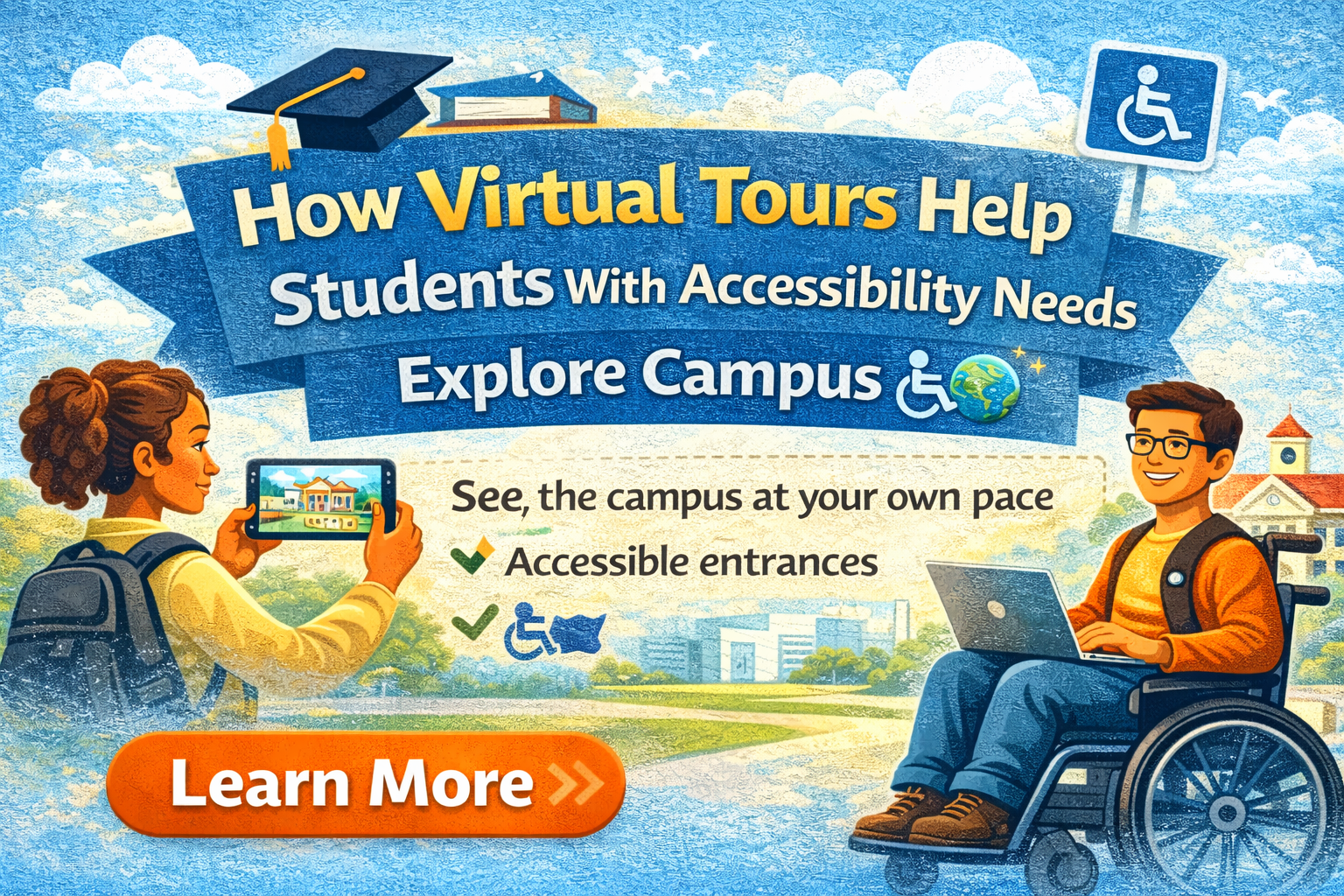
For many prospective students, visiting a campus in person is exciting—walking through buildings, sitting in classrooms, and getting a feel for campus culture.
But for students with accessibility needs, the campus visit experience can feel very different.
Challenges like stairs, long distances, unclear signage, limited parking access, sensory overload, and inaccessible routes can make a traditional campus tour stressful or even impossible. And unfortunately, that creates an unfair barrier at the very beginning of the enrollment journey.
That’s why accessible virtual tours education is becoming a major priority for schools that want to serve all students. With the rise of modern University Virtual Tour Services, institutions can create a more inclusive recruitment experience—allowing students to explore campus in a way that’s comfortable, safe, and personalized.
In this guide, we’ll break down how ADA virtual campus tours support students with accessibility needs, what features matter most, and how universities can build tours that are both compliant and genuinely helpful.
Accessibility is not only about what happens after a student enrolls.
It starts with the first impression.
When a student explores your website, requests information, or schedules a tour, they’re already evaluating:
A university that offers ADA virtual campus tours sends a clear message:
✅ “You belong here.”
✅ “We built this experience with you in mind.”
And that message matters.
In-person campus visits often assume everyone experiences campus the same way.
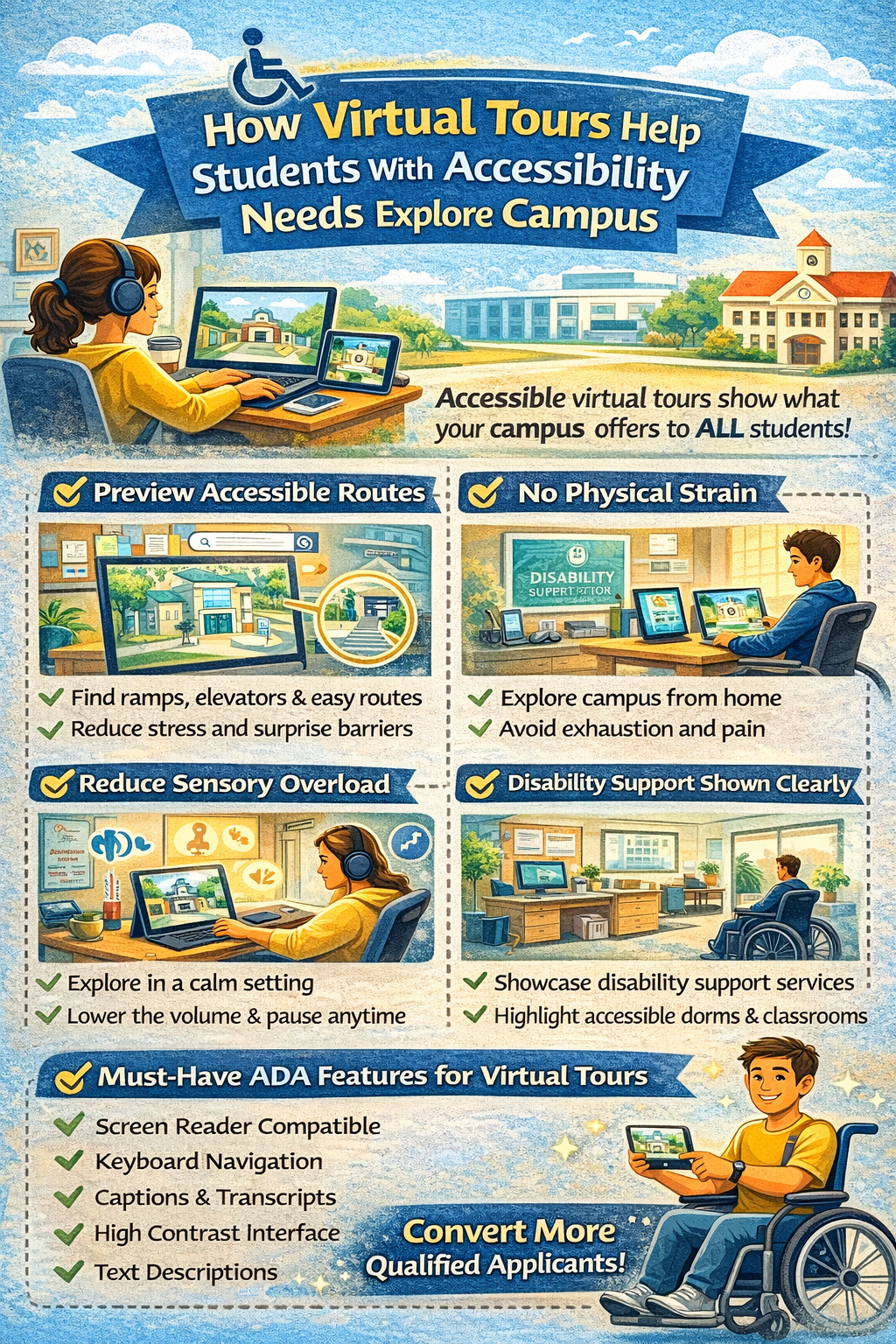
But students may face barriers such as:
Students shouldn’t have to “push through” to learn about their future school.
This is where accessible virtual tours education provides an immediate advantage.
ADA virtual campus tours are online campus tours designed to be accessible for people with disabilities.
These tours can include:
Most importantly, ADA-aligned tours follow accessibility standards that help users:
✅ navigate easily
✅ understand content clearly
✅ explore independently
A good tour is not just “available online.”
It’s built to be usable by everyone.
Virtual tours give prospective students the freedom to explore campus on their terms.
Instead of relying on:
Students can explore:
For accessibility needs, this control changes everything.
One of the biggest stressors for students with disabilities is not knowing what to expect.
Accessible virtual tours help students identify:
This helps students plan and reduces anxiety.
It’s not just “cool tech.”
It’s empowerment.
For a student with mobility limitations or chronic fatigue, even a short in-person tour can be draining.
Virtual tours offer:
That means students can focus on what matters: choosing the right university.
Traditional tours often gloss over accessibility elements—or forget to mention them.
But in ADA virtual campus tours, universities can intentionally highlight:
These features can be added as:
📍 info hotspots
🎥 short videos
🔗 resource links
This gives students information they actually need.
For many students (especially neurodivergent students), crowded campus tours are overwhelming.
Virtual tours allow students to:
This supports a more inclusive decision-making process.
Accessible education decisions often involve:
Virtual tours make it easy to share:
✅ “Here’s the dorm.”
✅ “Here’s the classroom building.”
✅ “Here’s the campus route.”
That’s huge for building confidence and trust.
To serve accessibility needs well, universities should include specific campus locations and features.
Here are the most important areas to showcase:
This is the #1 stop for many prospective students.
Include:
Not all dorms are created equal.
Show:
If possible, include multiple dorm options for students with different needs.
Highlight:
Include details on:
Accessibility includes food access too.
Show:
Transportation plays a massive role.
Include:
Virtual tours can map these options visually.
Accessible campus experience includes mental and emotional support.
Show:
This section is critical if you want your content to rank for accessible virtual tours education and ADA virtual campus tours.
A tour can look great visually but still be unusable if it doesn’t meet accessibility expectations.
Users should be able to navigate without a mouse.
Tour pages should include semantic structure:
Any video should include:
Key images and buttons must have text descriptions.
Text must be readable:
Avoid auto-advancing sections.
Students should control pacing.
Many universities try to DIY tours, but accessibility requirements can be complex.
Professional University Virtual Tour Services can help schools:
✅ create ADA-friendly experiences
✅ optimize for mobile + desktop
✅ improve SEO landing pages
✅ integrate captions + transcripts
✅ add interactive maps and accessible navigation
And because accessibility is a long-term priority, choosing the right service provider matters.
Creating ADA virtual campus tours isn’t only the right thing to do—it’s also great for discoverability.
Why?
Because students are searching for accessibility information directly:
When your tour pages include optimized content, they rank for these searches.
That means more qualified inquiries and better enrollment fit.
Compliance is the baseline.
Inclusion is the goal.
Here are best practices to create tours that truly support accessibility needs:
Avoid jargon and vague phrases.
Include clickable notes like:
Highlight calm areas where students can recharge.
Not just building exteriors—show how students actually enter and move around.
Include testimonials from students with disabilities describing their real experience.
This builds trust fast.
Virtual tours are changing campus recruitment—but their biggest impact may be in accessibility.
When universities invest in accessible virtual tours education, they remove barriers, reduce anxiety, and allow every student to explore campus with dignity and independence.
And when those tours follow the principles of ADA virtual campus tours, they send a clear message:
✅ “We designed this experience for everyone.”
✅ “We take accessibility seriously.”
✅ “You are welcome here.”
With the support of professional University Virtual Tour Services, schools can build virtual experiences that are inclusive, evergreen, and truly helpful—so students with accessibility needs can confidently choose their next campus home.


Compact, ready to go anywhere
Interchangeable lens that’s upgradeable
Dual 1-inch sensors for improved clarity and low light performance
Dynamic range and 6K 360° capture
360° photo resolution at 21MP

8K 360° video recording for ultra-detailed visuals.
4K single-lens mode for traditional wide-angle shots.
Invisible selfie stick effect for drone-like perspectives.
2.5-inch touchscreen with Gorilla Glass protection.
Waterproof up to 33ft for underwater shooting.

360° photo resolution in 23MP
Slim design at 24 mm thick
Built-in image stabilization for smooth video capture.
Internal 19GB storage for photo and video storage.
Wireless connectivity for remote control and sharing.

60MP 360° still images for high-resolution photography.
5.7K 360° video recording at 30fps.
2.25-inch touchscreen for intuitive control.
USB Type-C port for fast charging and data transfer.
MicroSD card slot for expandable storage.
.png)

.png)

Try it free. No credit card required. Instant set-up.







.svg)


.svg)