


.png)


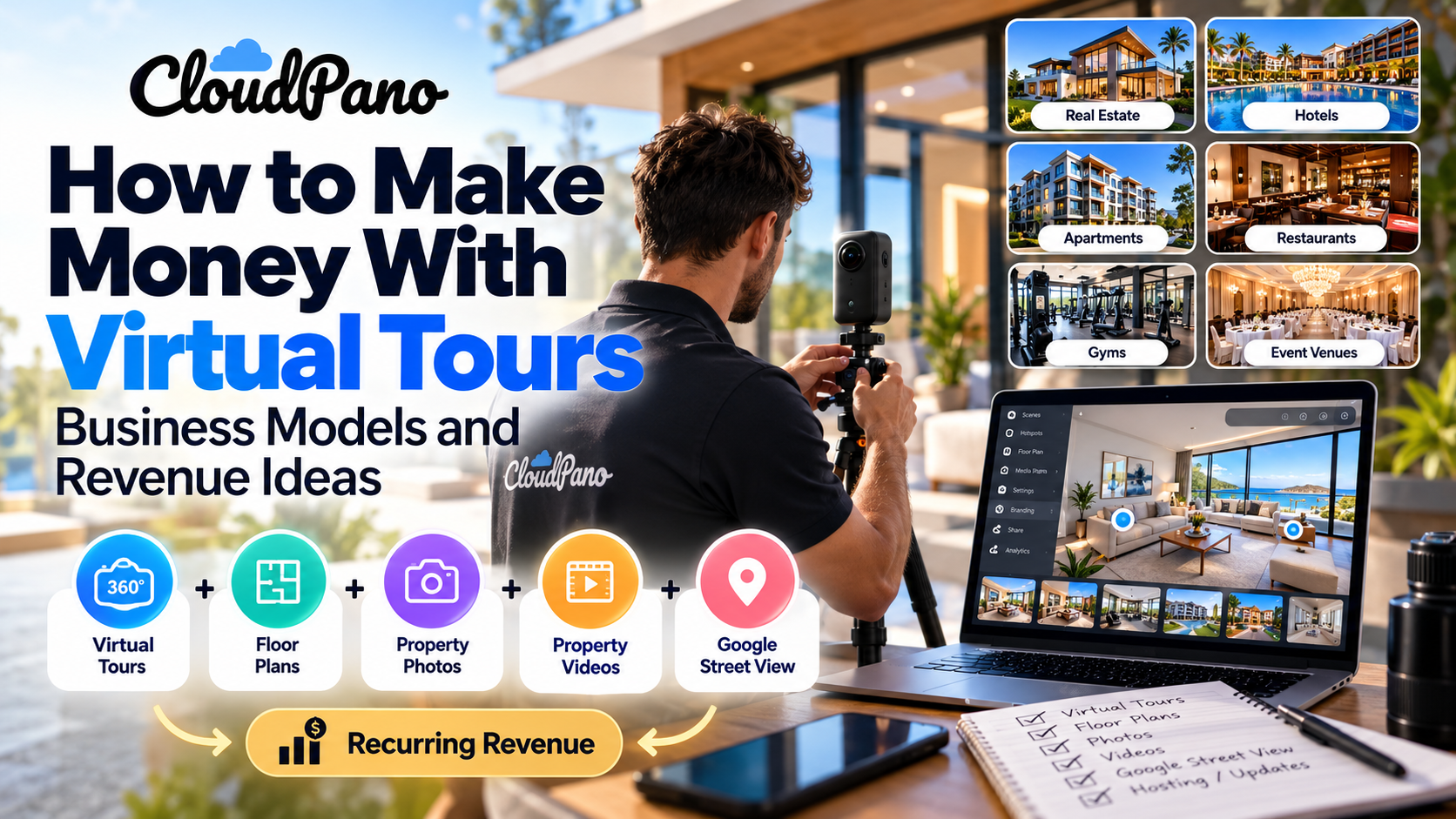
You can make money with virtual tours by charging businesses and property professionals for 360° photography, virtual tour creation, hosting, Google Street View publishing, floor plans, property videos, and tour updates. Virtual tour providers can also build recurring revenue through annual hosting, maintenance plans, white-label services, repeat real estate projects, and multi-location business contracts.
Virtual tours are no longer just a marketing feature for luxury real estate. They have become a service entrepreneurs, photographers, real estate professionals, and digital marketing agencies can turn into a standalone business or an additional source of revenue.
So, how do you make money with virtual tours?
The simplest business model is to charge clients to capture, create, and publish interactive 360° virtual tours of their properties or businesses. However, virtual tour providers can also generate revenue through recurring hosting fees, Google Street View publishing, photography packages, floor plans, video services, white-label services, and ongoing content updates.
The key is to stop thinking of a virtual tour as a single product.
Instead, think of it as the center of a broader visual marketing service.
A provider might create a 360° tour for a real estate agent, add a floor plan and property photos, host the tour online, and charge the agent for future property projects. Another provider might work with hotels, apartment communities, restaurants, gyms, or local businesses and charge recurring fees for hosting and updating their tours.
If you are considering starting a virtual tour business, here are the main business models and revenue opportunities worth exploring.
Yes. Virtual tours can be sold as a professional service to businesses and property professionals that need immersive ways to present physical spaces online.
Potential customers include:
The opportunity exists because these businesses need more than photographs.
Customers increasingly research locations and properties online before visiting them in person. Google, for example, specifically encourages businesses to use photos and virtual tours to help potential customers understand what a location looks like before visiting. According to Google Street View for businesses, businesses can publish indoor and outdoor 360° imagery to help people explore their locations through Google Maps.
That creates an opportunity for entrepreneurs who can capture, build, publish, and maintain professional virtual experiences.
The most straightforward virtual tour business model is project-based pricing.
You create a virtual tour for a client and charge a fixed price for the completed project.
For example, your package might include:
360° photography + virtual tour creation + branding + publishing
The amount you charge can depend on several factors:
A small residential property might require relatively few scenes, while a hotel, apartment complex, university, or commercial building could require dozens or even hundreds.
Instead of competing only on price, build packages around the value you provide.
For example:
Starter Tour
360° capture + interactive tour + shareable link
Professional Tour
360° capture + branded tour + hotspots + website embed
Premium Marketing Package
360° tour + photography + floor plan + video + Google Street View publishing
Packaging services this way can increase your average order value without requiring you to constantly find new customers.
One-time projects generate immediate revenue.
Recurring services can make a virtual tour business more predictable.
One option is charging clients a monthly or annual virtual tour hosting and maintenance fee.
Instead of delivering a tour and ending the relationship, you continue hosting or managing the client's virtual experience.
For example, you might charge for:
This model can be particularly useful for commercial clients.
Imagine creating tours for an apartment management company with 20 communities. The initial capture projects generate project revenue, while ongoing hosting and updates can create recurring revenue.
Over time, a portfolio of recurring clients can reduce your dependence on constantly selling one-off projects.
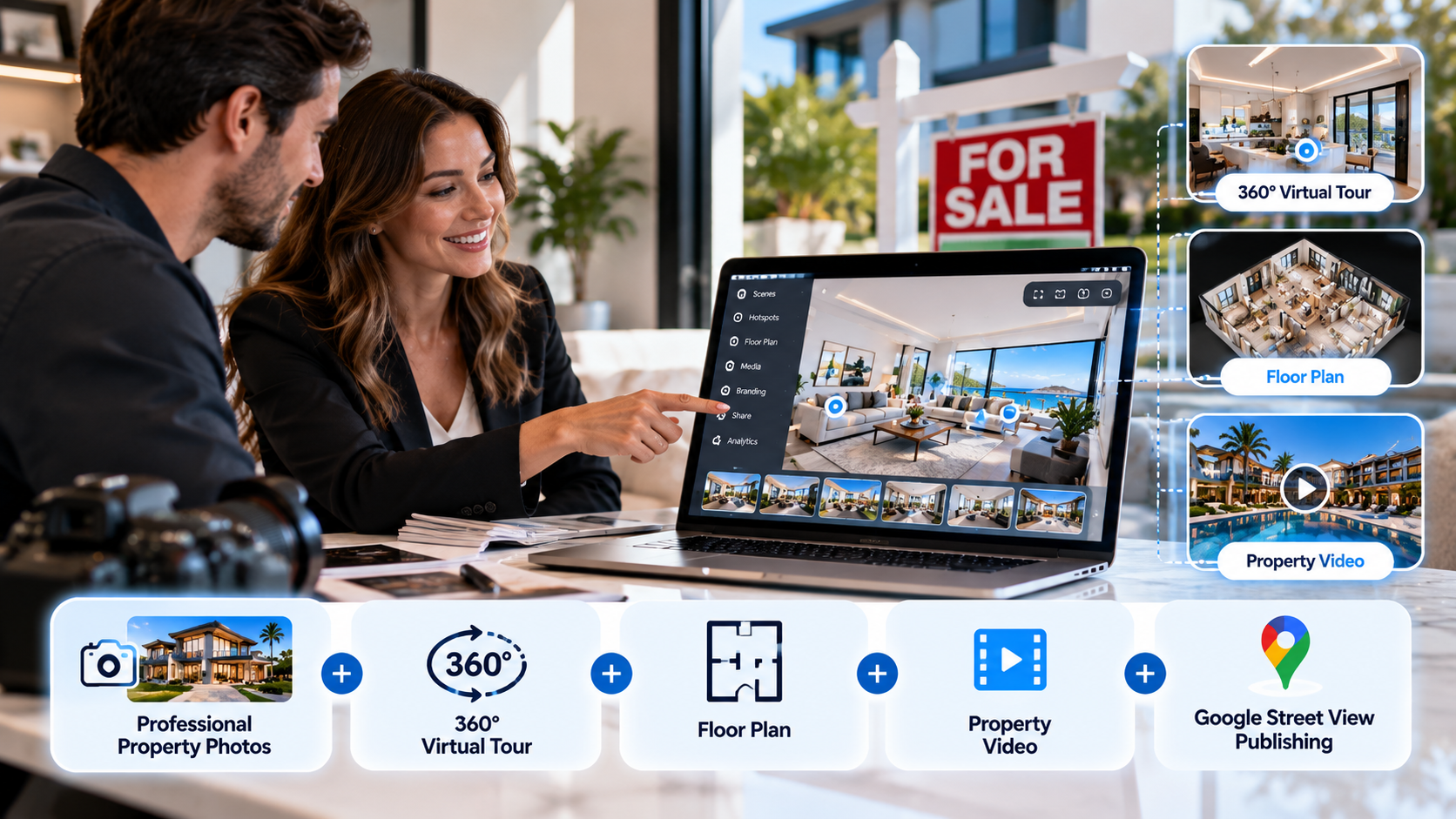
Real estate is one of the most obvious markets for virtual tour services.
Agents need marketing assets for new listings, and virtual tours allow prospective buyers to explore properties remotely.
A provider can offer 360° virtual tours for real estate as either a standalone service or part of a larger listing-media package.
Instead of selling only a tour, consider offering:
Real Estate Marketing Package
360° virtual tour
This approach changes the conversation from:
"Would you like to buy a virtual tour?"
to:
"Would you like us to create the visual marketing package for your listing?"
That is a much broader value proposition.
Better yet, successful real estate agents continuously acquire new listings. If an agent likes your work, one customer can potentially become a source of repeat projects.
Property management can be particularly attractive because one client may control many units or locations.
Instead of creating one tour for one home, you might create tours for:
The resulting tours can be embedded directly into property websites. Platforms such as CloudPano allow businesses to embed 360° virtual tours on property websites, making the tour part of the property's leasing experience.
Property managers may also need updates when units are renovated or amenities change.
That creates opportunities for both large initial projects and ongoing work.
Another potential revenue stream is creating and publishing 360° imagery for local businesses.
Restaurants, hotels, gyms, retail stores, event venues, medical offices, and other physical businesses may want customers to explore their locations through Google Maps.
Google allows businesses to create 360° imagery themselves or work with a professional to capture it. You can learn more through Google's official Street View business resources.
For a virtual tour entrepreneur, this can become an additional service:
Google Street View Package
360° photography
You can also combine Street View publishing with a more interactive branded virtual tour hosted on the client's website.
The two products serve different purposes and can complement each other.
Once a client hires you to capture a property, selling additional visual assets becomes easier.
One valuable add-on is a floor plan.
Floor plans help viewers understand how rooms connect and provide spatial context that photographs alone may not communicate.
Virtual tour providers can therefore create packages that combine:
360° Tour + 2D Floor Plan + 3D Dollhouse
CloudPano, for example, provides virtual tour and floor plan tools for property managers, allowing multiple property-marketing assets to be incorporated into the same workflow.
This is an example of service stacking: instead of acquiring another customer to increase revenue, you increase the value of each existing project.
If you already offer photography, virtual tours can become an upsell.
If you start as a virtual tour provider, photography can become an upsell in the opposite direction.
A client who needs a virtual tour often also needs:
That makes virtual tours a natural fit for a broader real estate media business.
For example, instead of charging for only a virtual tour, you could create three packages:
Bundling services can simplify the buying decision while increasing revenue per client.
Real estate is not the only market.
Almost any business with a physical space that customers care about can potentially benefit from an interactive tour.
Consider targeting:
Hotels and resorts: showcase rooms, pools, restaurants, spas, and event spaces.
Wedding venues: let couples explore ceremony and reception areas remotely.
Restaurants: showcase dining areas, private rooms, patios, and atmosphere.
Gyms: display equipment, training areas, locker rooms, and amenities.
Schools and universities: create virtual campus experiences for prospective students.
Senior living communities: showcase apartments, dining areas, amenities, courtyards, and common spaces.
Retail stores: allow customers to explore the physical shopping environment.
The broader your understanding of virtual tours for businesses, the easier it becomes to identify industries where immersive content solves a real marketing problem.
You do not always have to sell directly to the final customer.
Another business model is becoming a white-label production partner for photographers, agencies, or marketing companies.
Suppose a real estate photography company offers virtual tours but does not want to build the tours internally.
They could send the captured 360° images to you.
You build the tour behind the scenes.
The agency delivers it to its customer under its own brand.
Your client gets an additional service without expanding its internal production team, while you gain recurring production work without having to acquire every end customer yourself.
White-label capabilities are especially useful in this model because the final experience can maintain the client or agency's branding. CloudPano's virtual tour platform, for example, includes options for custom branding and white-label experiences depending on the plan.
One of the most scalable opportunities is working with businesses that operate multiple locations.
Instead of selling one $X project, you might negotiate a contract covering:
Multi-location contracts can significantly reduce customer acquisition costs because you sell once and potentially produce many projects.
A strong strategy is to complete one location first as a pilot.
Once the company sees the finished tour, you can propose expanding the experience across additional locations.
Physical spaces change.
Hotels renovate rooms.
Restaurants remodel.
Apartment communities update amenities.
Retail stores change layouts.
Businesses add products or services.
Instead of treating these changes as problems, virtual tour providers can turn them into recurring revenue opportunities.
Offer annual or seasonal update packages.
For example:
Annual Virtual Tour Refresh
This gives clients a reason to continue working with you after the original project is completed.
The strongest virtual tour businesses do not necessarily depend on a single service.
A single client could generate revenue from several sources.
For example:
Initial project: 360° photography and virtual tour
Upsell: floor plan
Upsell: property video
Add-on: Google Street View publishing
Recurring: annual hosting
Recurring: tour updates
Future revenue: additional properties or locations
This creates a simple business model:
Client Acquisition → Virtual Tour → Add-On Services → Hosting → Updates → Repeat Projects
Instead of constantly searching for new customers, your goal becomes increasing both customer lifetime value and repeat business.
You do not necessarily need a huge equipment budget to begin.
A basic setup generally includes:
Your software is particularly important because it determines how efficiently you can build, brand, publish, host, and share tours.
A platform such as CloudPano virtual tour software lets creators upload 360° images, connect scenes using hotspots, customize tours, share them through a URL, and embed tours on websites.
As your business grows, you can invest in better cameras, photography equipment, drones, video gear, or additional software.
Start locally.
Create a list of businesses or property professionals that would benefit from a virtual tour.
Then choose a niche.
For example:
"I create interactive virtual tours for apartment communities."
is often easier to market than:
"I create virtual tours for everyone."
Create one or two strong demonstration projects and use them as your portfolio.
Then contact potential customers through:
Do not simply explain what a virtual tour is.
Show prospects the experience.
A clickable demonstration often communicates the value much faster than a long sales pitch.
There is no universal income figure for a virtual tour business.
Revenue depends on factors such as your market, pricing, niche, number of projects, operating costs, recurring contracts, and additional services.
A better way to think about earning potential is through a simple revenue model.
For example:
10 virtual tour projects per month × average project price
plus
recurring hosting revenue
plus
floor plan, photography, video, or Street View add-ons
plus
repeat and multi-location projects
As the business grows, increasing the value of each client can be just as important as increasing the total number of customers.
A provider completing 20 low-priced tours is not automatically more profitable than one completing five larger commercial projects with recurring services.
The right model depends on the customers you choose to serve.
Making money with virtual tours is not limited to charging someone once to create a 360° walkthrough.
The larger opportunity is building a business around immersive property and location marketing.
You can generate revenue through:
The most scalable approach is to combine project revenue with recurring services and repeat customers.
Start with one niche. Create an impressive portfolio. Build a repeatable production process. Then add complementary services as demand grows.
If you are ready to explore the tools needed to build and sell professional tours, learn more about virtual tour software for entrepreneurs and start experimenting with your first interactive 360° experience.
Virtual tour businesses typically make money by charging clients for 360° photography and virtual tour creation. They can also earn revenue from hosting, floor plans, property photography, videos, Google Street View publishing, tour updates, white-label services, and multi-location projects.
Virtual tour pricing varies based on property size, number of scenes, location, editing requirements, industry, and included services. Providers can charge per project, per square foot, per scene, or through tiered service packages.
Yes. Providers can create recurring revenue by charging for tour hosting, annual maintenance, updated photography, new scenes, branding changes, and ongoing management of tours for businesses with multiple properties or locations.
Virtual tours can be used by real estate agents, property managers, apartment communities, hotels, resorts, restaurants, retail stores, gyms, senior living communities, schools, universities, event venues, dealerships, and other businesses with physical locations.
Not necessarily. A beginner can start with a compatible 360° camera, tripod or monopod, computer, smartphone, and virtual tour software. Equipment can be upgraded as the business begins generating revenue.


Compact, ready to go anywhere
Interchangeable lens that’s upgradeable
Dual 1-inch sensors for improved clarity and low light performance
Dynamic range and 6K 360° capture
360° photo resolution at 21MP

8K 360° video recording for ultra-detailed visuals.
4K single-lens mode for traditional wide-angle shots.
Invisible selfie stick effect for drone-like perspectives.
2.5-inch touchscreen with Gorilla Glass protection.
Waterproof up to 33ft for underwater shooting.

360° photo resolution in 23MP
Slim design at 24 mm thick
Built-in image stabilization for smooth video capture.
Internal 19GB storage for photo and video storage.
Wireless connectivity for remote control and sharing.

60MP 360° still images for high-resolution photography.
5.7K 360° video recording at 30fps.
2.25-inch touchscreen for intuitive control.
USB Type-C port for fast charging and data transfer.
MicroSD card slot for expandable storage.
.png)

.png)

Try it free. No credit card required. Instant set-up.




.svg)


.svg)