


.png)


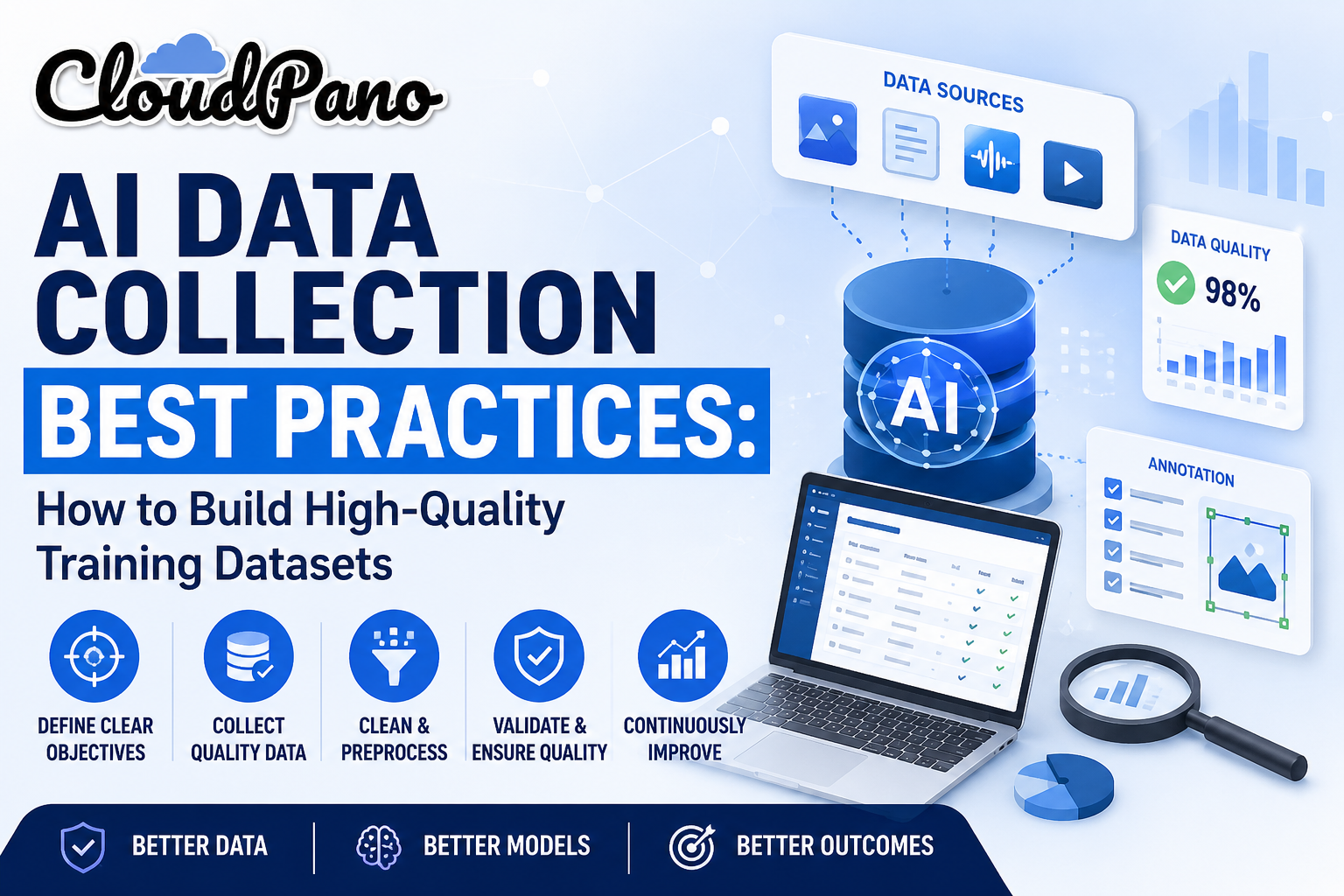
Most model failures trace back to the same root cause: the data, not the architecture. A transformer trained on inconsistent labels or a non-representative sample will underperform no matter how much compute you throw at it. That's why AI data collection best practices have become a core discipline for any team building production AI systems, not a side task handed off to whoever has spare time.
This matters more now than it did three years ago. Models have gotten larger and more capable, which means the data feeding them has become the actual bottleneck. Stanford's AI Index Report has tracked this shift year over year, noting that data availability and quality — not just model scale — increasingly determine performance ceilings (Stanford HAI, AI Index Report).
Poor data quality doesn't just produce a worse model. It produces a model that looks fine in testing and then fails in ways that are expensive to diagnose after deployment.
Google Research documented this pattern directly in a widely cited study of production ML teams, coining the term "data cascades" for the compounding failures that start with a small upstream data issue and surface much later as a customer-facing bug (Sambasivan et al., "Data Cascades in High-Stakes AI," ACM CHI 2021). Their interviews found that data issues were common across teams and consistently under-prioritized relative to model work.

The downstream cost shows up in a few predictable places:
NIST's AI Risk Management Framework treats data quality and provenance as a named risk category precisely because these failures are so consistent across industries (NIST AI RMF 1.0).
AI data collection quality assurance is not a single checkpoint — it's a pipeline with validation built into every stage. Raw data comes in from sensors, scraped sources, user interactions, or manual capture. It gets cleaned, then annotated according to a labeling spec, then reviewed against that spec, then sampled for statistical checks before it's cleared for training.
The teams that do this well treat the labeling spec as a living document, not a one-time instruction sheet. Edge cases get logged, the spec gets updated, and annotators get retrained against the new version — otherwise inconsistency creeps back in every time an unusual example shows up.

Investing in structured data collection pays off in ways that compound over the model's lifecycle:
McKinsey's research on enterprise AI adoption has repeatedly flagged data readiness — not talent or tooling — as the most common blocker to scaling AI initiatives past pilot stage (McKinsey, "The State of AI").


They're the set of processes — defining requirements, sourcing diverse data, building a labeling spec, running QA, and documenting provenance — that produce datasets a model can learn from reliably and that hold up to later audit.
Architecture improvements have diminishing returns if the underlying data is inconsistent or unrepresentative. A better model trained on flawed data still inherits that data's blind spots and biases.
Common methods include inter-annotator agreement scores, sampled human review against the labeling spec, distribution comparisons against production data, and tracking downstream model error rates back to specific data segments.
Data collection is gathering the raw inputs (images, text, sensor readings). Annotation is labeling that raw data according to a defined specification so a model can learn from it. Quality problems can originate at either stage.
It depends on task complexity and how well the data represents real-world conditions; a smaller, well-sampled and well-labeled dataset often outperforms a larger, inconsistent one. Coverage of edge cases matters more than raw volume.
Provenance documentation — source, consent basis, collection date, annotation version — is what makes a dataset auditable. It's increasingly treated as a named risk category in frameworks like NIST's AI RMF, particularly for regulated industries.
For models in active production, periodic re-validation against current production data distributions is standard practice, since real-world conditions drift even when the original dataset was well built.
Synthetic data is useful for oversampling genuinely rare edge cases (rare defects, unusual driving conditions) but generally supplements rather than replaces real-world data collection, since it can't fully capture the noise and variability of production conditions.
The teams shipping reliable AI systems aren't necessarily using better models — they're using better data pipelines. Labeling specs get written down and versioned. Sampling is deliberate, not convenient. QA happens at multiple stages instead of one. Provenance gets documented as data comes in, not reconstructed under audit pressure. None of this is exotic; it's disciplined process applied consistently, and it's the difference between a model that performs in testing and one that holds up in production.
If your team is rebuilding its data collection workflow from scratch or auditing an existing one, our training data services can help you design a pipeline built around labeling accuracy, representative sampling, and audit-ready documentation from day one.


Compact, ready to go anywhere
Interchangeable lens that’s upgradeable
Dual 1-inch sensors for improved clarity and low light performance
Dynamic range and 6K 360° capture
360° photo resolution at 21MP

8K 360° video recording for ultra-detailed visuals.
4K single-lens mode for traditional wide-angle shots.
Invisible selfie stick effect for drone-like perspectives.
2.5-inch touchscreen with Gorilla Glass protection.
Waterproof up to 33ft for underwater shooting.

360° photo resolution in 23MP
Slim design at 24 mm thick
Built-in image stabilization for smooth video capture.
Internal 19GB storage for photo and video storage.
Wireless connectivity for remote control and sharing.

60MP 360° still images for high-resolution photography.
5.7K 360° video recording at 30fps.
2.25-inch touchscreen for intuitive control.
USB Type-C port for fast charging and data transfer.
MicroSD card slot for expandable storage.
.png)

.png)

Try it free. No credit card required. Instant set-up.







.svg)


.svg)