


.png)


Video is no longer optional in real estate marketing. Listings with video generate more engagement, more inquiries, and more showings than those without it. But now there’s a new question agents and media companies are asking:
AI avatar vs traditional real estate video — which actually converts better?
If you can create a professional property walkthrough from a single image…
Clone yourself…
Add a script or voice recording…
And generate a talking presenter automatically…
Why would you still set up lights, cameras, and spend hours filming?
In this evergreen guide, we’ll break down:
Let’s dive in. 🚀
A traditional real estate video typically includes:
These videos often feel polished and cinematic. The agent physically walks through the property and speaks directly to camera.
They are powerful because they feel human and authentic.
But they also come with friction:
Traditional video is effective — but it’s not frictionless.
An AI avatar real estate video uses artificial intelligence to:
Instead of filming live, the AI avatar “walks” the viewer through the property digitally.
No camera crew.
No lighting.
No studio.
No rescheduling.
You can create an entire talking walkthrough in minutes.
This is where the comparison of ai avatar vs traditional real estate video becomes interesting.
Before deciding which converts better, we need to understand what drives conversion.
Real estate video converts because it:
Both AI avatars and traditional videos can accomplish these goals — but they do it differently.
Traditional videos require coordination.
AI avatars require clicks.
When evaluating ai avatar vs traditional real estate video, speed is a massive factor.
With AI:
Consistency increases brand authority.
If an agent posts one polished traditional video per month, that’s great.
If another agent posts three AI-powered walkthroughs per week?
They dominate mindshare.
Conversion isn’t just about quality. It’s about frequency.
Traditional video involves:
AI avatar video dramatically reduces production costs.
That means:
When more listings have video, more listings convert.
Many agents hate being on camera.
They worry about:
AI avatars eliminate that fear.
You can:
Confidence improves delivery.
Delivery improves viewer retention.
Retention improves conversion.
Imagine cloning an entire brokerage team.
With AI avatars, you can:
In the ai avatar vs traditional real estate video debate, scalability heavily favors AI.
Traditional filming 20 agents?
That’s a scheduling nightmare.
AI cloning 20 agents?
That’s operational efficiency.
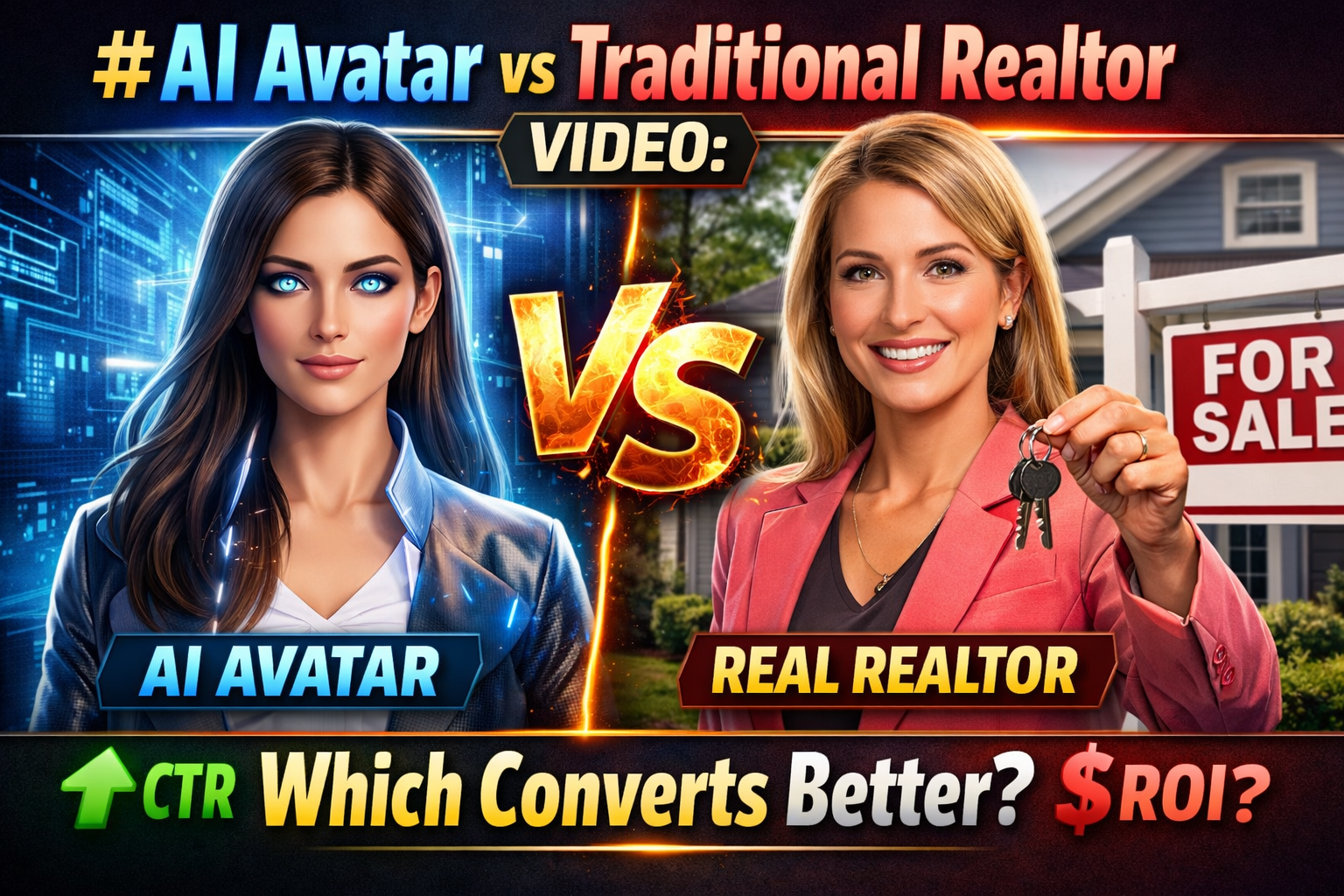
To be fair, traditional video has strengths.
A live human walking through a property can feel deeply authentic.
Facial expressions.
Body language.
Natural movement.
High-end luxury listings often benefit from cinematic storytelling.
Million-dollar listings often demand cinematic production.
Drone sweeps.
Sunset lighting.
Slow-motion transitions.
Traditional video shines in prestige positioning.
Here’s where data matters.
AI avatar videos often:
Traditional videos sometimes lose viewers if:
Clarity drives conversion.
AI ensures clarity every time.
The real answer may not be either/or.
The most powerful strategy is:
This creates omnipresence.
And omnipresence converts.
AI avatar videos are not just listing tools.
They can be used for:
Traditional videos are harder to repurpose quickly.
AI content is modular and flexible.
That increases ROI.
What converts better?
If we measure by:
AI avatars often outperform traditional methods in practical business terms.
However, for luxury branding and prestige positioning, traditional video still carries weight.
The smart agents combine both.
From a business model standpoint:
AI video allows:
Traditional video often operates per listing.
Subscription models create predictable revenue.
Predictable revenue fuels growth.
Time matters in real estate.
If you can:
You win the speed game.
Speed means:
In competitive markets, speed alone can improve conversion rates.
Technology rarely replaces human connection.
It enhances it.
AI avatars are not removing agents from the equation.
They are amplifying them.
The agents who embrace AI will:
That’s a conversion advantage.
The honest answer:
For high-end cinematic branding → Traditional video wins.
For scalability, frequency, cost efficiency, and operational leverage → AI avatars win.
When evaluating ai avatar vs traditional real estate video, the question isn’t just about aesthetics.
It’s about:
The agents who dominate will not choose one.
They will use both strategically.
Video converts. That’s not up for debate.
But the method of producing video is evolving.
AI avatars offer:
Traditional realtor videos offer:
The future belongs to agents who combine automation with authenticity.
If you want predictable growth, scalable marketing, and higher listing conversion rates, understanding the difference between ai avatar vs traditional real estate video is no longer optional.
It’s strategic.
And the agents who adopt early?
They don’t just compete.
They dominate. 🚀


Compact, ready to go anywhere
Interchangeable lens that’s upgradeable
Dual 1-inch sensors for improved clarity and low light performance
Dynamic range and 6K 360° capture
360° photo resolution at 21MP

8K 360° video recording for ultra-detailed visuals.
4K single-lens mode for traditional wide-angle shots.
Invisible selfie stick effect for drone-like perspectives.
2.5-inch touchscreen with Gorilla Glass protection.
Waterproof up to 33ft for underwater shooting.

360° photo resolution in 23MP
Slim design at 24 mm thick
Built-in image stabilization for smooth video capture.
Internal 19GB storage for photo and video storage.
Wireless connectivity for remote control and sharing.

60MP 360° still images for high-resolution photography.
5.7K 360° video recording at 30fps.
2.25-inch touchscreen for intuitive control.
USB Type-C port for fast charging and data transfer.
MicroSD card slot for expandable storage.
.png)

.png)

Try it free. No credit card required. Instant set-up.





.svg)


.svg)