


.png)


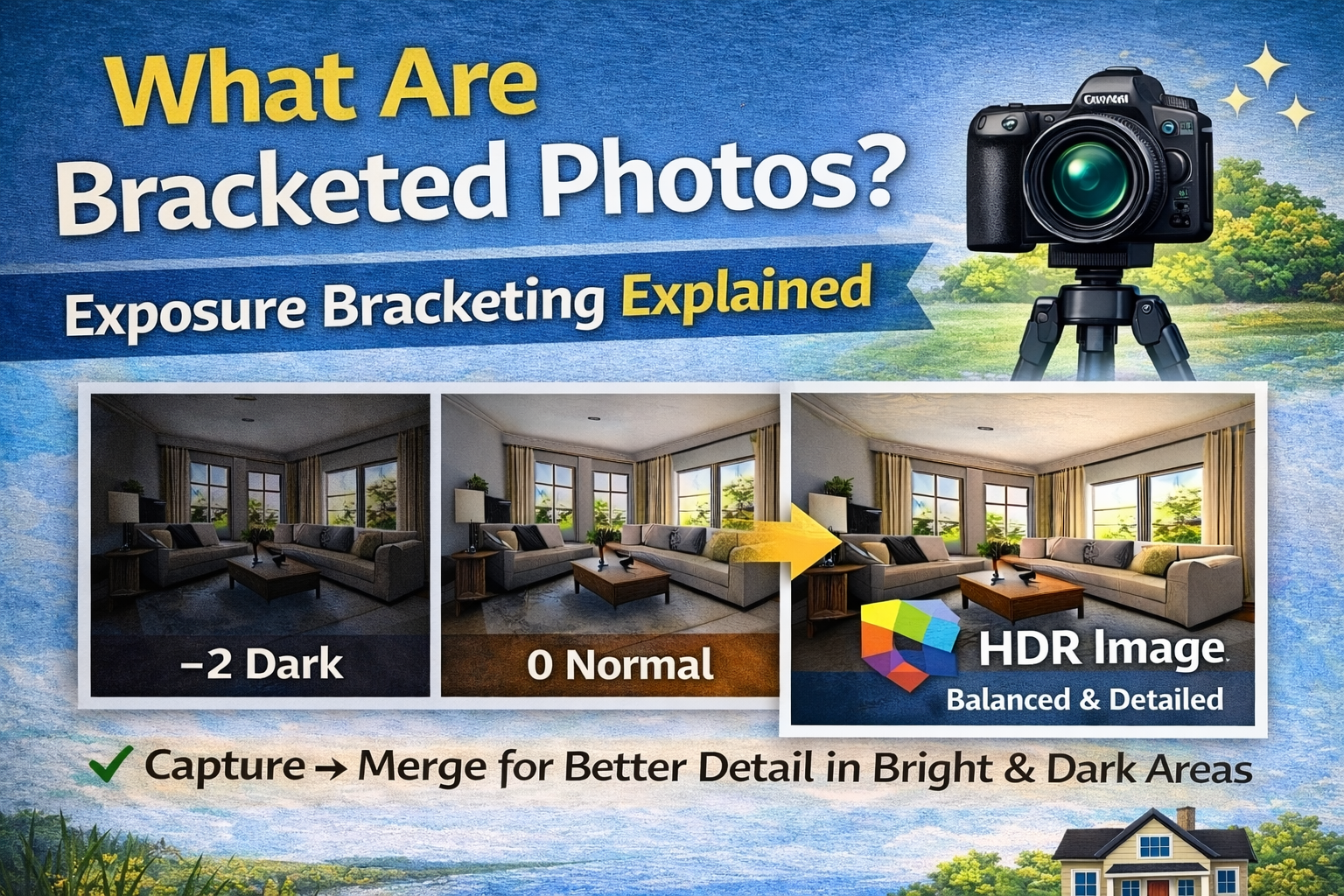
Understanding Bracketed Photos, Exposure Bracketing, and Bracketing Photography Meaning
If you’ve ever taken a photo and felt like it didn’t quite match what your eyes saw, you’re not alone. Cameras sometimes struggle with scenes that have both bright and dark areas. That’s where bracketed photos come in.
In this guide, we’ll explain the bracketing photography meaning in simple terms, break down how exposure bracketing works, and show why bracketed photos are such an important tool for photographers of all skill levels.
Whether you shoot real estate, landscapes, interiors, or travel, understanding bracketing can instantly improve your results. Let’s dive in. 🚀
Bracketed photos are a series of images taken of the same scene at different exposure levels.
Instead of taking just one picture, you take multiple:
📷 One darker image
📷 One normal exposure
📷 One brighter image
These are later combined or used selectively to create a final image with better detail in highlights and shadows.
So the bracketing photography meaning is simple:
👉 It’s a technique where photographers capture multiple exposures of the same scene to expand the amount of light and detail recorded.
Your eyes are amazing at adjusting to light. You can see detail outside a window and inside a dim room at the same time.
Cameras, however, have limited dynamic range. They often must choose between:
❌ Keeping window detail but making interiors too dark
❌ Brightening interiors but blowing out windows
Exposure bracketing solves this problem by capturing multiple exposures, so no important detail is lost.
At its core, exposure bracketing means taking several photos while changing only the exposure.
Here’s what usually changes:
For example, you might shoot:
🌑 A dark exposure (-2 stops)
⚖ A balanced exposure (0)
🌕 A bright exposure (+2 stops)
These bracketed photos give you a range of lighting information to work with during editing.

Let’s simplify the bracketing photography meaning even more.
Imagine you’re trying to capture a sunset inside a house:
If you expose for the sky, the room is too dark.
If you expose for the room, the sky looks washed out.
Bracketing means you take both versions — and more — so you can later create a balanced image that looks closer to real life.
It’s like giving your camera extra chances to get the exposure right.
Bracketed photos are especially helpful in scenes with high contrast between bright and dark areas.
Here are common situations:
🏠 Real estate interiors with bright windows
🌄 Landscapes with dramatic skies
🏢 Architectural photography
🌅 Sunrises and sunsets
🛋 Interior design shoots
Any time a scene has both deep shadows and bright highlights, exposure bracketing is your friend.
Most modern cameras have a built-in bracketing feature.
Here’s how photographers typically use it:
1️⃣ Set your camera to bracketing mode
2️⃣ Choose how many photos to take (usually 3–5)
3️⃣ Decide how far apart the exposures should be
4️⃣ Press the shutter once — the camera captures multiple exposures automatically
You now have a set of bracketed photos ready for editing or blending.
Once you’ve captured your bracketed photos, you have options.
You can combine them into a single image using HDR (High Dynamic Range) software. This creates a balanced photo that shows detail in both highlights and shadows.
Sometimes, you don’t merge. You simply pick the exposure that looks best for the scene.
Either way, exposure bracketing gives you flexibility that a single photo can’t provide.
Understanding the bracketing photography meaning is important because it helps you:
✔ Avoid blown-out highlights
✔ Preserve shadow detail
✔ Create more realistic images
✔ Reduce the risk of unusable shots
Bracketing increases your chances of getting a great photo — especially in tricky lighting.
Why not just take one perfectly exposed photo?
Because in many scenes, there isn’t one perfect exposure. A single image may lose detail in bright or dark areas.
Bracketed photos capture a wider range of light, giving you more control later.
Think of it as insurance for your photography.
While exposure bracketing is the most common, there are other forms of bracketing too.
Different brightness levels (most popular)
Different focus points for sharper depth of field
Different color temperature settings
But when people talk about bracketing photography meaning, they usually mean exposure bracketing.
It depends on the scene.
📸 3 exposures – Mild contrast
📸 5 exposures – Standard high-contrast scenes
📸 7+ exposures – Extreme lighting differences
More bracketed photos provide more data but also increase processing time.
If you want cleaner bracketed shots, follow these tips:
📌 Use a tripod to keep images aligned
📌 Keep aperture and ISO constant
📌 Let shutter speed change the exposure
📌 Avoid moving subjects when possible
Stable scenes work best for exposure bracketing.
Even though bracketing is powerful, there are some pitfalls.
People, pets, or curtains can cause ghosting when merging.
Too much blending can make photos look unrealistic.
Misaligned bracketed photos are harder to merge cleanly.
Knowing these helps you get better results from your bracketing photography workflow.
Real estate photographers rely heavily on bracketed photos.
Why?
✨ Interiors often have bright windows and dark rooms
✨ Clients expect natural-looking light
✨ Balanced images help listings stand out
Without exposure bracketing, it’s very difficult to make interiors look both bright and realistic.
Even smartphones use exposure bracketing behind the scenes. Many phones automatically take multiple exposures and blend them into one HDR image.
So even if you’re not doing it manually yet, you’re already benefiting from bracketing photography techniques.
To sum up the bracketing photography meaning:
It’s about capturing multiple versions of a scene so you don’t lose detail in challenging lighting.
Bracketed photos give photographers:
📸 More flexibility
🎨 Better editing options
💡 Improved highlight and shadow detail
🏆 Higher-quality final images
It’s one of the simplest ways to dramatically improve your photography results.
Understanding what bracketed photos are and how exposure bracketing works can transform your photography.
The next time you face tricky lighting, remember:
👉 Take multiple exposures
👉 Protect your highlights
👉 Preserve your shadows
That’s the true bracketing photography meaning — giving your camera the range your eyes naturally have.
Once you start using bracketed photos, you’ll wonder how you ever shot without them. 📷✨


Compact, ready to go anywhere
Interchangeable lens that’s upgradeable
Dual 1-inch sensors for improved clarity and low light performance
Dynamic range and 6K 360° capture
360° photo resolution at 21MP

8K 360° video recording for ultra-detailed visuals.
4K single-lens mode for traditional wide-angle shots.
Invisible selfie stick effect for drone-like perspectives.
2.5-inch touchscreen with Gorilla Glass protection.
Waterproof up to 33ft for underwater shooting.

360° photo resolution in 23MP
Slim design at 24 mm thick
Built-in image stabilization for smooth video capture.
Internal 19GB storage for photo and video storage.
Wireless connectivity for remote control and sharing.

60MP 360° still images for high-resolution photography.
5.7K 360° video recording at 30fps.
2.25-inch touchscreen for intuitive control.
USB Type-C port for fast charging and data transfer.
MicroSD card slot for expandable storage.
.png)

.png)

Try it free. No credit card required. Instant set-up.







.svg)


.svg)