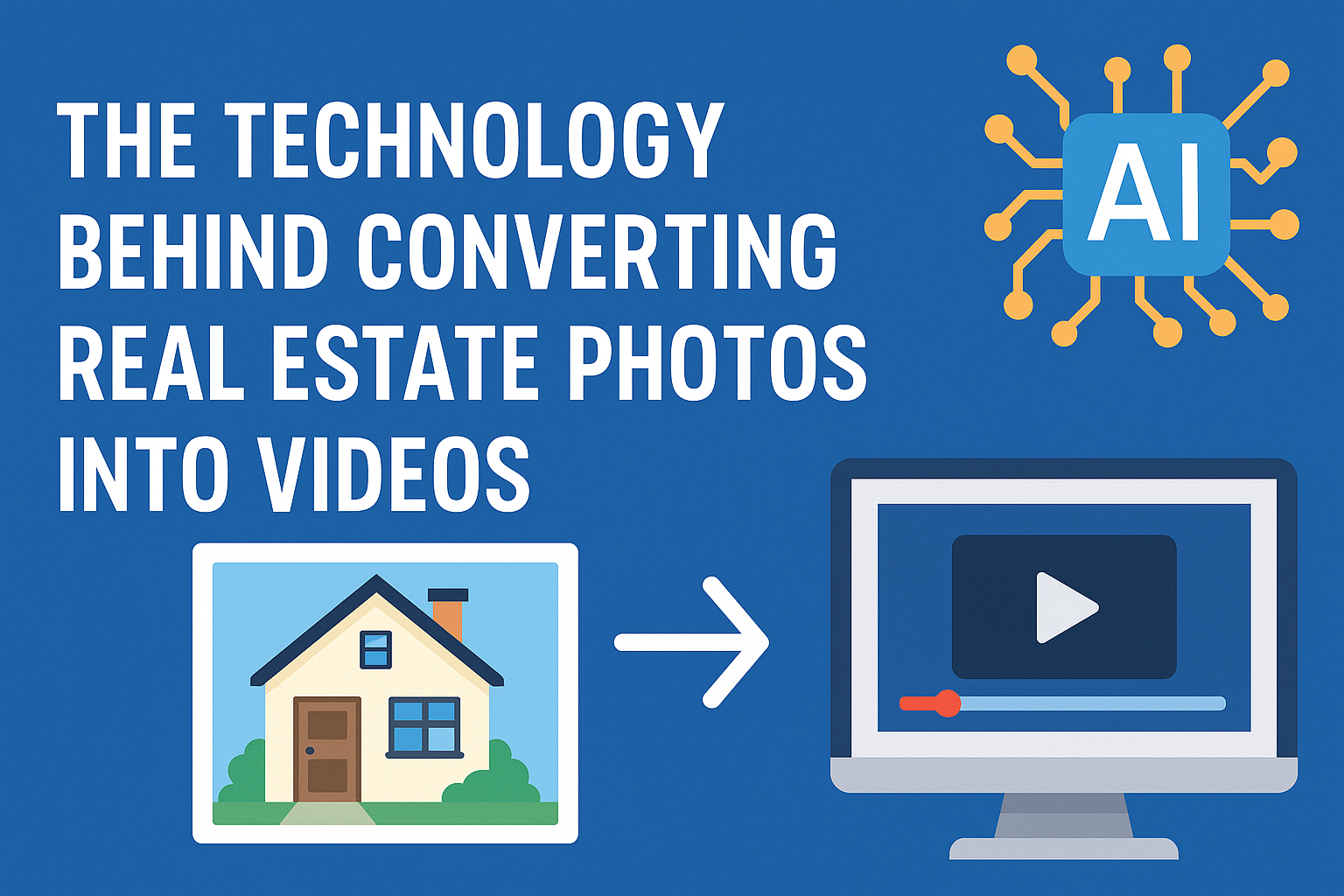
The Technology Behind Converting Real Estate Photos into Videos

Cloudpano
June 30, 2025
•
5 min read
Share this post

🤖 The Technology Behind Converting Real Estate Photos into Videos

The real estate marketing landscape in 2025 is being reshaped by artificial intelligence—particularly through the automation of listing videos from static images. Gone are the days of manually stitching together slideshows or hiring expensive videographers. Instead, advanced AI platforms now create cinematic, branded videos from property photos—automatically. 📸🎞️🏡

In this guide, we’ll break down the core technologies, AI workflows, and top platforms that are transforming how real estate professionals engage buyers.

📸 From Still Images to Motion: Why Video Matters in Real Estate

  • Listings with video generate up to 403% more inquiries 📈
  • Agents using video increase brand recall and time-on-page ⏳
  • Video walkthroughs provide an emotional, immersive buyer experience 🏠❤️

See the strategy: Marketing Gold: How to Turn Real Estate Photos Into Videos That Sell

🧠 The Core AI Technologies Powering Photo-to-Video Conversion

1. Computer Vision

AI scans and understands photo elements (like rooms, furnishings, layout) to determine how to animate transitions intelligently. 🧠🔍

2. Natural Language Processing (NLP)

Used to auto-generate property descriptions, captions, and even voiceovers from image context. 🗣️💬

Learn more: How to Add Voiceovers and Captions Automatically

3. Machine Learning Models

These models improve video flow and sequencing over time, learning from user feedback and engagement. 📊

🔧 How the Workflow Works

✅ Step 1: Upload Your Real Estate Photos

Just drag and drop them into a platform like PhotoAIVideo.com 📂📷

🎬 Step 2: Select a Template

Choose from cinematic, vertical, or branded templates. Add your logo, colors, and font.

🎵 Step 3: Add Audio and Text

Voiceovers, captions, and royalty-free music are added with AI assistance.

🚀 Step 4: Generate & Download

Click "Generate" and get your MP4 in 60 seconds or less. Share to MLS, YouTube, email, or social media.

Go deeper: The Ultimate Workflow: How to Convert Real Estate Photos Into Engaging Videos With Ease

🛠️ Top AI Platforms for Photo-to-Video in Real Estate

  • PhotoAIVideo.com – 🔥 Fastest generation time, white-label ready
  • Animoto – Good for basic slideshows
  • Pictory – Focuses on text-to-video
  • Canva – Great for design-heavy edits, not built for automation

Compare them: Top AI-Powered Services for Real Estate Photo-to-Video Marketing in 2025

📲 Use Cases for Agents, Creators, and Teams

  • Real estate agents who want to enhance listings fast 🏡
  • Media creators building monthly content plans 🗓️
  • Marketing agencies scaling branded videos across teams 🌍

Start small: Create AI Videos From Real Estate Photos for Free: Best Tools to Try in 2025

🧩 Integrate Into Your Tech Stack

Most leading tools integrate with:

  • Google Drive 📂
  • Zapier ⚙️
  • CRMs and email tools 💌

Learn how: Automating Your Weekly Video Content Plan With AI

📈 What’s Next for AI and Real Estate Video?

Expect:

  • 3D virtual walkthroughs from flat images 🌀
  • Multilingual auto-dubbing 🗣️🌎
  • Smarter scene detection + auto-feature overlays ⚡

Stay ahead: 2025 Review: Best Photo-to-Video AI Tools for Real Estate Marketing

🚪 Final Thoughts: Step Into the Future

Whether you're an agent looking to close more deals, or a media creator scaling production, AI-powered video creation is the next essential skill.

✅ It’s faster✅ It’s scalable✅ It’s affordable

Ready to try it? Start here 👉 PhotoAIVideo.com

‍

Share this post
Cloudpano

Choose The Right 360° Camera

Insta360 ONE RS 1-Inch 360 Edition

  • Compact, ready to go anywhere

  • Interchangeable lens that’s upgradeable

  • Dual 1-inch sensors for improved clarity and low light performance

  • Dynamic range and 6K 360° capture

  • 360° photo resolution at 21MP

Learn More

Insta360 X4

  • 8K 360° video recording for ultra-detailed visuals.

  • 4K single-lens mode for traditional wide-angle shots.

  • Invisible selfie stick effect for drone-like perspectives.

  • 2.5-inch touchscreen with Gorilla Glass protection.

  • Waterproof up to 33ft for underwater shooting.

Learn More

Ricoh Theta Z1

  • 360° photo resolution in 23MP

  • Slim design at 24 mm thick

  • Built-in image stabilization for smooth video capture.

  • Internal 19GB storage for photo and video storage.

  • Wireless connectivity for remote control and sharing.

Learn More

Ricoh Theta X

  • 60MP 360° still images for high-resolution photography.

  • 5.7K 360° video recording at 30fps.

  • 2.25-inch touchscreen for intuitive control.

  • USB Type-C port for fast charging and data transfer.

  • MicroSD card slot for expandable storage.

Learn More
Property Marketing
Allows potential buyers to explore properties in detail from anywhere, enhancing the real estate marketing process.
Automotive Spins
Create an interactive virtual showroom and engage affluent digital buyers with live 360º video calls, all through the CloudPano mobile app for a complete automotive sales solution.
Interactive Floor Plans
Create 2D and 3D floor plans with measurements in 4 minutes or less, all from your phone. Download the Floor Plan Scanner app and get your first scan free.

360 Virtual Tours With CloudPano.com. Get Started Today.

Try it free. No credit card required. Instant set-up.
Try it free
Latest posts

See our other posts

Interviews, tips, guides, industry best practices, and news.

How to Deliver Egocentric Data in LeRobotDataset Format

Google archived the RLDS repo in November 2025, and LeRobotDataset v3.0 is now the default format for robot learning on Hugging Face. This guide explains the v3.0 layout, how to map egocentric video and hand pose into it, and what to check before delivery.
Read post

RLDS Is Archived: What Format Should You Ship Robot Data In Now?

Google archived the RLDS GitHub repo in November 2025, and robotics teams now need a new default for shipping episodes. This guide explains what archiving changes, which format fits which training stack, and how to move RLDS format data to LeRobotDataset.
Read post

Human vs. Automated Evals: Which Should You Use for LLM Testing?

Human and automated evaluations play essential roles in measuring the accuracy, safety, and quality of large language model (LLM) outputs. This guide explores the key differences between human vs automated evals, including their strengths, limitations, costs, and scalability. Learn when to use human reviewers, when automated testing works best, and how combining both approaches creates a more reliable LLM evaluation strategy.
Read post