


.png)


Drones have become one of the most important tools on modern construction sites. Once considered a futuristic luxury, aerial technology is now a standard part of surveying, inspections, progress tracking, and project reporting. Construction teams are using drones to reduce manual labor, improve accuracy, and speed up nearly every operational workflow.
But here’s the challenge: flying a drone is not the same as using a drone professionally.
To capture accurate survey data, execute inspections safely, and produce actionable reports, operators need structured, step-by-step training.
This guide breaks down what comprehensive drone training looks like—from safety and flight fundamentals to advanced mapping, inspections, and reporting. It also highlights how the same training supports growth opportunities in drone services for inspections, the drone roof inspections business, and even drone services for real estate and the real estate drone photography business.
If your goal is to run more efficient construction projects—or expand into profitable aerial service lines—this guide is your roadmap.
Modern construction demands precision and speed. Drones help teams:
The shift from manual surveying and risky site inspections to aerial technology has enabled companies to save time, money, and manpower—while improving safety.
As demand grows, companies are investing in training their staff to operate drones professionally. Structured training ensures safe flights, regulatory compliance, and high-quality deliverables.
Drone surveying is not a replacement for every traditional method, but it dramatically improves speed and scalability.
The ROI becomes clear quickly. With trained operators, construction teams complete more work with fewer resources—while producing better results.
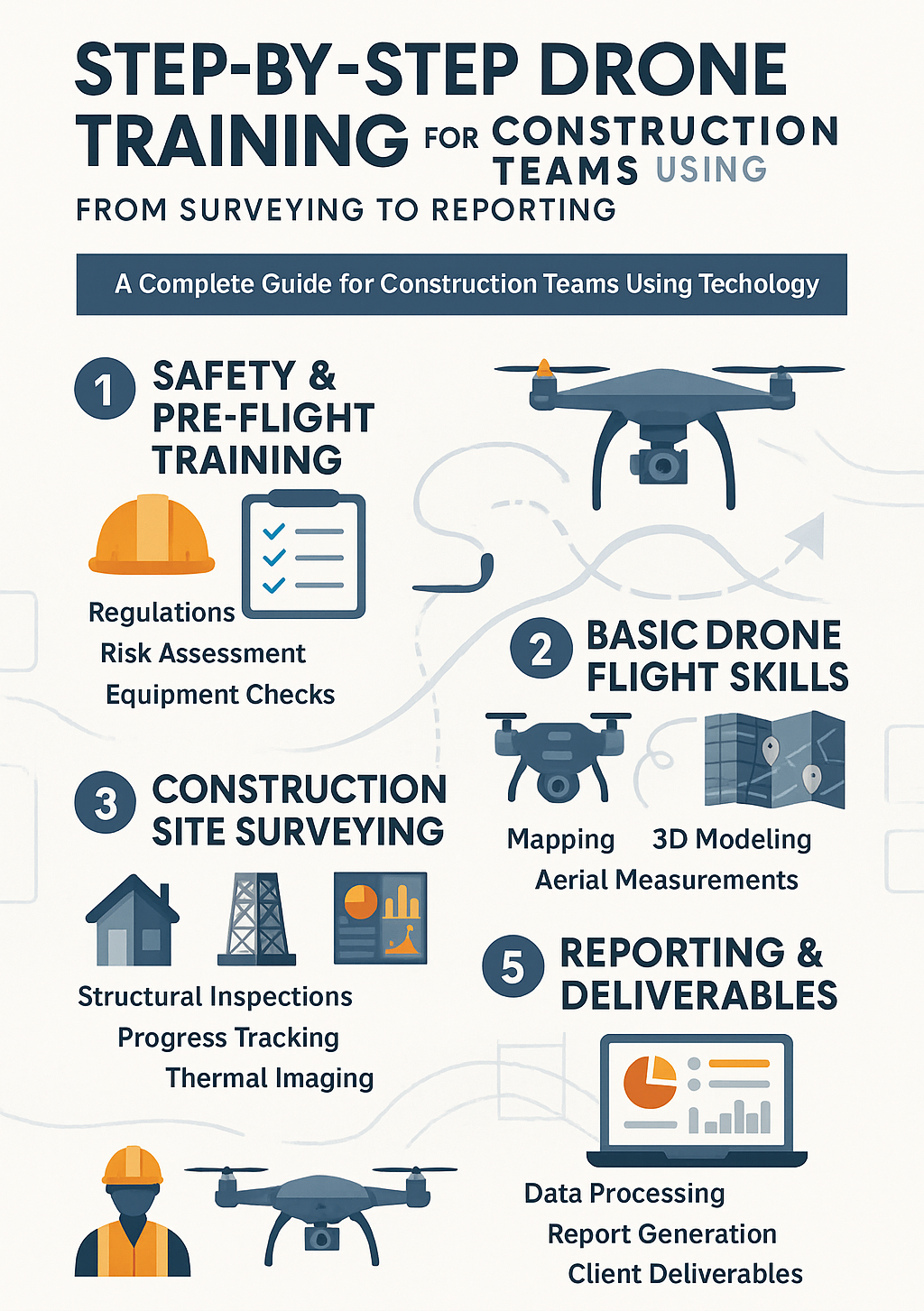
A strong drone training program is structured, practical, and designed to build competency in real-world construction environments. Below is a complete breakdown of what step-by-step training should include.
Before touching the controls, operators must understand:
This foundation ensures pilots fly legally and safely—critical for any drone services for inspections or commercial operation.
Hands-on flight training builds confidence and muscle memory. Operators learn:
This step prepares pilots for more advanced tasks like mapping, elevation surveying, and roof inspections—all essential skills for a drone roof inspections business.
This is where drone training becomes a powerful construction asset.
Operators learn how to:
These mapping skills directly impact project planning, grading, excavation, and engineering workflows.
Drone training teaches professionals to capture repeatable, consistent, measurable site data, including:
These visuals support better communication across teams and stakeholders.
Drones dramatically improve inspection workflows. Training covers:
These modules help professionals expand into drone services for inspections or launch a drone roof inspections business—two of the highest-demand niches in construction and insurance.
Not all drone operators know how to capture usable visuals. Training teaches:
These skills overlap directly with the real estate drone photography business, making training valuable across multiple industries.
Raw images are just data—training turns them into insights.
Operators learn how to:
Accurate reporting is essential for engineering teams, contractors, roofing companies, and real estate developers.
While construction teams are the primary audience, drone training benefits a wide range of professionals:
Drone training creates multiple revenue paths across commercial industries.
Here are the core tools new pilots learn to use in training:
Training helps operators choose the right combination for their specific projects.
Training pays for itself quickly. Construction companies using drones see:
No more sending teams to manually measure, climb roofs, or walk steep terrain.
Mapping that once took 4 hours now takes 20 minutes.
Drones reduce the need for ladder climbs, hazardous work, and manual inspections.
Site managers receive accurate updates weekly or even daily.
Companies can offer:
Some construction companies even spin off their own drone roof inspections business as an additional service line.
Construction companies that invest in drone training gain the power to work faster, safer, and smarter. A structured, step-by-step program equips teams to handle surveying, inspections, progress tracking, and reporting—while opening new revenue opportunities across drone services for inspections, the drone roof inspections business, and drone services for real estate.


Compact, ready to go anywhere
Interchangeable lens that’s upgradeable
Dual 1-inch sensors for improved clarity and low light performance
Dynamic range and 6K 360° capture
360° photo resolution at 21MP

8K 360° video recording for ultra-detailed visuals.
4K single-lens mode for traditional wide-angle shots.
Invisible selfie stick effect for drone-like perspectives.
2.5-inch touchscreen with Gorilla Glass protection.
Waterproof up to 33ft for underwater shooting.

360° photo resolution in 23MP
Slim design at 24 mm thick
Built-in image stabilization for smooth video capture.
Internal 19GB storage for photo and video storage.
Wireless connectivity for remote control and sharing.

60MP 360° still images for high-resolution photography.
5.7K 360° video recording at 30fps.
2.25-inch touchscreen for intuitive control.
USB Type-C port for fast charging and data transfer.
MicroSD card slot for expandable storage.
.png)

.png)

Try it free. No credit card required. Instant set-up.







.svg)


.svg)