Flying a Drone? Part 107 & Insurance Compliance Made Simple

Cloudpano
December 11, 2025
5 min read
Share this post

Flying a Drone? Part 107 & Insurance Compliance Made Simple 🚀

Introduction

Drones aren’t just cool gadgets anymore—they’re powerful business tools. Whether you’re capturing weddings, inspecting real estate, or offering 360° virtual tours with CloudPano, operating a drone means following strict FAA rules and protecting yourself with the right insurance coverage. To learn more, watch this FAA Part 107 and drone business compliance guide on YouTube.

In this guide, you’ll learn:
✅ Why Part 107 compliance is non-negotiable.
✅ The two types of insurance every drone pilot needs.
✅ How forming an LLC keeps your personal assets safe.
✅ Practical tips to avoid costly mistakes before your first flight.

Let’s break it all down in plain English (with emojis to keep things fun).

1. Why Drone Compliance Matters📜

Flying drones for fun is one thing. But the moment you accept money for your services—photos, videos, inspections, or virtual tours—you’re a commercial drone operator.

That means you need:

  • An FAA Part 107 license 🎓
  • Proper insurance coverage 🛡️
  • A business structure (LLC) to separate your work from your personal assets 🏢

Failing to comply can result in:

  • Fines up to $32,000 😬
  • Seizure of your drone ✋
  • Losing client trust permanently

👉 Think of compliance as your ticket to bigger contracts. Large enterprises, government projects, and real estate companies will only work with compliant drone pilots.

2. Step 1 – Forming an LLC 🏢

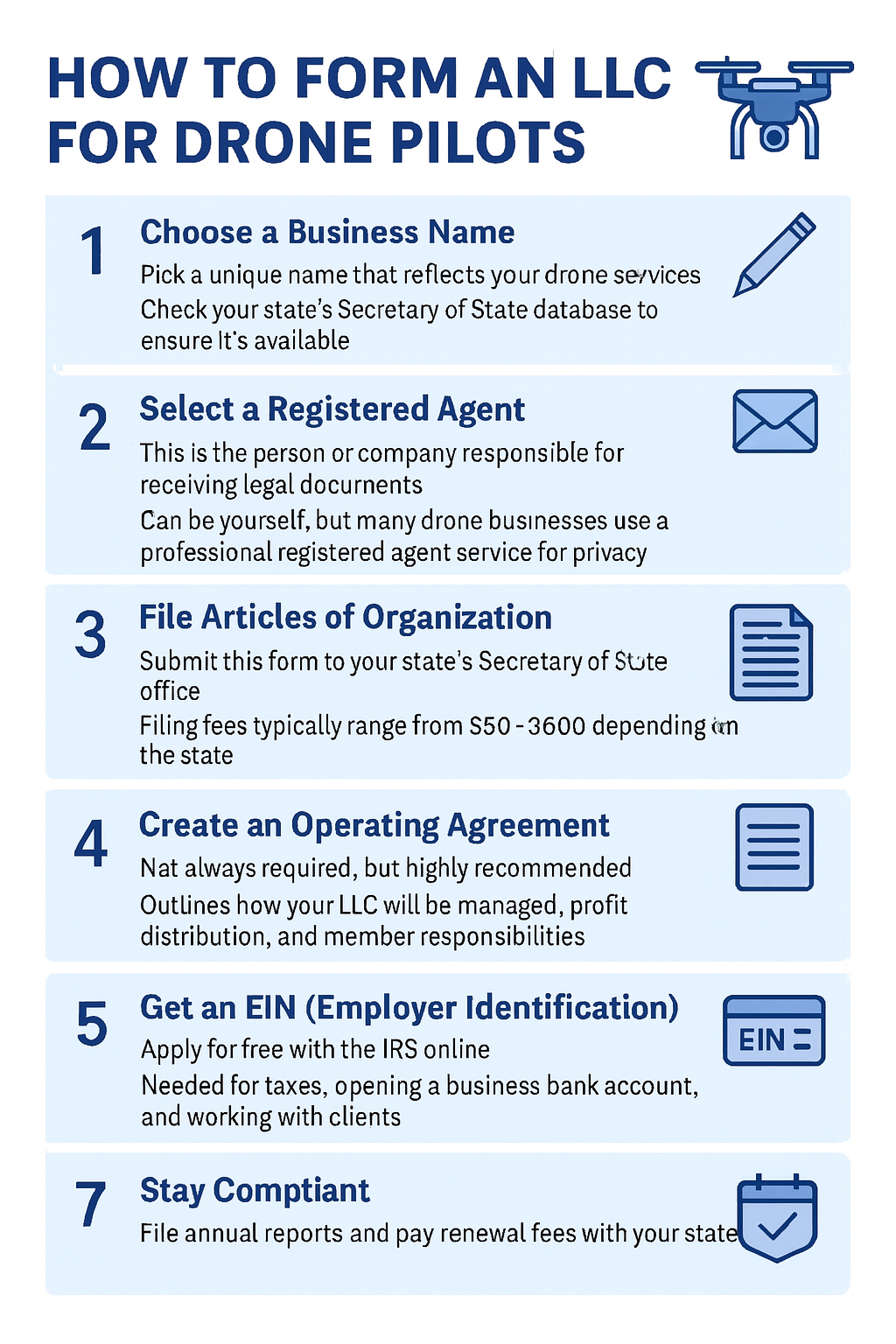
The first thing every drone pilot should do is form a Limited Liability Company (LLC).

Why it matters:

If something goes wrong (e.g., your drone crashes into a wedding cake 🎂 or scratches a car 🚗), your LLC is liable—not you personally.

Benefits of an LLC for drone pilots:

  • Protects your home, car, and savings from lawsuits.
  • Makes it easier to open a business bank account.
  • Gives you credibility when bidding for jobs.
  • Simplifies taxes with an EIN number (Employer Identification Number).

💡 Pro tip: In states like Texas, you can file directly with the Secretary of State, or use services like LegalZoom if you want help.

👇How to form LLC for Drone Pilots
3. Step 2 – Getting the Right Drone Insurance 🛡️

Insurance is your safety net. Clients will often ask for proof of insurance (COI) before signing a contract.

The Two Types You Need:

  1. General Liability Insurance – Protects you if your drone injures someone or damages property.
  2. Hull Insurance – Covers the drone itself in case of crashes or equipment loss.

Popular drone insurance providers include:

  • SkyWatch.AI – Flexible, on-demand coverage 📱
  • Next Insurance – Affordable, full business coverage 💼
  • Verifly (Thimble) – Great for short-term jobs ⏳
  • Global Aerospace – Enterprise-level protection 🌍

4. Step 3 – Passing the FAA Part 107 Exam 🎓

Every drone pilot flying commercially must pass the FAA Part 107 knowledge test.

What’s on the test?

  • Airspace classification ✈️
  • Weather and drone performance 🌦️
  • Safety regulations ⚠️
  • Emergency procedures 🚨

✅ The test has about 70 questions.
✅ You must score 70% or higher.
✅ Renew your certification every 24 months.

💡 Study tip: Use an FAA Part 107 study guide or apps designed for pilots.

5. Avoiding Costly Mistakes❌

Here are the top mistakes new pilots make (and how to avoid them):

  • Flying without Part 107 license → Risk of fines + loss of credibility.
  • Skipping insurance → One crash could bankrupt your business.
  • Mixing personal & business accounts → Leads to tax headaches.
  • Not carrying COI or Part 107 license on site → Clients won’t trust you.
  • Flying above 400 feet or in restricted zones → FAA penalties are no joke.

👉 Always wear a reflective vest when on commercial jobs. It signals professionalism and keeps you safe around construction sites.

6. Fast-Track Tip: Get Clients First 💼

Here’s the mindset shift:
Don’t spend months setting up your LLC, bank account, and insurance before getting clients.

Instead:

  1. Land your first customer 🤝
  2. Subcontract a licensed pilot if you’re not Part 107 certified yet.
  3. Use that momentum (and cash flow) to set up your LLC + insurance.

Clients create urgency. Once you have paying work, you’ll move faster on compliance.

7. Tools to Boost Your Drone Business🚀

Compliance is just step one. Profit comes from selling high-value services:

  • 360° Virtual Tours with CloudPano 🌐
  • Real Estate Drone Photography 🏡
  • Construction Progress Tracking 🏗️
  • Roof Inspections for Insurance Companies 🏠

Conclusion ✨

Flying drones for business is exciting—but also comes with responsibility. To recap:

Form an LLC to protect yourself.
Get insurance (general liability + hull).
Pass your FAA Part 107 exam.
Avoid costly mistakes by staying compliant.

📖 Read More

By doing these three things, you’ll not only stay legal—you’ll also attract bigger, higher-paying clients who trust your professionalism.

📌 Ready to take the next step?

Share this post
Cloudpano

Choose The Right 360° Camera

Insta360 ONE RS 1-Inch 360 Edition

  • Compact, ready to go anywhere

  • Interchangeable lens that’s upgradeable

  • Dual 1-inch sensors for improved clarity and low light performance

  • Dynamic range and 6K 360° capture

  • 360° photo resolution at 21MP

Learn More

Insta360 X4

  • 8K 360° video recording for ultra-detailed visuals.

  • 4K single-lens mode for traditional wide-angle shots.

  • Invisible selfie stick effect for drone-like perspectives.

  • 2.5-inch touchscreen with Gorilla Glass protection.

  • Waterproof up to 33ft for underwater shooting.

Learn More

Ricoh Theta Z1

  • 360° photo resolution in 23MP

  • Slim design at 24 mm thick

  • Built-in image stabilization for smooth video capture.

  • Internal 19GB storage for photo and video storage.

  • Wireless connectivity for remote control and sharing.

Learn More

Ricoh Theta X

  • 60MP 360° still images for high-resolution photography.

  • 5.7K 360° video recording at 30fps.

  • 2.25-inch touchscreen for intuitive control.

  • USB Type-C port for fast charging and data transfer.

  • MicroSD card slot for expandable storage.

Learn More
Property Marketing
Allows potential buyers to explore properties in detail from anywhere, enhancing the real estate marketing process.
Automotive Spins
Create an interactive virtual showroom and engage affluent digital buyers with live 360º video calls, all through the CloudPano mobile app for a complete automotive sales solution.
Interactive Floor Plans
Create 2D and 3D floor plans with measurements in 4 minutes or less, all from your phone. Download the Floor Plan Scanner app and get your first scan free.

360 Virtual Tours With CloudPano.com. Get Started Today.

Try it free. No credit card required. Instant set-up.
Try it free
Latest posts

See our other posts

Interviews, tips, guides, industry best practices, and news.

Using AI Avatars for Real Estate Listing Presentations and Property Walkthrough Videos

This article explains how real estate professionals are using AI avatars for listing presentations and property walkthrough videos to scale their marketing and stay competitive in a video-first industry. It covers how AI avatars work, why they are becoming popular among agents, and how they help create professional listing videos without constant filming. The post also highlights how tools like PhotoAI allow agents to upload a headshot, generate a digital avatar, and quickly produce polished video content for property tours, seller presentations, and social media marketing. By leveraging AI avatars, agents can maintain consistent branding, create more content, and showcase listings more effectively while saving time.
Read post

AI Avatar Compliance and Best Practices for Real Estate Marketing

This article explores how real estate professionals can responsibly use AI avatars in property marketing while maintaining transparency and trust. It explains the importance of AI real estate compliance, including how agents should implement proper disclosure for AI videos and follow ethical AI marketing practices when using AI-generated presenters in listing videos. The guide walks through how AI avatars are created, how they can automate listing presentations, and how agents can integrate them into their marketing workflow without misleading buyers or violating advertising standards. By following clear best practices—such as accurate scripts, transparent disclosures, and consistent review of generated content—real estate teams can scale video marketing while protecting their reputation and building long-term client trust.
Read post

Managing Multiple AI Clones Inside One Real Estate Team

This article explains how real estate teams can successfully manage AI avatars across multiple agents to scale their marketing and listing presentations. It walks through the process of creating AI avatar clones, organizing them into a structured team avatar management system, and integrating them into a streamlined real estate AI workflow. The guide demonstrates how listing descriptions can quickly be converted into scripts, allowing AI avatars to present properties automatically in listing videos. By combining automation with personalization, brokerages can maintain individual agent branding while producing high-quality marketing content faster than ever. The article also highlights how photographers and real estate media companies can resell AI avatar presentations as an additional service, creating new revenue streams while helping agents generate engaging listing videos without filming themselves.
Read post