


.png)


Drone mapping and surveying is often described as one of the most lucrative applications in the drone industry. Between construction sites, land development, agriculture, and infrastructure projects, the demand for aerial data continues to grow.
But the real question most pilots ask before investing time, money, or training is simple:
How profitable is drone mapping and surveying—really?
In this guide, we’ll break down the real earning potential, business realities, and what separates a profitable drone business from one that struggles to gain traction. If you’re looking to make money with a drone beyond photography and video, this drone business guide will give you clarity without hype.
Drone mapping and surveying involves capturing aerial data and converting it into measurable outputs such as:
These deliverables are used by professionals who need accuracy, efficiency, and repeatable data, not just visuals.
Industries that rely on drone mapping include:
This is where mapping differs from creative drone work—it’s a data-driven drone services business, not a visual one.
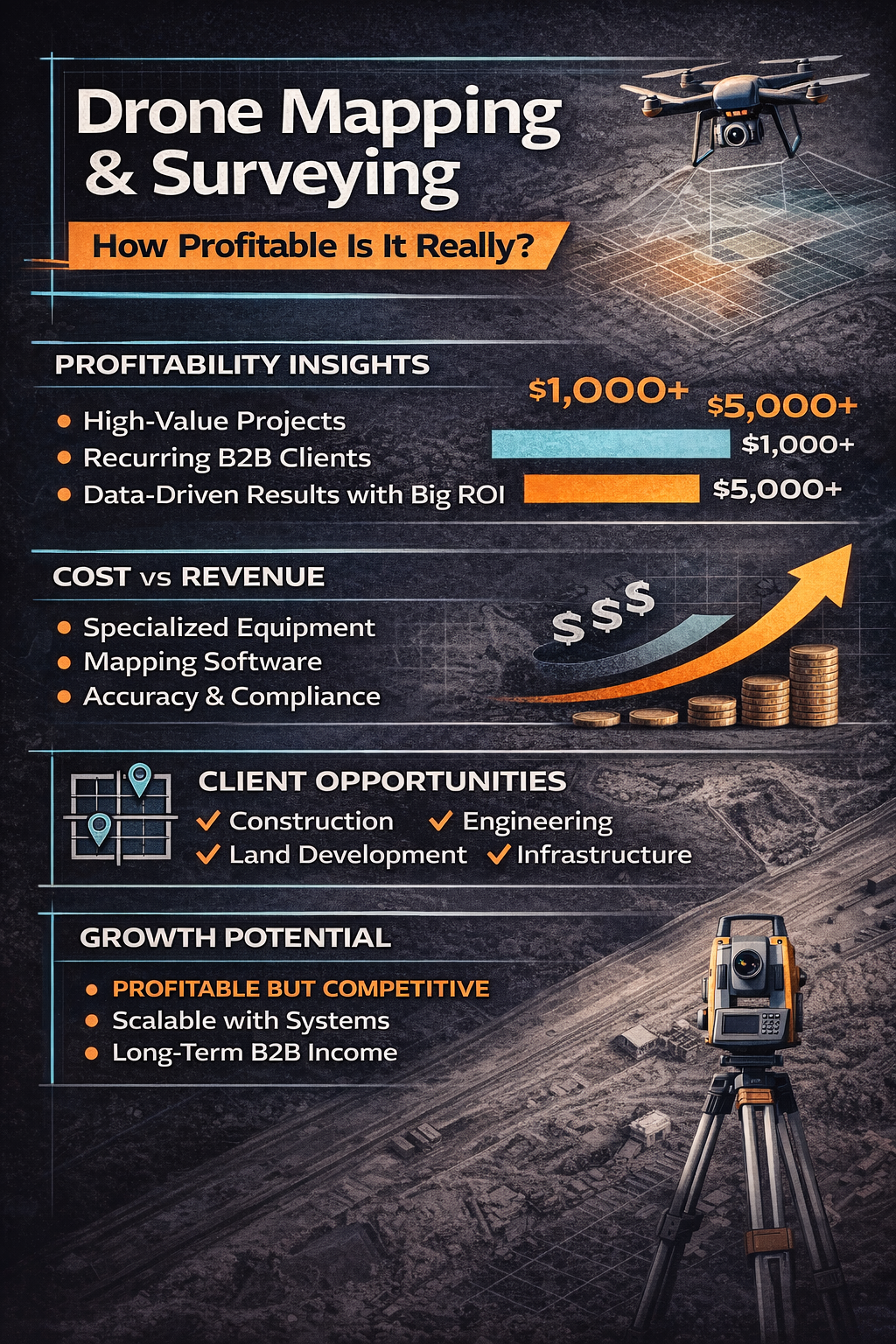
Drone mapping is often seen as more profitable than traditional drone photography because it:
Businesses don’t hire mapping pilots for “cool footage.” They hire them to reduce risk, increase efficiency, and support decision-making.
That’s an important distinction if your goal is to build a profitable drone business instead of chasing one-off gigs.
Drone mapping becomes profitable when it is positioned as a professional service, not a technical hobby.
Mapping services are typically sold based on:
Most successful operators do not charge by flight time. They charge based on deliverables and outcomes, which is a core principle of every scalable drone services business.
Drone mapping can generate strong revenue, but income varies widely depending on focus, clients, and systems.
Common income scenarios include:
The biggest difference between low and high earners is not equipment—it’s client type, pricing structure, and repeat work.
Mapping supports higher pricing because accuracy and reliability matter more than aesthetics.
Not every mapping pilot makes good money. The difference between success and frustration usually comes down to fundamentals.
Profitable drone mapping businesses focus on:
Struggling operators often:
Mapping is a business tool, not a creative service. Treating it that way changes profitability.
Some industries consistently produce better results for pilots looking to make money with a drone long-term.
Construction sites need:
This creates recurring demand, which is the backbone of any profitable drone services business.
Farmers and land managers use mapping to:
While pricing may vary by region, repeat work is common.
These clients value:
Fewer clients exist, but contracts tend to be higher value.
Mapping supports:
These projects often require professionalism, insurance, and reliability—factors that justify higher pricing.
Drone mapping does require more than a basic camera drone, but profitability does not come from buying the most expensive gear.
Smart operators:
Buying advanced sensors without revenue is one of the fastest ways to kill profit early.
In a profitable drone business, revenue justifies upgrades—not the other way around.
Drone mapping often comes with higher expectations than creative work.
Clients expect:
You must operate legally and ethically, especially when working near construction sites or sensitive infrastructure.
Trust and professionalism are major profit drivers in this space.
Pricing is where most drone mapping businesses succeed—or fail.
Common pricing mistakes include:
Mapping should be priced based on:
Clients are paying for clarity, accuracy, and reduced risk, not airtime.
This mindset is essential if you want to make money with a drone consistently.
One-off mapping jobs can be profitable, but recurring services are what create stability.
Recurring opportunities include:
Recurring work:
Every scalable drone services business eventually shifts toward repeatable income.
Many pilots struggle with drone mapping not because demand is low, but because strategy is weak.
Profit-killing mistakes include:
The most profitable operators think like consultants, not pilots.
Drone mapping is not saturated, but it is selective.
Clients don’t hire dozens of mapping providers. They hire one or two they trust.
This creates opportunity for operators who:
You don’t need hundreds of clients. You need the right ones.
Yes—but not instantly, and not accidentally.
Operators who replace full-time income typically:
Mapping rewards focus and professionalism far more than hustle.
Drone mapping demand continues to grow because:
The industry rewards operators who treat mapping as a business, not a side project.
Drone mapping can be highly profitable, but only when approached correctly.
It is not:
❌ Easy money
❌ A shortcut to fast riches
❌ Guaranteed without effort
But it is:
✅ One of the strongest high-value drone services
✅ Well-suited for recurring income
✅ Ideal for business-focused operators
If your goal is to build a profitable drone business, drone mapping and surveying can be a powerful path—when paired with the right strategy.
Drone mapping isn’t about flying better—it’s about solving problems better.
If you want to:
Then focus on:
🚁 The drone is the tool.
💼 The business model is what creates profit.
When mapping is positioned correctly, profitability follows.


Compact, ready to go anywhere
Interchangeable lens that’s upgradeable
Dual 1-inch sensors for improved clarity and low light performance
Dynamic range and 6K 360° capture
360° photo resolution at 21MP

8K 360° video recording for ultra-detailed visuals.
4K single-lens mode for traditional wide-angle shots.
Invisible selfie stick effect for drone-like perspectives.
2.5-inch touchscreen with Gorilla Glass protection.
Waterproof up to 33ft for underwater shooting.

360° photo resolution in 23MP
Slim design at 24 mm thick
Built-in image stabilization for smooth video capture.
Internal 19GB storage for photo and video storage.
Wireless connectivity for remote control and sharing.

60MP 360° still images for high-resolution photography.
5.7K 360° video recording at 30fps.
2.25-inch touchscreen for intuitive control.
USB Type-C port for fast charging and data transfer.
MicroSD card slot for expandable storage.
.png)

.png)

Try it free. No credit card required. Instant set-up.






.svg)


.svg)