


.png)


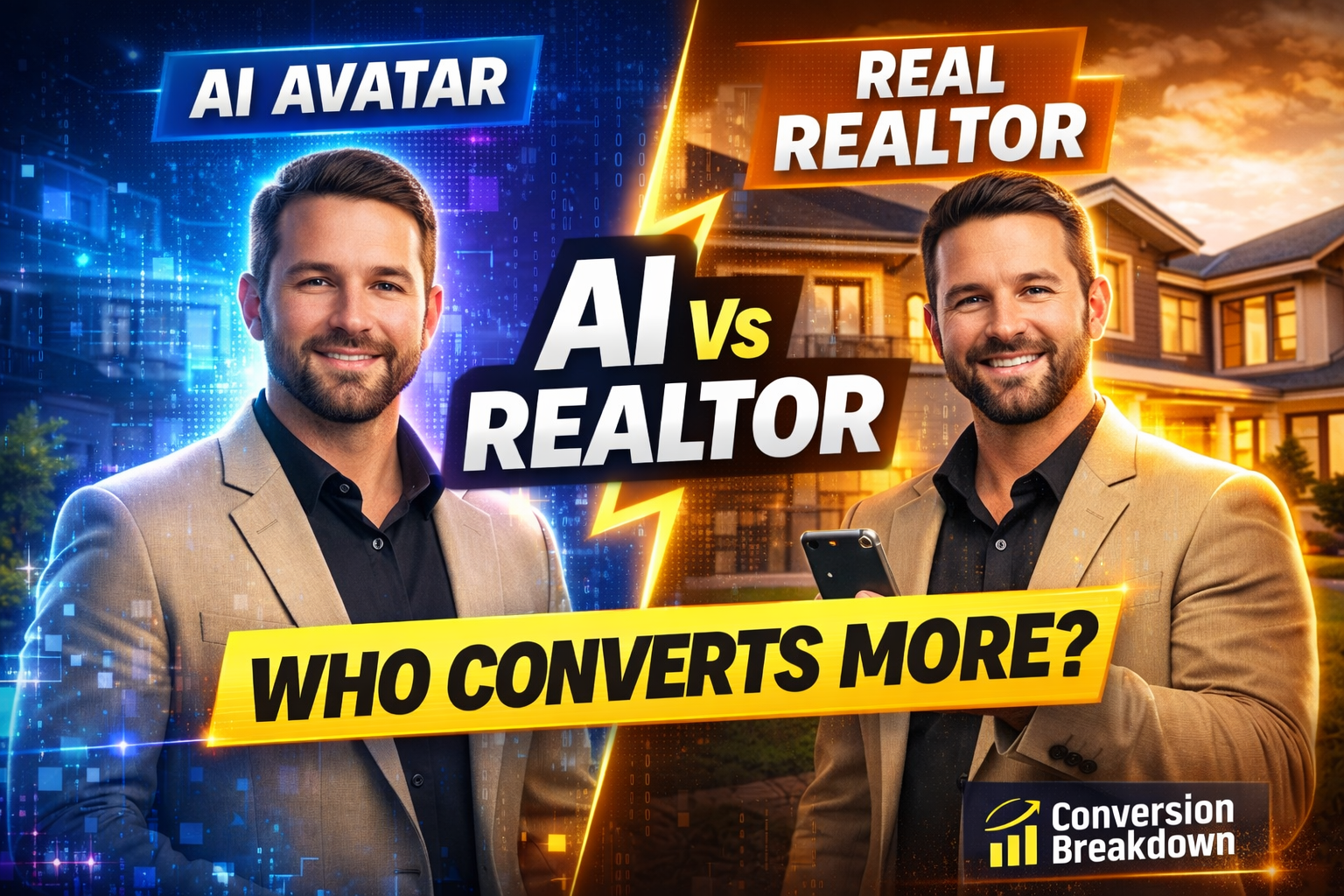
Real estate marketing has always been about one thing: attention.
In a crowded market filled with listings, scrolling buyers, and competing agents, the question is no longer whether you should use video — it’s what type of video actually converts better.
Are traditional, face-to-camera walkthroughs still king?
Or are AI-powered avatar presentations taking over?
In this in-depth comparison of AI avatar videos vs realtor videos, we’ll explore how each format impacts real estate video conversion rates, what drives engagement, and how AI video marketing for real estate is changing the way listings are presented.
If you’re an agent, broker, media company, or marketing strategist, this guide will help you decide which approach delivers stronger results.
Let’s break it down. 🚀
Before comparing formats, we need to establish one thing clearly:
Video works.
According to the National Association of Realtors, a significant majority of sellers prefer working with agents who use video marketing as part of their strategy.
Source:
https://www.nar.realtor/research-and-statistics
HubSpot research consistently shows that video content produces higher engagement and better ROI than most other content types.
Source:
https://blog.hubspot.com/marketing/video-marketing-statistics
Meanwhile, Wyzowl reports that consumers overwhelmingly prefer watching short videos to learn about products or services rather than reading text.
Source:
https://www.wyzowl.com/video-marketing-statistics/
The takeaway?
Video isn’t optional anymore. It’s expected.
But not all video formats are equal.
Realtor-led videos are traditional listing walkthroughs where the agent appears on camera. These may include:
This format builds authenticity and allows agents to express personality naturally.
Advantages of realtor-led videos:
✔ Strong personal connection
✔ Real-time authenticity
✔ Emotional storytelling
✔ Strong luxury positioning
However, they require:
Production effort increases with every listing.
AI avatar videos use artificial intelligence to generate a digital version of the agent.
The process typically involves:
Instead of filming physically, the AI-generated avatar presents the property using scripted narration.
This approach makes AI video marketing for real estate scalable, repeatable, and efficient.
Key advantages:
✔ No camera required
✔ No re-filming
✔ Faster production
✔ Easy script adjustments
✔ Consistent branding
Now the big question:
Do AI avatar videos vs realtor videos perform differently when it comes to conversion?
Conversion in real estate video marketing usually means:
Several psychological factors influence these metrics:
Let’s examine how each format performs across these dimensions.
Realtor-Led Video:
AI Avatar Video:
Speed matters.
Listings that go live faster attract attention sooner. More frequency also increases brand visibility across platforms.
In high-volume markets, AI often wins in this category.
Traditional realtor videos often rely on improvisation. Even strong communicators can vary in energy, tone, and phrasing between listings.
AI avatars operate entirely on script.
This means:
Consistency strengthens brand authority and may improve long-term real estate video conversion rates.
Authenticity remains a major factor in marketing success.
Realtor-led videos:
AI avatar videos:
In luxury or high-touch branding environments, authenticity often carries more weight.
In scalable marketing systems, consistency and efficiency may outweigh spontaneity.
Imagine a brokerage with ten agents.
Realtor-led video production for every listing becomes complex:
With AI avatars:
For brokerages, scalability is a major advantage of AI-driven strategies.
Traditional production often involves:
AI-based production typically involves:
Lower cost per listing increases ROI, particularly for agents handling multiple properties per month.
One overlooked advantage of AI video marketing for real estate is the ability to iterate quickly.
With traditional video:
With AI avatars:
This flexibility allows marketers to experiment and optimize presentation style, length, and call-to-action without major production costs.
Many forward-thinking professionals combine both approaches.
For example:
This hybrid model leverages the emotional power of human presence and the efficiency of AI automation.
Neuroscience research shows humans are wired to recognize and respond to faces instantly.
Whether it’s a real agent or a realistic avatar, facial presence increases viewer retention compared to text overlays alone.
The real differentiator is not whether a face appears.
It’s how often and how consistently that face appears across listings.
Consistency builds familiarity.
Familiarity builds trust.
Trust drives conversion.
The answer is nuanced.
AI avatar videos vs realtor videos do not compete in a vacuum.
They serve different purposes.
Realtor-led videos outperform when:
AI avatar videos outperform when:
The strongest results often come from strategic integration of both formats.
✔ Video marketing remains essential for real estate growth.
✔ AI video marketing for real estate improves speed and scalability.
✔ Realtor-led videos build deep emotional trust.
✔ AI avatar videos enhance production efficiency and consistency.
✔ Real estate video conversion rates improve with frequency and quality.
✔ A hybrid strategy delivers balanced performance.
The debate around AI avatar videos vs realtor videos isn’t about replacement.
It’s about evolution.
Technology doesn’t eliminate human connection — it enhances it.
Agents who embrace AI as a tool rather than a threat will gain:
The market is shifting toward smarter, more scalable systems.
The real question isn’t whether AI will play a role in real estate video marketing.
It’s how strategically you’ll use it.
If you found this comparison helpful, share it with your team, experiment with both formats, and measure what drives the strongest engagement for your audience.
Innovation belongs to those who test, adapt, and lead. 🚀


Compact, ready to go anywhere
Interchangeable lens that’s upgradeable
Dual 1-inch sensors for improved clarity and low light performance
Dynamic range and 6K 360° capture
360° photo resolution at 21MP

8K 360° video recording for ultra-detailed visuals.
4K single-lens mode for traditional wide-angle shots.
Invisible selfie stick effect for drone-like perspectives.
2.5-inch touchscreen with Gorilla Glass protection.
Waterproof up to 33ft for underwater shooting.

360° photo resolution in 23MP
Slim design at 24 mm thick
Built-in image stabilization for smooth video capture.
Internal 19GB storage for photo and video storage.
Wireless connectivity for remote control and sharing.

60MP 360° still images for high-resolution photography.
5.7K 360° video recording at 30fps.
2.25-inch touchscreen for intuitive control.
USB Type-C port for fast charging and data transfer.
MicroSD card slot for expandable storage.
.png)

.png)

Try it free. No credit card required. Instant set-up.





.svg)


.svg)