Before You Launch: Drone Insurance and FAA Part 107 Rules Every Pilot Must Know

Cloudpano
December 11, 2025
5 min read
Share this post

Before You Launch: Drone Insurance and FAA Part 107 Rules Every Pilot Must Know

Launching a drone business is exciting, but before you take off 🚀, you need to make sure your legal setup, insurance, and FAA Part 107 compliance are in order. Without these essentials, you risk fines, liability, or even losing clients. To avoid costly mistakes, watch this Drone Business Legal & FAA Part 107 Compliance Guide on YouTube and set your business up for long-term success.

In this guide, I’ll walk you through the three pillars every drone pilot must secure:
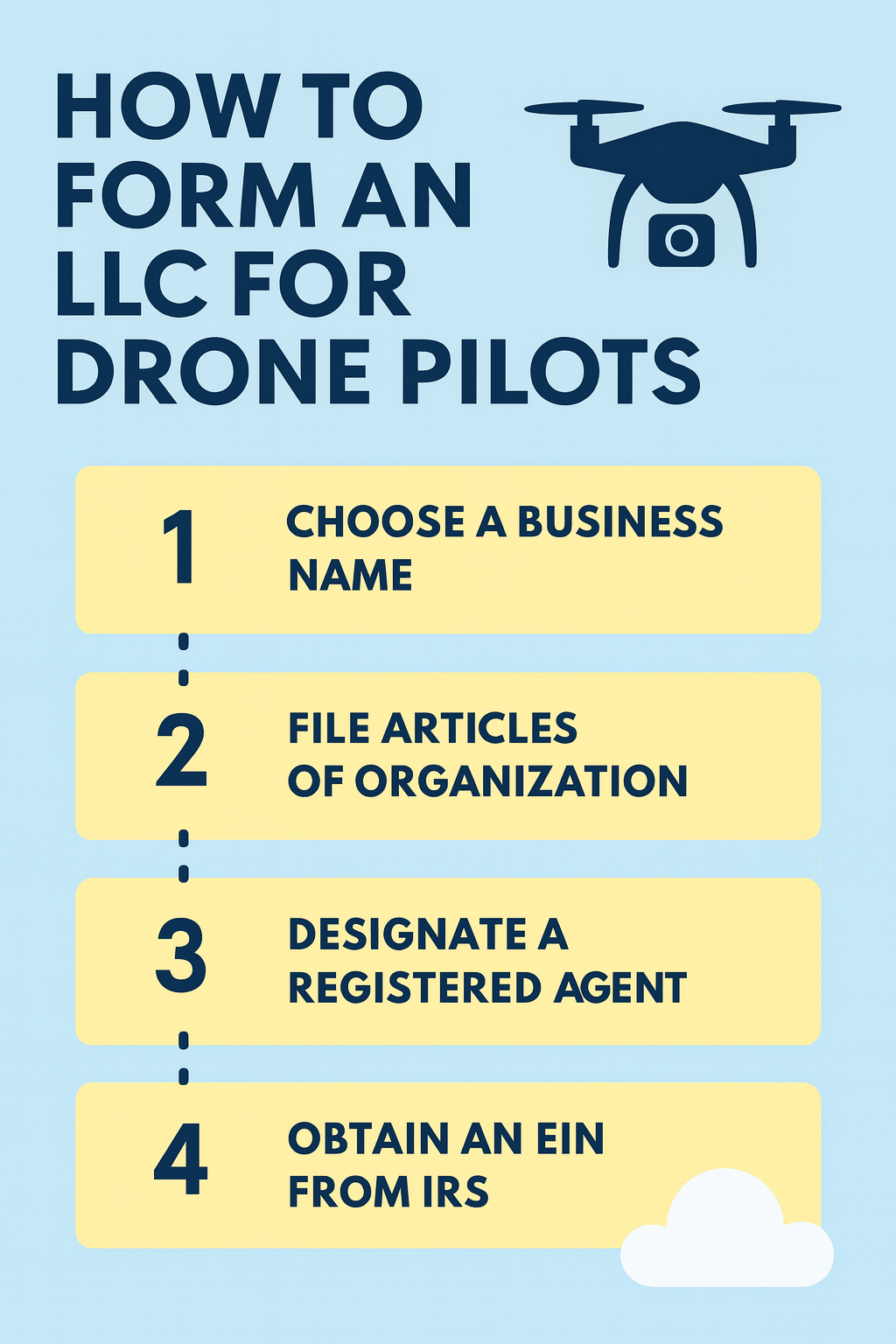
Forming an LLC
Getting the right insurance
Passing the FAA Part 107 test

Let’s break it all down step by step.

1. Forming an LLC 🏢

One of the first steps for drone pilots is creating a Limited Liability Company (LLC).

Why does this matter?

  • An LLC separates your personal assets from your business.
  • If your drone crashes into a car 🚗, damages a wedding cake 🎂, or injures someone, the LLC—not you personally—is liable.
  • You’ll gain credibility when working with bigger clients who often require contractors to have formal business entities.

How to Form an LLC

  • In most states (like Texas), you can file directly with the Secretary of State.
  • Services like LegalZoom can handle the paperwork for you if government sites feel overwhelming.
  • Once approved, you’ll get:
    • An EIN (Employer Identification Number) from the IRS (free online).
    • The ability to open a business bank account 🏦.
    • Cleaner bookkeeping and easier tax filing.

👉 Pro Tip: Keep your business income and expenses separate. This makes accounting and taxes simple, and it reinforces the protection your LLC provides.

2. Drone Insurance: Protect Yourself & Your Gear 🛡️

Insurance isn’t just a nice-to-have. For drone pilots, it’s a must.

Two Types of Insurance You Need

  1. General Liability Insurance
    • Protects against accidents, property damage, and injury claims.
    • Enterprise clients often require proof of coverage.
    • You’ll typically provide a COI (Certificate of Insurance).
  2. Hull Insurance (Drone Insurance)
    • Covers your actual drone.
    • If your drone crashes 💥, hull insurance ensures you don’t eat the full replacement cost.

Providers to Check Out

  • Next Insurance – affordable and easy to set up online.
  • SkyWatch.AI – popular among drone pilots with customizable coverage.
  • Verifly (pay-by-the-hour insurance for flexible projects).

👇Related Resource: Check out our Drone Insurance Comparison Guide to see side-by-side coverage details.
3. FAA Part 107 Certification 🎓

If you want to fly drones commercially in the U.S., you must pass the FAA Part 107 test.

Key Facts About Part 107

  • The test has around 70 multiple-choice questions.
  • You need a score of 70% or higher to pass.
  • Once certified, your license is valid for 24 months before renewal.

What You’ll Learn in the Exam

  • Airspace rules and reading sectional charts 🗺️
  • Weather patterns and how they affect flight 🌤️
  • Altitude limits (keep your drone under 400 feet)
  • Emergency procedures and safety protocols

👉  Tip: Study with a proven FAA Part 107 Study Guide and practice tests to make sure you’re prepared.

Why It Matters

  • Flying without Part 107 certification while doing commercial work can lead to hefty FAA fines.
  • Certification shows clients you’re professional, compliant, and safe.

Bonus: Compliance Beyond the Basics ✅

Having your LLC, insurance, and Part 107 license puts you on solid ground. But smart drone pilots go a step further:

  • Wear reflective safety gear 👷 so authorities and clients know you’re operating professionally.
  • Carry your license when flying. If questioned, you can quickly prove your compliance.
  • Keep contracts on hand 📑. If you’re on a job, having a signed scope of work adds another layer of protection.

4. Get a Customer First 💡

Here’s a golden tip from years in the drone business:
👉 Secure a client before worrying about every setup detail.

Why?

  • A paying customer validates your idea.
  • It gives you a clear timeline for setting up compliance.
  • You can subcontract a certified pilot at first if needed while you work on your own Part 107.

Remember: Revenue first, paperwork second. But don’t wait too long—get legal and insured as soon as possible.

Final Thoughts: Fly Safe, Fly Smart ✈️

Starting a drone business is an incredible opportunity. The demand for aerial photography, videography, mapping, and inspections is exploding 🌍. But if you want to avoid costly mistakes, you must:

  • Form your LLC to protect your personal assets.
  • Get the right insurance to stay covered.
  • Pass the FAA Part 107 test to fly legally.

👉 Ready to take the next step?

Share this post
Cloudpano

Choose The Right 360° Camera

Insta360 ONE RS 1-Inch 360 Edition

  • Compact, ready to go anywhere

  • Interchangeable lens that’s upgradeable

  • Dual 1-inch sensors for improved clarity and low light performance

  • Dynamic range and 6K 360° capture

  • 360° photo resolution at 21MP

Learn More

Insta360 X4

  • 8K 360° video recording for ultra-detailed visuals.

  • 4K single-lens mode for traditional wide-angle shots.

  • Invisible selfie stick effect for drone-like perspectives.

  • 2.5-inch touchscreen with Gorilla Glass protection.

  • Waterproof up to 33ft for underwater shooting.

Learn More

Ricoh Theta Z1

  • 360° photo resolution in 23MP

  • Slim design at 24 mm thick

  • Built-in image stabilization for smooth video capture.

  • Internal 19GB storage for photo and video storage.

  • Wireless connectivity for remote control and sharing.

Learn More

Ricoh Theta X

  • 60MP 360° still images for high-resolution photography.

  • 5.7K 360° video recording at 30fps.

  • 2.25-inch touchscreen for intuitive control.

  • USB Type-C port for fast charging and data transfer.

  • MicroSD card slot for expandable storage.

Learn More
Property Marketing
Allows potential buyers to explore properties in detail from anywhere, enhancing the real estate marketing process.
Automotive Spins
Create an interactive virtual showroom and engage affluent digital buyers with live 360º video calls, all through the CloudPano mobile app for a complete automotive sales solution.
Interactive Floor Plans
Create 2D and 3D floor plans with measurements in 4 minutes or less, all from your phone. Download the Floor Plan Scanner app and get your first scan free.

360 Virtual Tours With CloudPano.com. Get Started Today.

Try it free. No credit card required. Instant set-up.
Try it free
Latest posts

See our other posts

Interviews, tips, guides, industry best practices, and news.

Creating a Repeatable System for AI Video Ads for Car Dealers to Drive Continuous Traffic

This 1,500-word deep dive shifts the automotive marketing narrative from temporary "campaigns" to a permanent "Traffic Engine." It outlines how to build an infrastructure where video content scales automatically with inventory. Key Pillars Covered: The Consistency Gap: Addressing why manual ad production fails to maintain local market presence and how automation creates a "perpetual showroom." Data-Driven Pillars: Utilizing the Inventory Management System (IMS) to trigger real-time, VIN-specific video renders. Technical SEO Deep-Linking: The importance of sending users from a video ad directly to the specific VDP, increasing dwell time and Google E-E-A-T signals. Creative Fatigue Solution: How the system prevents "ad blindness" by dynamically refreshing creative every time the lot inventory or pricing changes.
Read post

Why Car Dealership Video Automation is Essential for Dominating Local Market Share

This 1,500-word authority guide positions car dealership video automation not just as a tool for efficiency, but as an essential weapon for competitive local dominance. It explains how to move from a passive digital presence to an "omnipresent" regional authority. Key Pillars Covered: The Psychological Edge: How automated video tours build immediate rapport and "proof of life," outperforming competitors who rely on static imagery. Content Density & SEO: The technical correlation between video-enabled VDPs and increased "dwell time," which serves as a major signal for Google’s local Map Pack rankings. Precision Targeting: Using AI video ads for car dealers to move away from broad, wasteful spending toward high-intent, VIN-specific local targeting. The Sinker Strategy: Using personalized automated video responses to close the "trust gap" the moment a lead is captured.
Read post

Integrating CRM Data with an AI Video Generator for Inventory Listings for Seamless Operations

This 1,500-word technical authority piece explains how to break down the silos between customer data and creative production. It positions integrating CRM data with an AI video generator for inventory listings as the definitive move toward hyper-personalized automotive retail. Key Pillars Covered: Intent-Based Creation: How CRM data (like specific feature interests) can dictate the content of an automatically generated vehicle video. Technical Connectivity: A breakdown of API-first architectures, webhooks, and native CRM applications to achieve a "zero-click" workflow. Operational Flow: A look at the 5-step journey from a lead submitting a form to receiving a personalized video and tracking their engagement. Trust & E-E-A-T: Using data-driven video to provide verified, real-time transparency that builds dealership authority and user trust.
Read post